

The belief that “fellowship programs only care about big-name residencies” is exaggerated, lazy, and often flat-out wrong.
They care how you used your residency far more than where you did it. But there are patterns—some uncomfortable—that you deserve to see clearly.
Let me walk through what actually matters, where prestige really bites, and where it absolutely does not.
The Core Truth: Brand Helps, But It’s Not the Gatekeeper
Here’s the blunt version:
Program name is a modifier, not a make-or-break filter, for the vast majority of fellowship programs and applicants.
Fellowships care about things like:
- Your clinical performance and reputation
- Letters of recommendation from people they trust
- Concrete scholarly output (for academic or competitive fields)
- Board scores and in-training exam trends
- How you interview and fit
The residency name operates in the background as a noisy signal of training environment and expectations. It’s not the whole story.
Where does residency prestige actually show up?
Sorting huge application piles.
When a program director has 500–800 apps for 4–6 fellowship spots, they use shortcuts. Known programs/known letter writers naturally draw more attention. That’s convenience, not conspiracy.Risk perception.
If they’ve consistently had strong fellows from Program X, they assume the next person from X is likely decent. If they’ve had disasters from Program Y, you start behind. Fair? Not really. Real? Yes.For ultra-competitive fellowships.
Think big-name cards, GI, heme/onc, advanced endoscopy, top-tier academic critical care. In the top 10–15 programs nationally, residency brand plays a stronger role because the entire pool is already high-achieving.
But here’s the counterweight that gets ignored: every year, people from non-name programs land high-end fellowships at “fancy” places because their package is undeniable—research, letters, performance, and personality pull them across.
What the Data and Match Outcomes Actually Suggest
We don’t have perfectly clean, public datasets connecting specific residencies to every fellowship match, but we can triangulate from several sources:
- NRMP charting outcomes by specialty
- Program self-published match lists
- Specialty society surveys
- Fellowship program websites
I’ve sat in rooms where they review rank lists and compare CVs, and the pattern is consistent: they notice where you trained. They don’t worship it.
Here’s roughly how “where you did residency” functions in different competitiveness tiers.
| Fellowship Type | Role of Residency Name | Other Factors That Often Dominate |
|---|---|---|
| Ultra-competitive (cards, GI top) | Moderate to strong | Research, letters, board scores, interview |
| Competitive academic | Moderate | Letters, fit, niche interest, productivity |
| Bread-and-butter community | Weak to moderate | Work ethic, references, visa/logistics |
| Undersubscribed / less competitive | Minimal | Willingness, geographic fit, basic competence |
The more oversubscribed a fellowship is, the more every tiny signal is used to rank people. That includes your residency name. But name alone does not rescue a weak file.
What Fellowship PDs Actually Care About (More Than Your Program Name)
Programs don’t sit there saying, “Only interview people from MGH/UCSF/BI/etc.” The internal monologue is much more like:
“Who can safely take overnight call on day one?”
“Who will not embarrass us in conferences?”
“Who might actually stay and be faculty?”
“Who is low drama?”
And they answer that with evidence from your training, not just your letterhead.
Here are the levers that routinely outweigh pure brand:
1. Letters of Recommendation > Program Name
A strong, specific letter from a known, trusted faculty member can completely overshadow a less “famous” residency.
Programs heavily weight:
- Specific stories of your performance (“ran the MICU as a PGY-2 independently during a surge week”)
- Comparisons (“top 5% of residents I’ve worked with in 20 years”)
- Endorsements of your integrity and work ethic
I’ve watched PDs literally say: “I don’t know this residency, but if Dr. X is vouching for them like this, we should bring them in.”
Name recognition of the letter writer sometimes matters more than the institution name on your training line.
2. Performance Within Your Program
Being a top-tier resident at a mid-tier program often beats being mediocre at a brand-name place.
What PDs notice:
- Did you get chief? Or at least were you clearly trusted for leadership roles?
- Are there comments about professionalism issues? PDs email each other quietly.
- Did your in-training exams and board scores trend upward?
- Are your evals bland (“reliable, punctual”) or glowing and detailed?
They know every residency has variation. They’re trying to figure out if you’re one of the standouts or just average.
3. Tangible Output in the Direction of the Fellowship
You want GI? Show GI. Cards? Show cards.
That means:
- At least one project (case report, QI, retrospective, anything) in that field
- A poster or two at a relevant conference
- Some evidence you actually like the specialty, not just the paycheck
This is where “big-name” residencies may have an edge: more built-in research infrastructure, more ongoing projects, more well-known mentors. That’s access, not magic.
But plenty of smaller programs have hungry faculty eager for collaborators. The bottleneck is usually resident initiative, not opportunity.
Where Prestige Actually Hurts You
This part gets swept under the rug.
If you come from a very big-name residency and apply to a community-focused fellowship, especially in a smaller city, you may actually raise suspicion:
“They’ll leave as soon as they get a brand-name job.”
“They’re just slumming it here as a backup.”
“They’re not going to be happy seeing bread-and-butter patients.”
I’ve seen programs rank highly solid, middle-program candidates above elite-residency folks because the latter radiated “I’m too good for this” in their application or interview.
So no, being from Harvard doesn’t auto-win you a midwest community cards spot. It sometimes does the opposite.
Where Prestige Actually Helps You (And Where It Doesn’t)
Let’s be honest: there are certain scenarios where “where you trained” moves the needle more.
Cases where it helps:
Top 10-15 national programs in a given fellowship.
Big academic cards/GI/onc places know specific residencies they trust. If you come from those, they feel comfortable your floor of competence is high.You’re marginal by traditional metrics but have halo from famous mentors.
Example: mediocre Step 1, decent 2, but you did multiple projects with a nationally-known investigator who writes you a killer letter. The combined “institution + mentor” effect can pull you up.Very research-heavy fellowships.
Research pathways, T32 spots, advanced subspecialty training. Here, the residency name may reflect access to high-caliber labs and infrastructure. It’s shorthand for “this person has been around serious academic medicine.”
Cases where it doesn’t matter much:
Most community-based fellowships.
They need people who can run a service, cover nights, and not implode. A solid track record, decent boards, and trustworthy letters matter far more.Undersubscribed or newer fellowships.
Some programs are still filling or building reputation. They cannot be picky about brand. They care more about not-matching into a problem.When your story is strong and clear.
A resident who did strong projects, has focused interests, and interviews compellingly can easily beat a “big-name but generic” applicant.
The Quiet Reality: Geography and Networking Matter More Than People Admit
Another myth: “If I didn’t train at a huge name, I’m locked out of elite fellowships.”
Reality: Fellowship recruiting is heavily regional and relationship-based.
- Programs prefer people who trained nearby because faculty have already worked with their mentors or have seen grads from that residency rotate or present.
- Regional familiarity feels “low risk.”
- PDs email or text each other opinions on applicants all the time: “What’s your read on this person from your shop?” That informal network is powerful.
So if you’re at a non-elite but respected program in a large city with multiple fellowship programs, you often have stronger networking access than someone at a fancy but geographically isolated place.
This is exactly why you see plenty of New York IM residents matching NYC GI or cards without Ivy banners on their white coats.
How to Maximize Your Fellowship Chances From Any Residency
You cannot change where you matched for residency. You can absolutely control what you do with it.
Here’s the blunt playbook:
Become undeniably strong in your day job.
Programs do not want “research stars” who are a disaster on the wards. Be the person co-residents and nurses actually want on call. Word gets around.Get to know the fellowship division early.
Rotate with them. Go to their conferences. Ask for feedback like an adult, not a brownnoser.Do something scholarly that leaves a trace.
Not everyone needs an NEJM paper. But if you’re applying for cards with literally zero cardiovascular-related anything, you’re behind. A few posters and a small paper go a long way.Choose letter writers who know you, not just big names.
A famous but generic letter is useless. A “medium famous” but very specific, enthusiastic letter is gold.Own your program—don’t apologize for it.
Nothing screams insecurity more than “I know my program isn’t as competitive…” in your PS or interview. Stop. Frame it as: “I got broad exposure, I took advantage of my opportunities, and here’s what I accomplished.”If you’re from a smaller program, target and then stretch.
Apply broadly within your realistic tier, then add a handful of reach programs where you have some plausible connection (mentor trained there, regional tie, shared research interest).
A Hard Truth: Some Doors Are Narrower, Not Closed
I won’t sugarcoat this. If your goal is:
- Top 5 GI
- Top 5 cards
- Elite heme/onc with heavy research
- Hyper-selective procedure-focused advanced fellowship
Then yes, graduating from a nationally recognized, research-heavy residency does help. It gives you baked-in infrastructure, big-name mentors, and prior graduates who paved a path.
But the idea that only those residents match there is simply false. Every year, fellowship match lists show folks from:
- Strong but not “elite” university-affiliated programs
- Military programs
- Well-run community programs with academic ties
The difference is that from a smaller-name residency, you often need to be closer to the top of your cohort and more deliberate about building a clear, cohesive application.
Not impossible. Just less forgiving.
Visual Snapshot: What Actually Drives Interviews
Here’s a rough conceptual breakdown of what tends to drive interview offers in many IM subspecialties (not exact percentages, but this reflects how PDs informally “weigh” things when discussing candidates):
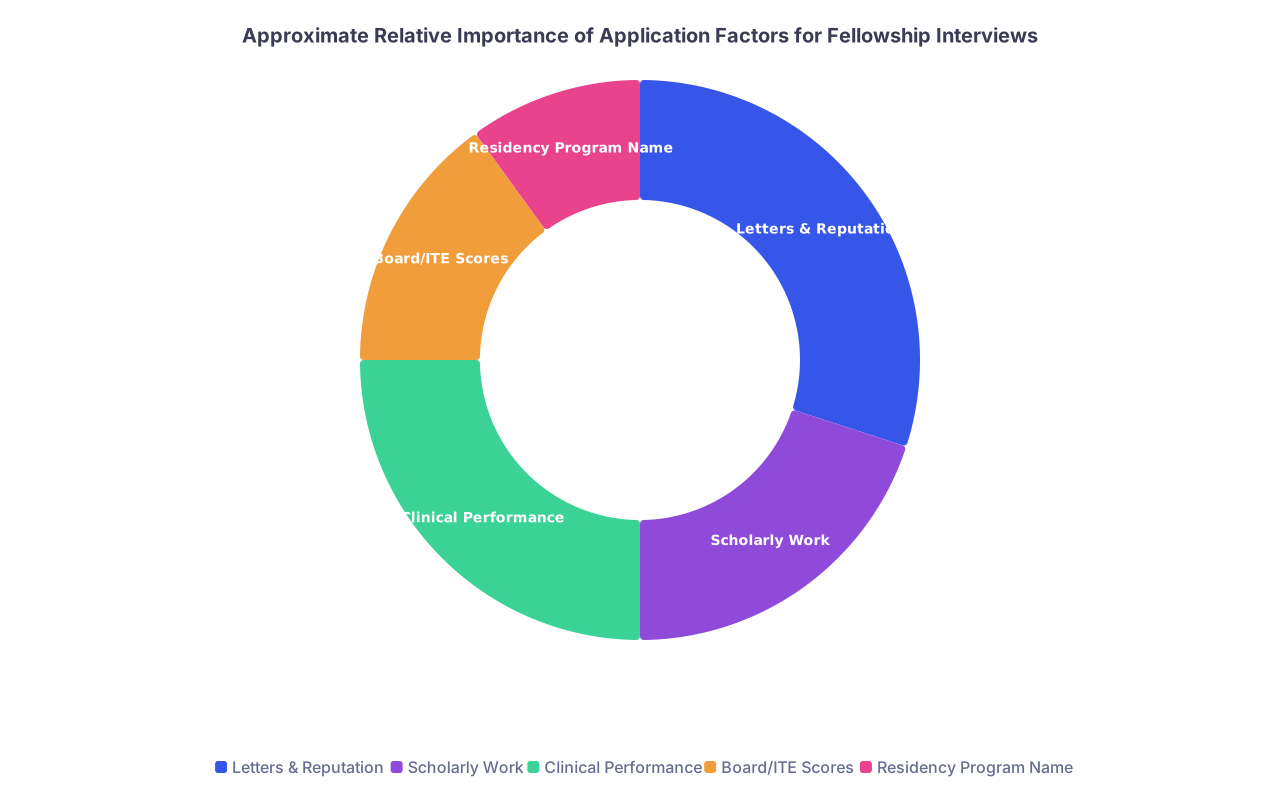
| Category | Value |
|---|---|
| Letters & Reputation | 30 |
| Scholarly Work | 20 |
| Clinical Performance | 25 |
| Board/ITE Scores | 15 |
| Residency Program Name | 10 |
Residency name appears. It’s just not running the show.
Application Flow: Where Program Name Enters the Picture

| Step | Description |
|---|---|
| Step 1 | ERAS Applications Arrive |
| Step 2 | Initial Filter - Scores and Failures |
| Step 3 | Scan for Known Programs and Letter Writers |
| Step 4 | Review CV for Specialty Fit and Productivity |
| Step 5 | Select for Interview Offers |
| Step 6 | Rank List Based on Interview and Letters |
Notice: residency name appears at the “scan” stage as a heuristic. It doesn’t override a weak or strong file at later stages.
Quick Comparison: Same Resident, Different Programs
Imagine the same resident cloned into three residencies with identical performance, letters strength, and research productivity.
| Residency Type | Likely Outcome at Mid-tier Academic Fellowship | Likely Outcome at Top 10 Fellowship |
|---|---|---|
| Top 5 academic IM program | High chance of interview, competitive | Solid interview chance |
| Solid university-affiliated program | Good chance of interview | Possible interview, more variable |
| Strong community program | Decent shot, especially regionally | Rare, but possible with strong hook |
Same person. Different baselines. Doors aren’t locked, but the hinges aren’t identical.
FAQs
1. I’m at a community IM program. Is a competitive fellowship like cards or GI realistic?
Yes, but you have less slack. You need:
- Strong ITE/board scores
- At least a couple of specialty-related projects (posters, case reports, QI)
- Excellent, specific letters from your subspecialty faculty
If your program has a history of placing people into that fellowship, lean into that pipeline. If not, target regionally and add some realistic backups.
2. I’m at a top-tier residency but don’t have much research. Will my program name carry me?
Not as much as you think. For the most competitive academic fellowships, no research is a major red flag regardless of where you trained. Your program name may secure interviews you wouldn’t otherwise get, but without aligned scholarly work and strong letters, you’ll slide down rank lists fast.
3. Do fellowship programs look down on osteopathic or international grads even from good residencies?
Bias absolutely still exists in some places, especially at older, brand-conscious academic programs. But if you’ve already matched into a respected ACGME residency and you perform at the top of your class, those labels fade quickly. Once you’re in a solid residency, how you perform there counts a lot more than where you went to med school.
Key takeaways:
- Fellowship programs care much more about what you did in residency than the logo on your badge.
- Program name is a tiebreaker and a heuristic, not a universal gatekeeper—except at the very top end, where it’s one of several heavy weights.
- From any residency, if you max out your performance, build a coherent specialty story, and get powerful letters, you’re in the game.


