

The belief that staying at your home program massively boosts your fellowship odds is exaggerated, outdated, and selectively true at best.
There is a home-field advantage. But it is smaller, more conditional, and more double-edged than most residents think when they cling to their own institution like it’s a cheat code for matching.
Let’s take this apart like an attending questioning a shaky presentation.
The Myth: “If I Stay Home, I’ll Match Easier”
You’ve heard this on rounds and in resident workrooms:
- “Our program takes care of its own.”
- “If you want cards here, you basically have to do residency here.”
- “If you leave for residency, you’ll never get back for fellowship.”
A lot of this is emotional folklore, not data.
Here’s what actually tends to be true, across many specialties and programs:
- Most fellowship programs take some of their own residents, but usually not the majority.
- Being a “known quantity” helps, but only if you’re actually strong relative to your peers.
- Some residents dramatically overestimate their home chances and under-apply elsewhere — and get burned.
Let’s ground this with structure and numbers instead of hallway mythology.
What the Data and Patterns Actually Show
There isn’t a single national dataset labeled “home vs away fellowship outcomes,” but we do have consistent patterns from:
- NRMP Program Director surveys
- Published fellowship program profiles and alumni pages
- Match lists from big internal medicine programs
- Specialty-specific studies (cards, GI, heme/onc, anesthesia subspecialties)
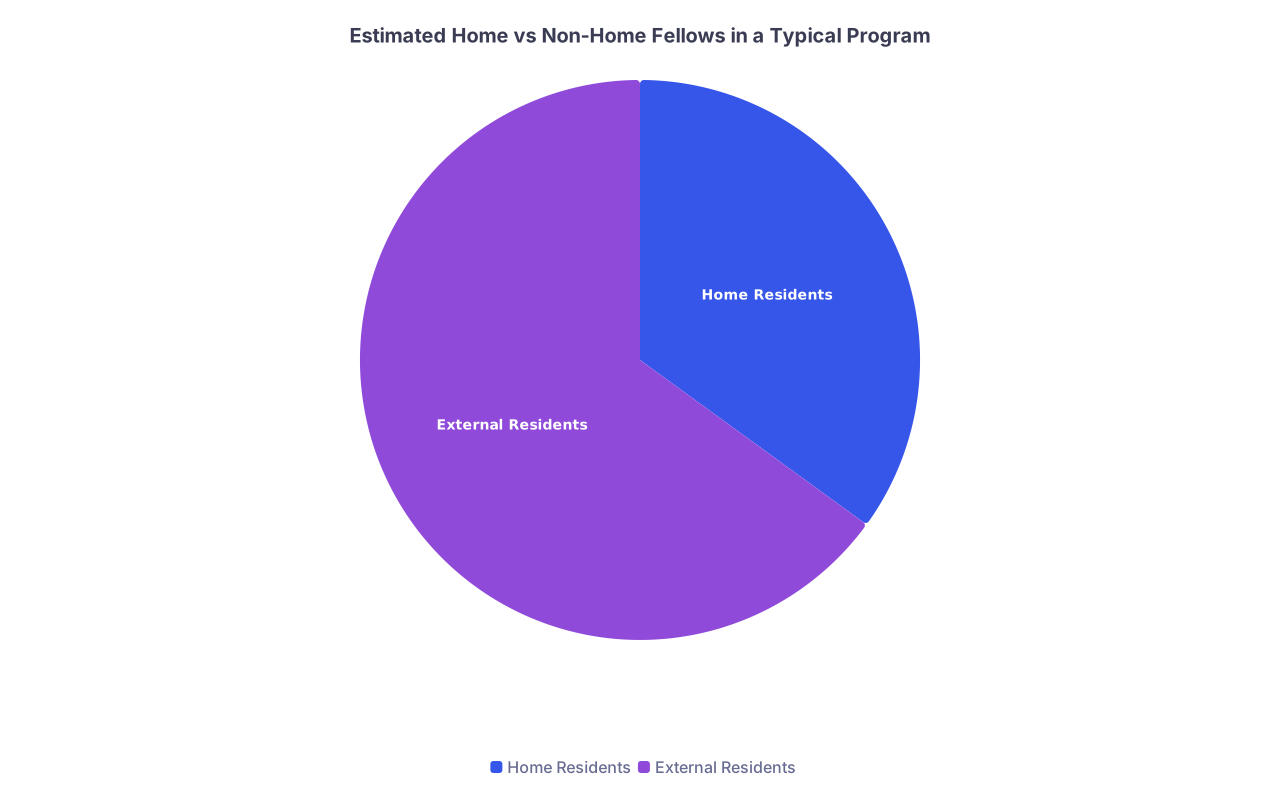
Across multiple fields, a rough but very real pattern emerges: many fellowships have a home match rate in the 20–50% range. Not 80–90%. And definitely not “we only take our own.”
| Category | Value |
|---|---|
| Home Residents | 35 |
| External Residents | 65 |
That approximate 35% home, 65% external breakdown is common in competitive subspecialties at academic programs. Sometimes it’s 25/75. Occasionally 50/50. Rarely above that.
What this means: yes, your home program likes its residents. But most spots are still going to people who trained somewhere else.
So “home” is a factor. It’s not destiny.
Where Staying Home Does Help You
Let’s be fair. There are real, structural advantages to staying at your home institution — or at least to being known there.
1. You’re not a stranger
Faculty already know:
- How you actually work on busy services
- Whether you melt down on call
- Whether your “great letters” match your behavior at 3 a.m.
Programs are terrified of problem fellows. A mediocre researcher is manageable. A toxic teammate is not. Someone who’s been solid on their services for three years is much safer than a complete unknown with a shiny CV.
So if you’ve consistently:
- Shown up
- Done the work
- Not been a jerk
- Performed above the median on your rotations
You’re already ahead of many outsiders.
2. You have more advocates
At home, you don’t need to explain who you are. Attending X remembers your ICU month. Attending Y knows you handled that impossible patient family. The PD has heard from multiple people that you’re reliable.
That can translate into:
- Stronger, more specific letters
- Closed-door conversations in applicant meetings where someone says, “I’ve worked with them — we should take them”
- A higher tolerance for small weaknesses (e.g., board scores slightly lower than the average)
3. Logistics and timing tilt in your favor
You:
- Rotate on the home fellowship services
- Can do “audition” rotations without applying away
- Are physically present for informal exposure: conferences, research meetings, journal clubs
Selection meetings are human. It is easier to advocate for:
“That’s the resident we just had on service — they crushed that cardiogenic shock patient,”
than for,
“This looks like a strong CV from somewhere I haven’t heard from in years.”
So yes, there is a home advantage.
But here’s the part people conveniently ignore.
When Staying Home Does Nothing For You (or Hurts You)
I’ve watched residents cling to the “I’ll be fine at home” fantasy… and then get passed over for external candidates. They look stunned. They shouldn’t be.
Being “home” does not erase:
- Weak clinical performance
- Mediocre evaluations
- Poor professionalism
- No meaningful scholarly output in a research-heavy department
- A reputation as difficult, unreliable, or disinterested
Your home program knows the good and the bad. The external applicant only shows their best side. You don’t.
1. If you’re middle-of-the-pack in a strong program
This is a big one.
Say you’re in a powerhouse IM residency. Great name. Strong cardiology division. Top-tier research. Half your class wants cards or GI.
You’re:
- In the middle academically
- Decent but not standout clinically
- Have one poster with a fellow
- Mixed feedback from multiple attendings
At your program, you are “fine.” But they may have:
- A rockstar co-resident who clearly outperformed you
- An external applicant with a 10x stronger research portfolio and equally good letters
Suddenly, your “home advantage” looks pretty weak. They know you’re safe. The external candidate might be both safe and exceptional.
Programs will not sabotage their own fellowship reputation to “take care of their own” if their own are just okay.
2. If your program has a culture of “not keeping too many”
Some fellowship programs consciously avoid becoming inbred. They don’t want their division to be 80% alumni from the same residency.
You’ll see this if:
- Their current fellows are from many different institutions
- The last 3–5 years of fellows show only 0–1 residents from your program per year
| Fellowship Year | Home Residents | External Residents |
|---|---|---|
| Class of 2021 | 1 | 2 |
| Class of 2022 | 0 | 3 |
| Class of 2023 | 1 | 2 |
| Class of 2024 | 1 | 3 |
Interpretation: this type of program will take a home resident when they’re clearly excellent. They will not bend the bar just because you’ve been there.
3. If you’ve had “issues”
Residents underestimate how long reputational stains last.
- A professionalism concern in PGY‑2
- A major conflict with nursing or another service
- Repeated feedback about attitude or reliability
At an outside program, that may be whitewashed or forgotten. At home, it lives in everyone’s head. If your home PD or CCC had to manage you, they may quietly block your fellowship chances there. Not maliciously. Just risk management.
I’ve seen residents with clean ERAS applications get blocked at home because the behind-the-scenes story wasn’t great.
So no, being at home definitely does not guarantee anything.
The Real Levers: What Actually Moves Fellowship Odds
Instead of obsessing about “home vs away,” you should be thinking about what actually shows up in selection decisions. Because PD surveys are boring but brutally clear.
For most fellowships (especially in IM subspecialties), the heavy hitters are:
- Quality of letters (especially from people known nationally)
- Perceived clinical performance and work ethic
- Research productivity if that field cares about it (cards, GI, heme/onc, pulm/crit, etc.)
- Board scores and ITE performance as a screen, not the primary selection tool
- Interview performance and professionalism
Where “home” fits into this is simple:
Staying at your home program only helps if it boosts those levers more than somewhere else would.
If your home institution:
- Has a strong division in your desired field
- Actually lets residents do worthwhile research
- Puts you in front of influential mentors
- Gives you legitimate responsibility and good exposure
Then yes, being there for residency and staying for fellowship can be very advantageous.
If your home institution:
- Has weak faculty in your interest area
- Produces almost no research in that subspecialty
- Rarely sends residents to competitive fellowships anywhere
Then relying on a “home advantage” is delusional. You’re trying to build a skyscraper on a parking lot.
The Hidden Risk: Overbetting on Home and Underapplying Elsewhere
Here’s where residents get burned.
They think:
“I really want to stay here. They know me. I have a good relationship with Dr. X. I’ll rank a few programs but honestly I expect to stay.”
Then fellowship season ends and they’re staring at a mismatch or no match because:
- They ranked their home program way too high relative to their actual odds there.
- They applied to too few external programs.
- Their application wasn’t competitive enough nationally, and they misjudged how their home faculty actually viewed them.
Meanwhile, the home program ranked them lower than they expected because:
- A co-resident was clearly stronger.
- Two external applicants had stronger research and still seemed normal human beings.
- The whisper network in the division said, “They’re fine, but not the best we can get.”
You feel betrayed. The division just thinks they picked the best fellows.
Remember: everyone is the main character in their own head. But to the fellowship, you’re one of dozens of solid applicants. Being “home” moves you a little. Not into a different universe.
Protect yourself by acting like home is one program, not your safety net.
When It Makes Strategic Sense to Leave Your Home Program
Sometimes the bravest and smartest move is not to stay.
You should seriously consider leaving if:
Your subspecialty at home is weak
- Few or no fellows
- Minimal research output
- No one in the division is known at national conferences You’re not getting much from staying, aside from comfort.
Your reputation at home is mixed You might actually do better where people only see your best letters and projects, not your awkward PGY‑1 months.
You want a strongly academic career and your home is community-focused If you dream of NIH grants and K awards, staying at a clinically heavy, low-research home program can cap your trajectory.
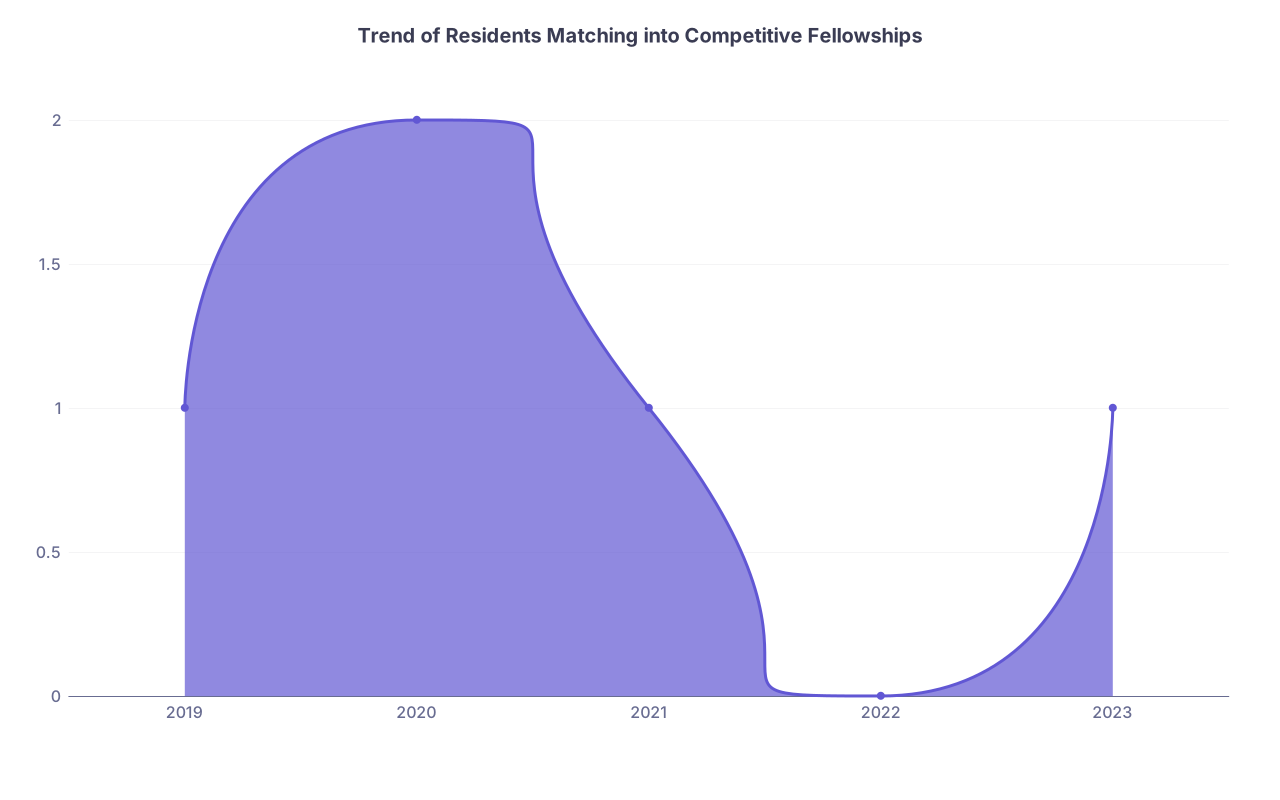
Your program rarely sends residents into good fellowships in your field Look at the last 3–5 years. If nearly nobody has landed strong fellowships in your subspecialty, that’s not an accident.
| Category | Value |
|---|---|
| 2019 | 1 |
| 2020 | 2 |
| 2021 | 1 |
| 2022 | 0 |
| 2023 | 1 |
That trend should make you uneasy if you’re banking on “home” to solve your fellowship aspirations.
How to Actually Use the Home Advantage Intelligently
You do not have to choose between blind loyalty to your home program and completely ignoring it. The smart play is more boring and more adult.
Build a strong presence at home as if you might stay. Work hard on your key rotations. Get to know faculty. Say yes to realistic research and scholarly projects. Actually finish them.
Get unfiltered feedback by PGY‑2. Not the “you’re doing great” fluff. You want something closer to: “If you applied to our fellowship, would you see me as a top, middle, or lower-tier applicant?”
Look at the past match lists. Who gets home spots? Are they clearly stronger than you on paper and in performance? Or comparable? Pattern recognition beats wishful thinking.
Apply broadly anyway. Even if you deeply want to stay, act like you may not. Give your future self options. Let the match, not your anxiety, decide.
Do not anchor your self-worth to your home program’s decision. If they don’t take you, it doesn’t automatically mean you’re bad. It may simply mean someone else was a better fit for their current priorities.
A Quick Reality Check Flow
Here’s a blunt decision overview.

| Step | Description |
|---|---|
| Step 1 | Want fellowship |
| Step 2 | Home program strong in field |
| Step 3 | Plan to leave for fellowship |
| Step 4 | Ask about home track record |
| Step 5 | Get honest feedback PGY 2 |
| Step 6 | Apply home plus broad |
| Step 7 | Apply broad, treat home as bonus |
That’s closer to how seasoned faculty think about it, whether they say it to your face or not.
Visualizing the Relative Impact: Home vs Merit
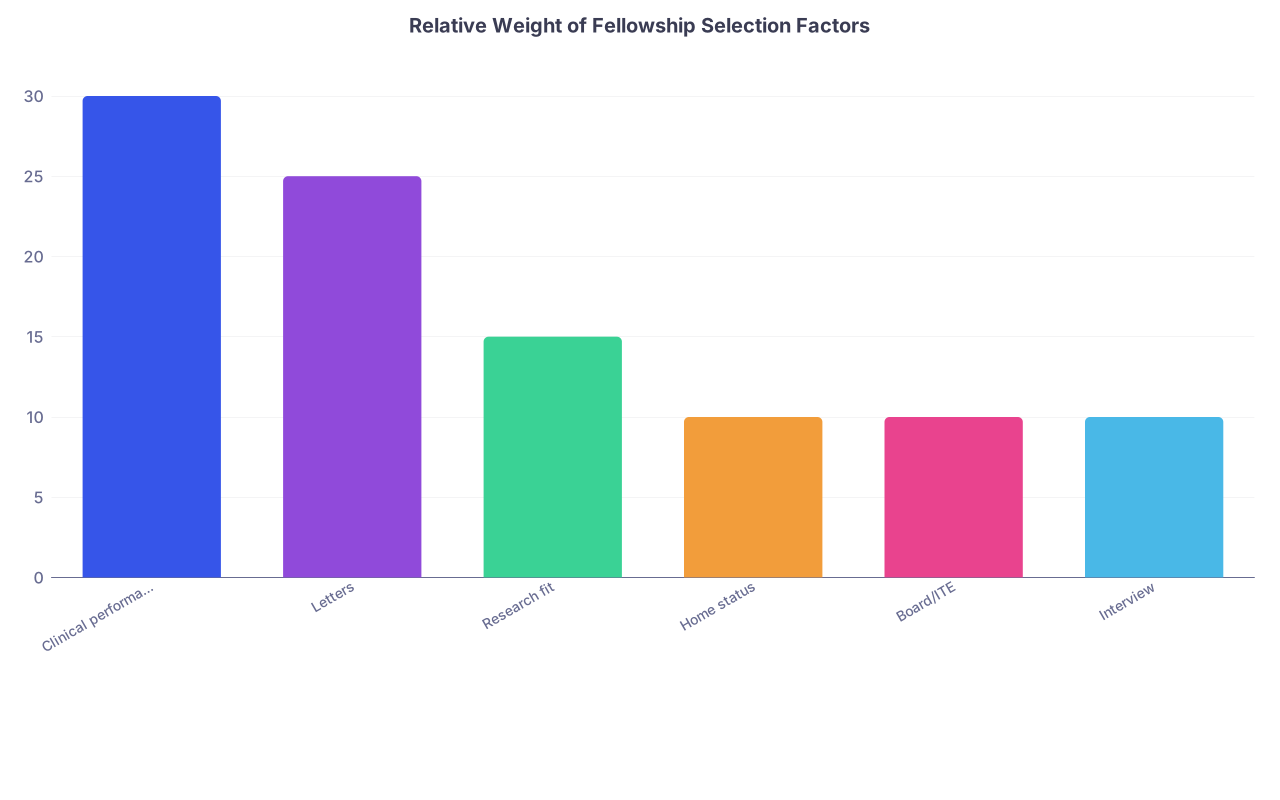
To drive this home, here’s how I’d weight factors in many academic fellowship selections.
| Category | Value |
|---|---|
| Clinical performance | 30 |
| Letters | 25 |
| Research fit | 15 |
| Home status | 10 |
| Board/ITE | 10 |
| Interview | 10 |
Home status is there. It’s just not the main character. It’s one more multiplier on top of actual performance and trajectory.
FAQs
1. If my top choice is my home program, should I tell them they’re my number one?
Yes, but do it like an adult, not a desperate applicant. A short, clear message to the PD or key faculty is fine: that they’re your genuine first choice and you’d be thrilled to train there. Do not play games or tell multiple programs the same thing; people talk, and you will be remembered for the wrong reasons.
2. I had a rough PGY‑1 year but have been strong since. Does my home program care more about my early missteps than an outside program would?
Probably yes. They saw the whole arc, including the messy parts. An outside program will mostly see the cleaned-up narrative and your stronger later letters. That can cut both ways: home knows your growth is real, but they also remember the chaos. If those early issues were serious, your best bet may be a fresh start elsewhere.
3. Is it a red flag to not match at your home fellowship if you applied there?
People will notice, but it’s not automatically damning. Programs know home slots are limited and politics, timing, and internal priorities matter. What matters more is where you did match. If you landed in a solid or even stronger program elsewhere, almost nobody will care that your home program didn’t take you. The narrative becomes, “You matched into a good fellowship,” not “Why didn’t your home take you?”
Key points:
- Staying at your home program offers a real but modest advantage — it does not override weak performance or a poor fit.
- Programs do not “owe” you a fellowship spot; they will take who they believe is best, home or not.
- Use your home status as a bonus, not a crutch: build a strong application, get honest feedback, and apply broadly so you are not hostage to one institution’s decision.


