

The belief that “all top fellowships only take academic residents” is lazy, wrong, and honestly a little outdated. Prestige-obsessed attendings keep repeating it; anxious residents repeat it to each other. The data and real match outcomes tell a different story.
You can land a “top” fellowship from a community program. People do it every year. But it is harder, and it requires a very specific strategy. The myth isn’t that it’s difficult; the myth is that it’s impossible or that your program label alone decides your fate.
Let’s separate superstition from reality.
What “Top Fellowship” Actually Means (And What It Does Not)
Before we can kill the myth, we have to define the target.
When residents say “top fellowship,” they usually mean some combination of:
- Big-name institution (MGH, Hopkins, UCSF, Penn, Mayo, Duke, MD Anderson, CHOP, etc.)
- Highly competitive subspecialty (cards, GI, heme/onc, PCCM, interventional tracks, peds subspecialties, surgical subs)
- Strong pipeline to academic careers or procedural volume
That’s very different from:
- “Any fellowship that is simply university-affiliated”
- “A place slightly better than where I trained”
Selection pressure is not equal across fields. A community IM resident aiming for a solid regional cardiology program is playing a different game than a community resident gunning for advanced GI at a top-10 academic center.
But here’s the first uncomfortable reality: top fellowships do not exclusively take residents from ivory-tower, R01-heavy, “I rounded with three NIH study section chairs” type programs.
They do, however, heavily favor academic trajectories. Not academic ZIP codes.
That distinction matters.
Where Fellows Actually Come From: Not Just Harvard, I Promise
Look at any big-name fellowship website and go through their current fellows’ bios. This is where the myth quietly falls apart.
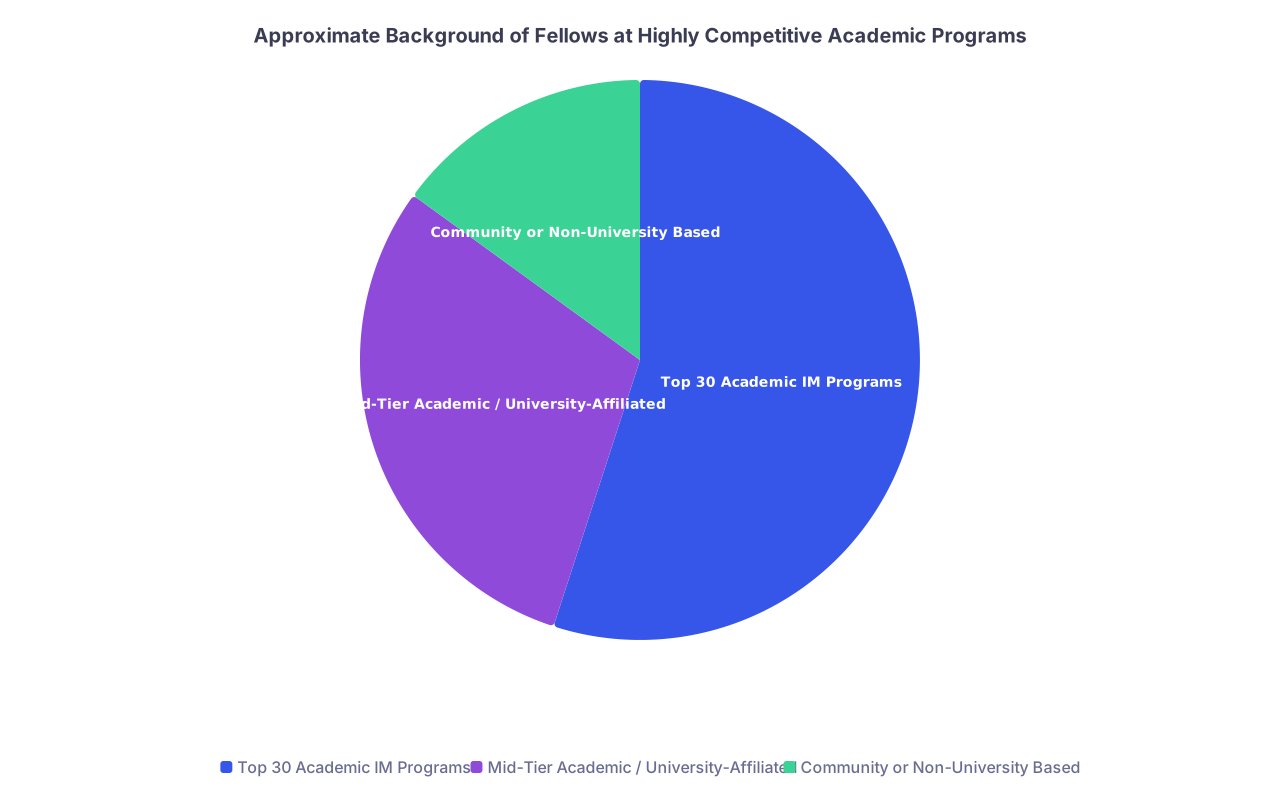
You’ll see a distribution roughly like this (varies by specialty, but the pattern is consistent):
- A core chunk from well-known university residencies
- A smaller but very real group from mid-tier academic/community hybrids
- A non-trivial minority from what most people would call “community” or “non-elite” residencies
Is it 50/50? No. But it’s also far from 100/0.
Here’s a simplified sketch of what you’ll often see in competitive IM subspecialties (cards, GI, heme/onc) at “brand-name” fellowships:
| Category | Value |
|---|---|
| Top 30 Academic IM Programs | 55 |
| Mid-Tier Academic / University-Affiliated | 30 |
| Community or Non-University Based | 15 |
Is that perfect data from a centralized source? No. Because there is no central dataset. But if you spend an afternoon combing through fellow rosters at places like UCSF, Brigham, Penn, Northwestern, and UW, this is the ballpark you’ll land in.
So yes, academic-heavy. But not academic-exclusive.
What is nearly universal among those community-resident fellows who break into top programs? They don’t just have a community program name. They have an academic profile built on top of it: research, letters, mentorship, conference presence, often a niche.
That’s the real selection pressure.
Why Academic Programs Have an Edge (Without Making It Destiny)
Let me be blunt: big academic residencies do have an advantage, on average. Pretending otherwise is just another form of myth-making. Here’s why:
Built-in research infrastructure
At big-name IM or peds programs, there are pre-existing pipelines: “you like cards? Talk to Dr. X, we have a retrospective dataset on 5,000 PCI patients ready for you.” At many community programs, you’re starting from zero—no IRB templates, minimal statisticians, maybe one research-active faculty stretched thin.Established name-brand and trust
Selection committees understand what “UCSF IM resident” or “BWH categorical” usually means: serious clinical training, heavy academic exposure. They also know the faculty writing the letters. That shortens the “risk assessment” for them.Letter writers that are known entities
A letter from a nationally recognized PI or division chief carries more predictive power for a committee than one from a well-meaning but unknown community attending. Not because the community attending is worse, but because the committee has less signal to interpret.Culture of “fellowship as default”
In many academic programs, chasing fellowships—especially competitive ones—is normalized and supported. There are mock interviews, CV workshops, fellows-turned-faculty feeding back advice. At some community programs, you might be the first person in years applying to a heme/onc or advanced GI spot.
All of that stacks the deck. It does not glue the cards to the table.
If you are in a community program and still want a “top” fellowship, your job is to recreate as many of those advantages as possible in a scrappier, more deliberate way.
What Top Fellowships Actually Screen For (Beyond the Program Label)
The myth says: “They look at where you trained and throw the rest away.”
Reality is more annoying and more specific. Strong fellowship programs care about:
- Can you handle the clinical workload and complexity here?
- Are you likely to be productive academically (if they’re research-heavy)?
- Are you a safe, low-drama colleague who will not flame out at 2 a.m. in the ICU?
- Will you reflect well on the program in 5–10 years (faculty positions, grants, procedural volume, reputation)?
Your program name is just a crude shortcut for those questions. A lazy prior. The further you are from the “default” applicant profile, the more work your application has to do to answer them convincingly.
Here’s the part that most residents underestimate: once you’re above a threshold of basic credibility, the levers become surprisingly similar whether you’re academic or community.
Same levers, different effort.
| Factor | Academic Resident Edge | Community Resident Path |
|---|---|---|
| Program name recognition | Strong | Weak to moderate |
| Research volume | Often built-in | Must self-create |
| LOR name recognition | Frequent | Must network externally |
| Conference exposure | Easier access | Requires hustle |
| Perceived clinical rigor | Assumed high | Must be proven |
The myth makes this binary: “academic = yes, community = no.” Reality is more Bayesian: academic gives you a better prior, but you can move the posterior with strong evidence.
The Community Resident Who Actually Matches Big — What They Have in Common
I’ve watched this play out multiple times: a resident from an unglamorous program lands a fellowship spot that their co-residents thought was “way too ambitious.” When you look under the hood, the patterns are boringly consistent.
They almost always:
- Develop a clear subspecialty identity early (end of PGY-1 or early PGY-2). Not “maybe cards, maybe GI, maybe hospitalist.” They pick a lane and start acting like that future fellow.
- Attach themselves to at least one research-active mentor, even if it’s not in-house. They co-author something. Case reports, retrospective charts, QI with real methodology—does not have to be NEJM, but it has to exist.
- Present at regional or national meetings—ACC, AASLD, ASCO, ATS, etc. Abstracts, posters, oral presentations if they can get them.
- Cultivate letters that speak to trajectory, not just “hardworking resident.” Program directors hate boilerplate.
- Pick programs strategically—where their atypical background is a feature, not a bug. For example, places that value community experience, or divisions hungry for clinically strong fellows who will grind.
Here’s where they get extra leverage: away electives and external networking.
You’d be amazed how much a 4-week visiting rotation at a target institution, with one enthusiastic letter from a known faculty, can soften the “never heard of this residency before” concern.
And yes, COVID temporarily wrecked some of that. But away electives and virtual networking are back on the table now.
The Ugly Truth: Some Community Programs Really Do Cripple Your Chances
I’m not going to sugarcoat this. There are residencies where your fellowship aspirations are functionally strangled at birth. Usually because:
- Zero real research support
- No faculty in your target subspecialty
- A culture openly hostile to academics (“Why do you want to be a GI fellow? Just moonlight and make more.”)
- Terrible in-service scores and board pass rates that make program directors suspicious of all graduates
- No alumni track record — no one from there has matched into anything competitive in years
If you are early in training and staring at that reality, transferring or doing a prelim year then reapplying might be rational. Painful, but rational.
If you’re already deep into PGY-2 or PGY-3 at such a place? Then the game changes. You’re not optimizing anymore; you’re salvaging. That doesn’t mean giving up on a good fellowship, but it probably does mean recalibrating what “top” realistically looks like and extending your timeline (more on that in a second).
The myth says: “Any community program kills your shot.”
Reality: A subset of truly non-academic, non-supportive programs make it brutally hard. Many others just make it logistically harder but still doable if you work smarter.
One Year Out vs Straight Through: The Delayed Attack Strategy
Here’s a pattern you rarely hear discussed, but fellowship directors quietly accept: taking one or two years post-residency to build an academic profile radically changes your odds, especially coming from a community background.
This might look like:
- A non-ACGME research year with a big academic group in your desired field
- A hospitalist year at an academic center where you plug into a research group
- A chief year at your program if it comes with real scholarly work, not just scheduling residents at 2 a.m.
Those 12–24 months can give you:
- Multiple abstracts and at least one decent manuscript
- Stronger letters from academic names
- Evidence that you function well in a more complex, academic environment
- A much more convincing narrative: “I came from X, I did Y to prove I can succeed at this level, here’s the proof.”
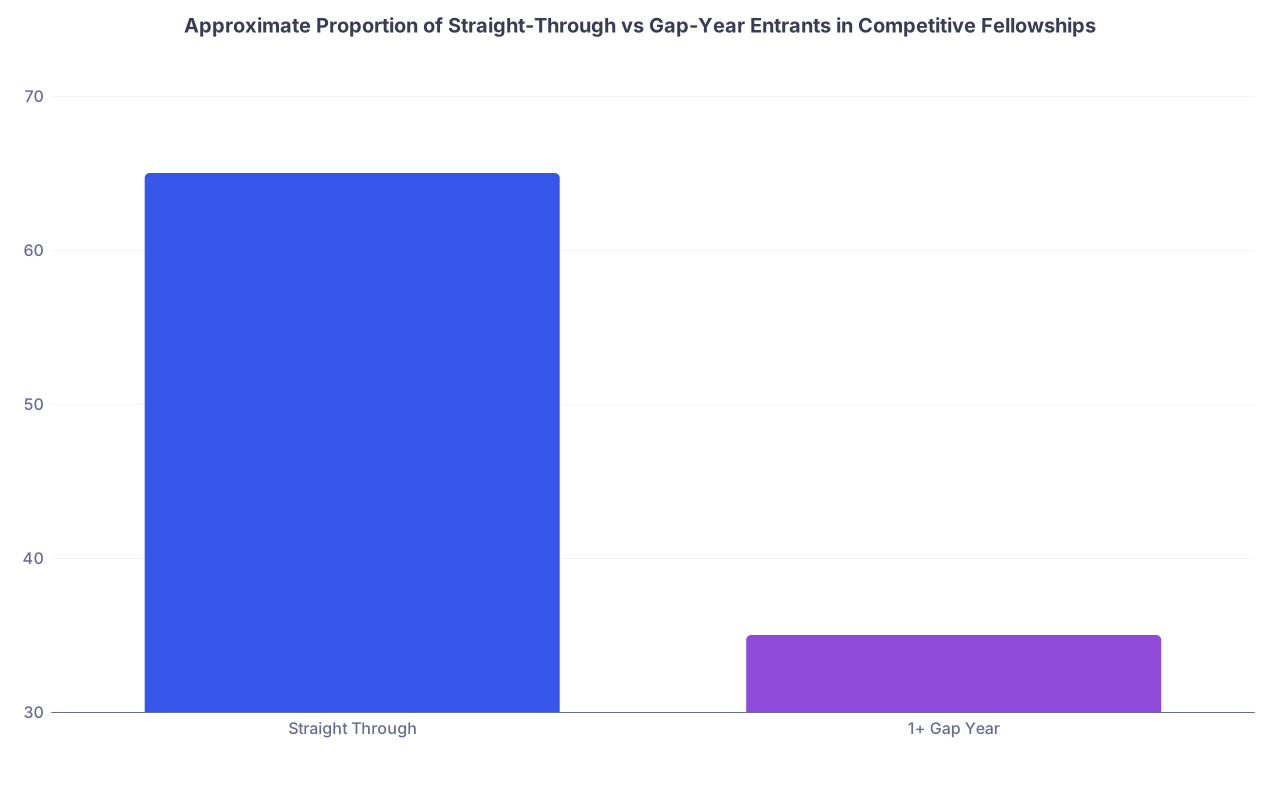
Look at rosters for high-end fellowships; you’ll see plenty of fellows who didn’t match straight through. They took the longer, smarter path. That’s especially common in heme/onc, pulm/crit, and GI.
| Category | Value |
|---|---|
| Straight Through | 65 |
| 1+ Gap Year | 35 |
You’re not “behind” if you do this. You’re just trading speed for probability.
How Different Specialties Treat the Academic vs Community Question
Not all fellowships are created equal in how much they fetishize your residency’s name.
- Hyper-academic, research-heavy fields (heme/onc at major NCI centers, transplant hepatology at liver meccas, EP/advanced interventional cards at top places) care a lot about academic trajectory. Community residents still get in, but usually after doing serious extra work.
- Procedural but clinically heavy fields (general cards, general GI, PCCM) still care about research but place a larger premium on clinical horsepower and recommendations from people they trust.
- Some surgical subspecialties are extremely clubby and network-driven; here, coming from a lower-prestige gen surg program can be a major handicap unless you have serious mentorship and external connections.
- Lifestyle or less-saturated subs (certain nephrology, endo, rheum in non-flagship institutions) are more forgiving. A strong community resident with a coherent story will absolutely match well here.
Paint with a broad brush: the more their website screams “NIH funding” and “T32,” the more your academic record matters. Which is different from “academic residency label only.”
How to Reality-Check Your Situation (Without Self-Delusion)
Residents are notoriously bad at self-assessment on this topic. Either they underestimate themselves (“I’m community, I have zero shot”) or massively overestimate (“I have two posters, so obviously Hopkins cards”).
You need external calibration.
First, track record:
| Question | Green Flag | Red Flag |
|---|---|---|
| Last 5 years: any fellows at your dream tier? | Yes, at least 1–2 | None, ever |
| Any faculty connected to your target field? | Yes, with active projects | No, or only peripherally involved |
| Recent graduates in your target specialty | Multiple, in decent programs | Rare or non-existent |
Second, brutally honest outside opinions. Not from your co-residents. From people who see national applicant pools:
- A subspecialty fellowship director (even if not in your dream institution)
- A research mentor who reviews applications regularly
- Former fellows currently at strong programs
When I’ve seen community-resident success stories, almost all of them at some point sat down with someone like this, heard “you’re competitive for X but not yet for Y,” and adjusted both their targets and their next 12 months of work accordingly.
The Money Line: Myth vs Reality
Let’s call it clearly.
The myth:
“All top fellowships only take academic residents. If you’re at a community program, you’re done.”
The reality:
- Top fellowships strongly favor residents who already look academic—research, letters, conference presence, coherent trajectory. That correlates with big-name academic residencies but does not map 1:1.
- Coming from a community program makes the path harder, not impossible. You need to actively manufacture the academic signals that big-name residents get passively.
- A subset of weak, zero-infrastructure community programs do severely limit your ceiling unless you extend your timeline with research or hospitalist years in more academic settings.
If you want the honest version of hope: you are not doomed by your residency name, but you are absolutely judged by your file, your output, and your trajectory. Top fellowships care far more about that than the gossip in your resident workroom.
Forget the myth. Ask a sharper question instead:
“Given where I am, what would a fellowship director need to see on paper and in letters to believe I’ll thrive at their program?”
Then build that. Relentlessly.


