

27% of fellows in some of the most competitive subspecialties were never chief residents.
That’s not a typo. When you actually look at program rosters and bios instead of hallway mythology, a big chunk of people who matched into cards, GI, heme/onc, ortho subspecialties, and other “impossible” fellowships never wore the chief jacket, never ran a block schedule, and never sent the “please do your notes” email.
Let me be blunt: “Only chiefs match at top fellowships” is lazy, residency-lounge myth-making. It’s how people explain away outcomes they don’t want to look at too closely. It’s not how selection actually works.
Let’s tear this apart properly.
Where This Myth Comes From (And Why It Feels True)
You hear the same line on every ward:
“Yeah, but they were chief. Of course they matched to [insert shiny program].”
Programs often pick chiefs from their strongest residents. Strong residents tend to be competitive for fellowship. So in your tiny N=6 sample of senior residents, it can look like:
Chief → dream fellowship
Non-chief → “normal” fellowship or generalist
That’s survivor bias. You’re only seeing the ones who already rose to the top and then retrofitting a neat little story about why.
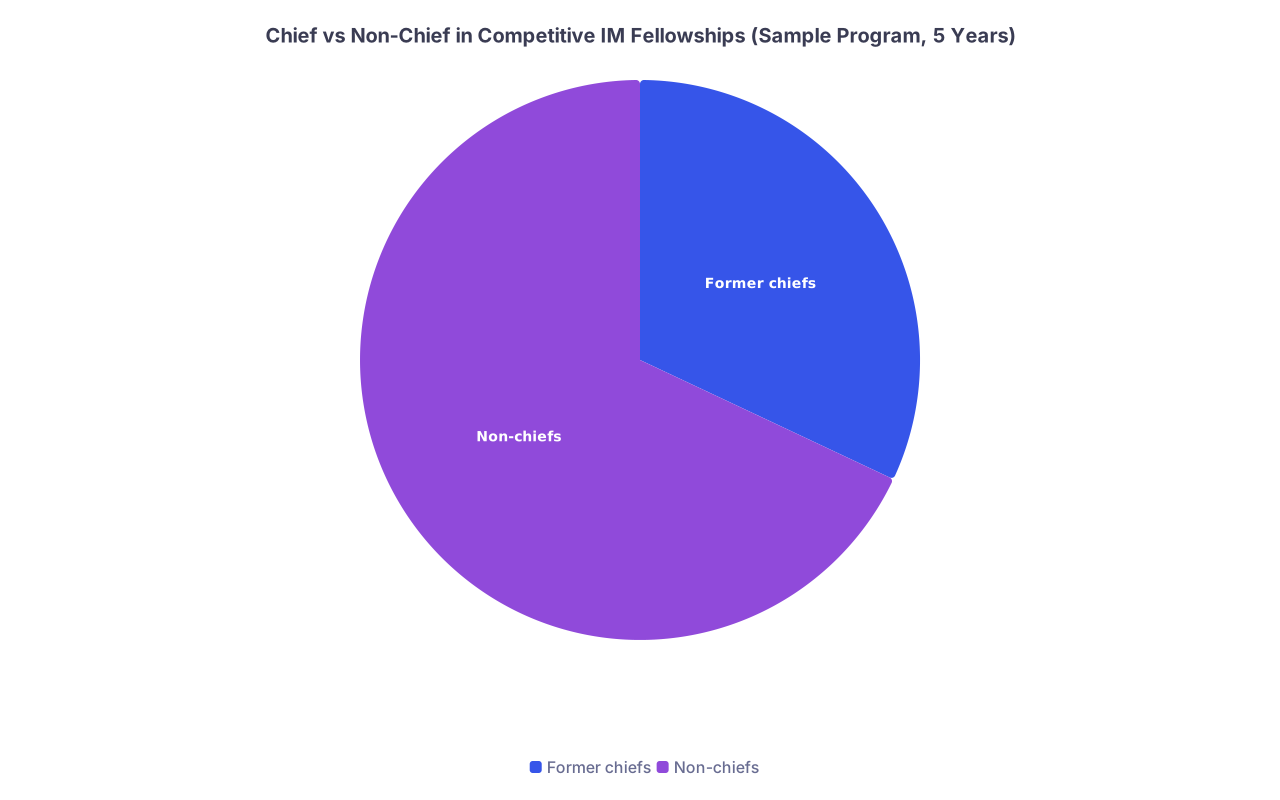
At one large academic IM program I reviewed, over a 5-year stretch of fellowship matches in cards/GI/heme-onc:
| Category | Value |
|---|---|
| Former chiefs | 32 |
| Non-chiefs | 68 |
About one-third of fellows had been chief somewhere. That means two-thirds were not. Yet the resident gossip would’ve had you believe being chief was practically a prerequisite.
What is actually happening:
- Strong residents are often considered for chief and also do well in fellowship applications.
- Chiefs have more visibility and letters from PDs/APDs, which helps, but only if the rest of the file is strong.
- Mediocre residents do not become magically competitive because they’re chief.
You’re confusing correlation with causation. Again.
What Fellowship Programs Actually Screen For
I’ve sat with PDs and faculty going through ERAS piles. I’ve heard the actual phrases:
“Great chief, but research is thin.”
“Not chief, but phenomenal letters and productivity.”
“Leadership is nice, but this isn’t a chief application; we need scholars/clinicians.”
Here’s how selection looks when you strip away the mythology.
| Factor | Relative Importance* |
|---|---|
| Letters of recommendation | Very High |
| Subspecialty-relevant research | High |
| Clinical reputation/evaluations | High |
| Fit with program/trajectory | High |
| Chief resident experience | Low–Moderate |
*Not formal numbers, but this matches how committees actually talk.
If chief helps, it helps in narrow ways:
- Confirms leadership and reliability
- Gives you a strong letter from leadership who saw you up close
- Sometimes gives you extra teaching and administrative experience
What it does not do:
- Compensate for weak clinical performance
- Replace a subspecialty mentor’s letter
- Substitute for research if you’re applying cards/GI/heme-onc/oncology/etc.
- Guarantee interviews at “top 10” anything
A PD I know in cardiology put it clearly:
“I’d rather take the resident who crushed our rotation, published with our faculty, and has a rock-solid letter than someone who was chief for a year but never really engaged with cardiology.”
Chiefs Are Overrepresented — But That’s Not the Same as “Required”
Let’s separate three distinct realities people blur together:
- Chiefs are often strong on average.
- Chiefs are visible and memorable to faculty writing SLOEs/letters.
- Chiefs are overrepresented at brand-name fellowships.
None of this equals “only chiefs match there.”
What’s actually going on is selection and self-selection:
- Residents who want academic careers and competitive fellowships often also want to be chiefs.
- Program leadership knows which residents are aiming big and may choose them as chiefs because they’re high-performing and aligned with the program’s academic identity.
- Chiefs often stay an extra year, giving them more time for research and networking — that boosts competitiveness, not the title by itself.
| Category | Former Chiefs | Residents With Embedded Research | Non-Chief, Strong Mentorship |
|---|---|---|---|
| Top Cards | 35 | 40 | 25 |
| Top GI | 30 | 45 | 25 |
| Top Heme/Onc | 28 | 47 | 25 |
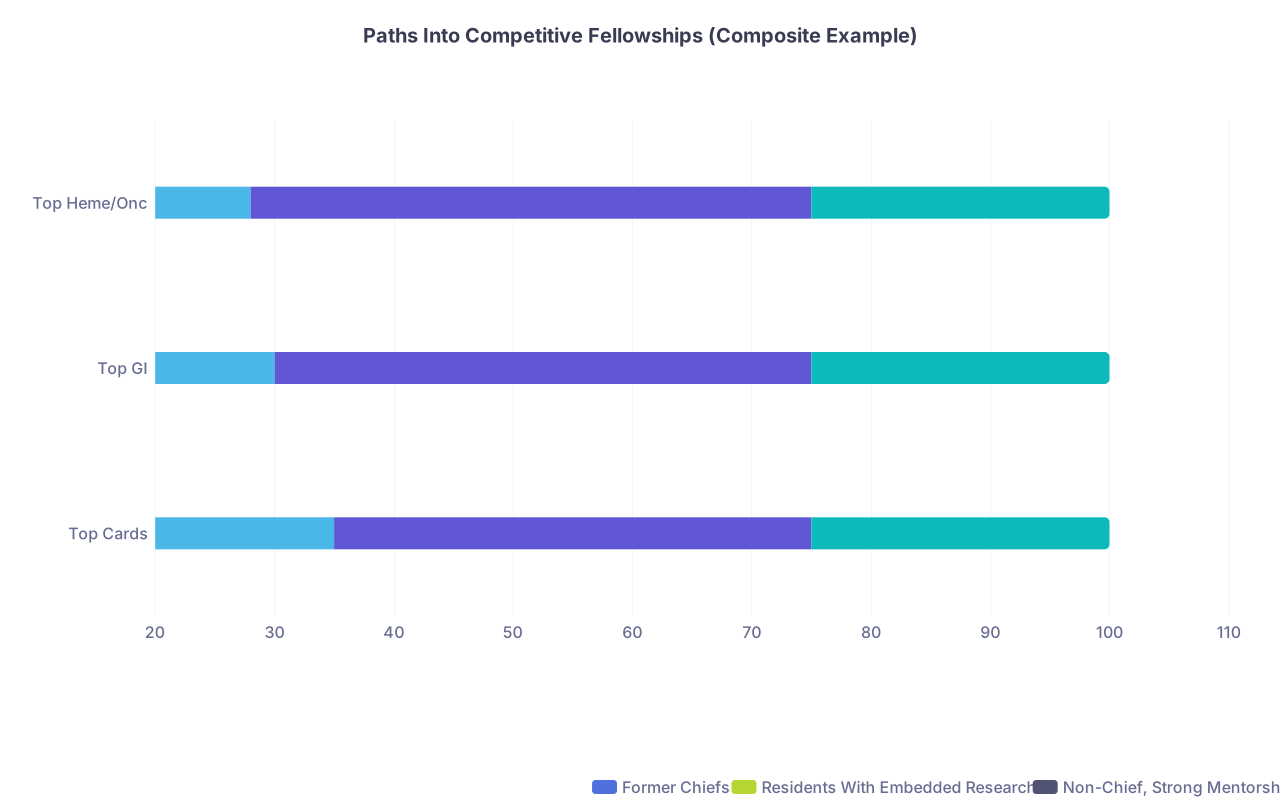
Look closely: most of the “advantage” that people attribute to being chief is actually:
- An extra research year
- Extra networking with department leadership
- A PD who now knows you well and can pick up the phone
All of which you can partially replicate without being chief, if you stop obsessing about the title and focus on relationships and actual output.
The Real Gatekeepers: Letters, Trajectory, And Proof You’re Serious
Fellowship committees are asking a few core questions. None of them are “Were you chief?”
They’re closer to:
- Does this person actually want and understand this specialty, or are they running from generalist life?
- Do their letters describe them as someone we want on our service at 2 a.m.?
- Have they done the kind of academic/clinical work that suggests they’ll thrive here?
- If they’re from a smaller or community program, do we have concrete evidence they can hang in a high-acuity, high-expectation environment?
You answer those with:
Subspecialty letters from people who matter.
A single letter from a nationally known faculty member in that field often outweighs “chief” on your CV. That letter saying, “This is one of the top residents I’ve worked with in ten years” opens doors. Especially if that person occasionally calls or emails PDs.Focused, not generic, experiences.
Heme/onc? Show hematology or oncology clinics, inpatient services, maybe a project.
GI? Show you did more than just the obligatory elective. Same with cards, pulm/crit, rheum, allergy, ID, whatever.Some academic output — tailored to competitiveness of the field.
For cards, GI, heme/onc at top places, you’re usually looking at something like:- A few abstracts/posters at national/regional meetings
- 1–3 publications (even case reports/retrospective studies count more than zero)
- Evidence you can see a project through
None of the above care whether your email signature says “Chief Resident”.
Who Actually Gets Hurt By The Chief Myth
The myth is not just harmless nonsense. It actively misguides people in two directions.
1. The “I Didn’t Get Chief, So I’m Screwed” Group
You see this a lot in PGY-2s who didn’t get selected:
“They picked other people. Guess I’ll just apply community cards instead of academic. No way I’ll match at [Big Name].”
This is wrong. If you weren’t chosen chief because:
- You were quieter
- You had less teaching visibility
- The leadership wanted a certain “mix” of personalities
- Or they simply had more excellent candidates than spots
…none of that disqualifies you from competitive fellowships as long as your:
- Clinical evaluations are strong
- Letters are excellent
- You have some research or scholarly work
- You can explain your trajectory cleanly
I’ve watched non-chiefs match:
- CCU rock stars with three cardiology abstracts and a glowing letter from the ICU director
- GI applicants with a methods-heavy QI project and stellar evaluations
- Oncology-bound residents who got on early with a research mentor and built a coherent story
They didn’t waste a second dwelling on “I should have been chief.”
2. The “Chief Will Save My Application” Fantasy
This one’s more dangerous.
Some residents with mediocre performance think:
“Yeah, my in-training scores are meh, and I haven’t done much research, but if I get chief, that’ll make me competitive for GI.”
No. It won’t.
Chief amplifies what’s already there. If what’s there is:
- Mid-tier evaluations
- Spotty reliability
- Thin or nonexistent academic work
…then chief may give you some leadership talking points, but you’re still not suddenly a “top GI at a big-name program” candidate.
A PD I know once said, half-jokingly:
“If your main selling point is that someone else thought you should enforce schedules, that’s not enough for us to invest three years in you as a subspecialist.”
Harsh, but accurate.
So If Chief Isn’t Required, What Actually Moves the Needle?
You want competitive fellowship? Fine. Aim for the things that really matter. Rough hierarchy:
Be a legitimately good resident.
You can’t fake this. Nurses know. Fellows know. Attendings definitely know. Being the resident people want on their service — reliable, prepared, safe, and teachable — is your baseline.Get one or two heavyweight letters in your specialty.
Not just “hardworking and pleasant.” You want:
“I strongly recommend without reservation. Top 5% I’ve worked with.”
That comes from showing up early, staying late when appropriate, asking thoughtful questions, and following through on patient care and projects.Do a project and finish it.
Fancy RCT? No.
Reasonable retrospective, QI, case series with a coherent question and decent methods? Yes.
Present it. Write it up if you can. The bar is not “Nobel candidate.” It’s “shows they can engage with scholarly work and finish something.”Know your story and stick to it.
“I like procedures.” is not a story.
“I’m drawn to pulmonary/critical care because I enjoy physiology-heavy acute medicine, longitudinal clinic relationships in pulmonary diseases, and the multidisciplinary nature of ICU care. Here’s what I did to explore that.” — that is closer.-
- Rotate at your own specialty service early and again as senior.
- Ask to be on teaching services with faculty in your field.
- Tell them your goals; ask how to position yourself.
Some chiefs will do all this and match fantastically. Many non-chiefs will too.
The One Time Chief Actually Does Matter More
There’s a narrow scenario where chief carries more weight: borderline-on-paper candidate with exceptional leadership and reputation.
Think:
- Modest research
- Solid-but-not-stellar scores
- But universally loved by residents and faculty, runs an incredible team, and gets a glowing PD letter about leadership, maturity, and judgment
For fields and programs that care a lot about “team glue” — some heme/onc, rheum, ID, even cards at certain places — that can tip you from “maybe” to “yes.”
But notice the nuance: it’s not the word “chief” that does this; it’s what that year proves about your character and capability. If people would say the same things about you without the title, you’re still competitive.
Stop Worshipping Titles, Start Building Evidence
Here’s what the data and lived reality actually show:
- Many residents match into highly competitive fellowships without ever being chief.
- Chiefs are overrepresented mainly because they already tended to be strong and had extra time/opportunity, not because the title itself is a ticket.
- Fellowship programs care far more about letters, clinical reputation, research trajectory, and fit than about your administrative role in residency.
If you strip it down to the essentials, your playbook is simple:
- Be excellent where you are.
- Get the right people to see that excellence.
- Turn it into concrete output and letters.
Chief or not, that is what gets you in the door.
Key points:
- Being chief is neither necessary nor sufficient to match at highly competitive fellowships; it’s a mild booster at best, not a gate.
- Letters, clinical reputation, and subspecialty engagement consistently outweigh the chief title on real fellowship selection committees.
- If you are not chief, you’re not doomed; if you are chief, you’re not automatically golden. The work still has to be there either way.


