

The belief that a community residency kills your chances at academic fellowships is wrong. Not exaggerated. Not “partly true.” Just wrong.
I’ve watched people match GI, cards, heme/onc, PCCM, even elite research fellowships from places most applicants have never heard of. Meanwhile, I’ve seen residents at big-name university programs whiff on their top choices. The pattern is not “university = guaranteed top fellowship, community = no chance.” The pattern is “strong applicant with evidence of potential = competitive anywhere.”
Let’s dismantle this cleanly.
Where This Myth Comes From (And Why It Feels So Convincing)
The story you’ve probably heard goes like this: fellowship is academic → academics only trust each other → if you’re not branded with a big-name university program, your application goes in the trash.
Here’s what’s actually going on.
Program leadership at university fellowships do see more applicants from other academic programs. Why? Because:
- There are simply more residents in academic IM programs going after subspecialties.
- Academic programs push research and academic careers harder.
- Residents at those places self-select into competitive fields.
So you see a class photo at a top GI fellowship: a bunch of residents from well-known university programs and maybe one community grad. People conclude: “See? No community folks. We’re done.”
Except that’s selection bias. You’re only looking at who matched, not who applied, not their relative strength, and definitely not how many community residents did not even apply because they’d been scared out of it by this exact myth.
The other reason this myth sticks is insecurity. Residents at community programs get told—often by med students, peers, even faculty who trained 20+ years ago—“it’s harder from a community place.” That sentence slowly mutates into “it’s impossible.” It is not.
What Fellowship PDs Actually Care About
Fellowship program directors are not sitting in a dark room sorting applications by “Ivy” vs “non-Ivy.” They are trying to answer a few very practical questions:
- Will you be safe and competent with their patients?
- Will you represent their program well (academically, professionally)?
- Do you have a real demonstrated interest in this field?
- Are you likely to finish and not be a headache?
The “academic prestige” of your residency is a proxy for those things. Not the thing itself.
Here’s how those priorities usually show up, based on PD surveys and what I’ve seen in actual selection meetings:
- Clinical performance and letters: Do faculty actually vouch for you in detail? Are your letters specific, credible, and from people who know fellowship worlds?
- Interview: Do you sound like someone who understands the field, has a coherent story, and will function on day one? Or like someone applying because they’re allergic to hospitalist work?
- Board scores: Not everything, but if you’re chasing cards or GI and your Step/Level scores are shaky, you’re playing on hard mode.
- Research and scholarly output: For academic fellowships, yes, this matters. But not everyone needs 10 first-author NEJM papers. Reasonable output, with a coherent thread, is often enough.
- Fit and trajectory: Does what you’ve done make sense for where you say you’re going? Or is it a random collage?
Where does “university vs community residency” come in? Think of it as a tiebreaker. If two otherwise similar applicants exist, the brand may sway perception. But residency type is not the core selection variable.
| Factor | Weight vs Program Type |
|---|---|
| Letters of recommendation | Much higher |
| Clinical performance | Much higher |
| Research output | Higher |
| Program reputation | Moderate |
| Personal statement | Moderate |
Data: Community Programs Do Match to Competitive Fellowships
Let’s ground this in something more than opinion.
You will not find a neat national dataset that says: “X% of community residents matched GI at T32 research powerhouses.” But you can see patterns in NRMP data and program rosters.
- NRMP’s fellowship match reports show that plenty of applicants come from “other” or “non-university” residency types.
- Look at current fellows on academic program websites—especially in cards, PCCM, GI. You’ll routinely see people from mid-size community programs, VA-based programs, hybrid community-university programs, and places most medical students never rank in their top 10.
Now, are top research fellowships disproportionately populated by academic-residency grads? Absolutely. But “disproportionately” is not “exclusively.” The door is not locked; it just demands a stronger key if you do not have the brand backup.
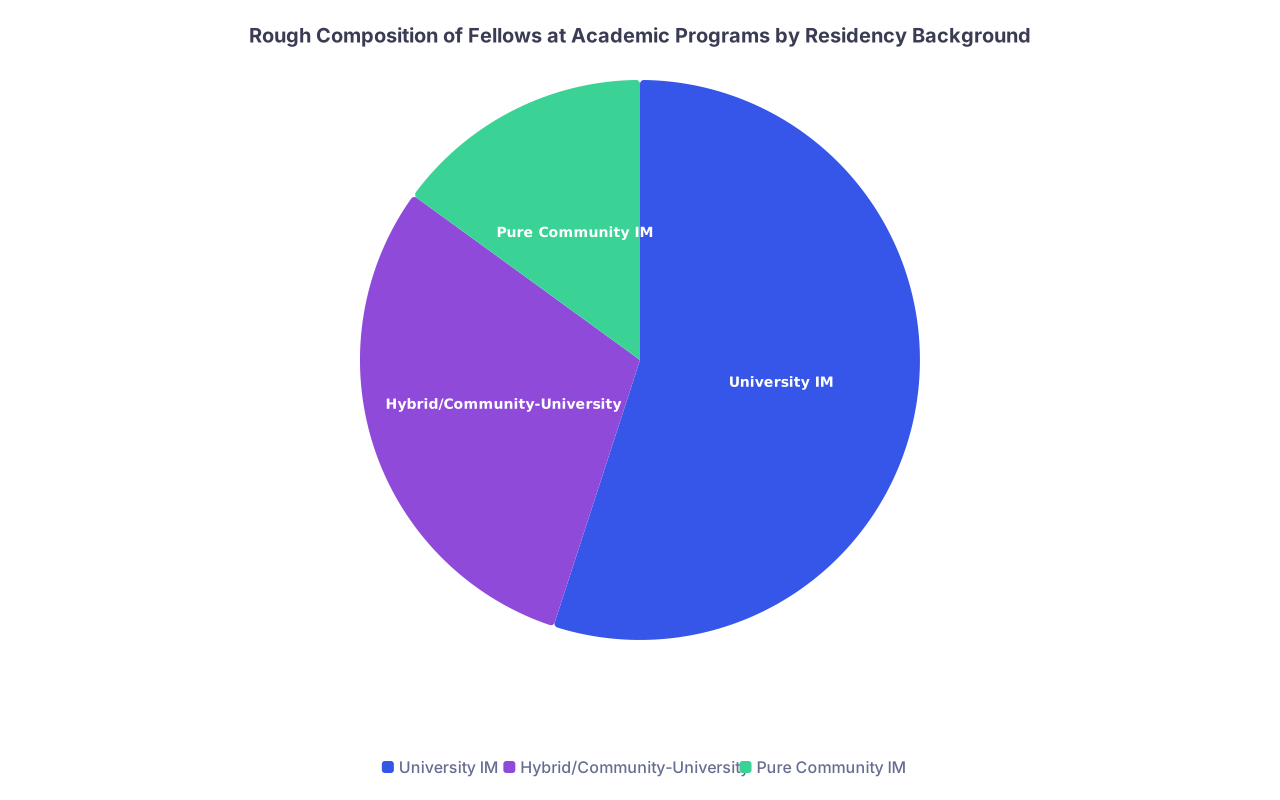
| Category | Value |
|---|---|
| University IM | 55 |
| Hybrid/Community-University | 30 |
| Pure Community IM | 15 |
These proportions are typical of what you’ll see scanning rosters at big-name programs. Again: 15% is not zero. And those 15% are not there by accident.
How Community Residents Actually Get Academic Fellowships
Here’s the part nobody explains well: top community residents who land strong fellowships do not act like “community residents.” They build an academic-leaning profile from a community base.
Patterns I see over and over:
They aggressively secure strong letters. They identify which attendings have academic ties or fellowship connections and work with them repeatedly. They do not settle for generic “hard worker” letters from random hospitalists. They get letters from section chiefs, subspecialists, or faculty who have credibility in the field.
They manufacture research opportunities. Yes, it’s harder at a pure community hospital. Nobody is spoon-feeding projects. But there is always low-hanging fruit: QI projects, chart reviews, case series, collaborative projects with nearby university faculty. They volunteer to be the “doer” on everything.
They attend and present at meetings. Even a poster at a regional ACP or subspecialty meeting signals that you care. Once you start stacking a few of those, you look a lot like the moderate-output academic-residency applicant.
They master the story. This is underrated. A community resident who can clearly explain: “Here’s why I ended up at this program, here’s what I did with it, and here’s why I’m now ready for a serious academic fellowship” will destroy a prestige-residency applicant who sounds vague, entitled, or bored.
I’ve seen a community resident with 2 modest posters, 1 QI project, and killer letters match GI at a solid academic center while a resident from a big-name university with scattered random research and lukewarm letters slid down to a backup.
Because again, the core currency is evidence of future performance. Not your ZIP code.
The Real Disadvantages of a Community Residency (No Sugarcoating)
Now let’s be blunt. There are disadvantages. They’re just not the ones people obsess over.
1. Less baked-in research infrastructure
At many community programs:
- No full-time research coordinators.
- Fewer faculty doing prospective trials.
- IRB processes are clunkier and slower.
- Nobody cares if you publish, clinically speaking.
So if you sit back and expect a pipeline of easy projects, you’re dead before you start. This is where the myth partly incubates: residents see no obvious path, assume there is none, and then repeat the “no shot at academic” line.
2. Letters that carry less default weight
A letter from “Program Director, Big University IM” gets a baseline level of respect before anyone reads it. A letter from “Hospitalist, County Community Hospital” does not.
Solution is not to give up; it’s to be very strategic about letter-writers:
- Subspecialists with academic ties, even part-time.
- Faculty who trained or worked at major centers and still know people.
- Program leadership who can speak in specifics, not cliches.
3. Fewer built-in fellowship pipelines
University IM programs often have in-house fellowships. You rotate with them, do research with them, then match there. Pipeline.
Community programs may have:
- No in-house fellowships, or
- Only in certain fields (say PCCM but not cards).
That means you’re an outsider applicant almost everywhere. That’s harder. Not impossible. You just don’t have home-field advantage.

| Step | Description |
|---|---|
| Step 1 | Community Residency |
| Step 2 | Local Subspecialty Mentors |
| Step 3 | Nearby University Collaboration |
| Step 4 | National Conferences |
| Step 5 | Strong Letters |
| Step 6 | Joint Research |
| Step 7 | Networking |
| Step 8 | Academic Fellowship Match |
The antidote to all three disadvantages is the same: you must be proactive and a bit relentless. If you’re waiting for someone to build an academic profile for you at a community program, you’re going to be another data point “proving” the myth.
What Community Residents Need to Do Differently (If They Want Academic Fellowships)
If you’re at a community program and aiming at an academic fellowship, here’s the uncomfortable truth: you cannot behave like the average resident at your program and expect an above-average outcome.
You need to front-load three things.
1. Start early and declare your intent
By mid-PGY1, your PD and key faculty in your target subspecialty need to know your goals. Not in a clingy way. Just:
“I’m strongly interested in [cards/GI/onc/etc], and I’d like to be competitive for an academic fellowship. What would you recommend starting now at this institution?”
That simple sentence:
- Gets you on their mental radar.
- Opens doors they know about that you probably don’t.
- Signals that you’re serious enough to plan longer than 6 months ahead.
2. Build a coherent scholarly track record
You do not need brute-force volume. You need coherence and follow-through.
For example, a community IM resident going for PCCM:
- PGY1: QI project on sepsis bundle compliance in your ICU → abstract/poster at a regional meeting.
- PGY2: Retrospective chart review looking at ARDS outcomes at your hospital → poster/paper, maybe multi-center collaboration.
- PGY2–3: Case series or educational project tied to ICU teaching.
On ERAS, that looks like someone actually interested in critical care, not someone who just hoarded random case reports because they panicked late.
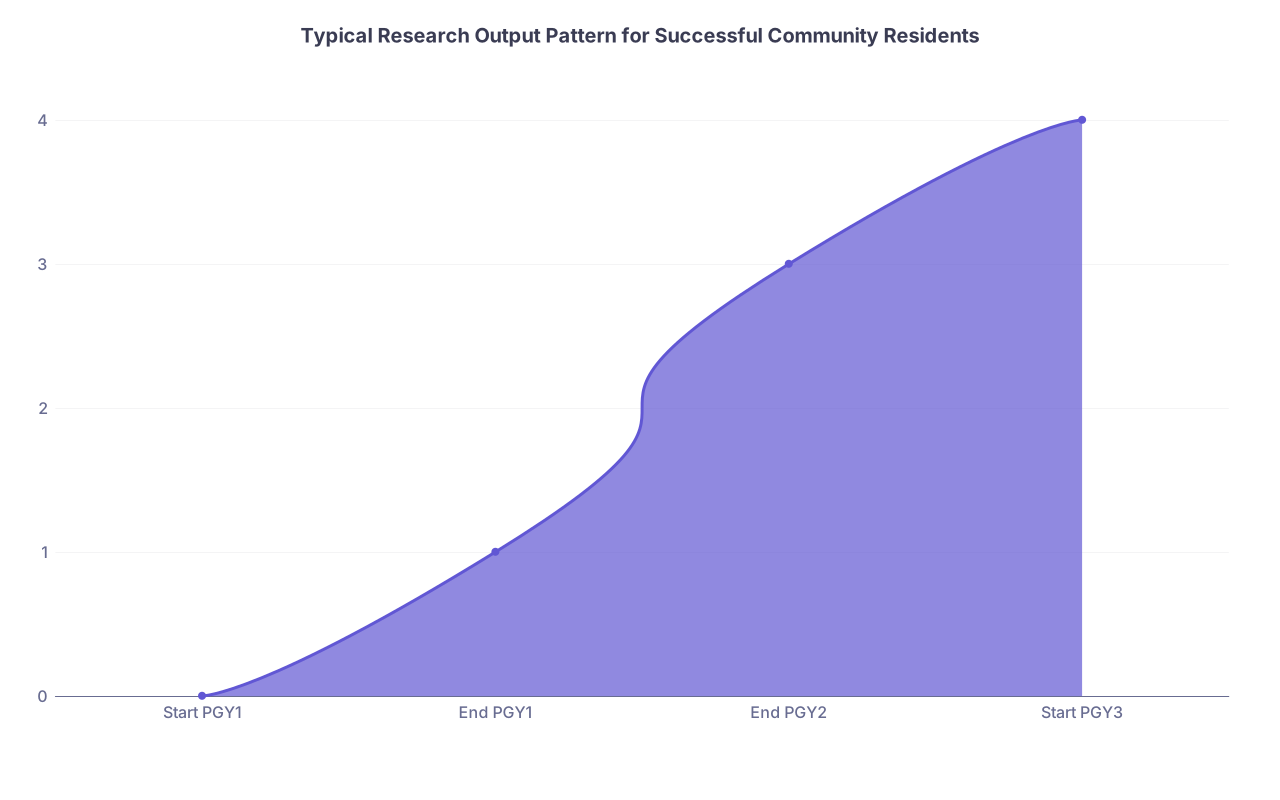
| Category | Value |
|---|---|
| Start PGY1 | 0 |
| End PGY1 | 1 |
| End PGY2 | 3 |
| Start PGY3 | 4 |
Notice the curve: nothing at the start, then a few meaningful items by the time applications go out. That’s realistic.
3. Letters and networking: your force multipliers
You cannot brute-force your way into a top academic fellowship on PubMed alone. Letters and human connections do heavy lifting.
That means:
- Rotate at a nearby academic center if you can.
- Ask your PD specifically: “Who in your network should I try to work with or meet, given my goals?”
- When you go to conferences, actually talk to people at poster sessions and during breaks, especially in the fellowship programs you’re targeting.
Plenty of fellowship interview invitations start with, “Oh yeah, I remember meeting you at CHEST/ACC/DDW, right?”
Stop Using “Community Program” As an Excuse
Here’s the harsh part.
A lot of people love this myth because it gives them a clean external reason not to push. “Well, I’m at a community place, what can I do?” is more comfortable than “I haven’t actually done the hard, non-mandatory things this goal requires.”
I’ve seen community residents with:
- Middle-of-the-road scores
- One or two modest projects
- Excellent clinical reputations
- Strong, detailed letters
…match into perfectly solid academic fellowships at university programs. Not always the T32 mega-labs, but absolutely respectable, research-active places.
And I’ve seen community residents with:
- Complaints about their program
- No protected time used for anything academic
- Last-minute panicked interest in “any fellowship”
- Generic letters
…fail to match and then blame “being from a community program.”
Bluntly: if your record looks like the second case, being at a big-name academic residency wouldn’t have magically transformed you. It would just give you a different excuse.

When a Community Residency Does Limit You
There is one corner case where the myth has a kernel of truth.
If your dream is a very specific, ultra-research-heavy career track—think “I want to be an NIH-funded basic science PI in cardiology at a top-10 research institution”—then:
- Doing residency at a place with minimal research infrastructure
- And then applying to the most academically intense, grant-heavy fellowships
…is swimming directly upstream.
In that case, you either:
- Use residency to build enough of a research foundation to then pivot hard during fellowship, or
- Consider doing research years, or
- Accept that you might train at a strong but not top-5-RO1 factory and then build your academic profile over time.
None of that equals “no shot.” It equals “longer runway, more deliberate planning.”
Bottom Line
Community residency does not mean no shot at academic fellowships. It means:
- You do not get default prestige points.
- You must be more proactive building research and mentorship.
- Your letters and your narrative have to do more work.
The door is open. It just doesn’t open itself.

FAQ (Exactly 5 Questions)
1. Do I need at least one letter from an academic institution to match an academic fellowship from a community program?
Not strictly, but it helps. What matters most is credibility and specificity. A detailed letter from a respected subspecialist at your community hospital who trained at a major center and is known in the field can outweigh a generic letter from some random assistant professor at a university. If you can get both—community and academic—that’s ideal.
2. If my community program has no research, is it even possible to build a competitive CV?
Yes, but you cannot be passive. You may need to cold-email nearby universities, collaborate on multi-center projects, or do QI projects that can be converted into abstracts and manuscripts. People have done this before you. It’s harder. Not impossible. You’ll work more nights and weekends than your colleagues who are not aiming for fellowship.
3. Are some fellowships more realistic than others from community programs?
Yes. Highly research-intense GI or cards fellowships at top-tier research institutions are the steepest climb. Heme/onc, PCCM, nephrology, ID, and academic hospital medicine are often more realistic if your research output is modest but your clinical performance and letters are strong. But even in cards and GI, I’ve seen community grads match well when they built a focused, coherent academic record.
4. Does doing an away elective at a university program actually help?
Often, yes—if you perform well and get a letter. An away rotation lets you show you can function at that level, gives you a shot at mentorship, and creates a name/face association when your application shows up. But it’s not mandatory. Don’t do an away if you’re going to be average. Only go if you’re ready to impress.
5. If I’m already mid-PGY2 at a community program with no research, is it too late to aim for a competitive fellowship?
It’s late, not too late. You need to compress the timeline: secure mentors now, start a realistic project (likely retrospective or QI), aim for at least a poster, and make sure your letters are stellar. You may need to adjust expectations slightly on program tier, or consider applying one year later with a gap year of research. But “too late” is usually code for “I don’t want to do the extra work.” If you’re willing, there’s still room.


