Why does it feel like one failed board exam during residency automatically means, “Say goodbye to any good fellowship for the rest of your life”?
Let me be blunt: that story gets repeated constantly in resident workrooms, and it is exaggerated at best, flat‑out wrong at worst. Fellowship selection is ruthless in some ways, but not in the simplistic, moralistic way residents like to scare each other with.
The truth is messier. And more survivable.
You are not dealing with an abstract “system.” You are dealing with a few attendings sitting in a room with a spreadsheet, a stack of ERAS PDFs, and 90 minutes between their last clinic patient and their kids’ soccer game. They do not have the time—or the interest—to hate you “forever.” They care about risk, optics, and whether you’re going to be a headache for them.
Let’s tear this apart systematically.
What Actually Shows Up On Their Screen
First myth: “If you ever failed Step 1 / Step 2 / Level 2 / your specialty boards, it’s a giant red flag label in ERAS or some permanent blacklist.”
Wrong.
Here’s what they actually see when they open your file (or the exported PDF they’re actually using):
- Your USMLE/COMLEX attempts and scores
- Whether your specialty boards are passed, pending, or failed attempts
- Your training history, including extensions, leaves, and sometimes remediation language in letters
- Dean’s letter, PD letter, other LORs, CV, personal statement, research
No flashing red “do not rank” banner. Just data in a table.
| Item | How It Appears |
|---|---|
| USMLE/COMLEX Steps | Scores + attempts, often in a table |
| Specialty In‑Training Exams | Sometimes summarized in PD letter |
| Board Certification Status | Passed / Eligible / Failed attempt(s) |
| Leaves/Extensions | Training dates + sometimes PD comments |
Do some program directors immediately sort by “failed exam attempts” and then look harder at you? Yes, some do. Especially in ultra‑competitive fellowships or at brand‑name institutions.
But that’s not “forever.” That’s, “for this specific application cycle, in this specific applicant pool, your failure is a risk factor they now have to contextualize.”
The Real Question Committees Ask: “Is This a Future Problem?”
Programs don’t care about your pride. They care about their board pass rates, their reputation, and how much supervision and paperwork you’ll require.
When they see a failed board, the thought process is usually something like:
- Is this a one‑time blip or part of a pattern?
- Did the applicant ultimately pass and move on, or are they still struggling?
- Did this failure cause training disruption? Extra year? Remediation?
- Do their letters sound like, “solid, dependable,” or “some concerns”?
- Are their recent evaluations strong enough to make us ignore the old stumble?
That’s the real calculus. It’s not moral judgment. It’s risk management.
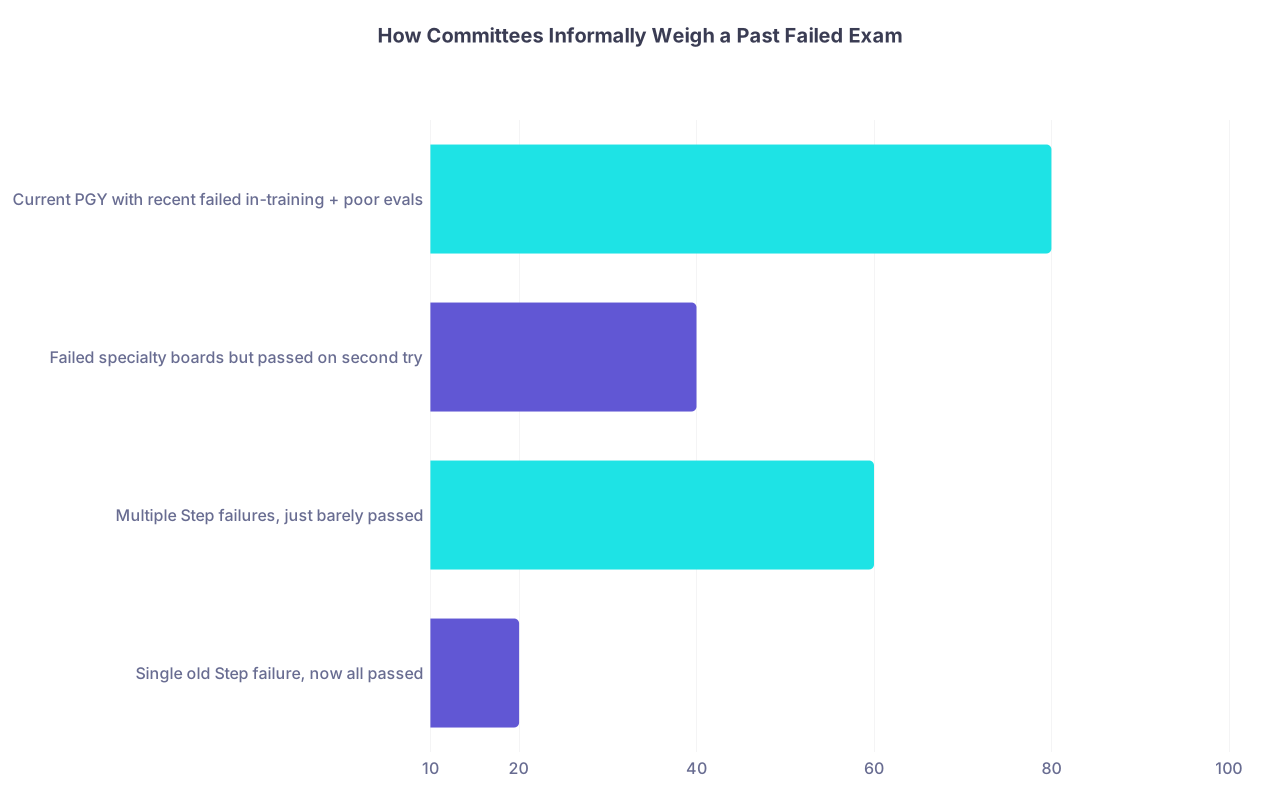
| Category | Value |
|---|---|
| Single old Step failure, now all passed | 20 |
| Multiple Step failures, just barely passed | 60 |
| Failed specialty boards but passed on second try | 40 |
| Current PGY with recent failed in-training + poor evals | 80 |
(Values here are conceptual “perceived risk,” not literal percentages, but they capture how this usually feels in the room.)
Notice something important: the worst case isn’t “I failed an exam once.” It’s “I’m currently unstable, still failing things, and my letters hint at problems.”
One failure isn’t career death. Ongoing concern is.
What The Data and Match Patterns Actually Suggest
We do not have a neat national dataset labeled: “fellowship match odds by board failure history.” NRMP and specialty societies do not publish that level of detail.
But we do have clues.
Plenty of fellows have prior exam failures.
I’ve sat in rooms where we ranked:- A gastroenterology fellow who failed Step 1 and later crushed Step 2 and their boards.
- A cardiology fellow with a failed internal medicine boards attempt who matched at a solid university program after passing on the second try.
- A heme/onc fellow who needed an extra year in residency after a tough personal year and low ITEs, but with glowing senior‑year letters.
Residents act like these people don’t exist. They do. You just don’t see their ERAS PDFs.
Programs care a lot more about specialty boards than Step 1.
A Step failure during med school that’s followed by a smooth residency and a passed specialty board? Usually a minor issue.
A failed specialty board that’s still unresolved? Much bigger problem.Once you’re board‑certified and practicing, this essentially disappears.
By your second attending job, no one is retro‑screening your Step 1 history. Credentialing wants: active state license, board certification, no major sanctions. That’s it.
So the “held against you forever” myth is already dead on arrival. The real issue is: how long does it linger, and where?
How Different Types of Failures Are Actually Viewed
Not all failures are equal. And committees absolutely make distinctions.
1. Failed USMLE/COMLEX Step During Med School
This is the most survivable category.
If you:
- Failed Step 1 or 2 once
- Then passed on second attempt with a solid score
- Completed residency on time
- Have no later exam problems
Most fellowship committees put this in the “mild concern, needs context, can be outweighed” bin.
What helps:
- Strong letters that emphasize reliability and clinical strength
- Good in‑training exam performance during residency
- No remediation or professionalism issues
- PD explicitly backing you as fellowship‑ready
What hurts more than the failure itself is you pretending it never happened. If it’s significant, you usually address it briefly and clearly in your personal statement or in an interview. Not with an essay. With a sentence or two of cause + growth.
2. Multiple Step Failures or Pattern of Struggle
Now you’re in a different risk category.
Repeated exam failures signal one of three things in the committee’s mind:
- Ongoing knowledge gap
- Ongoing test‑taking / anxiety issue
- Poor insight or effort
If the pattern stops, and you have years of clean performance, it can still be overcome. But it will close some doors. The hyper‑competitive, prestige‑chasing fellowships? They have enough 260‑score applicants with clean histories. They do not need to gamble.
Smaller, clinically focused fellowships? More flexible. Especially if your clinical reputation and work ethic are stellar.
3. Failed Specialty Boards
This one matters more. Because now the program’s board pass rate is on the line.
Here’s how committees typically stratify this:
- Failed once, now passed, with PD letter explaining concrete growth and current strength: cautious but often acceptable
- Failed, still not passed by application time: major red flag, often disqualifying at competitive sites
- Failed, extended residency, persistent ITE issues: most programs will pass unless there’s an extraordinary story and you’re in a less competitive fellowship field
And no, they do not hold it “forever” once you’re board‑certified and performing well. But during the first 1–3 years after that failure, it is absolutely a factor.
Context That Changes Everything
One of the laziest takes I hear from residents is: “Program X just filters out all failures, they don’t care about your story.”
Some do. Many do not.
Committees absolutely care about context when it’s clear, documented, and consistent:
- Major illness (yours or family) during exam period
- Visa chaos, severe financial hardship, or childbirth right before an exam
- Well‑documented learning disability with later improved accommodations
- Early‑training disaster that’s clearly resolved years later
What they do not like is vague emotional narratives with no objective turnaround. “I was going through a lot… but now I’m better” means nothing to a committee unless your later performance proves it.
You want the story to look like:
- Significant stressor or error
- Concrete change in behavior/support
- Clear track record of better performance for several years after
Not:
- Ongoing “stuff happened”
- Repeated failures
- Same excuses
The Competitive Specialty Problem: Not Everyone Gets a Second Look
Let’s talk about the specialties where residents panic the most: cardiology, GI, heme/onc, PCCM, some surgical fellowships.
Here’s the uncomfortable reality:
- These programs get flooded with applicants.
- Many have more than enough “clean file” candidates.
- They may never reach your file in the stack if you’re from a lower‑tier residency with failures and no differentiating strengths.
That’s not moral failure. That’s math. Scarcity plus sorting.
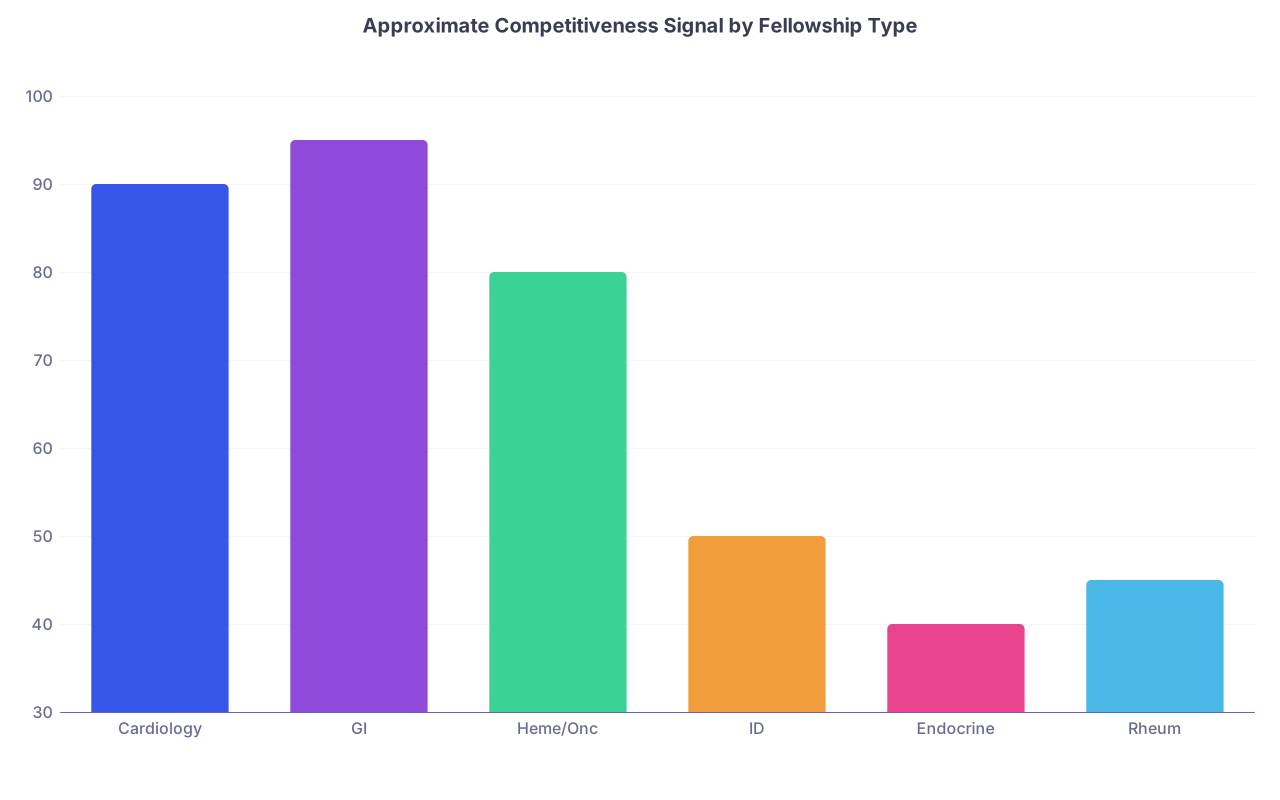
| Category | Value |
|---|---|
| Cardiology | 90 |
| GI | 95 |
| Heme/Onc | 80 |
| ID | 50 |
| Endocrine | 40 |
| Rheum | 45 |
Again, these aren’t exact match rates. Think of them as “relative pickiness.” GI programs with 300+ applications for 3 spots are not going to spend time rehabilitating a complex exam story. Infectious disease? Endocrinology? Rheumatology? Way more willing to look at the whole picture, especially at community or mid‑tier university programs.
So the myth that “they hold it against you forever” usually hides a more honest truth:
“I’m aiming only at the 5–10 most competitive fellowships, and those programs don’t need to invest in risk.”
That’s not the same as “no fellowship will ever want me.”
Concrete Ways to Make a Past Failure Matter Less
Here’s where most residents screw this up. They think they can “personal‑statement” their way out of a failure, or that one research poster fixes everything.
It does not.
What actually moves the needle:
Time + Clean Performance
A single Step failure 6 years and multiple successes ago is much less of a concern than a near‑miss ITE last year.Strong PD Letter That Addresses It Indirectly
Committees look for phrases like:- “Top third of our residents”
- “Required minimal supervision in the ICU”
- “We would be delighted to have them as a colleague”
Those lines mute an old exam failure more effectively than any personal essay.
Local Reputation and Networking
If your own cardiology division chief picks up the phone and says, “We’ve worked with her for years, she’s fantastic clinically,” that wipes out a lot of doubt. Phone calls matter more than residents realize.Strategic Targeting of Programs
Not everything is Harvard and Mayo. Many excellent fellowships at regional academic centers and strong community programs care more about: “Will this person carry the pager and not crash?” than about your Step 1 blemish.
When It Does Turn Into Something Like a Permanent Shadow
There are a few situations where, realistically, you will be fighting an uphill battle for a long time:
- Repeated failure of specialty boards, or never passing them
- Formal remediation for knowledge + professionalism issues with documentation
- Leaving a residency program in bad standing
- PD who will not write you a strong letter or subtly warns programs
This is not about a single exam score anymore. It’s about your training file as a whole. In that scenario, the path often becomes:
- Finish residency strongly where you are
- Get a solid generalist/primary attending job
- Rebuild your track record for a few years
- Then, maybe, re‑approach fellowship or niche practice opportunities
But again—that’s not a committee holding “one failure” against you forever. That’s them reacting to an ongoing pattern of risk that has not yet been resolved.
So, Are You Doomed or Not?
If your situation looks like:
- One failed Step or COMLEX during med school
- Or one failed specialty board, now passed
- No ongoing academic or professionalism concerns
- Solid letters and evaluations
- Clear upward trajectory
Then no—you’re not doomed. Are some hyper‑competitive fellowships less likely? Yes. Is “forever” accurate? Not even close.
If your situation looks like:
- Multiple failures, some recent
- No clean, sustained track record since
- Mediocre or vague letters
- PD not fully backing you
Then you have work to do before fellowship becomes realistic. That might mean delaying application a year. Or targeting different fields. Or frankly rethinking whether fellowship is the right move.
But do not confuse “this is harder than I want” with “this is impossible and they will hate me for life.”
Years from now, the question won’t be, “Did I ever fail an exam?” It will be, “Did I respond to that failure like someone I’d actually trust to take care of my patients?” And fellowship committees are a lot more interested in that second answer than residents like to admit.