

The belief that fellowship program directors carefully read every word of every personal statement is a comforting fiction. They don’t. They can’t. And pretending they do leads residents to waste time on the wrong things.
Let me walk through what actually happens on the other side of ERAS—and when your personal statement genuinely matters versus when it’s background noise.
What PDs Actually Do With Your Personal Statement
Here’s the hard truth: for most programs, your personal statement is not a primary decision-making tool. It’s a secondary or even tertiary filter.
How do I know? Because we have:
- Surveys of fellowship and residency PDs
- Realistic time math (number of apps vs. hours available)
- Firsthand reports from PDs, APDs, and fellows who’ve sat in the room when decisions are made
Typical scenario: a cardiology or GI fellowship gets 400–700 applications for 2–6 spots. Even if only 300 are serious, there is no universe where a PD reads 300 essays line by line with deep literary appreciation.
What usually happens instead:
Initial Screen = Numbers & CV
Step scores (or pass/fail status + Step 2), in-training exams, letters, reputation of residency program, research, and sometimes visa status do the heavy lifting.
At this stage, many PDs do not open the personal statement at all.Secondary Sort = “Maybe” Pile
Once the obvious automatic interviews and obvious no’s are pulled out, there’s a big gray zone.
This is where the personal statement starts coming into play. But again—skimmed, not studied.Pre-Interview Review = Targeted Reading
Before interviewing you (often the day before or even the morning of), PDs and faculty will open your personal statement. They’re not grading prose. They’re looking for:- Red flags (weird tone, arrogance, nonsense)
- Evidence of genuine interest in the subspecialty
- Hooks for interview questions (projects, life events, goals)
Post-Interview Tie-Breakers
Occasionally, when two applicants are neck-and-neck, someone will say: “What did their personal statement say again?” and re-open it to justify a rank decision. But this is far less common than you think.
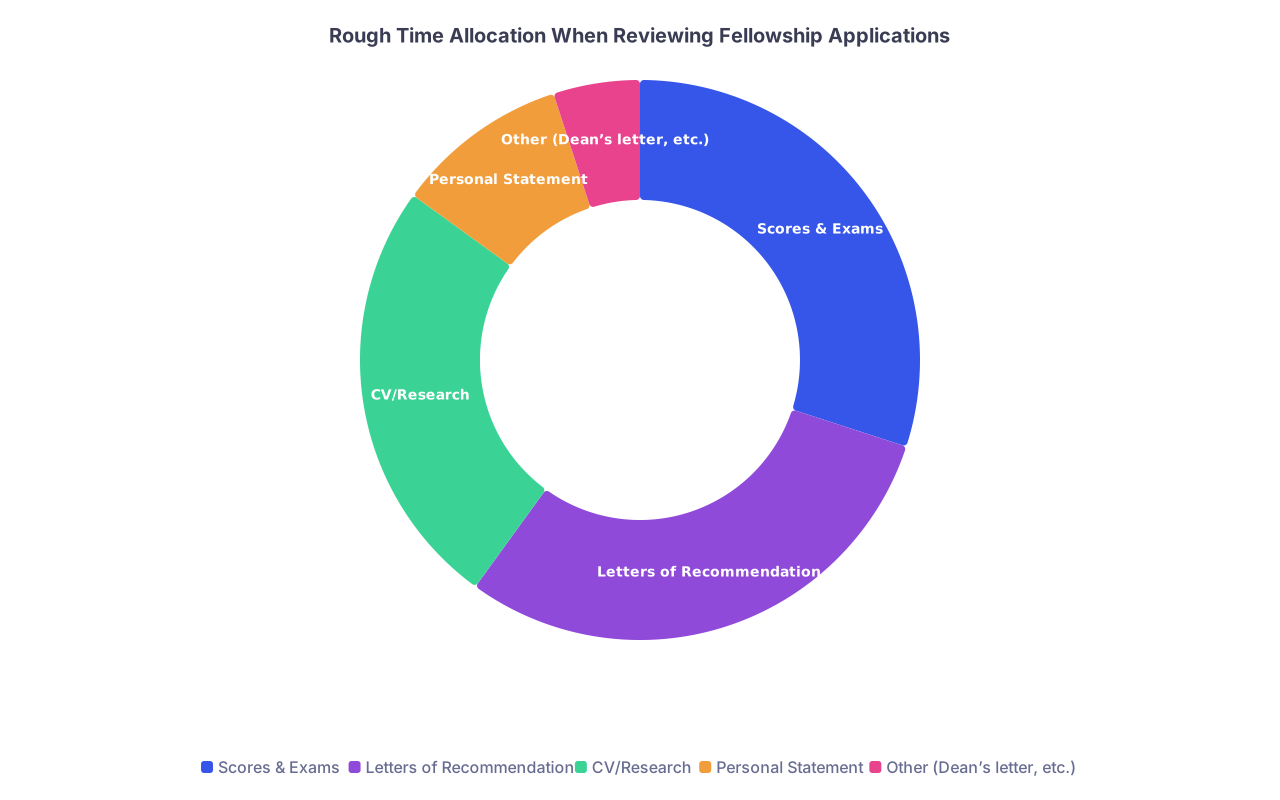
To make this concrete:
| Category | Value |
|---|---|
| Scores & Exams | 30 |
| Letters of Recommendation | 30 |
| CV/Research | 25 |
| Personal Statement | 10 |
| Other (Dean’s letter, etc.) | 5 |
Are those numbers exact? No. But they’re honest as an approximation. The statement is not irrelevant—but it’s not the star of the show either.
The Myth: “They Read Every Word Carefully”
Residents cling to this myth for a few reasons:
- It’s one of the only parts you feel you control in the moment.
- Attendings and advisors repeat vague advice like “this is your chance to tell your story,” without telling you how much (or how little) it’s actually weighted.
- You want to believe effort equals impact.
Let’s be blunt: a beautifully written personal statement will not rescue a weak application in a competitive specialty. And a mediocre but competent statement will not tank a strong one.
I’ve watched application review meetings where:
- A clearly stellar applicant had an obviously generic, templated personal statement. Nobody cared. They still got invited immediately.
- Another applicant had a moving, polished essay about adversity. But their research was nonexistent and their letters were lukewarm. People said, “Great story, but not a fit for this program.”
- The only time the room really focused on a personal statement? When it was weird.
That’s the first real job of your statement: not to dazzle, but to not be bizarre, off-putting, or delusional.
When They Actually Do Read Closely
Now the nuance. “They don’t read every word” doesn’t mean “it doesn’t matter.”
There are specific situations where your personal statement gets real attention:
1. Non-Linear Path or Red Flags
If you’ve:
- Switched specialties (e.g., started in surgery, now applying to pulm/crit)
- Taken extended leave
- Had a significant gap, remediation, or repeat year
- Have a specialty switch between fellowships
…they are hunting for your explanation. Here, your statement is not background; it’s evidence.
They’re asking themselves:
- Does this story make sense?
- Does it sound reflective or defensive?
- Are you owning the problem, or blaming everyone else?
This is where vague “I realized my true passion” nonsense fails. They want a coherent, mature explanation, not a Hallmark card.
2. Borderline Applicants in the “Maybe” Pile
For applicants sitting on the edge of “invite vs. no invite,” the statement can tip you up or down. PDs and selection committees might skim to see:
- Do you actually care about this subspecialty or just applying everywhere?
- Do your stated interests line up with what’s on your CV?
- Are you someone who seems easy or painful to work with?
In this zone, the bar is not “brilliant writer.” The bar is: does this person come across as grounded, thoughtful, and actually interested in what we do?
3. Niche Programs or Sub-subspecialty Interests
Some programs are unapologetically niche—e.g.:
- HF/transplant-heavy cardiology
- Interventional pulm with huge procedural volume
- Physician-scientist tracks with 80% research time
Those PDs may look specifically for:
- Alignment of your stated goals with what they offer
- Mention of specific kinds of research, patient populations, or procedures
- Signs you actually understand what their program is about
Here, generic “I love cardiology because the physiology is fascinating” hurts you. Not because it’s wrong, but because it’s bland and interchangeable.
What PDs Are Quietly Looking For
No, they’re not line-editing your metaphors. But they absolutely are picking up on a few key features quickly:
Professional maturity
Are you self-aware? Or are you grandiose and cliché-heavy about your “calling”? Saying you want to “revolutionize the field” as a first-year fellow looks naive unless your CV backs up serious research chops.Insight and coherence
Can you articulate why you want this field in a way that isn’t just “I like complex patients and procedures”? Does your narrative line up with your actual experiences?Consistency with letters and CV
If your statement says you’re “deeply committed to academic medicine” but you have zero research, no teaching, and your letters never mention academics—PDs notice the disconnect.Red-flag attitudes
This is where people shoot themselves in the foot. Examples I’ve actually seen:- Throwing shade at another specialty (“unlike internal medicine, GI allows me to actually fix problems”)
- Overly dramatic trauma dumping without any reflection
- Tone of entitlement: “I know I will be an asset to any top-tier program.”
That last one guarantees eye-rolling.
The Time Math: Why Full Careful Reading Is Impossible
Let’s do real math for a busy subspecialty program.
Say a nephrology fellowship receives 300 applications. Be conservative:
- 300 applications
- 50–70 get serious consideration
- Each personal statement is ~1 page, ~700–900 words
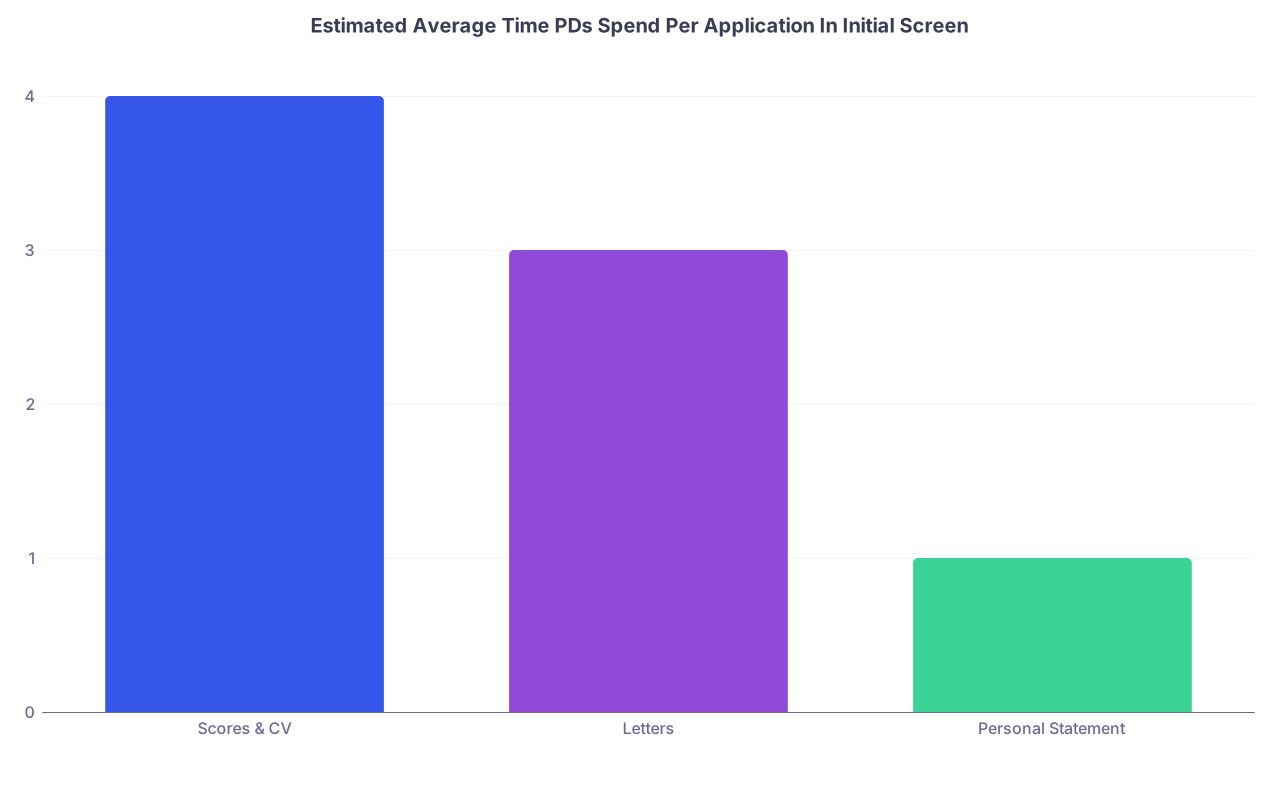
For a PD to deep read even 70 statements at 4 minutes each is nearly 5 hours. That’s just the statements. Not the letters, not the CVs, not the meeting where they argue about who to invite.
Many PDs are still clinically full-time or close to it. They’re doing this between consults, admin meetings, and family life.
So what actually happens? Skimming. Pattern recognition. Using the statement like a signal, not a sacred text.
| Category | Value |
|---|---|
| Scores & CV | 4 |
| Letters | 3 |
| Personal Statement | 1 |
One minute on your statement is generous in the first pass. Sometimes it’s ten seconds: first paragraph, last paragraph, quick scroll in the middle. That’s it.
The Biggest Myth: “You Need a Dramatic, Unique Story”
Another common lie: if your personal statement isn’t a tear-jerker or “unique,” you’re doomed.
Nonsense.
PDs are not auditioning you for a storytelling competition. They’re trying to decide whether they want to work with you for 1–3 years at 2 a.m. on call.
Most residents are normal humans with fairly standard trajectories. Good. You don’t need a rare disease childhood story or a life-changing moment in an ICU in a remote village.
What they want instead:
- Clear, believable reasons you like the field
- Evidence that you’ve actually spent time in it (electives, research, QI, teaching)
- A sense of where you think you’re headed (even if that changes later)
You know what stands out? Clarity. Alignment. Sanity.
A focused, adult-sounding paragraph about why you like advanced heart failure and longitudinal relationships is more compelling than some overwrought story about “the first time I heard a holosystolic murmur, my life changed.”
Where Applicants Systematically Over- and Under-Invest
Here’s where residents get this completely backward.
They:
- Spend 30+ hours obsessing over tiny word choices in the statement
- And 3 hours total thinking about who their letter writers are and what those letters will actually say
Bad trade.
Reality for most fellowships:
| Component | Relative Impact |
|---|---|
| Letters of Recommendation | Very High |
| Research/Scholarly Work | High |
| Residency Program/Performance | High |
| Personal Statement | Moderate–Low |
| Hobbies/Interests Section | Very Low |
What this means in practice:
- You should make your statement solid, coherent, and free of landmines.
- But you should spend far more political capital and time on:
- Strong, specific letters from people who actually know you
- Getting your PD letter to say something real, not just generic
- Having your research and experiences clearly documented and framed
Polish the statement to the level of “no one can reasonably object to this, and it sounds like me.” Then stop. You’re better off adding a figure to your abstract or asking your letter writer if they need your updated CV.
So What Should a Fellowship Personal Statement Actually Do?
Given the reality of how PDs read (or skim), your statement has four real jobs:
Avoid disqualifying you.
No arrogance, no blaming, no weird ideology, no bizarre writing style. If your tone is off, you get quietly dropped.Align your story with your CV.
If your CV screams research, your statement should mention your curiosity, your projects, and what questions in the field interest you. If your CV screams clinical educator, underline that. Coherence wins.Signal genuine interest in the field and (optionally) program type.
Not “I love cardiology.” Everyone says that. More like:- “I’m particularly drawn to managing advanced heart failure patients and the longitudinal relationships built in transplant medicine.”
- Or: “I hope to practice as a clinician-educator in an academic safety-net hospital, balancing complex inpatient GI with teaching residents.”
Provide hooks for conversation.
A distinct project, a specific patient that changed your thinking (described concisely, not like a novel), or a concrete future goal gives faculty something to ask you about.
You’re not writing art. You’re writing functional, strategic, clean copy that does its job in under a minute of someone’s attention.
The Real “Secret”: PDs Want Reasons to Say Yes, Not Just No
Behind the cynicism, here’s the part people miss: most PDs are not trying to catch you out. They’re overwhelmed, a little tired, and looking for reasons to believe you’d be a good fit.
A sane, grounded, well-aligned personal statement helps them trust that:
- You understand what you’re signing up for
- You’ve thought about your path
- You won’t be a drama generator on service
Years from now, you won’t remember the exact adjectives you picked for your fellowship personal statement. You’ll remember whether you built a coherent story with your CV, letters, and experiences—and whether you treated the statement as a tool, not a masterpiece.


