

The Truth About ‘You Must Publish in Fellowship-Specific Journals’
Does your shot at cardiology die because your heart failure paper ended up in a general medicine journal instead of Circulation or JACC?
Short answer: no. And if someone told you otherwise, they’re either misinformed, oversimplifying, or trying to sound more “academic” than they actually are.
Let me be very direct. The idea that you “must publish in fellowship-specific journals” to match a competitive fellowship is one of the more persistent, anxiety-inducing myths floating around residency workrooms and Reddit threads. It’s convenient. It gives people a simple rule to cling to in a messy process.
It’s also wrong. At least in the absolute, black‑and‑white way it’s usually repeated.
You are not building a shrine to The Journal Name. You are building a story: I’m serious about this field, I can think, I can finish work I start, and I won’t collapse the first time a project hits a wall.
Let’s pull this apart.
What Program Directors Actually Look At (Not What Residents Gossip About)
When fellowship program directors review your application, they are not counting “how many times did this person publish in my subspecialty journal?” like some deranged impact-factor accountant.
They’re trying to answer a few basic questions:
- Do you genuinely care about this field, or are you just scrambling for a backup plan?
- Can you see a project through from idea to completion?
- Are you intellectually curious, or just a checkbox hunter?
- Will you contribute something — clinically, academically, or educationally — to this fellowship?
Publications are just one signal. Not the only one, not the most important one in every specialty, and definitely not defined purely by journal title.
We actually have data on this, not just hallway speculation.
The NRMP “Program Director Survey” — for multiple specialties and subspecialties — consistently shows the same pattern:
- Research productivity (abstracts, presentations, publications) matters.
- Where you published is rarely listed as a top decision factor.
- The number of scholarly products, plus letters and residency reputation, rank much higher than journal prestige.
Do some big-name, top-5 programs care more about journal caliber and subspecialty fit? Yes. Especially research-heavy ones. But that’s not the same as “you must publish in fellowship-specific journals or you’re dead.”
The Myth: Only Fellowship-Specific Journals Count
The myth usually sounds like this:
“If you want GI, you need at least one paper in a GI journal. Otherwise programs will think you’re not serious.”
Or:
“Cards PDs only care if you’ve been in Circulation or JACC. The rest might as well be blog posts.”
This is where I roll my eyes.
Let’s be precise. There are three separate claims buried in that myth:
- You must publish.
- You must publish in that fellowship’s topic area.
- You must publish in that fellowship’s specialty-branded journals.
Claim #1 is… mostly true for competitive fellowships (cards, GI, heme/onc, PCCM) at strong academic centers. Little less true for community-based or more clinically focused fellowships.
Claim #2 is directionally correct: having work related to the field helps a lot, especially for select specialties.
Claim #3 — “must be in that field’s journals” — is where the nonsense lives.
A high‑quality general medicine paper on heart failure outcomes often impresses cardiology PDs more than a flimsy case report shoved into a low-tier cardiology journal they’ve never heard of. They are not idiots. They read your CV.
What Actually Matters About Your Research
Stop fixating on the journal before you even have a project. That’s like arguing over which Michelin restaurant will serve your dish before you’ve learned how to cook an egg.
The hierarchy that actually matters:
Rigor and completion
Did you help design a real project? Contribute intellectually? Stick with it? See it published or at least accepted as an abstract or manuscript? Fellowship directors want finisher energy, not “had an idea once on rounds.”Relevance of the topic to your field
Not “did this land in Subspecialty Journal X,” but: does your work live in the same world as the fellowship?
Cardiology: HF outcomes, arrhythmia management, CV imaging, prevention.
GI: IBD, liver disease, GI bleeding, endoscopy quality.
PCCM: ICU outcomes, sepsis management, ventilator strategies.
That kind of thing.Your role and depth
First-author or major contributor in a small journal > 8th author on a mega‑study you barely touched. PDs know how authorship games work. They will ask you what you did.Trajectory and consistency
A resident who did no research for two years, then panics with one rushed “specialty journal” case report looks worse than someone with a clean trail of serious work, even if some of that work is in general internal medicine or QI journals.
Here’s the ugly secret: a lot of residents burn months trying to “target” specialty-branded journals and never finish anything. That hurts them more than a solid, publishable project in a general or cross-specialty journal would have.
Where Journal Choice Does Start to Matter
Now let’s not swing into the other extreme and pretend journal doesn’t matter at all. It does — just not in the caricatured way people like to repeat.
Journal characteristics that actually influence how your application is perceived:
Is it legit or predatory?
If the journal screams “submit your manuscript in 48 hours for a low fee” and emails your spam folder weekly, that does not help you. PDs know these. Some will hold it against you. A small, niche but legitimate journal from a known society? Totally fine.Is the audience remotely relevant?
A heme/onc applicant with a first-author paper in a decent general oncology or internal medicine journal will look absolutely fine. A PSUEDO-oncology paper in a random engineering journal because someone wanted to check a box? Looks weird.Does the journal match the type of work?
QI and education work often belongs in QI/education-focused journals. That’s not “lesser.” That’s the right venue. Feeling ashamed that your handoff-improvement project got into Journal of Graduate Medical Education rather than a subspecialty clinical journal is just misunderstanding how academic niches work.
For research-track or T32-type fellowship spots, the highest-level programs may indeed weigh journal impact and specialty prestige more. They want candidates already on a research trajectory. But those same places are also smart enough to recognize strong work in Annals, BMJ Open, or Chest even if it’s not stamped with their subspecialty logo.
How Program Directors Actually Read Your CV
They don’t scan for the word “cardiology” in the journal header. They skim for patterns.
Here’s what they look for when they scroll your pubs list:
- Do I see a concentration in this field or related domains?
- Are there first-author or substantive roles?
- Are there abstracts/posters at relevant national meetings? (AHA, ACC, ACG, ASH, ATS, SCCM, etc.)
- Does the work match what this applicant claims to care about in their personal statement and interviews?
- Does their letter writer from that field mention their research in any detail?
Most PDs care as much about presentations and abstracts at specialty meetings as they do about which journal finally took the paper. If you presented a solid poster at AHA or Digestive Disease Week, they know you’re at least orbiting the right world.
This is why the “journal name worship” is such a distraction. Specialty societies themselves run the conferences, the mentorship programs, and sometimes the fellowships. They care about you being present, engaged, and contributing — not only whether Journal of X appears three lines down on your CV.
Data: Specialty vs General Journals for Fellowship
Let’s take a hypothetical but realistic three-application snapshot for, say, a pulmonary/critical care fellowship:
| Applicant | Pulm/CCM-related work | Journal Types | First-Author Pieces |
|---|---|---|---|
| A | 3 projects | 1 general IM, 1 CCM, 1 QI journal | 2 |
| B | 1 project | 1 small PCCM case report journal | 1 |
| C | 4 projects | 3 general IM, 1 ICU outcomes in a non-CCM journal | 3 |
Applicant B is the only one with something in a “pure” pulm/CCM journal. They’re not automatically the best candidate.
Applicant C, with four serious projects, mostly in general/internal medicine journals but clearly ICU-focused topics, will usually be more attractive to academic PCCM programs than B, whose sole “field” paper is a low-yield case report in a no-name subspecialty outlet.
Topic and depth beat label.
To make this even clearer:
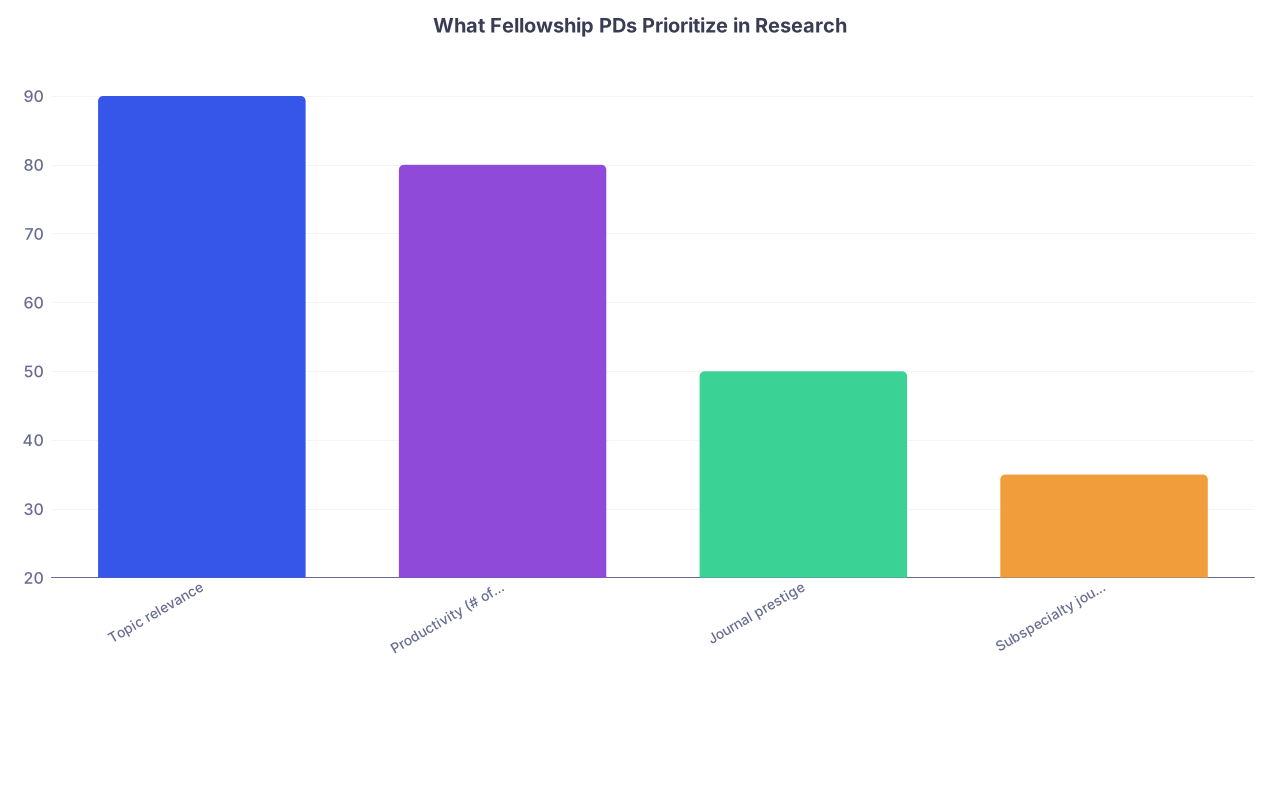
| Category | Value |
|---|---|
| Topic relevance | 90 |
| Productivity (# of works) | 80 |
| Journal prestige | 50 |
| Subspecialty journal label | 35 |
No, those numbers aren’t pulled from one magical study — they’re a realistic representation of what multiple surveys, PD comments at conferences, and match outcomes actually reflect: relevance and productivity dominate.
The Real Strategy: Build a Coherent Academic Story
If you want fellowship, stop chasing one magic “fellowship-branded” journal paper and start building a story that makes sense.
That story should sound like this:
“By PGY‑3, I’d worked on three projects related to heart failure and coronary disease: a QI project reducing 30‑day readmissions, a retrospective review on adherence to guideline-directed therapy, and a case series on cardiogenic shock. I presented posters at our regional ACC chapter and SGIM, and one paper’s in a general IM journal, another under review at a cardiology journal.”
Any reasonable cardiology PD will think: this person is serious, engaged, and productive. Whether the second paper lands in Heart, American Heart Journal, or some modest general IM journal will not make or break your application.
Here’s a more productive mental model:
- Specialty-branded journals are nice-to-have, not must-have.
- Specialty-related topics are close to must-have for competitive fields.
- Consistency and completion are non-negotiable.
When A Fellowship-Specific Journal Might Actually Be Worth Targeting
There are a few scenarios where pushing for that subspecialty outlet makes sense:
You’re at a strong academic residency with access to subspecialty mentors and statisticians.
You’re aiming at top-tier academic fellowships with a research track.
You have a real, reasonably powered study or high-impact review that your mentor believes is competitive for a specialty journal.
You’re willing to accept the risk of rejection and time delay without imploding if it bounces down the ladder.
That’s a very specific subset of residents. If your daily life is 60% cross-cover, 30% notes, 10% desperately trying to not drown, then pinning your hopes on The Perfect Fellowship Journal is fantasy. You’re better off completing a realistic project and getting it into a solid, reachable journal — even if it’s general.
Common Bad Advice You Should Ignore
You will hear variations of this bad advice repeatedly:
“Don’t waste time on QI, it doesn’t count for fellowship.”
False. QI and education work absolutely count as scholarly activity. They often fit nicely in general or education journals and can be highly relevant (e.g., ICU delirium pathways, chemo safety protocols, IBD care standardization).
“Case reports only count if they’re in a subspecialty journal.”
False. Case reports are minor currency no matter where they land. They’re fine as early steps or if they truly illustrate something educational, but nobody’s picking a fellow on the basis of three case reports in a specialty journal.
“If this paper doesn’t get into a major specialty journal, it’s not worth doing.”
Catastrophically false. That mindset is how residents end up with half-finished projects and empty CVs.
“PDs don’t respect general medicine journals.”
Some residents really believe this. It’s absurd. Many of the most practice-changing, methodologically solid studies are in big general journals. PDs know that.
Where to Put Your Energy (If You Actually Want to Match Well)
Here’s the part that actually matters, and you won’t hear in the workroom because it’s not sexy:
Your energy is finite in residency. Protect it. Aim for:
- 1–3 meaningful, related projects over chasing 5–7 half-baked “for the CV” attempts.
- Early connection with a mentor in your target field (or at least adjacent) who has a track record of getting residents across the finish line.
- At least one project where you’re first or second author, and you can talk about it comfortably at the whiteboard during interviews.
- Presentations at specialty or regional meetings — they’re more visible than a name buried in PubMed.
If, in the process, one of those projects lands in a fellowship-specific journal? Great. Frame it as part of your broader story. Not as your golden ticket.
To tie it back to data and outcomes, look at who actually matches into competitive fellowships from mid-tier residencies. I’ve reviewed dozens of these CVs. Here’s the pattern:
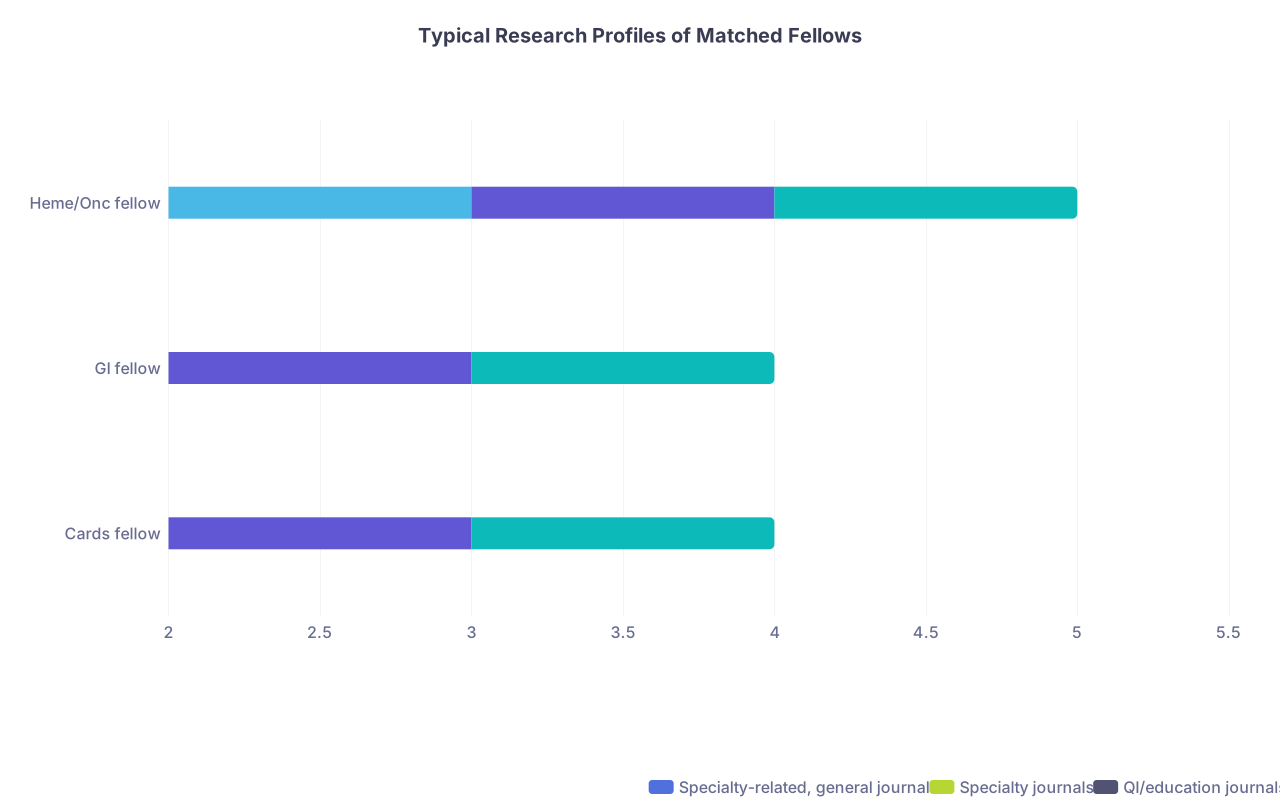
| Category | Specialty-related, general journals | Specialty journals | QI/education journals |
|---|---|---|---|
| Cards fellow | 2 | 1 | 1 |
| GI fellow | 2 | 1 | 1 |
| Heme/Onc fellow | 3 | 1 | 1 |
They’re not stacked with nothing but subspecialty journal logos. They have a mix. The throughline is topic relevance and productivity — not journal branding.
So What Should You Actually Do?
Compress this into something actionable:
If you’re a PGY‑1 or early PGY‑2:
- Find a mentor in or near your desired field. Not “the fanciest name.” Someone who finishes projects.
- Join an existing, realistic project with a clear plan. Don’t obsess about the future journal yet.
- Absorb how projects move: IRB, data collection, drafting, revision, submission, rejection, resubmission.
If you’re PGY‑2 heading into application season in a year:
- Focus on finishing what you’ve already started. Get abstracts out. Submit the manuscript.
- If you have bandwidth, pick one more tightly related project to your target fellowship area.
- If your attending wants to shoot for a high-tier specialty journal and is willing to do the heavy lifting on resubmissions, fine. But insist on timelines and backup options.
If you’re late PGY‑3:
- Stop chasing journal fantasy. Get things submitted somewhere reasonable. Accepted > “perfect but imaginary.”
- Make sure your letter writers actually mention your research involvement. That’s often more powerful than the journal name.
Key Takeaways
- You do not “need” fellowship-specific journals on your CV to match; you need field-related, completed work and a coherent academic story.
- Topic relevance, productivity, and your actual role in projects matter more than whether the journal header matches the fellowship name.
- Obsessing over specialty journal labels is how residents end up with unfinished work and weak applications; finishing solid projects in reasonable journals beats that every time.


