

The obsession with “big name” mentors for competitive fellowships is badly overblown. Not useless. But wildly misunderstood.
I’ve watched residents contort their entire training around chasing one famous PI or division chief, only to end up with weak letters, minimal facetime, and a mediocre application. Meanwhile, their colleague working with a no-name but invested junior faculty quietly racks up papers, strong letters, and top-tier matches.
If you want to stop playing the prestige lottery and start playing the numbers game you can actually influence, you need to separate mythology from data.
Let’s do that.
The Myth: Only Big Names Get You Big Fellowships
You’ve probably heard some version of this in the workroom:
- “If you want heme/onc at a top place, you have to work with Dr. X.”
- “Cards won’t look at you unless you have a letter from the division chief.”
- “Nobody cares about your research unless your PI is on every guideline panel.”
This is how residents talk when they have no clue how selection actually works.
Fellowship selection in competitive fields (cards, GI, heme/onc, pulm/crit, rheum) is driven by several buckets:
- Clinical performance and program reputation
- Research productivity and relevance
- Letters of recommendation (LORs) – quality and specificity
- Fit with the fellowship’s research/clinical interests
- Interview performance and interpersonal reputation
The “big name” mentor idea lives in just one of those buckets: LORs and, sometimes, networking.
And here’s what faculty actually say behind closed doors during ranking meetings:
- “This letter is from a famous person, but it’s generic. Pass.”
- “I do not know this mentor, but this letter is insanely detailed and strong.”
- “This applicant clearly did the actual work on these projects.”
- “This person has three middle-author papers with a huge name but nothing first-author. What did they actually do?”
The prestige of the letter writer is a multiplier, not the base value. If the underlying signal (your work, your relationship, your performance) is weak, there is nothing to multiply.
What the Data and Real Outcomes Actually Show
No one is running randomized controlled trials on “famous vs non-famous mentors,” but we do have three types of evidence:
- Match outcome patterns from large programs
- Who actually gets interviewed and ranked highly
- What fellowship PDs and selection committees publicly and privately say
1. Patterns from big internal medicine programs
Look at any large academic IM residency that regularly sends people to GI, Cards, Heme/Onc, PCCM. Every year, you’ll find:
- Residents with big-name mentors who match well
- Residents with big-name mentors who match poorly
- Residents with non-famous mentors who still land at top-10 fellowships
I’ve sat in those post-match debriefs. The consistent pattern is not “big name = match” but:
- Sustained, visible work with someone who advocates for you
- Evidence that you actually drove a scholarly project or niche
- Letters that sound like: “I would put them in the top 1–2 residents I have worked with in 10 years.”
The supposed magical effect of big names is very inconsistent. The effect of strong mentorship and objective productivity is not.
2. Who actually gets interviews
Programs do soft screening on:
- Institution
- Publication list
- LOR snippets in the ERAS application
- Sometimes Step/ITE trends
Nobody runs a SQL query that says: WHERE mentor_name IN ('[Famous Cardiologist]', '[Famous GI Doc]').
More realistically, it’s: “Multiple first-author papers in [subspecialty]? Interesting.” Or, “Strong heme/onc research narrative and letters? Invite.”
Here’s a simplified version of what actually moves the needle, based on what selection people habitually flag:
| Factor | Impact Level | Comment |
|---|---|---|
| First-author subspecialty pubs | High | Especially original research or strong reviews |
| Strong, specific LORs | High | Content > name; details about your work |
| Consistent subspecialty focus | High | Story hangs together |
| Mentor reputation | Medium | Helps if other pieces are already strong |
| Program prestige | Medium | Opens doors, not guarantees |
| Random case reports only | Low | Barely moves needle for competitive fields |
Notice “mentor reputation” isn’t at the top. It’s a tiebreaker and a credibility boost, not the main course.
3. What PDs actually care about
Many fellowship PDs — especially at serious academic programs — will tell you something like:
“I would rather read a detailed letter from a mid-career associate professor who clearly knows the applicant well, than a vague letter from a ‘name’ who obviously barely interacted with them.”
And they mean it. They’re burned every year by residents who did the “work with the big famous person” thing but:
- Showed up twice a month
- Were one of eight residents on a bloated project team
- Contributed minimally and got a perfunctory letter
Let me underline this: a generic letter from a giant in the field is worse than a detailed letter from a mid-tier person who can tell a compelling story about you.
Where “Big Names” Actually Help (And Where They Don’t)
Let’s be fair. Prestige is not worthless. It’s just badly misused by residents.
Genuine upsides of a big-name mentor
A truly famous, well-connected mentor can help you in three specific ways:
Signal of quality – when paired with real work
If Dr. Huge Name writes, “This is one of the best residents I’ve ever had,” people pay attention. Because they know this person has a big sample size and a high bar.
Keyword: “when paired with real work.” They need to believe the letter.Network and advocacy
Big names often know fellowship PDs personally. They can email, call, or casually say at a meeting, “You should look closely at this applicant.” That bumps your app from the maybe pile to the interview pile.
No, this does not rescue a weak application, but it can help strong ones.Access to larger projects and higher-impact journals
Established PIs have grants, infrastructure, statisticians, and large datasets. If you are actually integrated into that machine, you can produce strong CV lines.
Now the part people ignore.
The hidden downsides of chasing famous mentors
Residents underestimate how often the “famous mentor” arrangement backfires:
- You are one of 15 trainees orbiting the same person. Little individual facetime.
- Your “project” is one figure in a massive paper that may not submit for 2–3 years.
- The PI is traveling constantly. You’re actually supervised by a postdoc or senior fellow who can’t write you a fellowship-level letter.
- The letter ends up sounding like: “They participated in research in my lab and were reliable.” Death sentence.
Meanwhile, your classmate on a practical, tightly scoped project with a mid-level mentor finishes:
- A first-author abstract at a national meeting
- A first-author paper in a decent subspecialty journal
- A detailed letter describing initiative, independence, and concrete contributions
Guess who reads stronger on paper?
What Matters More Than Mentor Fame: The Anatomy of a High-Impact Mentorship
1. Access and facetime
You want a mentor who:
- Knows your name without looking at your email
- Has seen you think through problems and handle setbacks
- Has met you enough times to speak to your growth
This is why mid-career and even junior faculty often end up being better mentors. They have time. They’re hungry. They remember what it’s like to be in your shoes.
2. Real ownership of work
Fellowship committees can smell fluff. Three middle-author papers spread over random topics doesn’t impress much. One solid first-author project in the target subspecialty? Much stronger.
Ask yourself simple questions:
- Will I be first or second author on anything here?
- Is the timeline realistic for submission before applications?
- Do I actually understand the question, the methods, and the stats?
If not, that name on your CV is just decoration.
3. Letters that actually say something
A high-impact letter has:
- Specific stories: “They took over a failing project and designed a new analysis plan.”
- Strong comparative language: “Top 5% of residents I’ve mentored in 15 years.”
- Evidence of trust: running a clinic, leading conferences, driving manuscripts.
This letter can come from a big name, a mid-tier researcher, or even (for one letter) a superb clinician-educator who has worked with you closely. What matters is signal density, not title.
A Useful Way to Think About Mentor Choice
Stop asking “Is this person famous enough?” and start asking three harder questions:
- Can this person give me meaningful, usable work in my target subspecialty on a realistic timeline?
- Will this person spend actual time with me and advocate for me when it counts?
- Does this person’s reputation in their circle align with where I want to go?
That last point is sneaky. You don’t need a world-famous cardiologist if you’re aiming at a solid regional cards fellowship. But you do want someone the cardiology PDs vaguely know as “sharp and fair.”
Here’s a rough comparison that matches reality more than resident gossip:
| Feature | Big-Name Mentor | Mid-Level / Junior Mentor |
|---|---|---|
| One-on-one time | Often limited | Often plentiful |
| Project scope | Large, slow-moving | Focused, faster |
| Chance of name-recognition | High | Low to medium |
| LOR specificity | Variable | Often high |
| Competition with other trainees | High | Lower |
| Networking leverage | Strong if they engage | Moderate but real |
Notice how many advantages actually lean toward the non-famous person when you care about you rather than their CV.
How to Use a Big Name Strategically (If You Have One)
I’m not saying avoid famous people. I’m saying stop worshipping them.
If you happen to land with a big-name mentor, here’s how to avoid the common traps:
Get a clear, bounded project
Don’t just join “the lab.” Get a defined question, dataset, and endpoint that could plausibly become a poster and paper before ERAS submission.Secure facetime early
Regular check-ins, not just email. If direct facetime with the big name is impossible, make sure someone with their ear (co-PI, senior collaborator) knows you well enough to vouch for you.Pair with a “workhorse” co-mentor
Often the real day-to-day mentor is an associate professor, junior attending, or senior fellow who makes the project move. Treat them as your primary mentor for LOR content, even if the famous person signs it.Make sure your output is visible and attributable
Be the person presenting the abstract. Be the person giving the division talk. Make it hard for that mentor to not write a personalized letter.
How to Win Without a Big Name At All
Let’s flip it. Say you’re at a mid-tier or community-based program with zero “household names” in your subspecialty of interest. Are you screwed for competitive fellowships?
No. You’re just not allowed to be lazy.
Here’s the playbook I’ve seen work repeatedly:
Find the most research-engaged person in your subspecialty locally
Not the nicest. Not the most senior. The one who publishes anything and has projects moving. Attach yourself.Aim for 1–2 solid, complete projects, not 7 half-baked ones
Abstract → conference → manuscript. That closed loop looks very good in applications, even from a modest program.Leverage external collaborators smartly
This is where you can create some prestige if you want it. Multi-center projects, registry work, or remote collaborations can bring in bigger names later — after you’ve shown you can produce.Get fierce, specific letters
Make it easy for your mentor to write a killer letter: send them your CV, a bullet list of your concrete contributions, and your personal statement. The more detail they include, the less anyone cares that they’re not a superstar.Target the right programs
Some top fellowships genuinely prefer heavily research-branded pedigree. Many excellent academic programs care far more about evidence that you can do the work and not implode as a fellow.
Here’s the uncomfortable reality: many residents at name-brand programs waste their built-in advantage by being passive with big-name mentors. A hungry resident at a smaller place with a sharp mid-level mentor often outperforms them on paper.
Visual Reality Check
To drive home the point, imagine you’re a PD scanning two anonymized profiles:
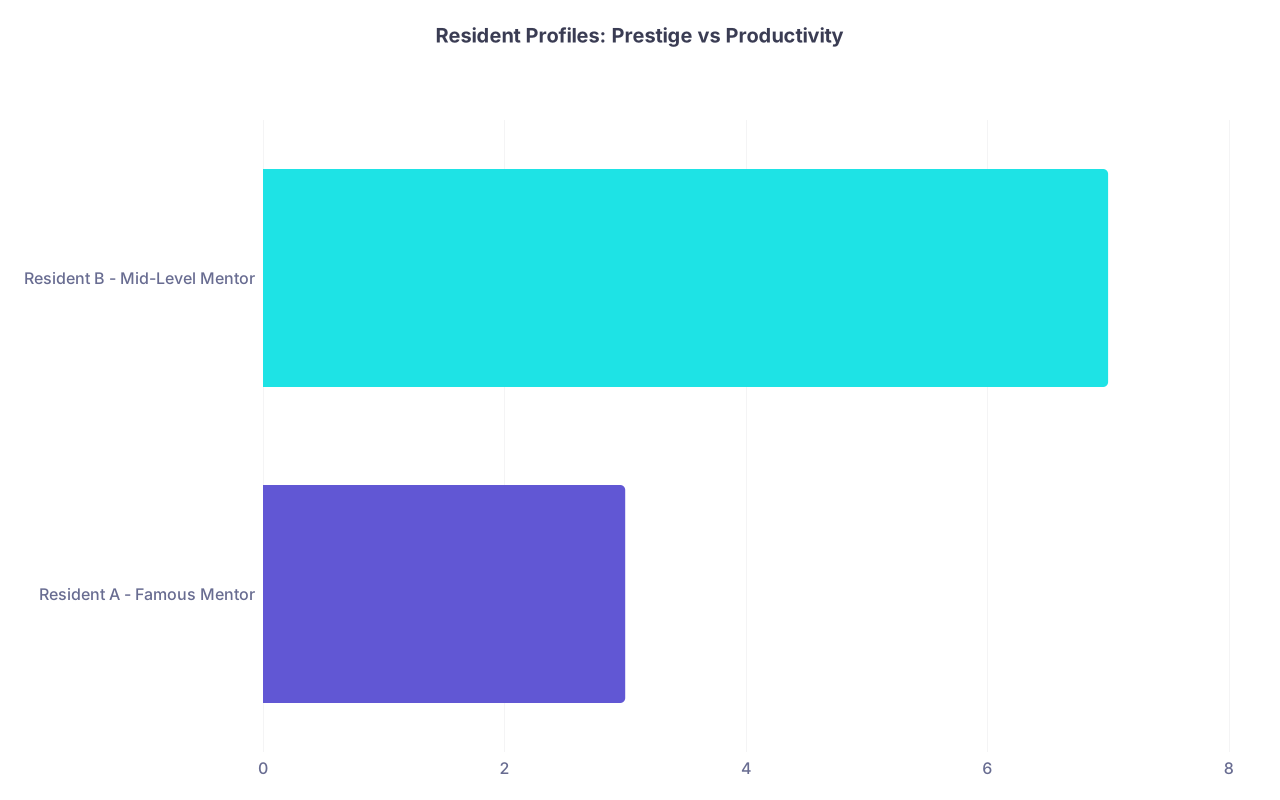
| Category | Value |
|---|---|
| Resident A - Famous Mentor | 3 |
| Resident B - Mid-Level Mentor | 7 |
Resident A:
- Famous mentor, 3 total outputs (2 middle-author abstracts, 1 poster), generic letter.
Resident B:
- Unknown mentor, 7 total outputs (2 first-author abstracts, 1 first-author paper, 2 posters, division talk, glowing detailed letter).
If you think committees are automatically picking A because their mentor name is recognizable, you’re giving prestige way too much credit.
I’ve watched those ranking meetings. B often wins.
The Bottom Line
You do not need a big-name mentor to match into a competitive fellowship. It can help, but only under specific conditions.
The real levers you control:
- Choose mentors who give you time, ownership, and advocacy, not just prestige.
- Optimize for first-author, completed work and detailed, specific letters over name-recognition.
- Use big names strategically, not worshipfully — and never as a substitute for doing real, visible work.
If you focus on those three, the name on your mentor’s office door becomes a nice bonus, not a prerequisite.


