

The idea that a gap between residency and fellowship is a dealbreaker is wrong. Not “sometimes wrong.” Just wrong.
What actually kills fellowship applications is not the gap itself. It is an unexplained gap, a wasted gap, or a gap that exposes deeper performance or professionalism problems. Those are very different things.
Let’s walk through what program directors actually do with that “gap year” line on your CV—and when you should worry, and when you really should not.
What the data actually shows about gap years
There is no NRMP headline that says “Applicants with gap years are doomed.” Because that is not what the data shows.
Most of our best information comes from three places: NRMP Program Director Surveys, specialty-specific fellowship selection data, and published studies on career interruptions in medicine.
Here’s the pattern that keeps showing up:
- Program directors care most about: performance metrics (board scores, in-training exams, evaluations), letters of recommendation, and evidence you can handle the work.
- “Non-traditional” paths—extra years, research time, switching specialties—are common enough that they’re not automatically red flags.
- Gaps are scrutinized. But not uniformly penalized. Context matters. A lot.
The 2024 NRMP Program Director Survey for fellowships is very consistent with prior years: directors are significantly more likely to rank applicants down or not rank them at all for professionalism issues, unexplained time off, and weak letters—not for “nonlinear” timelines by themselves.
When you actually talk to PDs (the stuff that doesn’t make it into glossy PDFs), you hear versions of:
- “If they took a year for research and got a couple of pubs? That can be a plus.”
- “If they took time off and can’t tell me clearly what they did or why? That’s concerning.”
- “I’ve ranked applicants 3+ years out from residency. Some of them are excellent.”
So no, a gap is not an automatic dealbreaker. But it is a spotlight. It makes people look closer. What they see under that light is what makes or breaks you.
Types of “gaps” and how they really play with programs
Lumping every gap into one category is lazy. A one-year research fellowship after IM is not the same as two years of being “between things” with no clear narrative.
Let’s break it out.
| Scenario Type | Default PD Reaction |
|---|---|
| Structured research year | Often positive/neutral |
| Chief year | Usually positive |
| Hospitalist / clinical | Neutral to positive |
| Visa / logistical delay | Neutral if explained |
| Family/health pause | Neutral if owned clearly |
| Unexplained “time off” | Negative |
1. Research or additional training year
This is the most “socially acceptable” gap.
You finish residency, then do:
- A research year in your target field
- A non-ACGME clinical fellowship (e.g., echo, pain, hospitalist-focused training)
- A formal scholar or educator track
Program directors generally understand this. In competitive subspecialties like cardiology, GI, heme/onc, pulm/crit, this is common strategy, not strange behavior.
Here’s the nuance: a research year that produces nothing is not a “research year.” It is a red flag labeled “could not follow through.” But a research year with even modest productivity and strong letters? Often a net positive versus going straight through as an average-on-paper applicant.
2. Chief year
This isn’t even considered a “gap” by most people, but technically it is a delay between residency and fellowship.
For many IM, peds, EM, and surgery programs, chief residents applying to fellowship are seen as:
- Trusted by their home program
- Given leadership and teaching roles
- Often strong clinically (or at least organized and reliable)
There are exceptions—if your home program has a reputation for making weak residents chiefs just to keep the schedule afloat, people know—but in general, a chief year does not hurt fellowship prospects. It can help.
The only catch: if you’re a chief and still have mediocre letters, that does get noticed.
3. Pure clinical gap: hospitalist, generalist, locums
This one scares residents the most. “If I go be a hospitalist for a year or two, I’ll never match into fellowship.”
Reality: that’s not what the evidence or real-world behavior shows.
Look at cardiology, heme/onc, pulmonary/critical care, ID—there’s a steady stream of applicants each year who did 1–3 years as hospitalists or generalists before applying. Many match.
Where this becomes a problem isn’t the gap. It’s what your record looks like during that gap. Program directors will ask:
- Did your clinical references from that time show you’re reliable, thorough, teachable?
- Did you completely disconnect from your target specialty, or did you maintain some link—procedures, QI projects, case reports, teaching, conferences?
- If you worked at three different hospitals in two years, why?
A hospitalist gap plus strong, recent letters and a clear story (“I gained confidence as an attending, saved money, and confirmed I really want pulm/crit”) is fine. It may even address the “are they ready to be independent?” question better than a straight-through candidate.
Where people sink themselves is: “I was a hospitalist for two years, I didn’t really do anything related to cardiology, my references are generic, and I’m a vague interview.” That combination, not the job title, kills them.
4. Visa, military, or logistical delays
These are usually the least problematic, assuming you are upfront.
PDs have seen:
- J-1 waiver years in underserved areas
- Delays due to military obligations
- Administrative or licensing delays that pushed a start date back
- Couples trying to align locations
Nobody loves complexity, but these are common stories. As long as:
- The time is accounted for on your CV
- There are no professionalism disasters hiding in that interval
- You can explain it cleanly and briefly
…it’s usually a nonissue. Mild curiosity at worst.
5. Health, family, or burnout-related time off
This is where people get nervous. And where the myths are loudest.
“I had to step away from medicine for a year to care for a sick parent. I’m done, right?”
“I burned out, took 6 months completely off. No one will touch me.”
Not automatically. And the data backs that up.
Multiple studies on physicians with career interruptions—parental leave, health-related breaks, caregiving responsibilities—show that long-term performance is not inherently worse. What matters most is:
- Fitness to practice at the time of application (are you ready now?)
- Documentation and remediation if there was any impairment
- How you discuss it—defensive and evasive vs. grounded and honest
You don’t need to give your entire psychiatric history in an interview. You do need a clear arc: there was a problem, I addressed it, here’s how I know I’m stable and ready, here’s what I’ve done clinically since.
The worst strategy is pretending nothing happened and hoping no one notices the gap. They will.
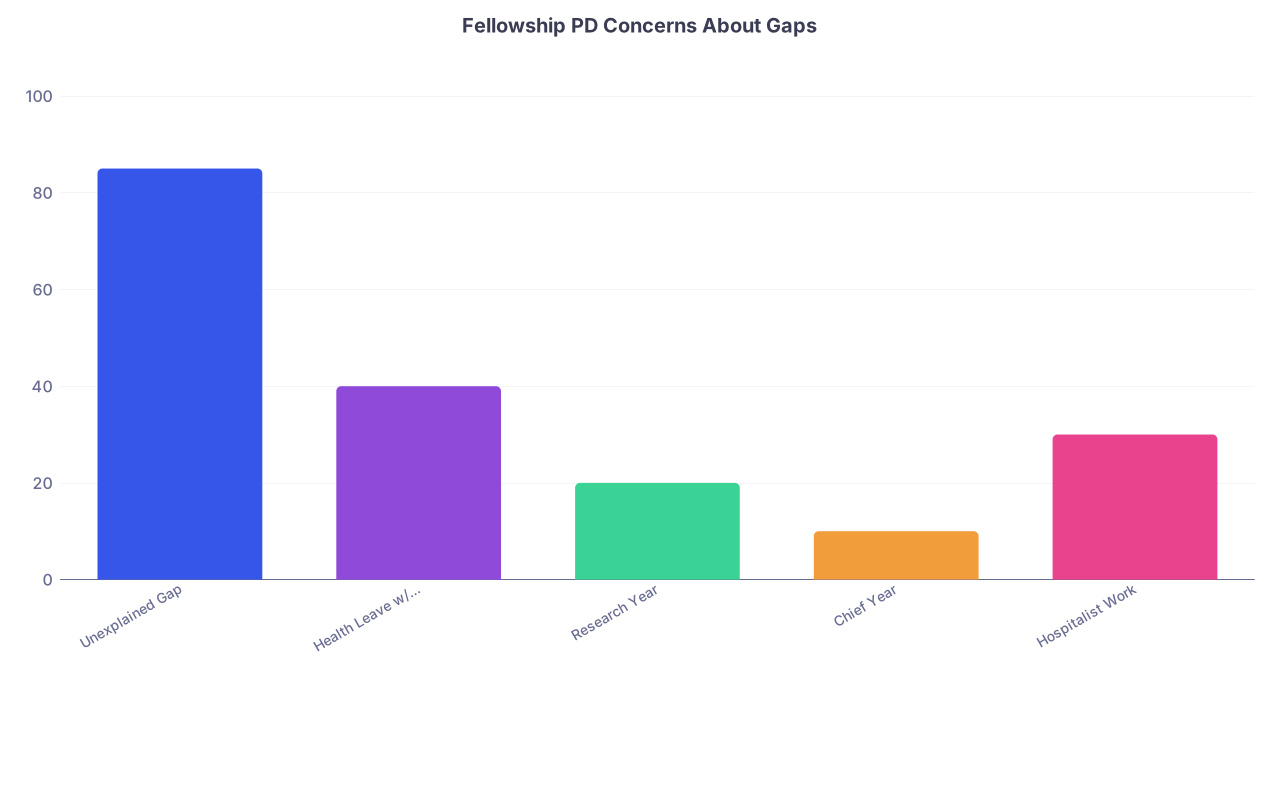
| Category | Value |
|---|---|
| Unexplained Gap | 85 |
| Health Leave w/ Clear Return | 40 |
| Research Year | 20 |
| Chief Year | 10 |
| Hospitalist Work | 30 |
(Values illustrative, but the ranking matches what you’ll hear behind closed doors.)
When a gap does become a serious problem
Let me be blunt. There are situations where a gap is not just a “talking point.” It’s a red flag that many programs will not touch.
These tend to fall into four buckets:
Professionalism or dismissal issues
- You left residency early under pressure.
- You were put on probation.
- You had serious boundary, substance, or behavior violations.
Programs are terrified of inheriting someone else’s known problem. If your “gap” is really a quiet exit from a troubled residency and there’s no clean remediation story, that can be a dealbreaker.
Skill atrophy with no remediation
- You’ve been clinically inactive for 3+ years with no structured re-entry.
- You can’t get strong, recent clinical references.
PDs worry that you’re rusty and unsafe. Without a reentry plan—observerships, supervised practice, or a structured return—this is hard to overcome.
Repeated, inconsistent paths
- Multiple short jobs.
- Unclear reasons for leaving each role.
- Tons of geographic or specialty hopping without a coherent thread.
That signals instability. Nobody wants to invest a limited fellowship slot in someone unlikely to finish.
Defensive, incoherent explanations
You cannot sell a gap year if you don’t own it. “Things happened, it was complicated, but it’s fine now” is not an answer. It’s an alarm.
So no, the gap itself isn’t the problem. What happened, how long you were detached from serious clinical work, and how you tell the story—that’s what matters.
What strong vs weak gap years actually look like
Let’s get specific. I’ve seen both sides.
A strong 1–2 year hospitalist gap before, say, cardiology fellowship usually looks like:
- Consistent work at 1–2 hospitals, not 5
- At least one fellowship-level mentor who can write, “They are ready for advanced training; I’d take them myself”
- Some tie to cardiology: involved in heart failure QI, cath lab consult exposure, echo reading, research collaboration, conference presentations
- A clear explanation in the personal statement: why you delayed, what you learned, why you’re ready now
A weak 1–2 year hospitalist gap looks like:
- Several jobs in quick succession with vague reasons (“it wasn’t a fit”)
- References that are purely generic (“hardworking, punctual”) with no insight into your higher-level thinking or consult skills
- No visible engagement with your desired specialty
- A story that centers on frustration and bitterness more than growth
Same chronological “gap.” Very different risk signals.
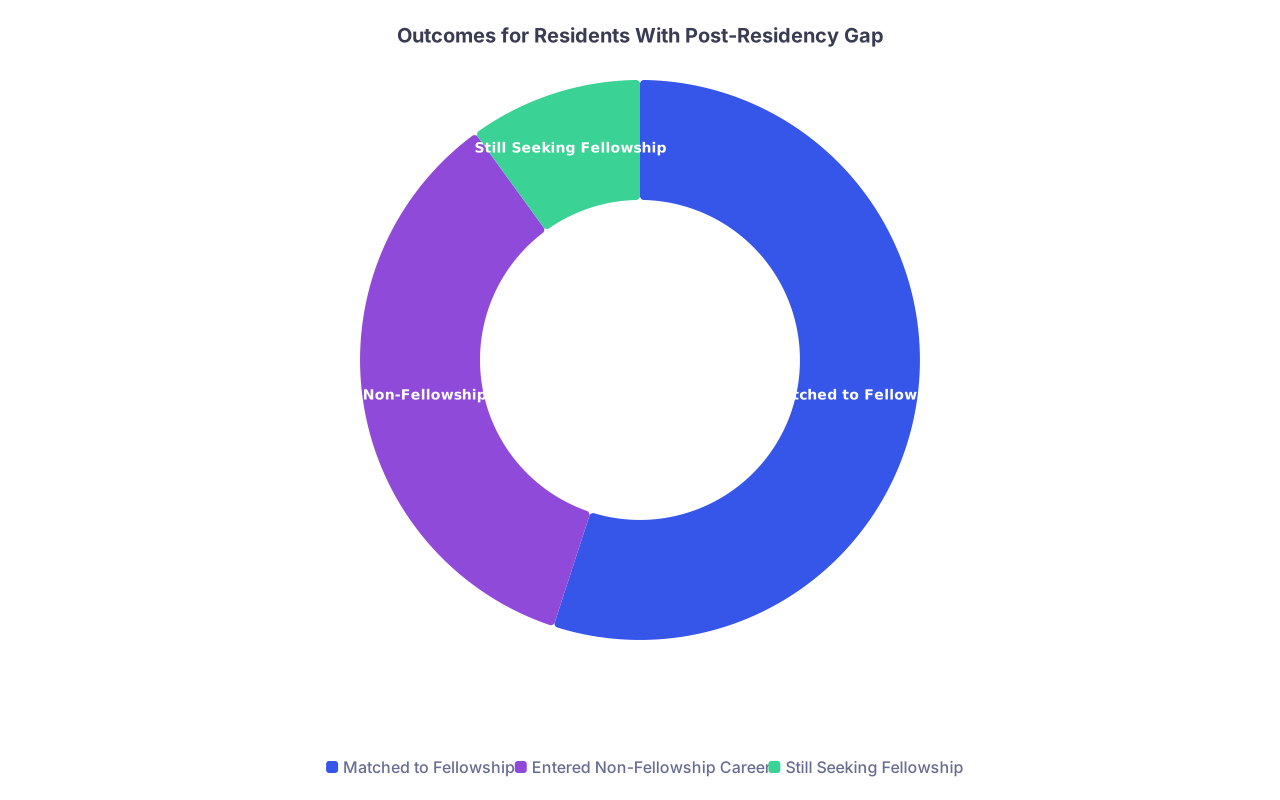
| Category | Value |
|---|---|
| Matched to Fellowship | 55 |
| Entered Non-Fellowship Career | 35 |
| Still Seeking Fellowship | 10 |
Again, numbers here are illustrative but directionally accurate for many IM subspecialties I’ve watched: a substantial fraction of “gap” applicants do match.
Specialty differences: some are pickier than others
Not all fellowships view gaps the same way. The more competitive and “straight-through” a specialty’s culture, the more explanation you’ll need.
At a high level:
| Fellowship Type | General Attitude to Gaps |
|---|---|
| IM subspecialties (cards, GI, heme/onc) | Gap neutral if productive |
| Pulm/crit, nephro, ID | Often gap-friendly |
| EM fellowships | Common to work first |
| Surgical subspecialties | Prefer linear paths |
| Anesthesia/CCM, pain | Mixed, program-specific |
Surgical fellowships in particular tend to prefer continuity: straight from residency, possibly with a research year built in. Three years out in community practice with minimal OR time? That’s much harder to sell than two years as a hospitalist before cards.
But even there, the “never” language is overblown. There are vascular and trauma fellows who spent time as general surgeons first. They just tend to come in with superb letters and a clear arc.
How to frame your gap so it helps instead of hurts
You can’t change the past. You can absolutely control the story.
Three things programs are trying to answer about your gap:
- Are you clinically competent today?
- Are you reliable and stable, or a future problem?
- Does this path make sense, or are you flailing?
So your application and interview need to hammer those pillars.
A useful framework for how you talk about it:
Own the decision
“I chose to work as a hospitalist for two years after residency because…”
Not “I kind of ended up doing this because of circumstances.”Name the benefits concretely
- “I managed complex decompensated heart failure independently.”
- “I led QI projects that cut sepsis time-to-antibiotic by 20%.”
- “I got comfortable making overnight decisions without backup.”
Show maintained or improved connection to your target field
- “I attended weekly cards conference and collaborated on a case series.”
- “I became the go-to person for managing arrhythmias on the floor.”
Close the loop
“That experience clarified that I want to focus on X, and I’m applying now because I have the clinical confidence and specific goals to benefit fully from fellowship.”
If your gap was for health or family reasons, the same skeleton applies, just adapted:
- “I stepped away from training due to X. During that time I did Y to address it. For the last Z months/years, I’ve been back to full clinical practice without limitations, as reflected in my current letters. Now I’m ready to pursue fellowship with a level of resilience I did not have before.”
Short. Clear. Adult.

| Step | Description |
|---|---|
| Step 1 | Residency Graduation |
| Step 2 | Apply Directly |
| Step 3 | Define Gap Purpose |
| Step 4 | Neutral or Positive Impact |
| Step 5 | Red Flag Risk |
| Step 6 | Strong Letters and Narrative |
| Step 7 | Address Skills and Story |
| Step 8 | Competitive Applicant |
| Step 9 | Gap Before Fellowship? |
| Step 10 | Productive and Explained? |
What you should worry about—and what you should stop obsessing over
You should absolutely worry if:
- You’re clinically rusty and doing nothing structured to fix that.
- You have serious professionalism events without a remediation story.
- You’re planning to “hide” the real reason for a long gap and hope nobody asks.
You should stop obsessing over:
- “They’ll see the year on my CV and auto-reject me.” No, they will ask what you did.
- “Everyone else is straight-through, I’ll look strange.” Many programs like having a mix of backgrounds.
- “One extra year means they’ll think I’m less committed.” Commitment is shown by what you did in the gap, not by blindly grinding forward.
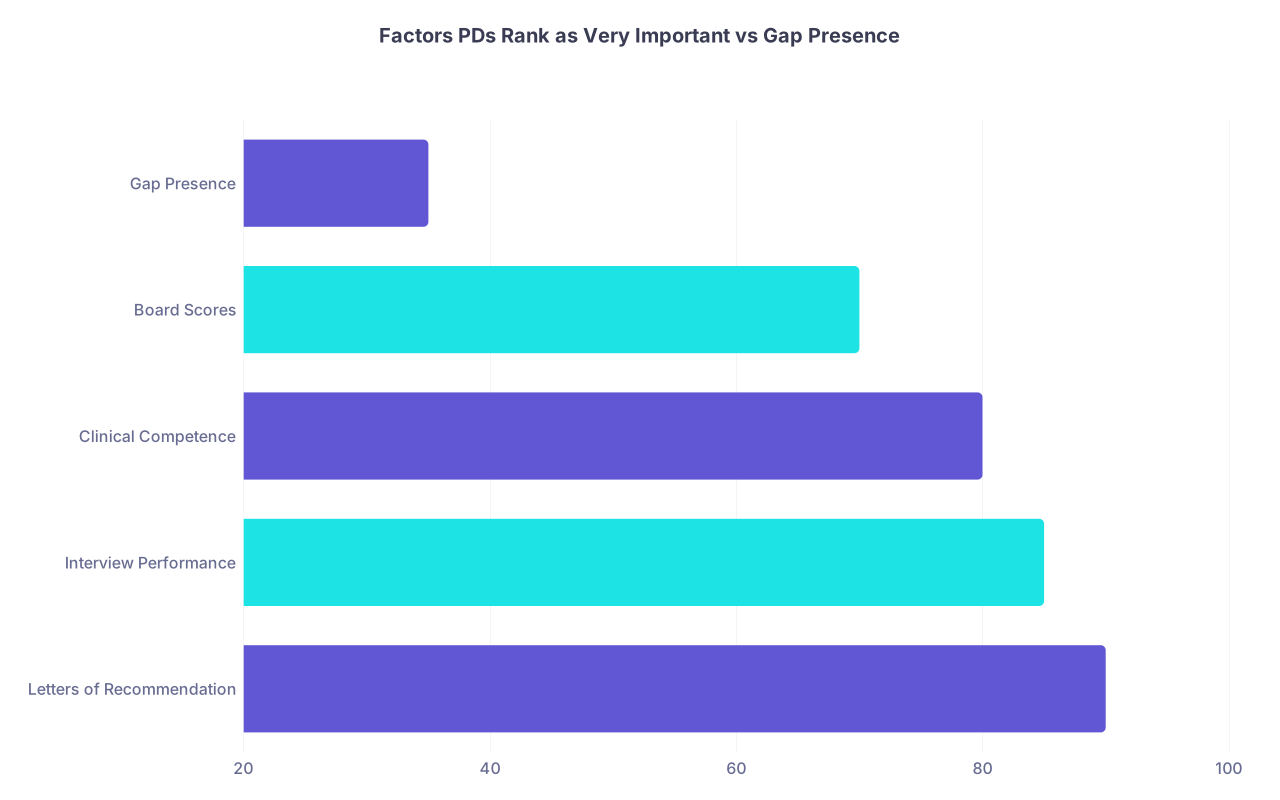
| Category | Value |
|---|---|
| Letters of Recommendation | 90 |
| Interview Performance | 85 |
| Clinical Competence | 80 |
| Board Scores | 70 |
| Gap Presence | 35 |
Gap presence is not at the top of the list. How you fill that time affects the other things at the top of the list.
The bottom line
A gap between residency and fellowship is not a dealbreaker. It is an x-ray.
For some applicants, that x-ray shows a thoughtful, maturing physician who used time to sharpen skills, clarify goals, and bring real-world experience into advanced training. Programs love those people.
For others, the x-ray shows avoidance, drift, or unresolved problems. Programs will pass, and they should.
The gap itself is not your enemy. The story it tells—and the evidence you give programs to back that story up—decides what happens next.
Years from now, you won’t be remembering whether you started fellowship at 29 or 31. You’ll be looking back at whether you used the in-between time to become the kind of physician your future self is actually proud of.


