Following Up After Residency Interviews: Best Practices for High-Impact Thank-You Emails
In the residency application process, the interview often feels like the grand finale. You’ve researched programs, polished your ERAS application, rehearsed answers, and survived interview season. However, there is one more critical step in your Job Search Strategies for residency: a strategic, well-written thank-you email to your interviewers.
Thoughtful Thank-You Emails are more than a polite formality. They are a professional communication tool that can reinforce your fit with a program, clarify points from the interview, and keep you memorable in a crowded applicant pool. This guide explains why thank-you emails matter, when to send them, exactly what to include, and how to avoid common missteps—all tailored specifically to residency applications.
Why Thank-You Emails Matter in Residency Applications
Residency interview days are long and intense—for you and for faculty. A concise, sincere thank-you note can positively shape how you are remembered in ranking discussions and beyond.
1. Demonstrating Professionalism and Courtesy
Program directors expect residents to communicate professionally with patients, colleagues, and staff. Sending a thank-you email:
- Shows respect for the interviewer’s time and effort
- Signals you understand professional norms and etiquette
- Aligns with what is expected of a physician in training
In a tight match cycle, professionalism is not a “nice to have”—it’s a core competency.
2. Reaffirming Your Interest in the Program
Residency programs want residents who genuinely want to be there. A clear, tailored thank-you email allows you to:
- Explicitly restate your interest and enthusiasm
- Clarify how you see yourself thriving in that specific environment
- Highlight key program features that align with your goals (e.g., strong ambulatory training, diverse patient population, robust research infrastructure)
Especially if you are strongly considering ranking the program highly, your note can subtly signal that mutual interest.
3. Standing Out in a Competitive Interview Season
Program directors and faculty meet dozens, sometimes hundreds, of applicants. Many of you will have similar USMLE/COMLEX scores, research output, and extracurriculars. Your thank-you email can help you stand out by:
- Reminding the interviewer of a strong moment from your conversation
- Connecting your unique background to their team’s needs
- Demonstrating insight, reflection, and maturity after the interview
In residency ranking meetings, faculty often remember applicants in terms of short narratives: “the applicant who was passionate about addiction medicine” or “the student who had experience in quality improvement.” Your email can solidify that narrative.
4. Building Long-Term Professional Connections
Residency is just the beginning of your career. Those who interview you may:
- Become your future colleagues, mentors, or fellowship directors
- Sit on committees reviewing fellowship or job applications years later
- Invite you to collaborate on research or educational projects
A gracious and well-timed thank-you message helps lay a foundation for ongoing professional relationships—even if you don’t end up at that specific program.
Perfecting the Timing: When to Send Your Thank-You Email
Timing is one of the most overlooked Interview Tips. A strong message sent too late may lose impact; a prompt email reinforces the positive impression while your interview is fresh in the interviewer’s mind.
Ideal Time Frame: Within 24 Hours
Aim to send your thank-you emails within 24 hours of the interview day. This time frame:
- Keeps your conversation vivid for the recipient
- Demonstrates promptness and reliability
- Signals that the program is a priority for you
If your interview ends late in the evening, it is completely acceptable to send the email the following morning.
Considering Time Zones and Working Hours
For virtual interviews, it’s common for applicants and faculty to be in different time zones. When possible:
- Send your email during the interviewer’s typical working hours (e.g., 8 AM–6 PM local time)
- Avoid automated sends in the middle of the night in their time zone when it is obvious it was scheduled
This level of thoughtfulness shows attention to detail, which is an important trait in residency.
What If You’re Delayed?
Life happens—especially during a busy interview season with rotations, exams, and travel. If you miss the 24-hour window:
- It is still better to send a thoughtful note within 2–3 days than to skip it entirely
- Acknowledge the timing briefly if you’re significantly delayed (e.g., “Apologies for the slight delay; I was traveling back from another commitment.”)
- Focus the rest of your message on gratitude and interest, not on excuses
Are Additional Follow-Ups Appropriate?
Your initial thank-you message is your main follow-up. However, a second, shorter follow-up may be acceptable in specific situations:
- If the program staff or interviewer invited you to reach back out with questions
- If you have a substantive update to share (e.g., new publication accepted, significant award, leadership role) and decisions have not been finalized
- If the program explicitly mentioned a decision timeline and you have not heard back after a reasonable interval (primarily for non-ERAS job search strategies or prelim/transitional years with rolling offers—be cautious for NRMP-participating programs)
Keep additional follow-ups extremely brief, respectful, and never pushy about ranking or outcome.
Components of an Effective Residency Thank-You Email
Strong Professional Communication follows a clear structure, especially in Residency Applications. Here is a step-by-step breakdown of what to include and how to tailor each section.
1. Clear and Professional Subject Line
Your subject line should be simple and informative. Examples:
Thank You – [Your Full Name], [Specialty] InterviewThank You for the Interview – [Your Name][Program Name] Interview – Thank You from [Your Name]
Avoid vague or overly creative subject lines; clarity is better than cleverness here.
2. Proper Greeting and Address
Use a professional salutation:
- “Dear Dr. [Last Name],”
- “Dear Program Director [Last Name],” (if this is their known title)
- For non-physician staff: “Dear Mr./Ms./Mx. [Last Name],”
Tips:
- Double-check spelling of names and titles, especially for faculty with hyphenated or non-English names.
- If you had multiple interviewers, send individual emails to each person when possible. Use unique content tailored to what you discussed.
3. Opening With Specific, Genuine Gratitude
Start by thanking them specifically for the interview and their time. Avoid generic phrases you could send to any program.
Example:
Thank you very much for taking the time to speak with me on October 5 about the Internal Medicine residency program at University Medical Center. I truly appreciated learning more about your approach to resident autonomy and your outpatient curriculum.
Key elements:
- Mention the date of your interview (helpful when they interview many applicants).
- Reference the program name and/or their role.
- Use sincere language without exaggeration.
4. Referencing a Memorable Part of the Conversation
This is where you personalize the message and help the interviewer remember you. You might reference:
- A specific patient-care philosophy they shared
- A research project, QI initiative, or curriculum innovation they described
- A shared interest (e.g., medical education, advocacy, underserved populations)
Example:
I especially enjoyed our discussion about your community-based addiction medicine rotation and the opportunity for residents to partner with local recovery organizations. Your description of how residents are empowered to design longitudinal projects resonated strongly with my experience leading a naloxone distribution initiative in medical school.
This type of detail:
- Shows you were engaged and attentive
- Demonstrates alignment between your experiences and their program
- Makes it easier for them to recall your application during ranking discussions
5. Reaffirming Your Fit and Interest in the Program
Next, explicitly connect what you learned about the program with your goals and values. Avoid generic statements like “This is a great program.”
Stronger examples:
Our conversation confirmed that your program’s emphasis on [resident independence/longitudinal continuity clinics/trauma exposure/academic research] aligns closely with my goal of becoming a [type of physician you aspire to be].
I am particularly excited about the opportunity to work with a diverse patient population and faculty committed to health equity, as this is central to my career plans in community-focused family medicine.
You do not need to declare ranking intentions (and should avoid any language that could be interpreted as a violation of NRMP rules). Instead, focus on genuine enthusiasm and perceived fit.
6. Optional: Briefly Adding Something You Forgot to Mention
If there was an important point you didn’t have time to share during the interview—or a clarification needed—you can briefly include it:
In our discussion of research, I realized I did not mention that I recently submitted a manuscript on [topic], which is now under review at [journal name]. I would be excited to continue this line of work within your program’s research infrastructure.
Keep this short and relevant. The thank-you email is not the place to rewrite your application.
7. Closing With Appreciation and Invitation for Further Contact
Wrap up by thanking them again and leaving the door open for follow-up.
Example:
Thank you again for the opportunity to interview and for sharing your insights about the program. I would be honored to train at [Program Name] and contribute to the work being done there. Please let me know if I can provide any additional information.
8. Professional Sign-Off and Signature Block
Use a formal closing:
- “Sincerely,”
- “Best regards,”
- “With appreciation,”
Then include a simple, complete signature:
Sincerely,
[Your Full Name], MS4
[Medical School Name]
Phone: [Number]
Email: [Email Address]
AAMC ID: [Optional, helpful for large programs]
For residents applying for fellowships or jobs, adjust your title accordingly.
Sample Residency Thank-You Email (Annotated)
Below is a full-length example that incorporates the components discussed above.
Subject: Thank You – Alex Rivera, Pediatrics Interview
Dear Dr. Lee,
Thank you very much for taking the time to speak with me on November 3 about the Pediatrics residency program at Children’s City Hospital. I truly appreciated hearing your perspective on how the program supports residents in developing autonomy in both inpatient and outpatient settings.
I especially enjoyed our discussion about the longitudinal continuity clinic and your focus on partnering with families over several years. Hearing how residents learn to manage complex chronic conditions alongside social determinants of health reinforced my interest in training at an institution that prioritizes comprehensive, family-centered care.
Our conversation confirmed that your program’s emphasis on advocacy and community engagement aligns closely with my career goal of working as a general pediatrician in underserved urban communities. I am particularly excited about the opportunity to participate in your school-based health initiatives and to learn from faculty who are leaders in health equity.
Thank you again for the opportunity to interview and for sharing more about the culture of the program. I would be honored to contribute to the care of your patients and the work being done at Children’s City Hospital. Please feel free to reach out if I can provide any additional information.
Sincerely,
Alex Rivera
Fourth-Year Medical Student, Eastside University School of Medicine
Phone: (555) 123-4567
Email: alex.rivera@email.com
You can adapt this template for different specialties and programs, always personalizing the middle sections based on your actual conversations.
Common Pitfalls to Avoid in Thank-You Emails
Even with the best intentions, certain missteps can undermine your message. Here are the most frequent problems—and how to avoid them.
1. Sending Generic, Copy-Paste Messages
Faculty can easily tell when they are reading a template with the program name swapped out. Generic messages can signal:
- Lack of genuine interest
- Minimal effort or attention
- Poor communication skills
Solution: Include at least 1–2 specific details unique to each conversation—something the interviewer said, a program feature discussed, or a shared interest.
2. Writing Overly Long or Rambling Emails
Thank-you emails should be concise. Most busy faculty will skim.
Aim for:
- 150–250 words for most notes
- 3–5 short paragraphs (as in the sample)
If it feels like a personal statement, it’s too long. Reserve depth for your ERAS application and interview itself.
3. Typos, Errors, and Incorrect Names
Spelling a faculty member’s name wrong (or the program’s name wrong) is a preventable error that can leave a poor impression.
Before sending, always:
- Spell-check and grammar-check your message
- Confirm the correct spelling of the interviewer’s name and title
- Verify you are sending the correct email to the correct person (no mixing up programs)
4. Overly Casual Tone or Emojis
Residency interviews are professional interactions. Avoid:
- Slang, abbreviations (“thx”, “u”, “lol”)
- Emojis or GIFs
- Overly casual sign-offs (“Cheers!”, “Take care :)”)
Keep the tone warm but professional—think “young physician,” not “texting a friend.”
5. Discussing Rank Lists or Pressuring Programs
Be very careful not to:
- Ask directly how they plan to rank you
- Promise that you will rank them #1 in a way that could violate NRMP communication guidelines
- Ask them to disclose future decisions or influence outcomes
You can express strong interest, but avoid explicit ranking statements. Many programs now include standard language advising applicants not to interpret their communication as ranking promises.
6. Multiple Unnecessary Follow-Ups
One well-written thank-you email is usually sufficient. Repeated messages without new content can be seen as persistent or anxious.
If you must send a second follow-up, make sure it:
- Has a clear purpose (e.g., important update, requested information)
- Is very brief and respectful
- Does not ask them to change decisions or ranking
Advanced Tips: Maximizing the Impact of Your Thank-You Emails
Once you’ve mastered the basics, a few advanced strategies can help you make your Professional Communication even more effective.
Organizing Your Thank-You Workflow During Interview Season
Residency interview season is hectic. To avoid errors and missed opportunities:
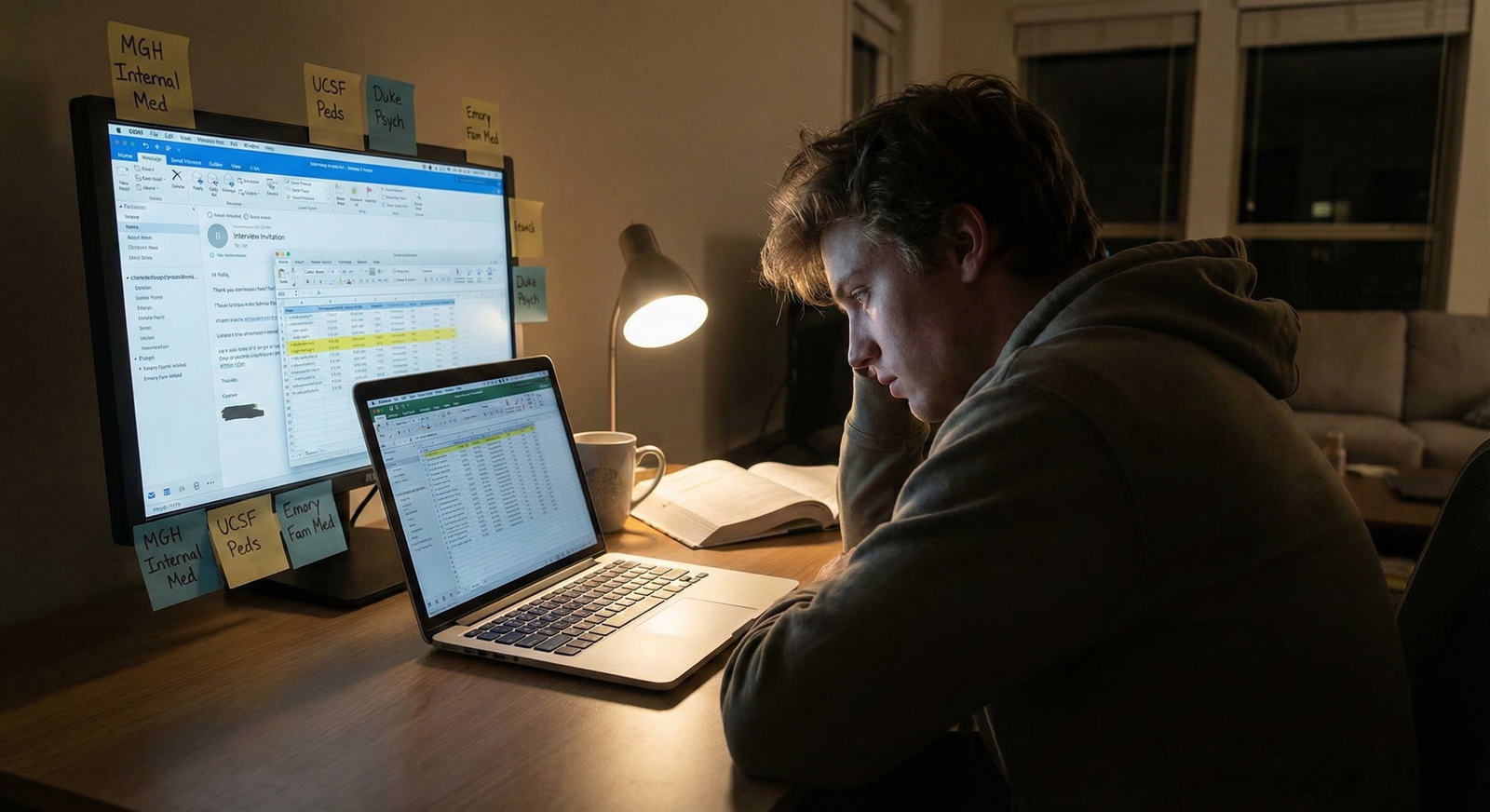
Create a simple spreadsheet (or note on your phone) with:
- Program name
- Date of interview
- Names and emails of interviewers
- 1–2 key points from each conversation
- Status: “Thank-you sent?” and date
Draft a base template for each specialty, then customize for each interviewer using notes from your spreadsheet.
Block time after each interview day (e.g., that evening) to draft and send your notes while details are still fresh.
When You Don’t Have Direct Contact Information
Sometimes you might not receive individual email addresses for every interviewer. Options:
- Send a single, general thank-you to the program coordinator or main program email asking them to share your appreciation with the team.
- If you remember names, you can sometimes find institutional email addresses on the hospital or university website.
- Do not stress if you cannot individually reach everyone—programs understand this and it will not make or break your application.
Adapting for Virtual vs. In-Person Interviews
The core content remains the same, but you can reference the interview format if relevant:
- “Thank you for the opportunity to speak with you virtually…”
- “I appreciated how smoothly your team organized the virtual interview day and breakout sessions.”
This acknowledges the effort programs invest in making the virtual format work well.
Using Thank-You Emails Beyond Residency Applications
The same principles apply to:
- Fellowship interviews
- Academic job searches
- Preliminary or transitional year positions
- Research positions or advanced electives
Cultivating this habit now will serve you throughout your career.
FAQs: Thank-You Emails After Residency Interviews
Q1: How long should my residency thank-you email be?
Aim for 150–250 words. That’s typically 3–5 short paragraphs. Long enough to personalize and express interest, but short enough for busy faculty to read quickly.
Q2: Should I send one email to the program director only, or separate emails to each interviewer?
If possible, send individual, personalized emails to each faculty member who interviewed you. For group sessions or panels where you don’t have all emails, a single thank-you to the program coordinator or general program email, asking them to extend your thanks to the faculty, is appropriate.
Q3: Is it acceptable to mention something I forgot to say during the interview in my thank-you email?
Yes—with limits. You can briefly mention an important point you didn’t get to share (e.g., a new publication, a relevant experience, or a clarification). Keep this to 1–2 sentences so the email still reads as a thank-you, not an addendum to your CV.
Q4: Should I send thank-you emails after virtual interviews too?
Absolutely. Whether the interview is in-person or virtual, thank-you emails remain a standard and appreciated part of Professional Communication. You can even acknowledge how well the virtual day was organized, which shows attentiveness and appreciation.
Q5: What if a program explicitly says “Do not send thank-you emails”?
Always follow program instructions. Some programs state in their Interview Tips or on their website that they prefer not to receive thank-you messages, often to reduce burden on faculty and not disadvantage applicants who can’t send them. In those cases, do not send a thank-you email; respecting their preference is the most professional choice.
By treating thank-you emails as a strategic part of your Residency Applications—and not just a courtesy—you reinforce your professionalism, highlight your fit, and build early habits of effective communication that will serve you throughout your medical career.