Why Your Thank-You Email Can Be a Game Changer in Residency Programs
In the high-stakes world of residency applications, small details can have an outsized impact. You spend months perfecting your ERAS application, rehearsing for medical interviews, and planning your away rotations—yet many applicants underestimate one simple, high-yield step: the post-interview thank-you email.
While a thank-you note will not magically overcome a weak application, it can strengthen an already solid one, reinforce your fit with a program, and subtly highlight your professionalism and communication skills. In a crowded field of well-qualified candidates, that may be enough to tip a borderline decision in your favor.
This guide explains why thank-you emails matter, how to write them strategically, and practical examples you can adapt for your own residency application season.
Why Thank-You Emails Matter in Residency Applications
Reinforcing Your Interest in the Program
Residency programs care a great deal about “fit” and genuine interest. They are not just recruiting test scores and CVs—they are building a team that will work together intensely for three to seven years.
A thoughtful thank-you email:
- Signals that you are sincerely interested in that specific program, not just any program.
- Reminds interviewers who you are and what you bring to the table.
- Reinforces positive impressions made during your medical interview.
Program leadership often informally tracks “demonstrated interest.” While NRMP rules prohibit programs from asking how you will rank them, they can (and do) observe your level of engagement. A timely, well-written thank-you email—even if it does not directly change your rank position—can help keep you top-of-mind when your file is being reviewed.
Building Professional Relationships and Networks
Residency is just the start of your professional journey. The faculty who interview you may later become:
- Your attendings or mentors
- Research collaborators
- Letter writers for fellowships
- Colleagues in your future career development
A respectful, personalized thank-you email is an early step in building that professional relationship. It shows you value their time and expertise, and that you’re someone who communicates thoughtfully.
This matters even if you don’t ultimately match at that program. Medicine is a small world; a faculty member you impressed during a medical interview at one institution may cross paths with you again in fellowship, academia, or professional organizations.
Demonstrating Professionalism and Communication Skills
Residency programs are constantly evaluating professionalism. How you communicate before and after the interview is part of that assessment.
A high-quality thank-you email showcases:
- Professionalism: You follow through, express gratitude, and respect others’ time.
- Attention to detail: Your message is polished, free of typos, and correctly addresses each person.
- Communication skills: You can be clear, concise, and personable in written form.
- Judgment: You know what content is appropriate—and what is not.
In many specialties, written communication is critical. Program directors notice applicants who can write succinct, well-organized emails—a skill that translates to writing notes, consults, and handoffs.

Core Elements of an Effective Residency Thank-You Email
Thank-you notes do not need to be long or elaborate, but they should be intentional. Think of them as a brief, professional follow-up to your medical interview.
1. Personalization: Make It Clear This Email Is Just for Them
Generic, copy-paste emails are easy to spot and can come across as perfunctory or insincere. Personalization helps you stand out and reminds the reader who you are.
Ways to personalize:
- Refer to a specific conversation or topic you discussed
- Mention a unique aspect of the program that resonated with you
- Refer to advice they gave or something you learned during the day
- Connect a feature of the program to your long-term goals
Example snippet:
“I especially appreciated our conversation about your quality improvement project in reducing ED wait times, and it reinforced my interest in engaging in systems-based practice during residency.”
This signals genuine attention and helps the interviewer recall you among dozens of applicants.
2. Reiterate Your Fit and Key Strengths
The thank-you email is a brief opportunity to subtly reinforce your fit for the program and highlight one or two strengths that align with their values.
You might reference:
- Your commitment to underserved populations in a safety-net hospital
- Your interest in academic medicine and teaching opportunities
- Your passion for research, global health, or public health
- Your alignment with the program’s culture (collegial, resident-driven, etc.)
Keep it focused. You are not rewriting your personal statement; you’re choosing one or two points that directly connect you to that program.
Example snippet:
“Our discussion about the program’s strong community health focus resonated with my experiences working at a free clinic, and I am excited about the opportunity to continue serving underserved populations in residency.”
3. Clear, Genuine Gratitude
At its core, this is a thank-you message. Make the appreciation explicit and concrete.
You can thank them for:
- Their time and the opportunity to interview
- Specific insights they provided about curriculum, culture, or mentorship
- Their honesty about strengths and challenges of the program
- Their advice regarding residency or career development
Avoid over-the-top flattery; sincere, straightforward appreciation is more professional and believable.
4. Professional Tone and Formatting
Your thank-you email is part of your professional brand. Treat it with the same care you used in your residency application materials.
Key points:
- Subject line: Clear and direct
- Example:
Thank You – [Your Name], [Specialty] Residency Interview on [Date]
- Example:
- Greeting: Use appropriate titles (Dr. [Last Name]) unless you are explicitly invited to use first names. Double-check spelling.
- Structure:
- Brief opening gratitude
- 1–2 personalized details or reflections
- Reiteration of interest and fit
- Closing thanks and professional sign-off
- Length: Typically 100–200 words—long enough to be meaningful, short enough to respect their time.
- Proofread: Check grammar, spelling, names, and program details before sending.
5. Timeliness: When to Send Your Thank-You Email
Timing affects impact. For most residency applications:
- Aim to send within 24 hours of your interview day.
- At most, send within 48 hours, especially during peak interview season.
Benefits of prompt follow-up:
- The interview is still fresh in their mind.
- You demonstrate responsiveness and organization.
- Your name reappears just as they may be starting to discuss candidates.
If you are delayed (e.g., multiple interviews back-to-back, travel issues), it’s still better to send a thoughtful late email than none at all. You can briefly acknowledge the delay:
“My apologies for the slight delay in writing; I’ve been traveling between interviews. I still wanted to express my sincere appreciation for the opportunity to interview with your program on [date].”
Practical Examples and Templates for Residency Thank-You Emails
Sample Email to a Program Director
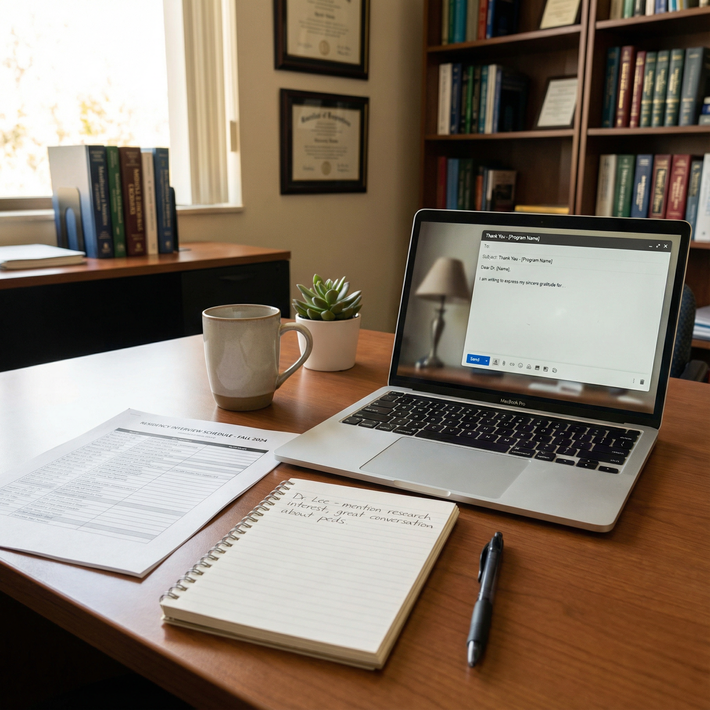
Subject: Thank You – Jordan Patel, Internal Medicine Interview on November 3
Dear Dr. Smith,
Thank you very much for the opportunity to interview for the Internal Medicine Residency Program at University Medical Center on November 3. I appreciated your candid discussion about how the program supports resident autonomy while maintaining strong supervision.
Our conversation about your residents’ involvement in quality improvement projects, especially in reducing hospital readmissions, aligns closely with my interests and prior work in population health. I am excited about the possibility of contributing to this kind of initiatives during residency.
I remain very enthusiastic about your program and would be honored to train at University Medical Center. Thank you again for your time and for sharing your vision for the program.
Sincerely,
Jordan Patel
[AAMC ID] | [Phone] | [Email]
Sample Email to a Faculty Interviewer
Subject: Thank You – Maria Lopez, Pediatrics Interview
Dear Dr. Johnson,
Thank you for taking the time to speak with me during my pediatric residency interview day on October 18. I especially enjoyed our discussion of your complex asthma clinic and the multidisciplinary approach to patient care.
Hearing how your team partners with social workers and school nurses reinforced my interest in your program’s holistic, family-centered model. As someone who has worked closely with school-based health centers, I would be excited to continue that work at Children’s Hospital.
I appreciate your insights and the warm welcome you extended. Thank you again for your time and mentorship.
Best regards,
Maria Lopez
Sample Email to a Chief Resident or Resident Interviewer
Subject: Thank You – Residency Interview Day
Dear Dr. Chen,
Thank you for sharing your perspective as a chief resident during my interview day on November 10. Hearing about your experience with the night float system and how the program prioritizes resident wellness was very helpful.
Your description of the supportive resident culture and opportunities for near-peer teaching strongly resonated with what I’m seeking in a training environment. I left the interview day even more excited about the possibility of joining your team.
Thank you again for your time and for answering my many questions.
Sincerely,
Alex Nguyen
You can adapt these structures to any specialty—surgery, psychiatry, EM, OB/GYN, etc.—by swapping in program-specific details and your unique interests.
Common Pitfalls and How to Avoid Them
Even well-intentioned thank-you emails can backfire if they cross professional or NRMP boundaries.
Pitfall 1: Overstating Your Rank Intentions
NRMP guidelines strictly regulate post-interview communication. While you may express interest, avoid explicit promises or pressure.
Risky phrases:
- “I will rank your program #1.”
- “I will definitely match with you.”
- “Please rank me highly; I really need this.”
Safer, appropriate alternatives:
- “I remain very interested in your program.”
- “Your program is one of my top choices.”
- “I would be thrilled to match at your institution.”
Always be honest. Do not tell multiple programs that they are your absolute first choice.
Pitfall 2: Treating It as a Second Personal Statement
Your thank-you email should not:
- Rehash your entire CV
- Introduce major new information that might appear desperate or confusing
- Include attachments (updated CV, new publications) unless specifically requested
Keep it focused, forward-looking, and concise.
Pitfall 3: Using Informal or Unprofessional Language
Avoid overly casual tone, slang, or texting-style abbreviations. This includes:
- “Hey Dr. J!”
- “Lol, that case you mentioned was wild.”
- “Thx for chatting with me.”
Stick with professional email etiquette: complete sentences, respectful tone, and proper salutations.
Pitfall 4: Sending Mass or Obviously Copied Emails
Faculty who sit on multiple committees or know each other may compare notes. If your “personalized” email is clearly a form letter, it can hurt your image.
Better approach:
- Use a basic template for structure (subject line, flow).
- Personalize at least 2–3 sentences for each recipient.
- Double-check you have the correct name, title, and program references.
Strategic Considerations: Who to Email, What to Include, and How Many
Who Should Receive a Thank-You Email?
In the context of residency applications and medical interviews, consider sending thank-you emails to:
- Program Director – Almost always appropriate and recommended.
- Associate/Assistant Program Directors who interviewed you.
- Faculty Interviewers you met one-on-one.
- Chief Residents or Residents who formally interviewed you.
- Coordinator or Administrative Staff – Optional but can be appreciated, especially if they were particularly helpful.
If you had a large group interview or panel and do not have all email addresses, you can:
- Send a primary thank-you to the Program Director and mention others by name in the body.
- Ask the coordinator to please extend your thanks to the individuals you cannot email directly.
How Many Emails Are Too Many?
You do not need to email every single resident or faculty member you briefly met on a tour. Focus on:
- Individuals who interviewed you directly
- Key program leadership
- Anyone who spent extra time mentoring or advising you
Quality matters more than quantity. A few personalized, well-written messages are far better than ten generic notes.
Should You Follow Up Again Later?
Apart from a thank-you email, additional follow-up is usually not necessary unless:
- You have a major update (new publication, award, or exam score) that significantly strengthens your file.
- The program explicitly invites or encourages updates.
- You have a specific, thoughtful question not addressed during interview day.
If you send an update, keep it brief and professional, and avoid angling for information about exactly where you stand on their rank list, as programs typically will not (and should not) disclose this.
Expanded FAQs About Residency Thank-You Emails
1. How long should my residency thank-you email be?
Aim for 100–200 words. That’s enough space to:
- Express gratitude
- Reference a personal interaction
- Reiterate interest and fit
Most faculty and program directors are extremely busy, especially during interview season. A concise message that respects their time reflects well on your professionalism.
2. Is it appropriate to send separate thank-you emails to multiple interviewers?
Yes, and it is generally recommended if you had multiple one-on-one interviews. Send individual, tailored emails to:
- Each faculty member who interviewed you
- The program director (even if you also interviewed with them)
- Any resident who formally interviewed or significantly mentored you
Avoid copying and pasting the same email. Even small customizations to reflect your actual conversation make a significant difference.
3. Can a thank-you email help if I feel the interview went poorly?
It can. While it may not reverse a truly disastrous interview, a strong thank-you email can:
- Clarify any brief point you feel you didn’t fully articulate (without sounding defensive).
- Show insight, maturity, and genuine interest despite some nerves.
- Shift the overall impression toward your strengths.
Example approach:
“I realized after our conversation that I didn’t fully convey how meaningful my time working at the student-run free clinic has been. It was a pivotal experience in shaping my commitment to primary care in underserved communities.”
Keep it brief, forward-looking, and avoid rearguing your entire interview.
4. Should I send thank-you notes via email or handwritten cards?
For residency applications, email is the standard and preferred format because:
- It’s immediate and timely.
- Faculty may be off-campus or working remotely.
- Programs largely manage communications electronically.
Handwritten notes are generally not necessary and may arrive too late to influence impressions. If the program is small, very traditional, and you truly know the culture well, a handwritten note to a specific mentor may be a nice supplement—but do not rely on that as your primary follow-up.
5. What should I avoid mentioning in a thank-you email?
Avoid:
- Rank list specifics: Don’t tell multiple programs they are your #1 in absolute terms.
- Negative comments about other programs, your medical school, or previous supervisors.
- Requests for special favors (e.g., asking for guaranteed ranking, letters of recommendation from someone you just met).
- Sensitive personal disclosures not already discussed in the interview that might be misinterpreted or feel out of context.
Keep the tone positive, forward-looking, and aligned with professional norms.
Conclusion: Small Step, High Yield for Your Professional Future
In the complex process of residency applications, a thank-you email may seem minor compared to your Step scores, clinical grades, or letters of recommendation. Yet it occupies a critical intersection of professionalism, communication, and relationship-building.
A well-crafted thank-you email:
- Reinforces your genuine interest in a residency program
- Demonstrates maturity, professionalism, and respect
- Highlights your fit with the program’s culture and mission
- Strengthens connections that can support your long-term career development
You cannot control every variable in the Match, but you can control how you show up—before, during, and after your medical interviews. Taking 10–15 minutes to write a thoughtful, timely thank-you message is one of the simplest, highest-yield steps you can take to differentiate yourself in a competitive field and leave a lasting positive impression.