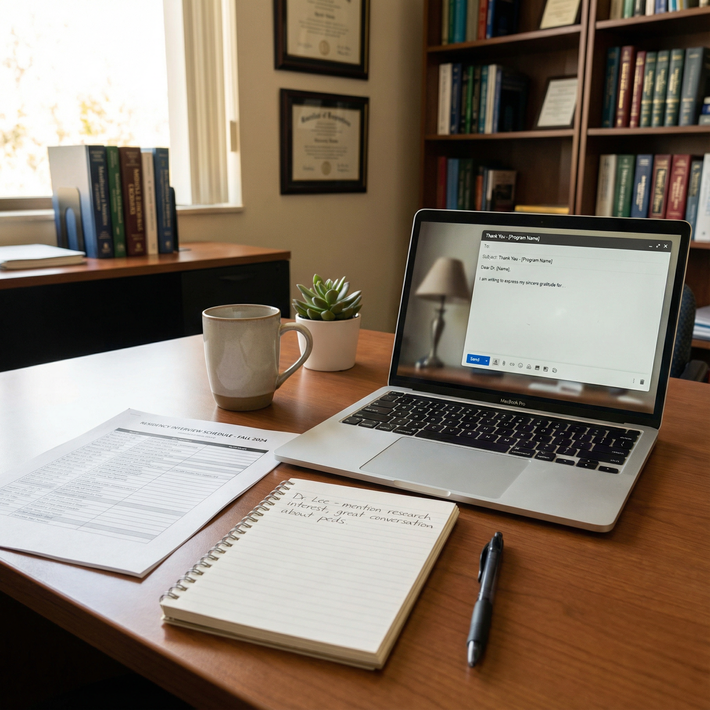
Why Thank-You Emails Still Matter in Residency Applications
In the landscape of residency applications, the interview is a pivotal moment where programs assess not only your credentials but also your professionalism, communication style, and “fit.” What follows immediately after can subtly reinforce that impression: the thank-you email.
A well-crafted thank-you email is more than a polite formality. It is:
- An additional touchpoint for professional communication
- A chance to reiterate your interest in the program
- An opportunity to highlight key strengths you want remembered
- A way to demonstrate maturity, courtesy, and attention to detail
Some programs explicitly state that thank-you emails do not influence ranking; others quietly appreciate them as a marker of professionalism. You cannot control how much weight they carry, but you can control how effectively you use this opportunity.
This guide walks through the key dos and don’ts of crafting a strong thank-you email after a residency interview, with practical interview tips, sample phrases, and common pitfalls to avoid.
Core Principles: What Makes a Strong Residency Thank-You Email?
Before getting into specifics, it helps to understand what programs generally look for in a post-interview note.
A strong residency thank-you email is:
- Prompt – sent within a reasonable time frame
- Professional – appropriate tone, formatting, and structure
- Personalized – clearly written for this interviewer and this program
- Concise – respectful of the recipient’s time
- Aligned – reinforces your fit and career goals without sounding salesy
- Error-free – no obvious grammar or spelling mistakes
If your email checks these boxes, it will support—not sabotage—your residency application.
The Dos of Crafting a Residency Thank-You Email
1. Do Send Your Email Promptly
Timeliness signals respect, organization, and enthusiasm—qualities every program wants in a resident.
- Ideal timing: Within 24 hours of your interview day.
- Acceptable window: Within 48 hours if your schedule is packed or you had multiple interviews back-to-back.
Why this matters:
- Interviewers often discuss candidates soon after interview day.
- A timely thank-you email helps keep your name and strengths fresh in their minds.
- It demonstrates that you can handle time-sensitive professional communication—critical in clinical practice.
Practical tip:
Draft a basic thank-you template before interview season. After each interview, customize and send quickly instead of starting from scratch.
2. Do Personalize Each Message
Generic messages feel transactional and forgettable. A personalized thank-you email shows that you were engaged, reflective, and genuinely interested in the program.
What to personalize
- The opening line: Reference the specific residency (e.g., “Thank you for the opportunity to interview for the Internal Medicine residency at [Program Name].”)
- One or two specific details from your conversation:
- A patient case or clinical scenario you discussed
- A particular rotation, clinic, or elective they described
- A shared interest (e.g., medical education, global health, quality improvement)
- Advice they gave you about career development
Example personalization:
I especially appreciated our discussion about your continuity clinic model and how residents are supported in managing complex chronic disease patients over time. It reinforced my interest in longitudinal patient care and your program’s approach to mentorship.
Aim for one specific memory anchor per email. This shows you remember who they are and that your interaction mattered.
3. Do Clearly Express Gratitude
Start with sincere, direct appreciation. Interviewers often clear clinical time, rearrange schedules, or join in between busy responsibilities to speak with you.
Strong examples:
- “Thank you for taking the time to speak with me during my interview day for the [Specialty] residency at [Program Name].”
- “I’m grateful for the opportunity to learn more about your program and your work in [specific area].”
Keep it straightforward—avoid overly dramatic language (“I’m eternally grateful…”) and long emotional paragraphs. Professional, calm appreciation reads best.
4. Do Reiterate Your Interest and Fit
Your thank-you email is a strategic chance to connect what you learned during the interview with your career goals and residency application narrative.
Focus on 1–3 points:
- Why this program fits your training goals
- How certain program features align with your strengths or aspirations
- What specifically excites you after the interview
Example language:
- “After our conversation, I am even more excited about the prospect of training at [Program Name], particularly because of your strong emphasis on [feature: e.g., resident autonomy in the ICU, community engagement, robust mentorship].”
- “Hearing about your residents’ involvement in [research/advocacy/education] aligned strongly with my long-term goal of [career aim].”
Avoid sounding transactional (“I am sure your program is the best and I hope you rank me highly”). Keep it focused on fit, not desperation.
5. Do Keep It Concise and Structured
Most faculty and program directors skim emails on busy clinic days. Help them by making your message easy to read.
Recommended structure (4–7 sentences total):
- Greeting + gratitude
- Brief personalization (reference a specific conversation or program feature)
- Reiterate interest / fit (1–2 short sentences)
- Polite closing + contact info
Aim for about 100–200 words—just enough to leave a positive impression without adding to their workload.
Example outline:
Dear Dr. [Last Name],
Thank you for taking the time to speak with me during my interview for the [Specialty] residency at [Program Name]. I particularly enjoyed our discussion about [specific topic], and your insights into [related theme] were extremely helpful as I clarify my career goals.
Learning more about [program feature] and [another feature] has strengthened my interest in training at [Program Name], especially given my passion for [brief career or academic goal]. I would be honored to contribute to and learn from your team.
Sincerely,
[Full Name]
AAMC ID: [Number]
Phone: [Number] | Email: [Email]
6. Do Proofread Carefully
In residency and beyond, details matter. A thank-you email filled with typos can subtly raise concerns about your attention to detail and communication skills.
Proofreading checklist:
- Names spelled correctly (interviewer, program, department)
- Program name and specialty are correct (no copy-paste mistakes)
- Grammar and punctuation are clean
- Professional email address used (e.g., not “doc4lifeLOL@…”)
- No leftover bracketed placeholders ([PROGRAM NAME]) still visible
Practical tips:
- Read the email aloud once; your ear often catches errors your eyes miss.
- Use a spelling/grammar checker.
- Double-check that you have not referenced the wrong program—a common error when sending multiple emails.
7. Do Include Key Contact Details
Most programs have your information already through ERAS, but including it in your signature:
- Makes it easier if they want to respond
- Reinforces professionalism
- Avoids confusion if they forward your message
Include:
- Full name (matching your application)
- Preferred email
- Phone number
- AAMC ID (optional but helpful)
- Medical school and graduation year (optional for clarity)
Example signature:
[Full Name], MS4
[Medical School], Class of 20XX
AAMC ID: XXXXXXXX
Phone: (XXX) XXX-XXXX | Email: [email protected]
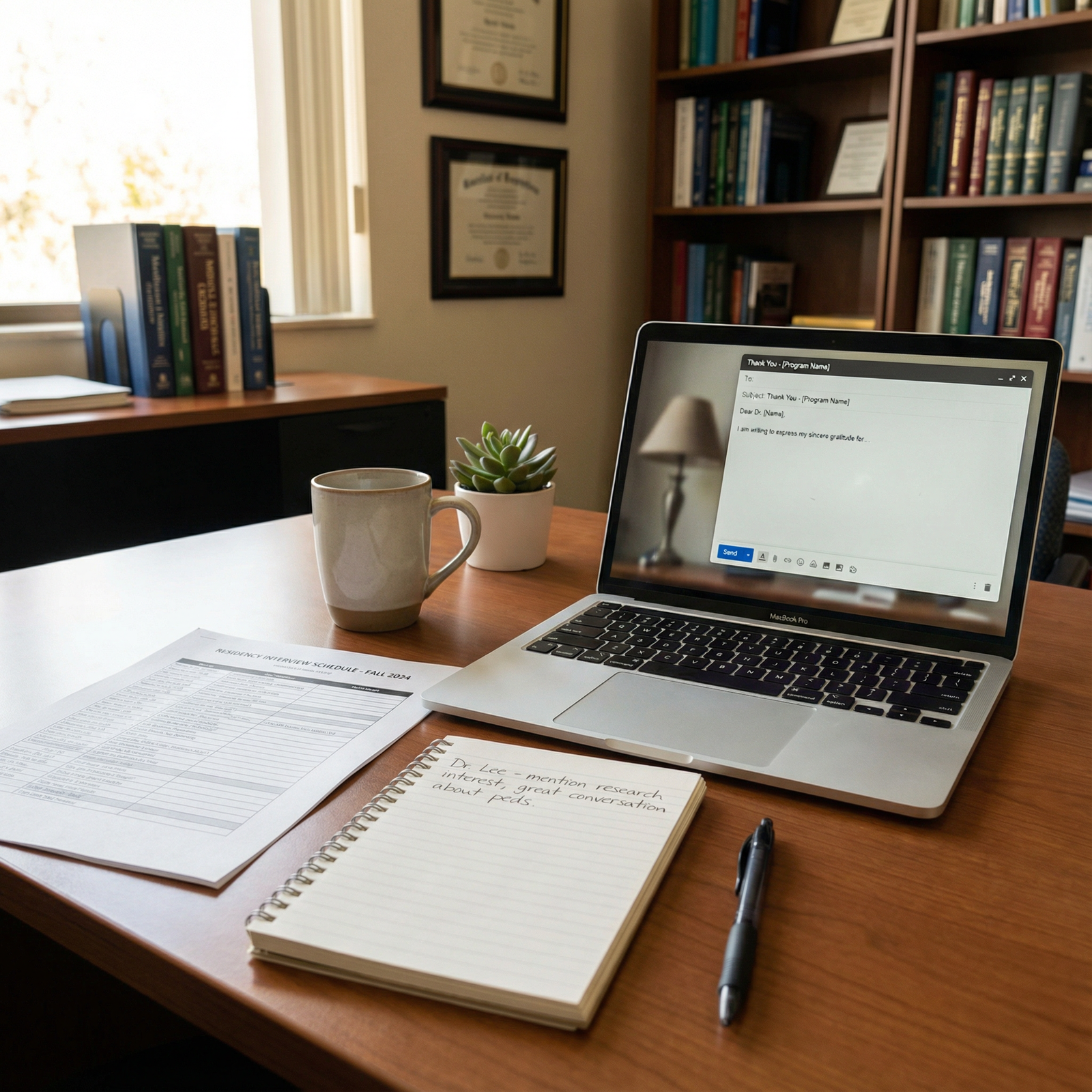
The Don’ts of Residency Thank-You Emails
1. Don’t Send Generic, Copy-Paste Emails
Programs can easily spot “template” messages that could have been sent to any interviewer at any institution.
Red flags of generic emails:
- No mention of anything specific to that interviewer or program
- Vague phrases like “your excellent program” with no details
- Identical wording sent to multiple people in the same department
Instead, use a simple base structure but customize the middle with at least one specific detail per recipient. Even a short, well-personalized note is better than a long, generic one.
2. Don’t Be Overly Casual or Overly Formal
Your thank-you email is part of your professional communication record. Avoid extremes in tone.
Too casual:
- Slang (“Hey,” “You guys,” “LOL,” “btw”)
- Emojis or excessive exclamation points
- Abbreviations that aren’t standard in professional writing
Too formal or stiff:
- Overly elaborate language that sounds unnatural
- Long, dense paragraphs full of jargon
- Dramatic flattery (“I am profoundly humbled and eternally grateful for…”)
Aim for a polite, conversational, professional tone—similar to how you might write to a respected mentor.
Example of balanced tone:
Dear Dr. Smith,
Thank you again for sharing your perspective on resident education and leadership development. Your description of how senior residents mentor interns was especially meaningful…
3. Don’t Ask for Decisions or Rank Information
Your thank-you email is not the place to:
- Ask how the program will rank you
- Ask whether you are “competitive” there
- Request that they rank you highly
- Negotiate anything related to the Match
Phrases to avoid:
- “I hope to hear that I’ve matched with your program.”
- “Where do I stand on your rank list?”
- “Am I still being seriously considered?”
The Match has strict rules and expectations around communication. Use your email to show professionalism and appreciation—not to apply pressure or seek inside information.
You may, if you genuinely mean it and if allowed by Match guidelines and institutional policies, express continued strong interest in the program later in the season via a separate, appropriately worded communication (e.g., a “letter of interest” or “letter of intent”), but that is distinct from a thank-you email immediately post-interview.
4. Don’t Forget People You Met on Interview Day
If you interviewed with several people, try to send an email to each interviewer. This typically includes:
- Program Director
- Associate/Assistant Program Directors
- Faculty interviewers
- Chief residents or residents who conducted formal interviews
If you had an informal conversation with a resident (e.g., social event or lunch) and you have their contact information, a short thank-you can also be appropriate—especially if they spent significant time with you.
What if you don’t have everyone’s email address?
- Check the interview invitation or information packet.
- Look at the program’s website for contact details.
- If you cannot locate it reasonably, consider sending one carefully written email to the program coordinator asking them to forward your thanks to specific individuals.
5. Don’t Write an Essay
Being “too lengthy” can dilute your main message and burden your reader. If your email starts to look like a personal statement, it’s too long.
Common signs you’re overdoing it:
- More than 3–4 paragraphs
- Repeating your CV or personal statement
- Detailing every aspect of your career goals
Keep your thank-you email focused on:
- Gratitude
- One or two key impressions of the program
- A brief note on fit
- Professional closing
If you have extensive follow-up questions, consider a separate, concise email at a later time or address them to the program coordinator when appropriate.
6. Don’t Use an Unprofessional Sign-Off or Signature
Your closing should match the professional tone of your residency application.
Appropriate closings:
- “Sincerely,”
- “Best regards,”
- “Warm regards,”
- “Thank you again,”
Avoid:
- “Cheers,”
- “Best,” (can feel abrupt in this context)
- No sign-off at all
- Nicknames instead of your full name
Remember: your email is a small but real sample of how you will communicate with patients, colleagues, and supervisors.
7. Don’t Over-Follow-Up or Create Pressure
If you don’t receive a reply, that’s normal. Many interviewers receive dozens of thank-you emails and may not have time to respond.
Reasonable follow-up:
- If you have a specific question that is important for your decision-making, it’s acceptable to send a brief follow-up after several days or a week—ideally separate from your thank-you email.
- A single polite follow-up later in the season (e.g., expressing continued interest) may be appropriate, depending on program and Match guidelines.
What not to do:
- Sending multiple emails asking if they saw your thank-you
- Expressing frustration about not receiving a response
- Pressuring them for information about your rank status
Balance is key: you want to show interest, not desperation.
Practical Examples: Putting It All Together
Example 1: Faculty Interviewer Thank-You Email
Dear Dr. Johnson,
Thank you for taking the time to speak with me during my interview day for the Internal Medicine residency at Riverside Medical Center. I especially enjoyed our discussion about your outpatient curriculum and how residents are trained to manage complex chronic conditions in a community setting.
Learning about the strong mentorship culture and opportunities for quality improvement projects reinforced my interest in Riverside as a place where I can grow as a clinician and contribute to meaningful systems-based change. I would be grateful for the opportunity to train with your team.
Sincerely,
[Full Name]
[Medical School], Class of 20XX
AAMC ID: XXXXXXXX
Phone: (XXX) XXX-XXXX | Email: [email protected]
Example 2: Program Director Thank-You Email
Dear Dr. Patel,
Thank you for the opportunity to interview for the Pediatrics residency at City Children’s Hospital and for sharing your vision for resident education and wellness. I appreciated hearing how your program supports residents through a structured mentorship program and protected academic time.
Our conversation, along with the chance to meet your residents, confirmed my strong interest in your program’s emphasis on advocacy and community engagement. These are areas in which I hope to build a long-term career, and I believe your training environment would be an excellent fit.
Warm regards,
[Full Name]
[Medical School], Class of 20XX
AAMC ID: XXXXXXXX
Phone: (XXX) XXX-XXXX | Email: [email protected]
Example 3: Resident Interviewer Thank-You Email
Dear Dr. Lee,
It was great speaking with you during my interview day for the Emergency Medicine residency at Harbor Medical Center. I really appreciated your honest perspective on the program’s strengths and the supportive culture among residents.
Hearing about your experience balancing high-acuity clinical training with wellness initiatives reassured me that Harbor is a place where I could both be challenged and supported. Thank you again for your time and for answering my questions about life in the city.
Best regards,
[Full Name]
[Medical School], Class of 20XX

Frequently Asked Questions About Residency Thank-You Emails
1. Do programs actually care about thank-you emails?
Practices vary. Some programs say explicitly that thank-you notes do not influence their rank list; others quietly appreciate them as markers of professionalism and engagement. Regardless, a well-written, concise thank-you email:
- Reinforces a positive impression
- Demonstrates strong communication skills
- Shows respect for the interviewer’s time
Even if it doesn’t move your position on the rank list, it helps ensure you are remembered as courteous and professional—qualities that matter for your overall reputation.
2. How long should my thank-you email be?
Aim for 100–200 words, usually:
- 1–2 short paragraphs, or
- 3 very short paragraphs (greeting + body + closing)
Focus on:
- Thanking them for their time
- Mentioning one or two specific takeaways
- Briefly reiterating your interest and fit
If your email runs longer than 250 words, look for repetition or unnecessary details you can remove.
3. What if I don’t remember specific details from each conversation?
This is common when you have multiple interviews in a short time.
To help:
- During interview day, jot down 1–2 quick notes after each meeting (e.g., “Dr. Smith – loved CKD clinic; research in QI; emphasized resident autonomy”).
- If you forgot to take notes, review:
- The program’s website
- Your interview schedule
- Any information sheet or pre-interview materials
Use even a small, genuine detail—like a topic you discussed or a question they answered—to personalize your note. If you truly remember almost nothing, keep the email simple but program-specific (e.g., “I appreciated learning more about your night float system and resident support resources”).
4. Is it okay to send a single group email to everyone who interviewed me?
In most cases, no. Whenever possible, send individual emails:
- It signals that you value each person’s time.
- It reduces the chance of awkward mistakes (wrong names, irrelevant comments).
- It allows you to personalize based on your interaction with each interviewer.
An exception: if you participated in a group session with several residents and no individual contact information was provided, a single thank-you email to the program coordinator asking them to share your thanks with the resident team is acceptable.
5. Should I include attachments or links in my thank-you email?
Generally, avoid attachments or additional links unless:
- The interviewer specifically requested a document (e.g., a paper you mentioned, a poster, or an updated CV).
- You are following up on a particular academic or research conversation and they asked you to send more information.
In most cases, keep your thank-you email simple and text-only. Adding extra materials can make it feel like you are trying to “sell” yourself rather than express gratitude.
6. What if I realize I made a small error after sending the email?
If it’s a minor typo (e.g., missing comma, small grammar issue), let it go. Everyone makes human errors, and drawing attention to them with another email can be more distracting than helpful.
If it is a major error, such as:
- Using the wrong program name
- Addressing the email to the wrong interviewer
- Clearly referencing details from a different institution
Then you may send a short, calm correction:
Dear Dr. [Last Name],
My apologies for the error in my previous email. I meant to write [correction]. Thank you again for your time during my interview for the [Specialty] residency at [Program Name].
Sincerely,
[Your Name]
Keep the correction brief and professional, and then move on.
By following these residency interview thank-you email dos and don’ts, you’ll be equipped to handle this final, subtle but meaningful step in the residency application process. Thoughtful, timely, and professional communication helps you stand out for the right reasons and reinforces the narrative you have built throughout your application and interviews.