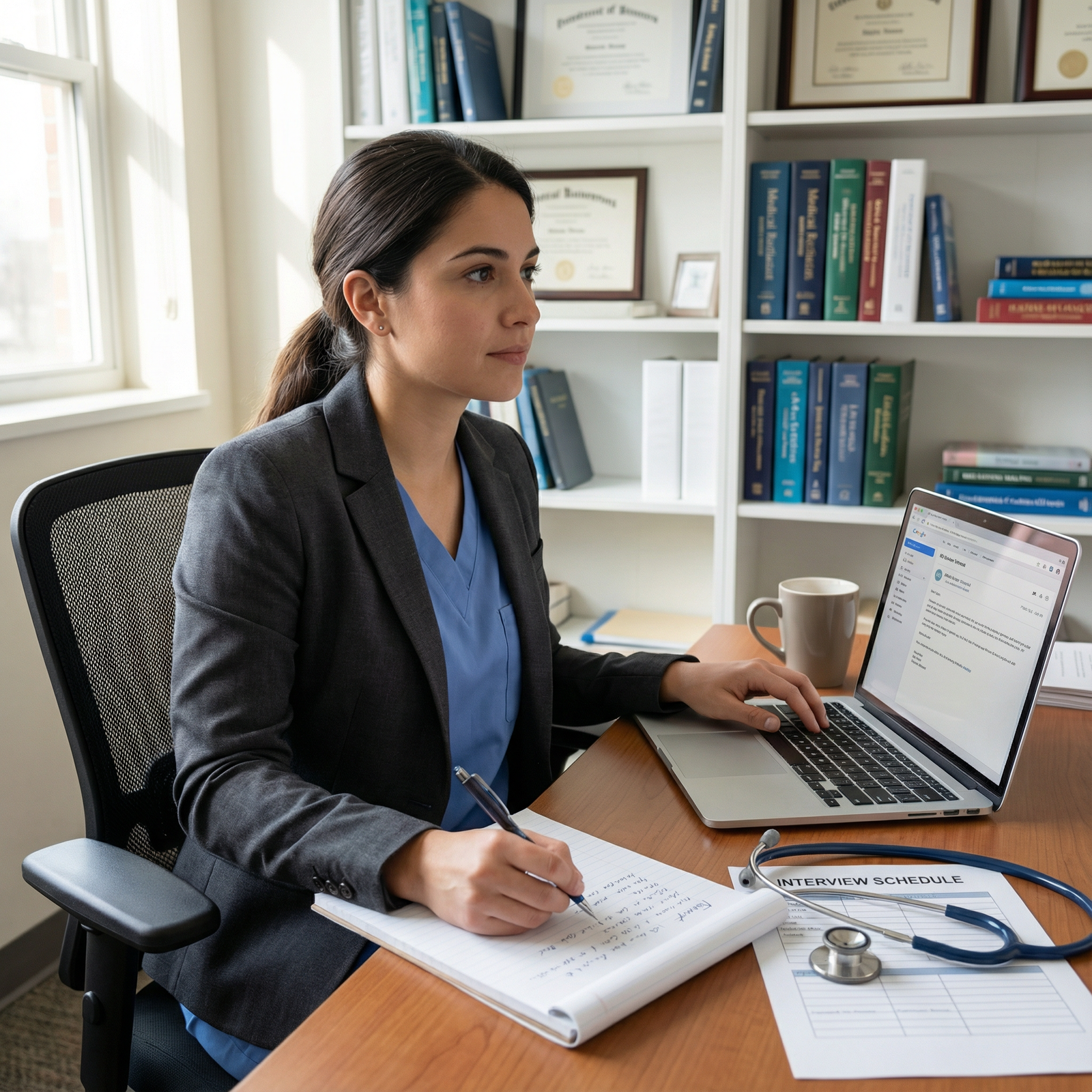
Navigating post-interview etiquette in residency applications can feel almost as stressful as the interview itself. You’ve prepared thoroughly, presented your best self, and survived a long interview day. Now you enter a gray zone: how do you follow up without overstepping? Should you send thank-you notes? How often is it appropriate to email a program? Does any of this actually affect your rank?
This guide walks you through a practical, professional, and ethical approach to post-interview etiquette—thank-you notes and beyond—so you can follow up confidently and strategically.
Why Post-Interview Etiquette Matters in Residency Applications
Post-interview etiquette in residency applications isn’t just about being polite; it’s an extension of your professional communication skills and your brand as a future colleague.
Reinforcing Your Interest and Fit
A thoughtful thank-you note gives you one more chance to:
- Reiterate your genuine interest in the program
- Highlight a few key ways you would add value as a resident
- Tie your experiences and goals to specific program strengths
Programs interview far more candidates than they can possibly remember in detail. A brief, focused message can help an interviewer recall what stood out about you and why you might be a strong fit.
Demonstrating Professionalism and Maturity
Residency is a job. Programs expect residents who:
- Communicate clearly and respectfully
- Follow up appropriately
- Are attuned to professional norms and boundaries
Well-written post-interview messages signal that you understand professional communication, attention to detail, and basic courtesy—traits that matter on busy clinical teams.
Shaping the Final Impression
Your follow-up may be:
- The last thing an interviewer sees from you before ranking
- The tie-breaker when comparing similar applicants
- A reminder of your maturity, insight, and enthusiasm
While a thank-you note alone won’t rescue a weak interview, it can strengthen a good one or solidify a borderline impression in your favor.
Building Early Professional Relationships and Networking
Thoughtful networking is a subtle but real benefit of good post-interview etiquette:
- A well-crafted note to a program director or faculty member can be the start of a long-term mentoring relationship
- A resident you connected with might become a future colleague, research collaborator, or letter writer
- Even if you don’t match at that program, you’re expanding your professional network
Handled well, these follow-up communications are about more than this single application cycle—they’re part of your long-term professional identity in medicine.
Timing, Platforms, and Strategy: How to Handle Thank-You Notes
When to Send Thank-You Notes
For most residency applications, the ideal time frame is:
- Within 24–48 hours after the interview day
This timing keeps:
- Your conversations fresh in the interviewer’s memory
- Your note clearly linked to your specific interview day
- You on pace before the fatigue of the season builds up
If you’re on a multi-day interview trip and can’t write that quickly, aim for no later than three days post-interview. After a week, the impact decreases, though sending a late note is still better than sending nothing.
Email vs. Handwritten Notes: Choosing the Right Format
In the modern residency landscape, email is the standard for post-interview etiquette.
Email advantages:
- Fast and reliable delivery
- Easy for busy faculty to read and respond to
- Automatically documented and searchable
- Appropriate for the professional culture of academic medicine
Handwritten notes:
- Can feel personal and memorable
- Work better when you already have a strong connection with one particular faculty member or mentor-type interviewer
- Risk arriving after ranking decisions, especially in shorter timelines or over holidays
Balanced approach (if you love handwritten notes):
- Send a prompt email within 24–48 hours (this is non-negotiable in most cases)
- If you choose, follow with a brief handwritten note to 1–2 key people (e.g., PD or a mentor-type interviewer) as an extra gesture, knowing its impact may be more relational than rank-influencing
Who Should Receive a Thank-You Note?
Prioritize:
- Program Director (PD) – almost always appropriate to email
- Associate PDs or key faculty who interviewed you
- Chief residents or faculty who spent significant one-on-one time with you
- Residents you had long or particularly meaningful conversations with, especially if they helped you understand the program culture
You do not need to send a separate message to every single person you met for 5 minutes. Focus on:
- Those who interviewed you formally
- Individuals you connected with in a substantive way
If the program uses a group interview format and you don’t have individual email addresses, you can:
- Send one consolidated thank-you email to the PD, mentioning the team as a group
- Or send a note to the program coordinator asking them to please convey your thanks to the interview panel
How to Get Contact Information
Common ways to find email addresses:
- Interview day materials (schedules, welcome packets, follow-up slides)
- Program website faculty or leadership pages
- Program coordinator – you may kindly email to request contact info if it wasn’t provided
Always be respectful of the coordinator’s time and don’t ask for more than is reasonable. For example, ask for PD and interviewers’ emails—not for the entire faculty directory.
How to Write Effective, Professional Thank-You Notes
Thank-you notes for residency applications should be:
- Concise (typically 1–2 short paragraphs, maximum 3)
- Sincere and specific
- Free of typos, slang, or overly casual language
Core Structure of a Strong Thank-You Email
You can use a simple, repeatable structure:
- Greeting + specific thanks for the interview
- Reference a meaningful part of the conversation or program feature
- Reinforce your fit and interest (in 1–2 sentences)
- Professional closing
Sample Template 1: To a Program Director
Subject: Thank You for the Opportunity to Interview
Dear Dr. Smith,
Thank you for the opportunity to interview for the Internal Medicine Residency at [Institution] on [date]. I appreciated learning more about your vision for resident education and the program’s strong emphasis on longitudinal ambulatory training.
Our discussion about developing residents into independent clinicians who excel in both patient care and quality improvement deeply resonated with my goals. My experiences leading a transitions-of-care QI project and my interest in primary care align well with the program’s focus and the diverse patient population you serve.
I remain highly enthusiastic about the possibility of training at [Institution] and contributing to your residency community.
Sincerely,
[Your Name]
AAMC ID: [Number]
Sample Template 2: To a Faculty Interviewer
Subject: Thank You – [Residency Program] Interview
Dear Dr. Lee,
Thank you for taking the time to speak with me during my interview for the Emergency Medicine Residency at [Institution]. I particularly enjoyed our conversation about managing complex cases in a resource-limited setting and your description of the program’s trauma experience.
Hearing how residents are empowered to take early ownership of patient care and participate in simulation-based training reinforced my excitement about the program’s educational environment. I would be thrilled to train in a setting that values both high-acuity clinical exposure and strong mentorship.
Thank you again for your time and insight.
Best regards,
[Your Name]
AAMC ID: [Number]
Sample Template 3: To a Resident
Subject: Thank You for Your Insights on [Program Name]
Dear Dr. Patel,
Thank you for speaking with me during the interview day at [Program Name]. Your candid description of resident life, call schedules, and the collegial atmosphere was extremely helpful.
I especially appreciated hearing about the support you’ve received from faculty in pursuing your interest in cardiology and research. That kind of mentorship and flexibility is exactly what I am seeking in a residency program.
Thank you again for your time and for sharing your experiences.
Warm regards,
[Your Name]
Key Elements to Include (and Avoid)
Include:
- Specific details that show you remember the conversation (e.g., “your description of the night float system” vs. “our conversation”)
- A short reminder of your alignment with the program (e.g., interest in underserved care, research, education, global health, etc.)
- Your AAMC ID in your PD email signature for easy reference
Avoid:
- Overly effusive language (“your program is absolutely perfect in every way”)
- Implied promises or commitments that might violate the NRMP Match Communication Code of Conduct (e.g., “I will rank you #1” or asking for rank intentions)
- Asking detailed questions that require lengthy responses—save complex queries for a separate email if needed
Beyond Thank-You Notes: Strategic, Ethical Follow-Up and Networking
Post-interview etiquette extends past the first thank-you email. The weeks between interviews and rank list submission are an opportunity for respectful professional communication and thoughtful networking—without crossing ethical boundaries.
Appropriate Reasons to Reach Out After the Thank-You Notes
You might consider an additional email if:
You have a specific question that will influence your ranking
- Example: Clarifying elective opportunities, fellowship match data, or parental leave policies if these were not addressed on interview day or the website
You want to update the program with a meaningful change in your application
- New publication or national presentation
- Major award or leadership role
- Significant change in personal circumstances affecting geographic preferences (if relevant and appropriate to share)
You’re sending a “continued interest” message (when consistent with program and NRMP guidelines)
- Many applicants send a single, brief email to their top one or few programs expressing strong interest later in the season
Crafting a Professional “Continued Interest” Email
Keep these messages short and honest. Do not pressure programs about ranking or ask how they will rank you.
Example:
Subject: Continued Interest in [Program Name]
Dear Dr. Smith,
I hope you are well. I wanted to reiterate my sincere appreciation for the opportunity to interview at [Program Name] on [date]. After completing several additional interviews and reflecting on what I am seeking in a residency, I remain extremely enthusiastic about your program’s strong clinical training, supportive culture, and commitment to [specific attribute, e.g., underserved care or resident wellness].
I continue to view [Program Name] as an excellent fit with my goals, and I would be thrilled to join your residency community. Thank you again for your time and consideration.
Sincerely,
[Your Name]
AAMC ID: [Number]
Follow your own institution’s and the NRMP’s guidance, as some schools discourage “love letters,” and some programs explicitly state that post-interview communication will not affect ranking.
Professional Networking with Faculty and Residents
Networking is not about lobbying for a higher rank. It’s about beginning genuine professional relationships.
Appropriate networking behaviors:
- LinkedIn or professional social media connections
- Send a short, professional note:
- “Thank you again for speaking with me during my interview at [Program Name]. I’d welcome the chance to stay connected as I pursue [field].”
- Send a short, professional note:
- Occasional academic follow-up
- If you discussed a research interest and the interviewer suggested a paper or project, it’s appropriate to follow up once if you have a substantive question or update
- Respectful boundaries
- Avoid frequent, repetitive emails
- Don’t contact faculty through personal social media accounts (Instagram, Facebook) in this context
When and How to Send a Gentle Follow-Up About Status
Most residency programs follow a strict communication policy and timeline. In general:
- You do not need to email to ask if they received your thank-you note
- You usually should not ask “where I stand” or “how likely I am to match”—this puts programs in an uncomfortable and often non-compliant situation
- Some programs send very little communication between interview and rank list deadlines. This is normal.
If a program has missed a promised communication deadline (e.g., a second look sign-up link they said they would send by a specific date) you may send a brief, polite clarification email to the coordinator or PD.
Common Pitfalls in Post-Interview Communication (and How to Avoid Them)
Before hitting send, consider these frequent missteps:
Being Overly Persistent
Red flags:
- Multiple follow-up emails without new content or questions
- Asking repeatedly about ranking or admission likelihood
- Contacting multiple faculty about the same issue when one email would suffice
Aim for:
- One concise thank-you message
- Only truly necessary follow-ups
Copy-Pasting Generic Notes
Interviewers can spot generic, recycled thank-you notes. To avoid this:
- Add at least 1–2 personalized sentences referencing your specific conversation
- Double-check names, titles, and program names to avoid copy-paste errors (common but damaging)
Violating Match Communication Guidelines
Know and respect:
- NRMP rules about ranking-related communication
- Program-specific statements (many websites specify: “Post-interview communication will not influence ranking”)
Avoid:
- Asking programs where they will rank you
- Stating definitively where you will rank them if your school advises against this
- Implying a quid pro quo (“If you rank me highly, I will rank you highly”)
Letting Emotions Drive Your Emails
Residency application season is emotional. Try not to send emails:
- Late at night when you’re anxious or frustrated
- Reactively, in response to perceived “snubs” or silence
Give yourself time; draft, then revisit with a clear head or ask a trusted mentor to review.
Putting It All Together: A Practical Post-Interview Game Plan
To simplify your post-interview etiquette strategy, consider this step-by-step framework for each program:
On Interview Day
- Take brief notes after each interviewer: name, role, key themes you discussed, and what you liked about the program.
Within 24–48 Hours
- Send a concise, personalized thank-you email to:
- Program Director
- Core faculty interviewers
- Residents or others with whom you had extended, meaningful conversations
- Log who you contacted and when in a spreadsheet.
- Send a concise, personalized thank-you email to:
Over the Following Weeks
- If needed, send a single follow-up for:
- Important clarification questions not answered by the website
- Major application updates (publications, awards)
- A carefully considered “continued interest” message, if appropriate.
- If needed, send a single follow-up for:
Before Certifying Your Rank List
- Review your communications to ensure:
- You’ve stayed within ethical and NRMP guidelines
- You’ve maintained professional, respectful tone
- You’ve not over-emailed any one program
- Review your communications to ensure:
This approach keeps you organized, professional, and aligned with best practices for residency applications.
Frequently Asked Questions About Post-Interview Etiquette in Residency Applications
1. Do thank-you notes actually affect my chances of matching?
Thank-you notes are unlikely to dramatically change your rank on their own, but they can:
- Reinforce a positive impression
- Help an interviewer remember you more clearly
- Demonstrate professionalism and communication skills
Some programs formally ignore thank-you notes in ranking; others consider them informally. Since you can’t know which is which, think of thank-you notes as part of your professional identity, not a magic ranking tool. They’re usually worth sending, but the quality of your application and interview performance remain far more important.
2. What if the program says “We do not expect or require thank-you notes”?
If a program explicitly states that thank-you notes are not necessary or are discouraged, you have a few options:
- Respect their stated preference and skip sending notes, which is perfectly acceptable
- If you still feel strongly about acknowledging their time, send one brief thank-you to the program coordinator or PD, keeping it very concise and clearly not intended to influence ranking
In all cases, prioritize respecting the program’s stated expectations. That in itself is good post-interview etiquette.
3. Is it okay to tell a program they are my “top choice” or “number one”?
This is nuanced and varies by institution and advisor. Consider:
- NRMP rules do not prohibit you from voluntarily stating your preferences, but they prohibit coercive communication and any request from programs that you disclose your rank list.
- Some medical schools strongly discourage “I will rank you #1” emails to maintain fairness and reduce pressure.
- Programs may or may not factor in such statements, and some explicitly ignore them.
If you choose to express strong interest, do so honestly, sparingly, and without implying any obligation on the program’s side, e.g., “Your program remains one of my top choices” or “I am very enthusiastic about the possibility of training at [Program Name].”
Always follow your school’s advising policies first.
4. Should I send separate thank-you notes to every single person I met?
No. Focus on:
- Program Director
- Your specific interviewers (faculty and key residents)
- Anyone with whom you had a particularly meaningful or extended discussion
You don’t need to email every resident from the social or every group session facilitator. The goal is targeted, thoughtful communication—not volume.
5. What if I realized I misspoke or forgot an important point during the interview?
A follow-up email can be appropriate if:
- You clarify a factual error (e.g., misquoting your publication status, misunderstanding a question)
- You briefly add a relevant detail that strengthens your answer (e.g., mentioning a related project you forgot during the interview)
Example:
Dear Dr. Jones,
Thank you again for the opportunity to interview at [Program Name]. After reflecting on our conversation, I realized that I misspoke when describing my research experience. The quality improvement project I mentioned was completed as a poster at [Name of Meeting] in 2023, rather than 2022 as I stated. I apologize for the confusion.
I appreciate your understanding and your time.
Sincerely,
[Your Name]
Keep it brief, factual, and focused; no need to apologize excessively.
By approaching post-interview etiquette—thank-you notes, follow-ups, and networking—as part of your professional development, you’ll do more than check a box. You’ll convey maturity, respect for your future colleagues, and clarity about your goals, all while staying aligned with ethical standards of the residency match.
Handled well, this phase can quietly reinforce the strong application and interview performance you’ve already put forward, and help you build relationships that may extend far beyond Match Day.