
Why Thoughtful Thank-You Notes Still Matter After Residency Interviews
Residency interviews are high-stakes, high-pressure moments in your medical career. By the time you log off Zoom or walk out of the conference room, your mind is usually racing: Did I connect with the program director? Did I highlight my strengths? Did I ask the right questions?
What many applicants underestimate is that the conversation doesn’t have to end when the interview does. A thoughtful, well-timed thank-you note is one of the most underused yet effective Professional Communication tools you have. Used correctly, it can:
- Reinforce a positive impression
- Demonstrate maturity and professionalism
- Clarify your interest in the program
- Subtly differentiate you from other strong candidates
In an era where programs are inundated with applications, small, strategic touches like thank-you notes can support your overall Career Advancement and help you stand out in the Residency Match and Applications process.
This guide walks you through exactly how to use thank-you notes as part of your Residency Interviews strategy—from timing and content to common pitfalls and advanced tips for different scenarios.
Why a Thank-You Note Is a Strategic Part of Your Residency Application
Thank-you notes are not just polite gestures; they are a targeted Job Application Tip that support your candidacy in several concrete ways.
1. Demonstrate Professionalism and Respect
Residency programs are not only evaluating your academic credentials; they are assessing what kind of colleague you will be at 3 a.m. on call, how you communicate, and whether you show respect for others’ time and effort.
A concise, respectful thank-you note:
- Signals that you understand professional norms
- Shows appreciation for faculty and residents who set aside time for you
- Reinforces that you are courteous and team-oriented
Program leadership consistently notes that a lack of follow-up—or poorly written follow-up—can indirectly reflect on an applicant’s professionalism and attention to detail.
2. Reiterate and Clarify Your Interest in the Program
Many applicants worry: “Can I really influence how I’m ranked?” While a thank-you note alone will not overcome major concerns about your application, it can:
- Confirm that you are genuinely interested in the program
- Clarify specific aspects that particularly appeal to you
- Demonstrate that you understand the program’s mission, structure, or culture
Programs are understandably more enthusiastic about ranking applicants who show real engagement and have done their homework.
3. Strengthen and Personalize Connections
Residency interviews often involve multiple interactions—program directors, associate program directors, faculty interviewers, chief residents, and current residents. By sending personalized thank-you notes, you:
- Turn a brief conversation into the start of a professional relationship
- Help interviewers remember you as an individual rather than “another strong applicant”
- Give them language and specifics to use if they advocate for you during ranking discussions
These relationships can benefit you not only for the Match, but later for mentorship, research collaborations, or future job references—true long-term Career Advancement benefits.
4. Showcase Your Written Communication Skills
Clear, organized, and thoughtful writing is crucial in medicine—whether documenting patient encounters, communicating with consultants, or writing research. A thank-you note allows you to demonstrate that you can:
- Communicate succinctly and professionally
- Tailor your message to your audience
- Pay attention to tone and detail
Poorly written or overly casual messages can inadvertently weaken the excellent impression you made in person. Done well, your note serves as one more data point that you are mature, organized, and detail-oriented.
5. Leave a Lasting, Positive Impression
By the time rank lists are compiled, programs may have met hundreds of applicants over many weeks. Your thoughtful thank-you note can:
- Bring your interview to mind again in a positive way
- Remind the interviewer of a memorable part of your conversation
- Differentiate you from similarly qualified candidates who did not follow up
In a competitive environment, even small, professional touches can be part of what makes you stand out.
Key Elements of a Strong Residency Thank-You Note
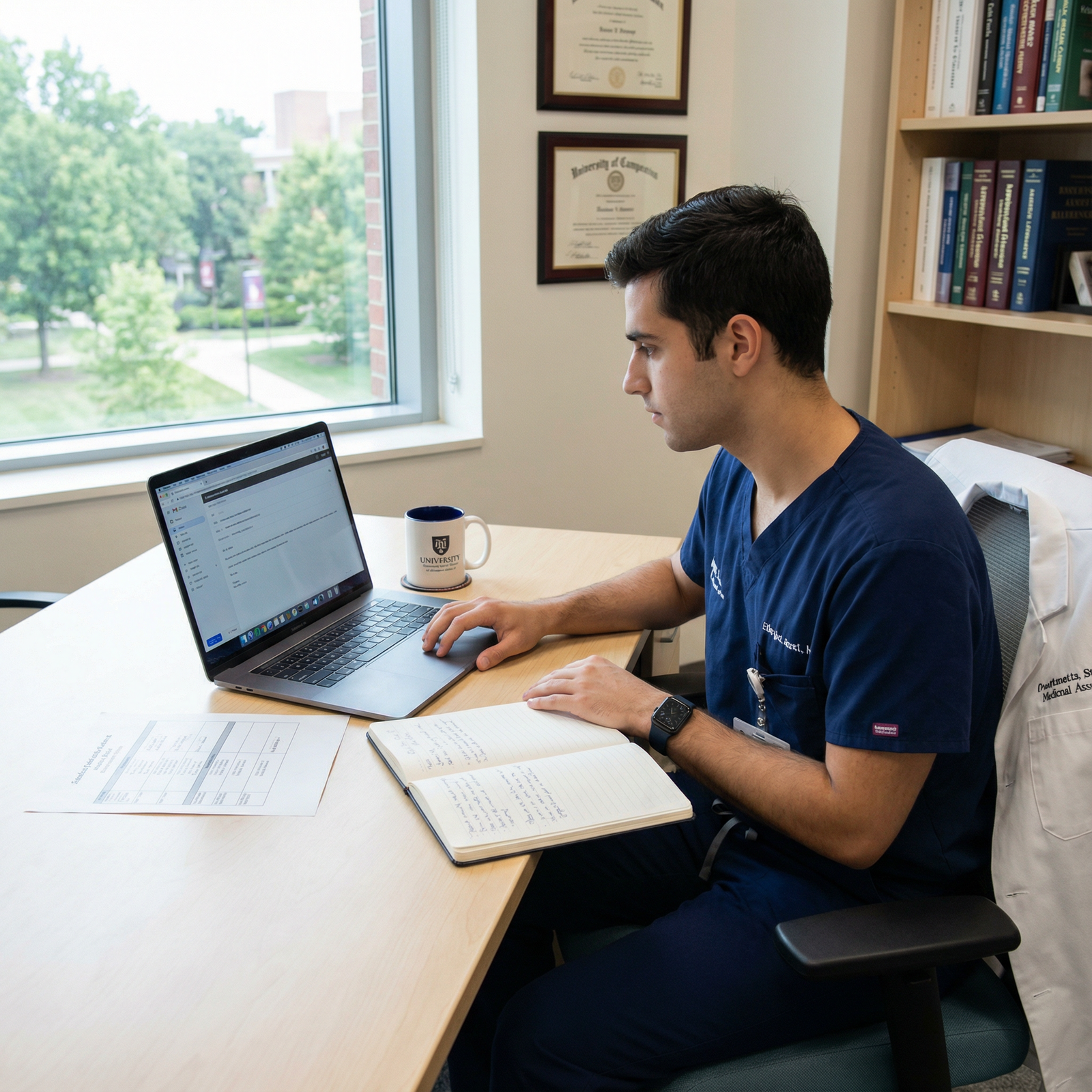
A high-impact thank-you note is brief, specific, and authentic. You are not writing an essay—you are reinforcing a conversation. Use the following structure as a guide.
1. Use a Professional, Personal Greeting
Whenever possible, address the recipient by name and title:
- “Dear Dr. Nguyen,”
- “Dear Dr. Patel and Dr. Lopez,”
Avoid generic openings like “To whom it may concern” or “Dear Interview Committee” when you know the person’s name. Correct spelling is critical—double-check the program website or your interview invitation.
If you interviewed with a resident and are unsure about titles, “Dear Dr. [Last Name]” is always safe and respectful.
2. Open with Specific, Genuine Gratitude
Start by explicitly thanking them for their time and referencing the interview:
“Thank you for taking the time to speak with me about the Internal Medicine Residency at University Hospital on January 15.”
You can enhance this by adding a brief appreciation of something specific:
“I appreciated your candid insights about the culture of the program and your approach to resident education.”
This shows that your message isn’t a generic template sent to every program.
3. Reference a Memorable Conversation Point
One of the most powerful elements you can include is a reference to something you specifically discussed. This demonstrates attentiveness and helps jog the interviewer’s memory.
Examples:
- “I especially enjoyed hearing about your work in global health and discussing how residents can get involved in international electives.”
- “Our conversation about the program’s consult curriculum and early autonomy resonated strongly with me.”
- “I appreciated learning about how the residency supports residents with families, including flexible scheduling options.”
Try to choose a detail that genuinely mattered to you—programs can usually sense when you are just flattering them.
4. Connect the Program to Your Goals and Strengths
Use one or two sentences to link what you learned about the program to your own experiences, goals, or values. This is a subtle but powerful way to reinforce your fit:
- “As someone who hopes to build a career in academic cardiology, your description of the strong mentoring culture and dedicated research time was especially exciting.”
- “Your emphasis on community engagement aligns with my work in student-run free clinics and my commitment to caring for underserved populations.”
Avoid rewriting your entire personal statement; this is a concise, targeted connection, not a repeat of your full application.
5. Reaffirm Your Interest (Without Overpromising)
It is appropriate—and helpful—to clearly state your enthusiasm for the program. For example:
- “Our conversation further strengthened my interest in your program.”
- “After meeting you and the residents, I am even more excited about the possibility of training at your institution.”
Be honest. Do not make promises like “I will rank your program #1” unless you are absolutely certain and understand the implications. Overstating your intent or sending similar “You are my top choice” language to multiple programs is unprofessional and can harm your reputation.
6. Close with a Professional, Upbeat Ending
Conclude with a warm but professional closing:
“Thank you again for your time and for considering my application. I would be honored to train at [Program Name] and contribute to your team.”
Use a standard closing such as:
- “Sincerely,”
- “Best regards,”
- “Kind regards,”
Then sign with your full name and contact information.
Sample Residency Thank-You Email
You can adapt the following template to your own style and specialty:
Dear Dr. Smith,
Thank you for taking the time to speak with me about the Family Medicine Residency at Lakeside Medical Center on January 10. I appreciated hearing your perspective on how the program balances strong inpatient training with meaningful outpatient continuity experiences.
I particularly enjoyed our discussion about the program’s community health initiatives and partnerships with local clinics. As someone who has worked extensively with underserved populations through student-run clinics, I am excited about the opportunity to continue this work during residency.
Our conversation further reinforced my enthusiasm for your program’s mission and collaborative culture. I would be thrilled to contribute to your team and learn from the faculty and residents at Lakeside.
Thank you again for your time and consideration.
Sincerely,
[Your Full Name]
[AAMC ID or ERAS ID (optional)]
[Email address]
Use this as a framework, not a script. Customize each note to reflect your individual conversation.
Practical Logistics: Timing, Format, and Personalization
Knowing how and when to send your thank-you notes is just as important as what you say.
Optimal Timing: When Should You Send a Thank-You Note?
Most programs and recruiters suggest sending your thank-you note within 24–48 hours of the interview. This timeline:
- Keeps you fresh in the interviewer’s mind
- Shows prompt, reliable follow-through
- Aligns with typical professional expectations in hiring and Job Application Tips
If you had multiple interviews in one day (common in residency), you can draft notes immediately afterward while details are fresh, then send them within one to two days.
If more than a week has passed, it can still be worthwhile to send a note; simply acknowledge the delay briefly and focus on expressing gratitude and reinforcing your interest.
Email vs. Handwritten Notes: Which Is Better?
For residency applications, email is usually the preferred method:
Advantages of email:
- Fast delivery—interviewers see it while they still remember you
- Easy to track, archive, and reference
- Universally accepted in academic medicine
- Appropriate when programs handle large numbers of applicants
When a handwritten note might be appropriate:
- You had an exceptionally meaningful interaction with one mentor or faculty member
- The program has a particularly traditional culture and strong in-person emphasis
- You have an established relationship (e.g., away rotation mentor, research advisor there)
If you choose a handwritten card, keep it neat, simple, and professional in appearance. However, email alone is more than sufficient and in most cases preferable for Residency Interviews follow-up.
Who Should Receive a Thank-You Note?
Ideally, send individual thank-you notes to:
- Each faculty member who formally interviewed you
- The program director and/or associate program director who met with you
- Chief residents or residents who played a significant role in your interview day (optional but appreciated)
If you participated in a large group session with many residents and cannot email each one, consider sending a note to the chief resident or designated contact, asking them to extend your thanks to the team.
Example:
“Please extend my appreciation to the residents who participated in the panel discussion. Hearing their perspectives on work-life balance and mentorship was extremely helpful.”
Customizing Without Overcomplicating
You do not need to reinvent the wheel for each note, but avoid obvious copy-paste messages. Efficient strategies to personalize include:
- Keeping a simple note after each interview with 2–3 specific points (e.g., research interests, patient population, unique curricular features)
- Using a consistent structure but changing at least one sentence that references your specific conversation with each person
- Mentioning a detail they brought up (e.g., their area of research, personal hobbies they mentioned, advice they gave)
Programs can tell when you have sent a generic template to all interviewers; a few targeted changes go a long way.
Proofreading and Tone Checks
Before sending:
- Run a spell-check and grammar check
- Confirm the correct spelling of names, titles, and program name
- Read the email out loud once—this quickly reveals awkward phrases or overly long sentences
- Check that your tone is professional, not overly casual (avoid slang, abbreviations like “u,” excessive exclamation points)
Your thank-you note is part of your professional brand—treat it with the same care as your personal statement.
Advanced Strategies and Common Pitfalls to Avoid
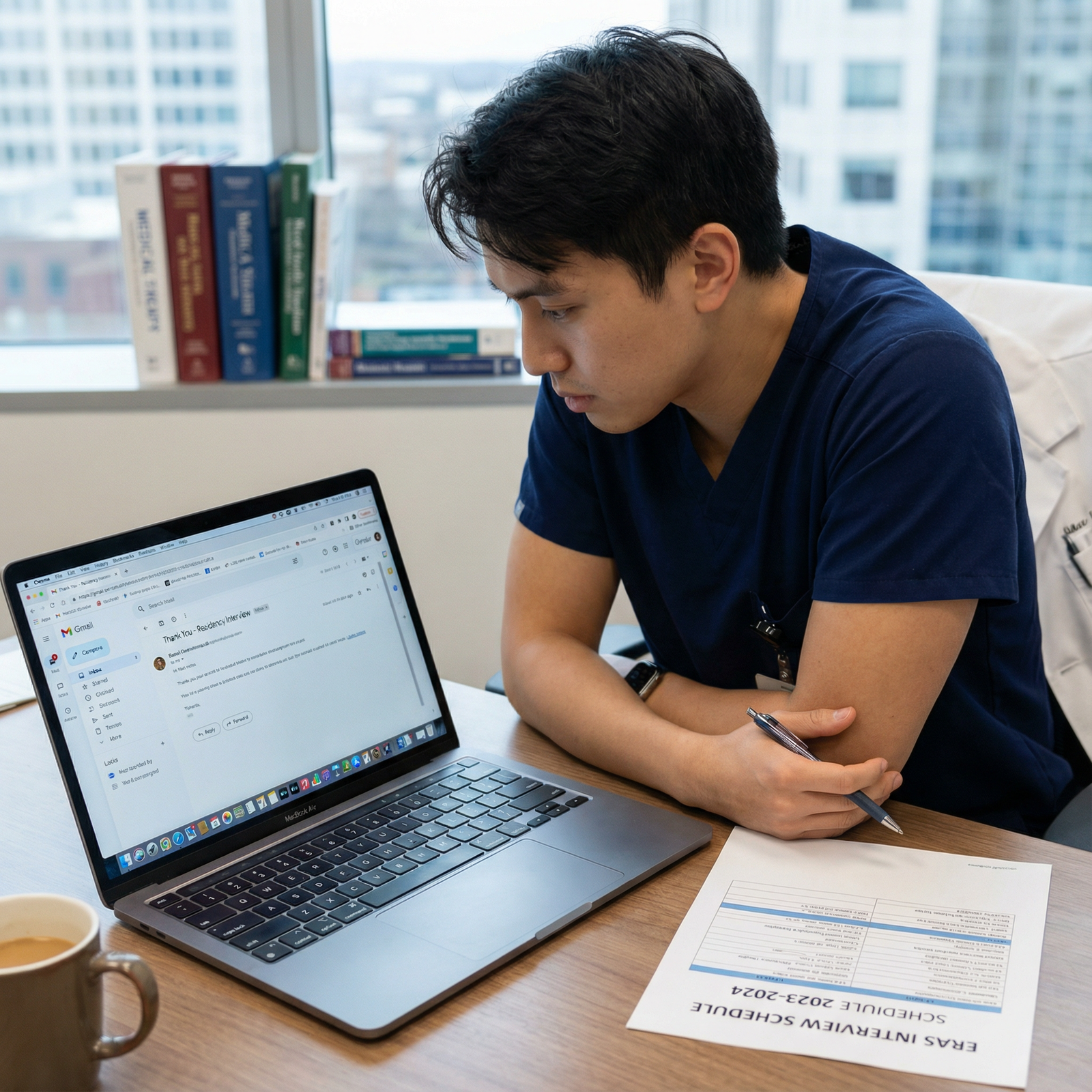
Beyond the basics, certain situations call for extra care and strategy.
Using Thank-You Notes to Address Missed Points or Concerns
If you left the interview thinking, “I wish I had mentioned X,” you can briefly and tactfully address it in your note:
“In reflecting on our conversation, I realized I did not have the chance to share that I recently presented a poster on sepsis outcomes at the regional ACP meeting. This experience further solidified my interest in hospital medicine and quality improvement.”
Keep this addition concise and relevant. Do not use the thank-you note to “redo” an entire answer or to argue with an interviewer about a challenging question.
Handling Virtual Residency Interviews
With most residency interviews being virtual or hybrid, your thank-you notes take on added importance because:
- You have fewer informal, in-person interactions to show your personality
- Slight technical issues or time pressure may have limited conversation depth
In your note, you can:
- Acknowledge and appreciate efforts to conduct comprehensive virtual interviews
- Briefly reference any tech disruption and your appreciation for their patience (if significant)
- Highlight something you observed about the program’s culture even through the virtual format
For example:
“Even over Zoom, I was struck by the camaraderie among the residents during the panel. It was reassuring to see how supportive the environment is.”
Avoiding Overly Aggressive or Misleading Language
Common pitfalls to avoid:
- Overpromising: Don’t say, “I will rank your program #1” unless absolutely true and used very selectively.
- Repeated follow-ups: A single, well-written thank-you email is enough. Avoid sending multiple messages asking if they received it.
- Negotiation tone: Do not imply that your interest depends on certain conditions (e.g., “I will rank you highly if I can be guaranteed a specific research mentor”).
- Flattery without substance: Saying “Your program is clearly the best” without any specific reasons can feel insincere.
Cultural and Institutional Variability
Not all programs weigh thank-you notes equally:
- Some explicitly state that thank-you notes do not affect ranking decisions
- Others appreciate them as evidence of professionalism and interest
- A few may advise that notes are unnecessary
If a program explicitly asks you not to send thank-you notes, follow their guidance. Respecting instructions is more important than sending a note.
Regardless of how each program views them, writing thoughtful, professional thank-you notes builds habits that will serve you throughout your medical career—with attendings, mentors, and future employers.
Frequently Asked Questions About Residency Interview Thank-You Notes
1. Do residency programs really care about thank-you notes?
It varies. Some programs consider them largely neutral, while others appreciate them as signs of professionalism and interest. Very few programs will advance or reject someone solely based on a thank-you email. However, in close decisions between similarly qualified applicants, positive, professional communication—including thank-you notes—can subtly reinforce a strong impression.
Think of thank-you notes as a low-risk, potentially beneficial component of your overall Professional Communication strategy.
2. What if I forget to send a thank-you note or send it late?
If you realize a week or more has passed:
- It can still be worth sending a brief, sincere note
- Acknowledge time passing indirectly by focusing on gratitude:
“I’ve been reflecting on our conversation and wanted to thank you again for the opportunity to interview…”
Do not over-apologize or draw attention to the delay. If you miss sending one entirely, don’t panic; it is only one piece of your application, not the determining factor.
3. Should I send the same thank-you note to everyone at the same program?
No. Using identical messages for multiple interviewers at the same institution is easy for them to spot and undermines the purpose of personal follow-up. It is fine to reuse a basic structure, but include at least one sentence tailored to each person—something you discussed, their role in the program, or advice they shared.
For group sessions or panels where you don’t have individual email addresses, a single note to the coordinator or chief resident thanking the group is appropriate.
4. Can I mention how I plan to rank the program in my thank-you note?
This is sensitive and must be handled carefully:
- You are not obligated to disclose your rank intentions
- If you choose to say a program is your “top choice” or “first choice,” do so only if it is completely true
- Avoid telling multiple programs they are your “number one”
Many applicants choose language that shows strong interest without making explicit ranking promises, such as:
“I will strongly consider ranking your program very highly on my list.”
This communicates enthusiasm honestly while preserving flexibility.
5. How long should my thank-you note be?
Aim for one short, clearly written email—typically 150–250 words. That is enough space to:
- Express gratitude
- Reference a specific conversation point
- Reaffirm your interest
Overly long messages can feel burdensome to busy faculty, while one-line notes can feel perfunctory. Brevity plus specificity is your goal.
Thoughtful thank-you notes will never replace strong clinical performance, solid letters of recommendation, or a compelling application—but they are a smart, professional way to maintain momentum after your Residency Interviews. By sending concise, personalized messages that reflect genuine interest and professionalism, you elevate your candidacy and refine a skill that will benefit you in every stage of your medical career.