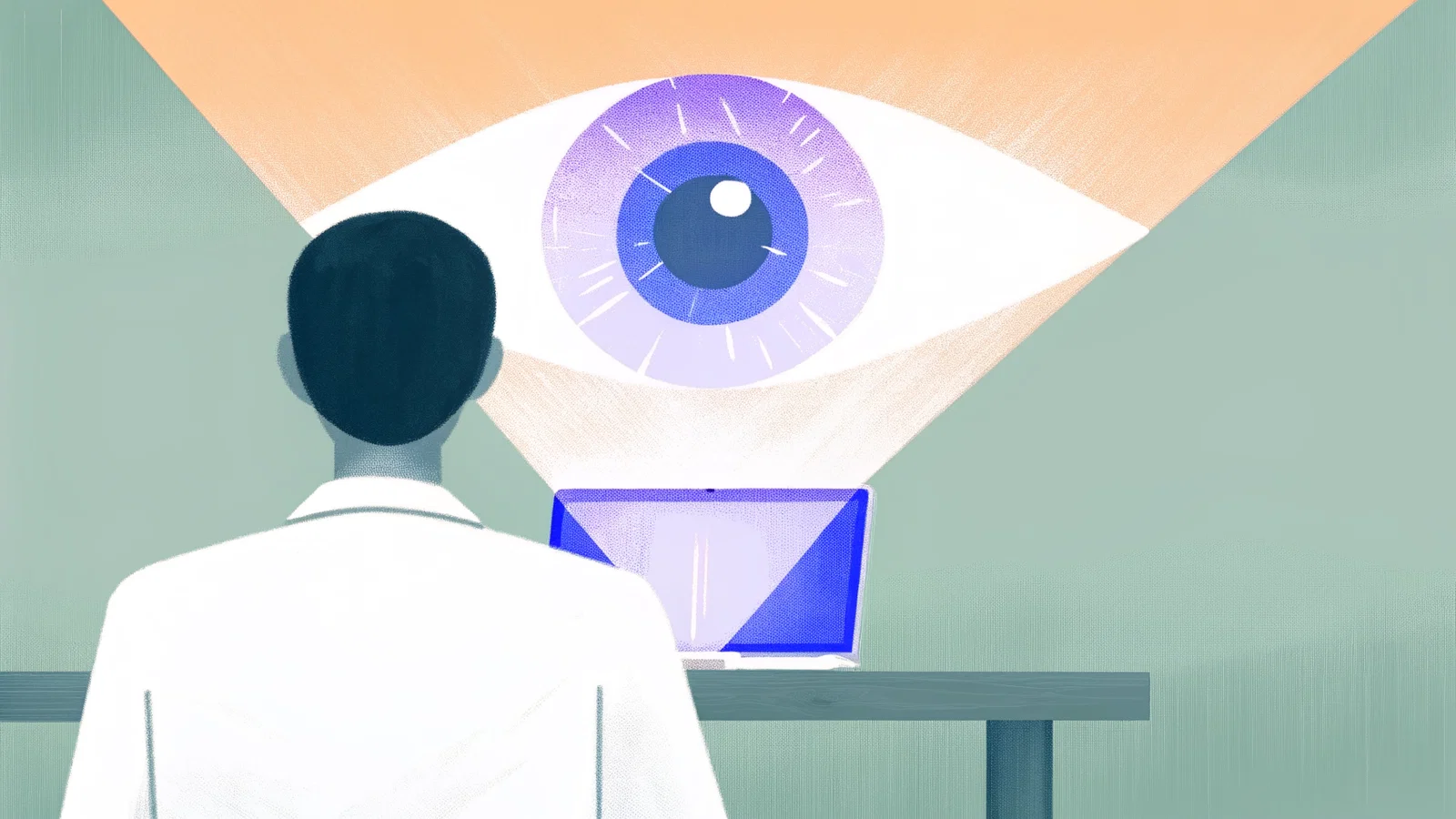
You know the moment. It's late. Too late. Your apartment is silent except for laptop fan noise and your own pulse in your ears. You've rewritten the same paragraph in your personal statement six times, and now you're staring at a sentence that still sounds wrong. So you do the thing almost everyone does now: you wonder if running it through Grammarly, or a summarizer, or even asking an AI tool, "Can you help me make this less clunky?" is going to somehow ruin your future.
And then the spiral starts.
What if ERAS has a secret detector? What if programs run everything through an algorithm you never hear about? What if one innocent edit gets labeled "AI-generated," and suddenly all the years of shelf exams, sub-Is, aways, research posters, and humiliatingly expensive application fees collapse because of one prompt at 3:00 AM?
I get why this fear has become so loud. Applicants are already trained to think one wrong move can be catastrophic. Wrong specialty signal. Wrong phrasing in an email. Wrong facial expression on Zoom. So of course AI became the new boogeyman. It fits perfectly into the existing panic ecosystem of residency applications: opaque rules, power imbalance, and just enough uncertainty to make your brain invent disaster.
Here's the truth I wish more people would say plainly: using a writing aid is not the same thing as committing fraud. Those are not morally or practically identical acts, and pretending they are only makes anxious applicants more paranoid. There is a real line, though. A very important one.
Editing assistance is one thing. That means grammar cleanup, sentence tightening, catching typos, maybe helping you organize your ideas after you've already done the hard part of actually living the story. Prohibited generation is something else. That's when you let a machine invent your voice, flatten your experiences into generic motivational sludge, or write the core narrative you're claiming represents you. That's where you get into trouble. Not because a magic robot catches you instantly, but because the result often sounds fake, bloodless, and weirdly polished in the worst way.
That's the part applicants miss. The bigger risk usually isn't a hidden AI police squad. It's turning yourself into a brochure. Program directors don't want brochure language. They want a doctor they can work with at 2:00 AM on a brutal call night. If your personal statement reads like it was assembled from med school website mission statements and inspirational LinkedIn captions, that hurts you far more than a grammar check ever will.
So no, we are not all one prompt away from disqualification. That's panic talking. But yes, there is a difference between ethical support and outsourced authorship, and pretending there's no line at all is just as foolish as acting like every spellcheck tool is a career-ending trap.
The Anatomy of an AI Audit: How Detectors Actually Work, and Why They Fail
Let's strip away the mystique. AI detectors are not mind readers. They are not courtroom-grade truth machines. They do not look at your paragraph and declare, with godlike certainty, "a human wrote this" or "a chatbot wrote this." That fantasy needs to die.
Most detectors work by generating probability scores based on patterns in text. The two buzzwords you'll see over and over are perplexity and burstiness.
- Perplexity asks, roughly, how predictable the text is.
- Burstiness looks at variation in sentence structure and rhythm.
AI-generated writing often has patterns that are smoother, more uniform, and more statistically predictable than messy human writing. So detectors try to spot that. The problem? Plenty of honest human writing is also predictable, especially medical writing.
If you are concerned about whether this includes research, review can you list AI-assisted research on your CV without violating academic integrity policies before submitting.
That's the nightmare baked into this whole issue. Medical students are trained to write in a formal, structured, cautious style. We use repeated phrases. We summarize clinical experiences in clean, restrained prose. We've been conditioned by evals, abstracts, case reports, and SOAP notes to sound polished and professional. Which means perfectly human medical writing can look "AI-ish" to crude detection tools.
That's why false positives are such a mess. A sincere applicant can absolutely get a suspicious score simply because their writing is organized, grammatically clean, and not full of chaotic diary energy. If you've ever written, "My experiences caring for underserved patients solidified my commitment to internal medicine," congratulations: half the internet thinks a bot wrote that. Maybe because a thousand humans wrote versions of it first.
And that brings us to the question everyone is really asking: does the AAMC or ERAS actually scan personal statements for AI fingerprints?
Right now, there is no credible public evidence of a widespread, standardized, automated ERAS process that mass-screens personal statements with some all-powerful AI detector and auto-rejects applicants. Could institutions technically use software? Sure. Technical possibility is not the same thing as current routine practice. That distinction matters. A lot.
Applicants keep imagining a hidden backend dashboard with red warning lights next to suspicious essays. I understand why. The application process feels secretive enough that anything seems possible. But feeling possible and being common are different things. Very different.
Remember that if you're worried about your specialty's future, it helps to understand what if AI makes my chosen specialty obsolete? how to think about risk as you frame your narrative.
Also, think about the logistics. Residency applications are already overloaded with real variables programs care about: board scores, transcripts, dean's letters, LORs, visa needs, geographic ties, signaling, clinical performance, research, and actual fit. Programs are not sitting around building elite forensic AI-linguistics task forces to hunt down every sentence polished by software. They barely have time to review what actually predicts resident success.
Could a school, advisor, or program become suspicious if a statement sounds robotic or wildly inconsistent with your known voice? Absolutely. Humans notice that. They don't need a detector for it. In fact, human suspicion is often more relevant than software output. If your emails sound normal, your interview sounds normal, and your personal statement suddenly sounds like a synthetic TED Talk wrote itself, that's a problem. A human problem.
So yes, detectors exist. Yes, they can score text. No, they are not reliable enough to serve as clean evidence of cheating. And no, there is no solid reason to believe honest applicants are being silently blacklisted en masse because they used a grammar tool or brainstorming prompt.
That rumor survives because fear spreads faster than facts.
Data Driven: The Reality of Modern Residency Vetting
Here's the boring truth, which is also the comforting truth: residency programs still evaluate applicants mostly the old-fashioned way. Not perfectly. Not always fairly. But mostly through established signals, not sci-fi text policing.
What moves the needle?
- Step 2 CK
- Clinical grades and transcript trends
- Letters of recommendation
- MSPE language
- Research and scholarly work
- Performance on away rotations
- Interview impression
- Evidence of professionalism and fit
That's the stack. That's where the oxygen goes.
The personal statement matters, but not in the melodramatic way applicants think. For most programs, it's a supporting document. It can help. It can hurt if it's awful. It can clarify a red flag, show maturity, or explain your path. But it is rarely the single lever on which your entire future hangs. A decent statement won't rescue a weak application. A fancy one won't distract from poor fit. And a suspiciously polished one can absolutely make readers trust you less.
That's why the current AI panic is so distorted. It treats the personal statement like a surveillance trap when, in reality, programs are using it more like a character sample. They want to know whether you sound reflective, grounded, and self-aware. Not whether you can produce immaculate corporate prose.
If you look at actual patterns of application disqualification historically, the reasons are usually concrete and old-school:
- Misrepresentation
- Missing or falsified credentials
- Professionalism issues
- Dishonesty in application content
- Sometimes plagiarism, when blatant
Not "used an AI sentence polisher once and got vaporized by a hidden detector."
That doesn't mean you should get reckless. It means you should fear the correct things. Fear submitting a statement that sounds fake. Fear claiming insights you don't actually believe. Fear letting a tool turn your real story into generic paste. That's the realistic danger.
I've seen applicants over-sanitize their essays into oblivion. A student tells a moving, very human story in draft one, messy, awkward, sincere. Then they keep "improving" it with outside tools until suddenly it sounds like this:
"My longitudinal exposure to diverse patient populations catalyzed a profound commitment to compassionate, interdisciplinary care."
Come on. Nobody talks like that. That sentence is application wallpaper. It says nothing. It could belong to anyone applying to anything. It's not unethical because a robot touched it. It's just bad.
So what does ethical AI use actually look like? Pretty simple.
Reasonable uses:
- Brainstorming themes from your own experiences
- Helping build an outline
- Asking for grammar or punctuation cleanup
- Tightening a sentence you already wrote
- Checking readability
- Generating a list of questions to help you reflect more deeply
Bad uses:
- "Write my personal statement for psychiatry"
- Feeding it your CV and asking for a complete narrative
- Copying large chunks of generated prose
- Using it to manufacture emotion or insight
- Letting it create stories, dialogue, or details you didn't live
If the tool is helping you think more clearly, fine. If it is replacing your thinking and voice, that's where the floor falls out.
The cleanest rule I can give you is this: if you'd be uncomfortable saying out loud exactly how you used the tool, you probably went too far.
Another practical reality: most programs aren't trying to catch tiny process violations. They're trying to choose residents who will be safe, teachable, hardworking colleagues. That's it. If your application reflects those qualities, you're speaking their language. If it reads like generated content designed to impress a machine, you've misunderstood the assignment completely.
And for the applicants losing sleep over "historical data" on AI disqualification specifically: there just isn't evidence of a massive, automated purge happening in residency admissions. The fear is louder than the facts. Again.
Could this change in the future? Sure. Institutions may create clearer AI policies. Some schools may get stricter. Some programs may ask for more explicit attestation of authorship. That's possible. But right now, in the real world, your energy is much better spent writing something true than trying to game invisible software.
Truthfully, the safest personal statement is not the one that tests "most human" on a detector. It's the one that actually is human. Yours. Specific. Imperfect in a good way. Anchored in moments no algorithm could invent convincingly because they're too particular: the patient who changed how you listen, the attending who pushed you, the rotation that clarified what kind of work leaves you feeling useful instead of hollow.
That's what sticks.
Protecting Your Future: The Do's and Don'ts for the Anxious Writer
If you're anxious, I don't think "just relax" is helpful. It's insulting, honestly. So here's the practical version.
Do:
- Write the first real draft yourself. Not the polished draft. The ugly one. The honest one.
- Use AI only after you know what you want to say. Never before.
- Keep version history. Google Docs timestamps, tracked changes, saved drafts. Cheap insurance for your peace of mind.
- Read your statement out loud. If it sounds like a hospital mission statement, fix it.
- Ask a real human who knows you whether it sounds like you. That feedback matters more than any detector score.
Don't:
- Don't outsource your core narrative. That's not editing. That's ghostwriting with extra steps.
- Don't chase "perfect" language. Perfect is suspicious. Personal is memorable.
- Don't assume every polished sentence is dangerous. Clean writing is not a crime.
- Don't panic over detector screenshots online. A lot of those tools are glorified nonsense calculators.
And let me say the quiet part clearly: robotic AI output is more dangerous to your application than being flagged by some mythical automatic cheating system. Program directors may never run a detector. But they absolutely can feel when an essay has no pulse.
Your residency future is not hanging by a thread over one grammar check. It is hanging, in part, on whether your application feels trustworthy. Human. Coherent. Real.
So protect that. Keep your drafts. Use tools lightly if you use them at all. And if your anxiety is so bad that every plugin feels radioactive, then turn them off and write in a blank document. Seriously. Peace of mind matters.
Then submit something that sounds like an actual future doctor. Not a chatbot wearing a white coat.
If you're stuck, do one brave thing tonight: open a clean page and write the version only you could write. Messy beats fake. Every time.