The 3:00 AM Cold Sweat: Is My AI Scribe a Career-Ending Mistake?
It is 3:14 AM. My laptop fan is whirring like a jet engine, casting a harsh blue glow across my bedroom wall. I'm staring at an empty EPIC note template, but my heart isn't beating normally. It's pounding against my ribs.
Before you stress too much about the audit trail, consider what attendings won't tell you about piloting AI tools as a resident.
Earlier today, during my internal medicine Sub-Internship, I recorded a complex admissions history using an ambient AI scribe tool. In less than forty seconds, it transformed twenty minutes of rambling patient dialogue, cholecystitis, a history of non-adherence, a messy social situation, into a gorgeous, perfectly formatted History and Physical. It was crisp. It was clean. It saved me an hour of soul-crushing typing after sign-out.
And now, in the pitch-black silence of my room, I am convinced I've ruined my life.
What if my attending noticed? What if the EHR audit trail logs that a 4-page note was pasted into the chart in three seconds flat? Will the Program Director at my dream residency program view this as modern efficiency, or am I about to get reported to the honor board for academic dishonesty?
That's the fear that keeps me awake. We live in an era where healthcare systems are aggressively purchasing AI documentation software like Nuance DAX, Abridge, and Freed. Hospitals boast about reducing physician burnout. Yet as a medical student applying to residency, I feel trapped in a terrifying gray zone.
There's a toxic, unwritten rule in medical education: suffering equals learning. If you didn't spend three grueling hours hunting down old records and manually typing out a 14-point Review of Systems, did you actually work? Or did you just cheat the system?
I catch myself spiraling into worst-case scenarios. I picture a Residency Selection Committee pulling up my application, seeing a glowing letter of recommendation, and then someone leaning forward to whisper: "Yeah, but they used AI to write their Sub-I notes. They can't synthesize a clinical plan on their own."
It feels like a trap. If I don't use the technology, I lag behind, look slow on service, and leave the hospital at 8:00 PM while everyone else is already home eating dinner. But if I do use it, I risk being branded a lazy, dishonest applicant who cut corners on their own education.
The Efficiency Paradox: Why I'm Terrified That Faster Isn't Better
We've been conditioned to believe that speed is a proxy for competence. When an attending asks for a differential diagnosis on rounds and a resident rattles off six spot-on possibilities in five seconds flat, we call them brilliant. But when it comes to documentation, speed suddenly feels suspicious.
Why am I so terrified that writing notes faster will make me look worse?
To keep your clinical skills sharp, remember the med student mistake: treating AI output as evidence in presentations.
The core of my anxiety stems from what I call the Efficiency Paradox. A clean, perfectly structured AI note looks professional on the surface. But to a sharp attending, does it look too perfect? Does it hide a total lack of underlying clinical reasoning?
When you manually write a note, the friction of typing forces your brain to process the case. You struggle to phrase the Assessment and Plan because you're actively figuring out if the patient's hyponatremia is hypervolemic or hypovolemic. The struggle is the proof of work.
When an AI scribe generates that text for you, it leaps straight to the end product. It swallows the raw data and spits out a pristine SOAP note.
Here's my nightmare: an attending reads my AI-generated note, nods at the slick formatting, and then asks me during table rounds, "Why did you order a serum osmolality here?" If I stumble, if I hesitate for even two seconds, the illusion shatters. They'll instantly know the note wasn't a reflection of my brain. It was just a machine talking to a machine.
Then there's the risk of robotic over-documentation. AI scribes love fluff. They pull in every minor detail, creating massive bloat. If my attending has to wade through five paragraphs of AI-generated prose just to find out if the patient passed gas post-op, they aren't going to be impressed by my "efficiency." They're going to be annoyed. And an annoyed attending doesn't write glowing Dean's Letters.
What PDs Actually Want: A Reality Check for the Paranoid Applicant
When I'm not panicking at three in the morning, I try to force myself to look at the cold, hard reality of how residency programs actually evaluate us.
Program Directors aren't sitting in their offices plotting ways to catch students using ambient scribes. They are drowning in administrative work themselves. What they actually care about isn't whether you suffered while typing; it's whether you are safe, accurate, and capable of taking care of human beings.
Look at that gap. We as applicants and residents love the convenience of these tools, 85% of us feel completely fine leaning on them for speed. But attendings are far more skeptical. Only 65% trust the output accuracy without heavy editing.
That gap is where our anxiety lives. But it's also where the solution lies.
PDs don't view AI as cheating unless you use it to replace your brain. The boundary between smart tool usage and intellectual dishonesty comes down to ownership.
If you let an AI scribe draft your History of Present Illness, but you personally craft the Assessment and Plan, stripping out the robotic fluff, double-checking every lab value, and verifying every detail with the patient, you aren't cheating. You're acting like a modern attending.
Think about it this way: when electronic health records first replaced handwritten paper charts, older physicians complained that copy-pasting lab results was "lazy." When medical calculators like MDCalc came along, people worried students wouldn't learn how to calculate an FENa by hand. Technology always triggers an existential panic in medicine.
The applicants who get into trouble aren't the ones using AI. They're the ones who copy, paste, and sign without reading. They're the ones who let the AI introduce a hallucinated physical exam finding, like documenting "normal bowel sounds" on a patient with a surgical ileus, and miss it because they were in a rush to leave.
That isn't a tech problem. That's a patient safety red flag.
Finding My Calm: Protecting My Future While Using Modern Tools
So how do I stop sweating through my bedsheets every time I press "generate" on an AI scribe? I had to build a personal rulebook. A set of non-negotiable boundaries to protect my education, my reputation, and my sanity.
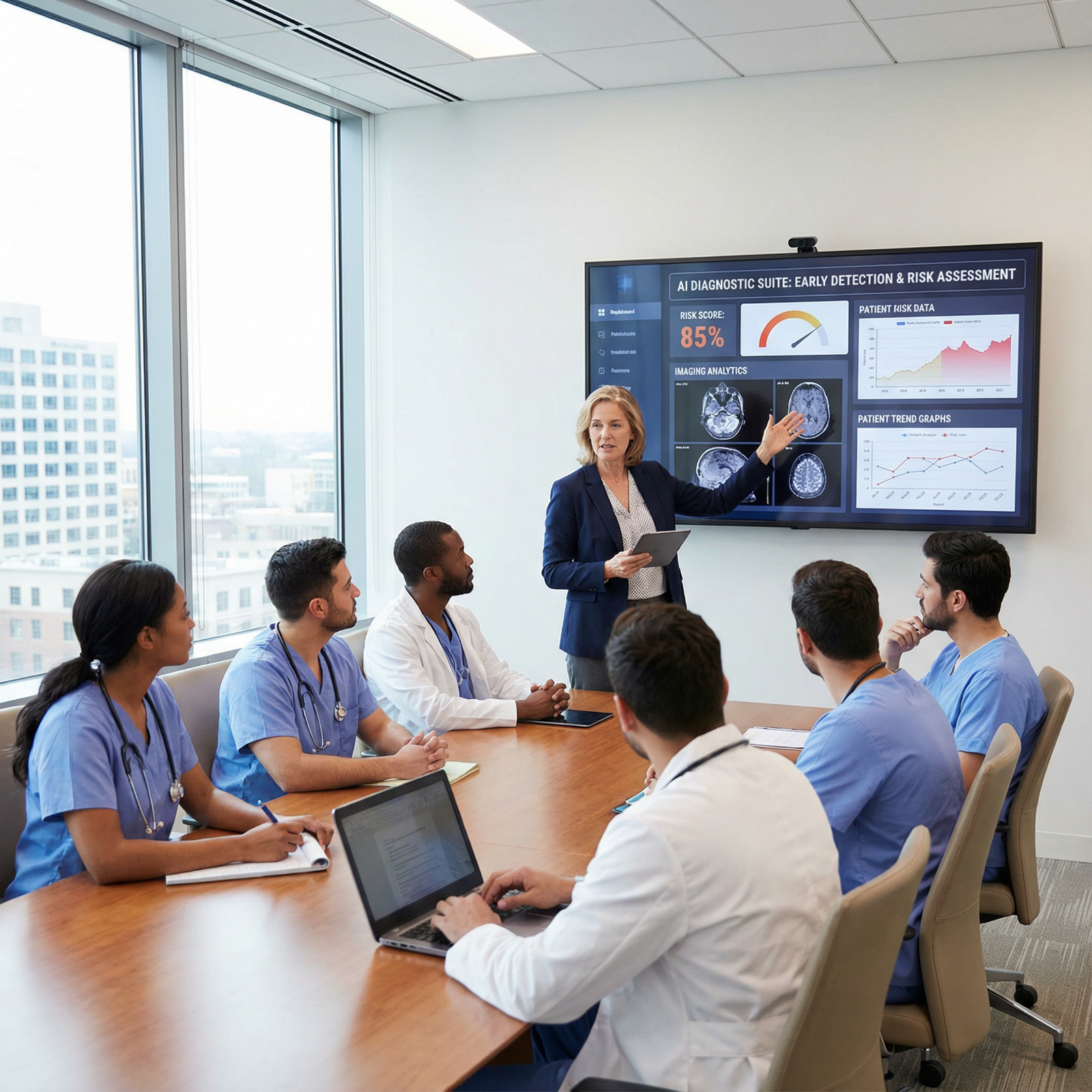
First, I strip the AI out of the Assessment and Plan entirely.
The HPI and Review of Systems are historical capture, that's data gathering. AI is brilliant at taking a ten-minute conversation about chest pain and organizing it chronologically. Let it do that heavy lifting. But the Assessment and Plan? That is my real estate. That is where I prove I am becoming a doctor. I delete whatever generic text the software generates for the A&P and type out my own reasoning, line by line.
Second, I treat the AI output like a rough draft written by a brand-new, overly eager rotating shadow student.
I assume it made a mistake. I audit every physical exam claim. Did the AI say "chest clear to auscultation" when I never pulled out my stethoscope during that quick bedside check? Delete. Did it turn "my granddad had heart trouble" into "family history of premature CAD"? Verify with the patient.
Third, I embrace total transparency. If an attending asks how I got my note done so quickly, I don't blush and stammer. I say directly: "I used an ambient scribe to capture the history, and then I went through and edited the plan to focus on our workup for pulmonary embolism."
It turns out, attendings don't hate tech. They hate deceit. When you frame AI as a workflow multiplier that allows you to spend more time at the patient's bedside and less time staring at a monitor, you aren't a shortcut-seeker anymore. You're an efficient, patient-centered clinician.
We are navigating a massive shift in how medicine is practiced. The anxiety is real, and the fears of getting it wrong are completely valid. But hiding from the tools of the future won't make us better doctors, learning to wield them responsibly will.
What about you? Have you ever had an awkward moment with an attending over an AI tool, or felt that sick pit in your stomach wondering if your note looked "too automated"? Share your worst AI mishaps and fears in the comments below, let's stop worrying alone in the dark at 3:00 AM.
Key Takeaways
- PDs prioritize patient safety and documentation accuracy above all else; if AI makes your notes cleaner and freer of errors, it is an operational asset, not a cheat.
- The 'human touch', your specific assessment and plan, must remain yours; never let an AI replace your clinical reasoning or decision-making process.
- Transparency is your shield: if your rotation allows AI tools, use them openly, but always edit the draft so it faithfully reflects your real-time encounter.