

Somewhere along the way, "I'm working full-time during my gap year" became a badge of seriousness, a way to signal to program directors, parents, and yourself that you weren't wasting time. Here's the problem: that belief is exactly that. A belief. There is no universal dataset showing that a 40-hour gap year job produces better match outcomes than a 20-hour one. What the evidence and the logic actually support is far less glamorous: the best schedule is the one matched to what you're trying to fix.
So let's ask the real question. When does part-time work actually outperform full-time work? And which outcomes should you even care about, income, application quality, burnout recovery, research output, clinical growth, or raw match readiness? Because once you define the outcome, the "right" answer changes fast. Let's bust this myth properly.
This article is for educational purposes only. It is not financial advice, not legal advice, and not tax advice. Figures vary by individual circumstances, so consult a qualified professional before acting.
What the Data Actually Measures: Outcomes That Matter, Not Just Hours Worked
First, an honesty check, because this is a Myth Buster article and we don't fake certainty here. Nobody has run a randomized trial assigning applicants to part-time versus full-time gap year jobs and tracking match rates. That data doesn't exist. What we do have is the NRMP Program Director Survey, match outcome reports, and a whole lot of observable patterns, and none of them say "programs prefer applicants who worked more hours."
What programs actually weigh heavily, survey after survey, are exam scores, clerkship performance, letters of recommendation, and whether you can tell a coherent story about your training gaps. Notice what's missing: your timesheet. Program directors don't ask whether your research coordinator job was 35 or 45 hours a week. They ask what you produced, who vouched for you, and whether you seem like someone who will show up functional on day one of intern year.
That's why "more hours" is a lazy proxy. Productivity during a gap year depends on role quality, mentorship, and alignment with your career goals, not clock time. Forty hours a week of scribing with zero mentorship can leave your application untouched, while twenty hours a week in a lab with a PI who actually emails your abstract to her colleagues can change your trajectory. I've watched both happen. The winner wasn't the busier person.
The chart above is illustrative, not gospel, but it reflects what applicants consistently say they're trying to get out of the year. Look at it carefully. Only one of those bars is about money. The rest are about becoming a stronger, saner candidate. That should already tell you the full-time-vs-part-time debate is about strategy, not virtue.
Full-Time Gap Year Work: Where the Advantages Are Real
Now let me debunk in the other direction, because the contrarian trap cuts both ways. The anti-hustle crowd loves to claim full-time work during a gap year is a burnout machine. Also not universally true.
Full-time work delivers three concrete advantages that part-time often can't. First, income stability. ERAS applications, interview travel, and relocation deposits add up to thousands of dollars, and plenty of applicants are making loan payments on top of that. If your financial floor is shaky, a steady paycheck isn't a luxury, it's what lets you apply broadly instead of strategically underapplying because you can't afford more programs.
Second, structure. This is the part people underestimate. Some applicants flounder with open time. Give them 30 free hours a week and they'll fill ten of them productively and twenty with anxiety and Netflix. A structured full-time job, say, a clinical research coordinator position with a real team, real deadlines, and a PI who expects weekly progress, eliminates decision fatigue. You wake up knowing exactly what to do. I've seen applicants whose entire gap year was rescued by that kind of scaffolding.
Third, immersion. If the goal is to strengthen a weak application efficiently, say you need publications, a specialty-specific letter, and clinical skills in one year, a well-mentored full-time research or clinical role compresses that growth. Depth beats breadth when the clock is ticking toward September.
So when does full-time win? When money is tight, when the role comes with genuine mentorship, or when your application needs a concentrated, all-in rebuild. That's a real list. Just don't pretend it's universal.
Part-Time Gap Year Work: The Flexibility Advantage People Underestimate
Here's the bias I want to kill: the assumption that part-time equals "less serious." I know an applicant who worked two eight-hour urgent care shifts a week during his gap year. The rest of his time went to Step 2 prep, a quality improvement project with his home program, and, critically, sleep and exercise after a brutal third year. He matched into emergency medicine at a strong program. Meanwhile, a classmate of mine took a 50-hour-a-week coordinator job and had to scramble to get shift coverage for three separate interview invites. One of them she nearly couldn't attend.
Which one was "less serious"?
Part-time work preserves bandwidth, and bandwidth is the scarcest resource in application season. Interview invitations cluster between October and January, often with limited scheduling windows. Step 2 CK retakes or Step 3 prep demand real study blocks. And if you're carrying burnout from clerkships, and a lot of you are, whether you admit it or not, recovery isn't optional self-indulgence. It's the difference between showing up to interviews as a compelling colleague or as a hollowed-out version of yourself.
The best-fit scenarios for part-time: applicants recovering from genuine exhaustion, people building a balanced portfolio (per diem clinical work plus volunteering plus research), and anyone juggling family or financial caregiving responsibilities alongside the application. Part-time done strategically doesn't dilute your application. It can produce a better one, because the freed hours go exactly where the application is weakest.
The Tradeoffs Nobody Likes to Admit
Both camps have a failure mode, and both camps pretend theirs doesn't exist.
Full-time's downside is obvious once you say it out loud: inflexibility. You're coming off one of the most demanding pipelines in professional education, and you're signing up for another year of fixed hours right when you need agility. Interviews, networking, second looks, a sudden Step 3 date, all of it competes with a boss who needs you Tuesday. And if the job is high-volume clinical work, you can finish your gap year more burned than when you started. That's not match readiness. That's damage.
Part-time's downside is quieter but just as real: drift. Lower income is the obvious cost, but the sneakier one is the collapse of structure. Without a disciplined plan, "I'm using the extra time for research" becomes "I opened the manuscript twice in October." I've seen applicants hit March with nothing to show but a lighter bank account and a vaguer personal statement.
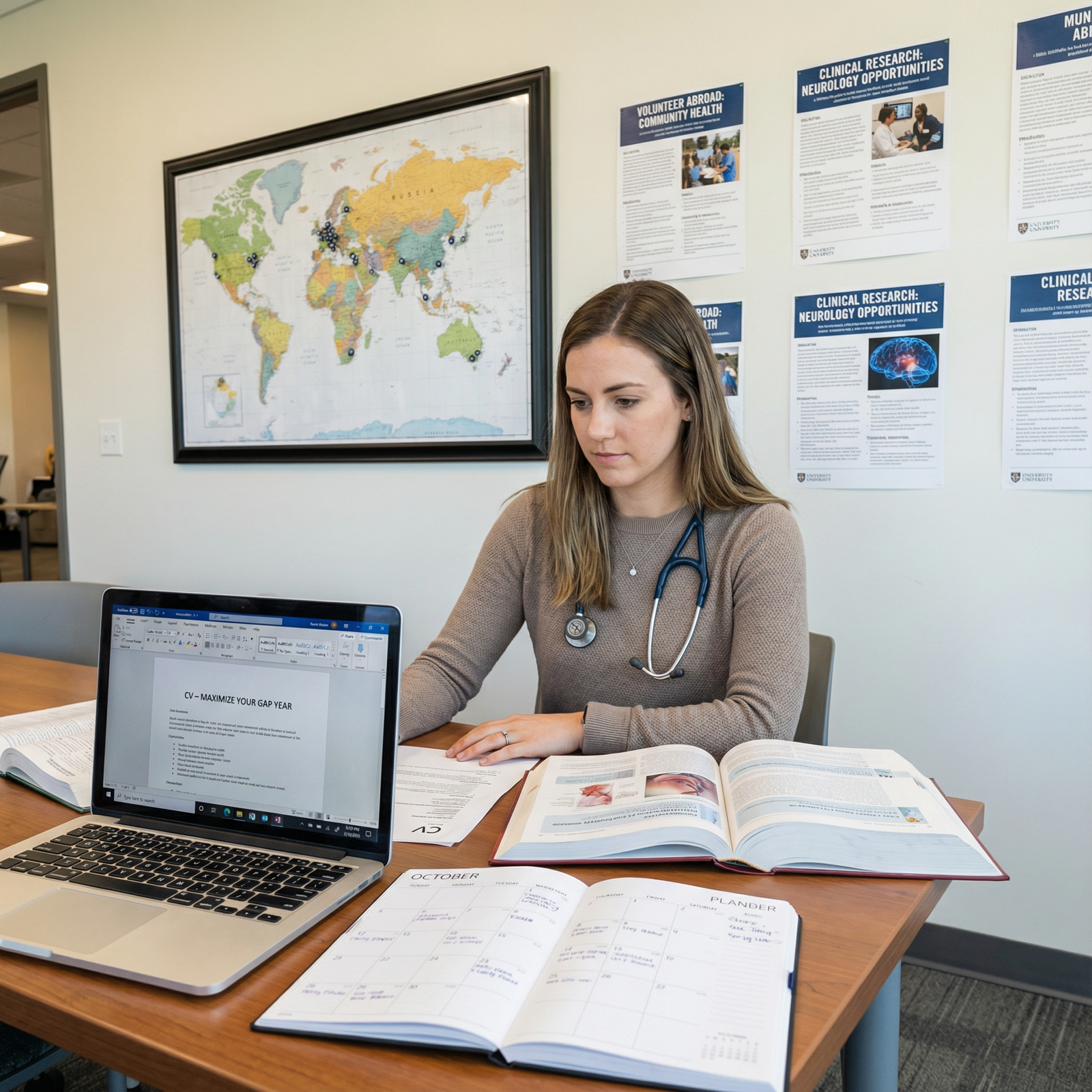
So the real variable isn't work status. It's whether your schedule, whatever it is, generates consistent output and protects your mental health. A calendar that does both is the entire game.
How to Choose Based on Your Goal: Money, Match Strength, or Recovery
Stop asking "which is better" and start asking "better for what." The framework is simple:
If your primary constraint is financial, rent, loans, application fees, full-time work is the rational choice, and don't let anyone shame you for it. Financial panic is a worse match-killer than a busy schedule.
If your primary goal is application strength, scores, publications, letters, a polished ERAS, part-time is often strategically superior, because it buys you the hours to attack your actual weaknesses.
And if your primary need is recovery, treat that as a legitimate goal, not a character flaw. A gap year spent clawing back your health while doing focused part-time work beats a year of performative grinding that leaves you interviewing like a ghost.
Whatever you pick, run it like a project. Set measurable weekly targets: manuscripts touched, questions done, programs researched. Protect your interview windows the day the job starts, negotiate that in writing if you can. And evaluate any job by a brutal filter: does it give me a story, a letter, a skill, or a line on ERAS? If the answer is "it fills time," keep looking.
Closing: The Reminder That the Best Choice Is the One You Can Execute Well
Here's what I want you to remember when someone at a family dinner raises an eyebrow at your "only part-time" gap year: there is no universal winner. The data favors fit, not ideology. Busy is a look. Output is a fact.
Choose the schedule that maximizes what you produce, protects your wellbeing, and gets you to interview season functional and prepared, without romanticizing hustle for its own sake. Then build the plan, run it for a month, and check the receipts. Is your application actually getting stronger? If yes, your schedule is right. If no, no amount of hours will save it.
The bottom line:
- Full-time isn't automatically superior, the better choice is whichever one serves your goals, energy, and strategy.
- Part-time is often the smarter play when flexibility, interviews, research, or recovery outrank maximum income.
- Judge your gap year by outcomes achieved, not by how impressive your exhaustion sounds.


