

Programs don’t reject you because you took a gap year. They reject you because you can’t explain it.
That’s the uncomfortable truth underneath all the doom-scrolling on SDN and Reddit. It’s not the year off. It’s the story. Or the total lack of one.
You’re probably here because your brain is doing the usual spiral:
“I took a gap year. I didn’t do a research fellowship at Harvard. I worked some random job, tried to fix my mental health, maybe studied for Step, maybe helped family… What if they think I got lazy? What if they think I couldn’t hack it? What if this gap year ruins my chances of matching?”
Let me say the thing you’re scared to believe: a gap year can make you look more mature and more ready for residency. Or it can make you look unfocused and flaky. Which one you are depends almost entirely on how you frame it.
The uncomfortable part: how programs actually see gap years
Let me be blunt. Program directors and interviewers don’t sit there with a spreadsheet going:
- Gap year? Reject.
- No gap year? Accept.
That’s Reddit logic. Real life is messier.
Here’s what they actually worry about when they see a gap:
Are you unreliable?
Did this person randomly disappear from medicine for a year with no coherent explanation?Are you running from something?
Big red flags: failed Step exams, professionalism issues, huge unexplained time off.Are you still “in shape” clinically and academically?
Especially if your gap was completely non-clinical or if you haven’t touched medicine in a while.Do you understand what residency actually is?
Or did you just… drift for a year?
Notice what’s missing? “Did this person do something super shiny and prestigious every second of that year?” No.
I’ve heard attendings say on selection meetings:
“I don’t care that they took time off. Just show me they used it to grow instead of hide.”
That’s your job now: turning “I’m scared they’ll think I’m unmotivated” into “Here’s why this year made me more ready for residency than I would’ve been otherwise.”
First, diagnose your own gap year (without lying to yourself)
You can’t reframe a gap year if you’re not honest about what you actually did.
And yes, this is the part that feels gross because your brain immediately goes: “It wasn’t enough. I should’ve done more. Everyone else did more. I wasted it.”
Slow down. Break it down into what you actually did. Even if you think it’s nothing, it’s probably not nothing.

Ask yourself:
- Did you work? Clinical or non-clinical. Scribe, MA, tutoring, barista, whatever.
- Did you study? Step 2/3, language learning, courses, board prep.
- Did you deal with health or mental health stuff? Therapy, burnout recovery, physical illness.
- Did you handle family responsibilities? Caregiving, financial support, immigration issues, kids.
- Did you do research? Posters, small projects, quality improvement, chart reviews.
- Did you volunteer? Free clinic, shelters, teaching, community work.
- Did you rest after a brutal stretch of training or exams?
Now, classify your year brutally honestly:
| Gap Year Type | How Programs Often View It |
|---|---|
| Structured (research, fellowship, MPH) | Clearly motivated, easy to frame |
| Semi-structured (mix of work, study, some clinical) | Neutral → can become a strength with good explanation |
| Recovery-focused (mental/physical health, burnout) | Can be a strength if explained with maturity |
| Family-need focused (caregiving, financial) | Often respected if clearly articulated |
| Drifting, no plan, minimal activity | Risky if not reframed carefully |
Most people are actually in that middle gray zone: semi-structured, messy, some progress, some flailing, some “I just tried to survive.”
That’s workable. What kills applicants is pretending they either did nothing wrong or spinning some fake “passion project.” Interviewers can smell that.
The core move: turn “gap” into “deliberate transition year”
You need one main narrative sentence about your gap year. One line that becomes your anchor.
Something like:
- “I took a year between graduation and residency to focus on Step 2, work clinically as a scribe, and address some burnout so I could start residency fully functional.”
- “I delayed applying by a year after medical school to care for a sick family member while staying connected to medicine through clinic work and research.”
- “I used this transition year to work in a community clinic, improve my Spanish, and confirm that primary care is the right path for me.”
Notice a few things these sentences do:
- They’re intentional. Not “I just didn’t match and then… yeah.” There’s purpose.
- They show continuity with medicine. Some thread that says: I didn’t walk away.
- They point to growth. Not escape. Growth.
Then you back that sentence up with specific examples.
But what if I “wasted” half the year?
Then you don’t pretend you didn’t.
You frame the year as having phases instead of some seamless, highly optimized timeline.
Something like:
- “The first few months after graduation, I realized how burned out I was. I was going through the motions and my studying wasn’t sticking. I started therapy, cut back on commitments, and gradually rebuilt my study habits. The second half of the year, I was consistently working part-time in clinic and studying for Step 2 in a much more sustainable way.”
You’re not a robot. Program directors know med school + exams wreck people. What they want to see is that you:
- Recognize problems
- Take responsibility
- Course-correct
That’s maturity, not unmotivation.
How different “messy” gap years can be reframed
Let’s go through some of the exact nightmare scenarios your brain keeps replaying.
Scenario 1: “I mostly worked a non-medical job. Hardly any clinical.”
Maybe you bartended. Or did Uber. Or retail. Because rent is real and med school debt doesn’t care about your “idealized CV.”
You’re terrified they’ll think: clearly not committed to medicine.
You reframe by:
Showing you stayed engaged with medicine somehow, even lightly:
- CME webinars
- Shadowing once a week
- Attending grand rounds
- Light volunteering at a clinic
Extracting real skills from that job that matter for residency:
- De-escalating angry customers at 2 am → you can handle angry patients.
- Rapid multitasking while short-staffed → welcome to every call night.
- Learning to actually listen because tips depended on it → bedside manner.
How you say it, concretely:
“In my gap year, I worked full-time at [job] to support myself financially while I prepared to re-apply. I knew I didn’t want to disconnect from medicine entirely, so I [shadowed in X clinic/volunteered at Y/attended Z lectures]. That job taught me how to manage high-volume, high-pressure situations while staying calm and respectful, which I’ve already found translates directly to working with patients and interdisciplinary teams.”
Is it glamorous? No. Is it useless? Also no. The only thing that makes it useless is if you present it as shame instead of learning.
Scenario 2: “I burned out and basically shut down for a while.”
This one feels like the ultimate shame scenario. “I broke.” So your brain says: hide it.
I think that’s a mistake.
You don’t need to give your life story. You don’t need to trauma dump in ERAS. But a vague, hand-wavy “I took some personal time” can actually look worse than a clear, concise explanation.
You might say:
“After an intense stretch of training and exams, I reached a point where I recognized I was burned out. I wasn’t functioning at the level I expect from myself, and it was affecting both my wellbeing and my performance. I made the decision to step back, work with a therapist, and rebuild more sustainable habits. During the second half of that year, I gradually increased my responsibilities, including [X clinical task / Y research / Z volunteer], and I’ve returned with better boundaries and much more self-awareness about my limits.”
That doesn’t read as “unmotivated.” That reads as “someone who will be less likely to implode PGY-1 and disappear mid-block.”
Residency is rough. Programs actually like people who understand what burnout is and have already done some work to manage it.
Scenario 3: “I didn’t match, then I had a messy year trying to regroup.”
This one stings the most.
Everyone tells you to explain your “SOAP year” perfectly. But your actual year looked more like: panic, scrambling for prelims, maybe a research thing that fell through, living at home again, random temp work, and a lot of shame.
Here’s what you need to do:
- Own that you didn’t match (don’t let them guess).
- Show you analyzed what went wrong.
- Show specific steps you took to improve your application.
- Show what you learned about yourself and your chosen specialty.
For example:
“After I didn’t match last cycle, I was devastated. Once I got past the initial shock, I took a hard look at my application with mentors. We identified two main weaknesses: limited clinical performance data late in medical school and a lack of recent specialty-specific experience. Over the year, I completed [sub-I/externship/observership] in [specialty], strengthened my letters, and worked as [job] to stay connected to patient care. Going through that process forced me to confront what I really want and to be more intentional. I’m coming back to this application with clearer motivation and a better understanding of how to contribute as an intern.”
You’re telling them: I fell. I didn’t stay down. That’s the opposite of unmotivated.
The part nobody tells you: what programs actually like about gap years
There’s this myth that they only want the 0-gap, 0-failure, straight-shot-through candidate.
Meanwhile, I’ve literally heard faculty say:
- “They’re a little older, they’ve worked outside medicine, they’ll probably be more grounded.”
- “I worry less about someone who’s already failed at something and recovered. They know how to handle disappointment.”
Where gap years help you:
- You look more like a functioning adult, not a sheltered test-taker.
- You often have better people skills from real jobs.
- You’ve had time to confirm your specialty choice.
- You can talk about resilience as something you actually lived through, not theory.
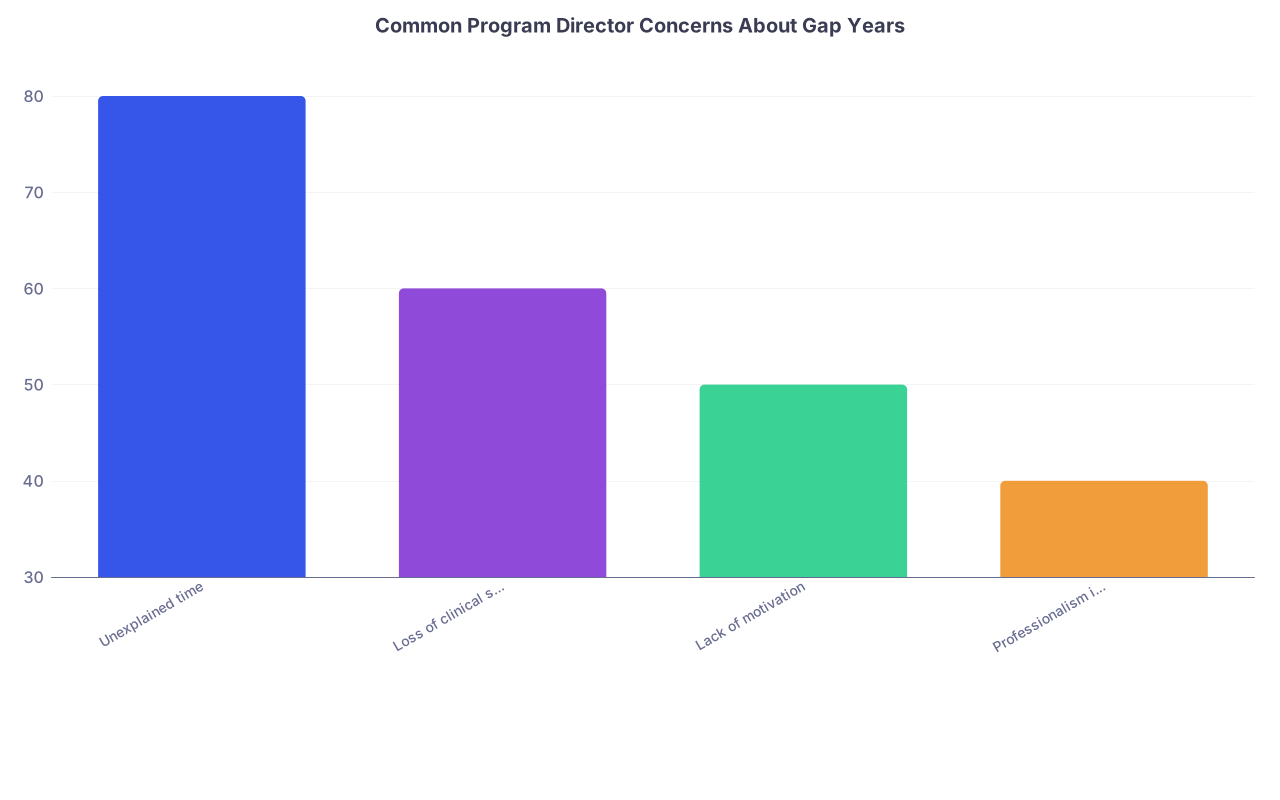
| Category | Value |
|---|---|
| Unexplained time | 80 |
| Loss of clinical skills | 60 |
| Lack of motivation | 50 |
| Professionalism issues | 40 |
Notice what’s at the top: unexplained time. That’s the fixable part.
How to talk about your gap year in ERAS, letters, and interviews
You need consistency. Same basic narrative, slightly adjusted for each format.
In ERAS / personal statement
You do not write an essay titled “Why My Gap Year Is Not Actually Terrible.” You weave it into your story in 1–2 concise paragraphs.
Structure it like this:
- One sentence explaining why you had a gap.
- A few sentences on what you did.
- One or two sentences on how it prepared you for residency.
Example:
“After graduating, I took a year before applying to residency to [reason: support my family financially / address burnout / prepare for re-application]. During this time, I [worked in X setting, completed Y project, maintained clinical involvement by Z]. The experience gave me [specific skills/insights], and I’m starting residency with a much clearer understanding of [patients, work-life balance, my specialty].”
That’s it. No 900-word confession.
In your CV
Don’t leave blank space. Ever.
If you had months where it really was just “figuring life out,” group that under a broader activity if you can:
- “Independent USMLE Step 2 CK Preparation and Clinical Shadowing (Month Year – Month Year)”
- “Family Caregiver and Part-time Employment (Month Year – Month Year)”
You’re not lying. You’re giving a name to what you were actually doing.
In letters of recommendation
If you did anything substantial during your gap year under someone’s supervision, beg them (politely) to mention:
- That they know about the gap year.
- That you used it productively.
- That they see you as motivated and reliable.
A line like:
“During their gap year, [Name] consistently showed up prepared and engaged in clinic, and it’s clear they’re committed to pursuing residency training in [specialty].”
does a lot of damage control.
In interviews
This is where your anxiety really spikes, because you’re imagining the dreaded question:
“So… tell me about your gap year.”
You answer in three parts, and you practice this out loud so you don’t ramble.
- Brief reason
- Concrete activities
- Takeaway
For example:
“I took a year after graduation mainly to [reason]. During that time, I [worked/studied/volunteered specifics]. It ended up being valuable because [what you learned/how you changed], and I feel more ready now to handle the demands of residency.”
If they push deeper, you answer honestly but still briefly. You don’t overshare, you don’t sound defensive, and you don’t apologize for existing.

| Step | Description |
|---|---|
| Step 1 | Gap Year Question |
| Step 2 | State main reason in 1 sentence |
| Step 3 | Summarize key activities |
| Step 4 | Highlight 1-2 skills or lessons |
| Step 5 | Connect to residency readiness |
What if my gap year truly was “bad”?
Let’s say you really did mostly:
- Scroll on your phone
- Hide from your email
- Avoid dealing with applications
And now you’re panicking because you can’t spin that into something noble.
Then your job isn’t to invent a fake story. It’s to show what changed.
You might frame it like:
“The first part of my gap year was honestly unproductive. I struggled with [motivation/anxiety/depression] after [failing Step/not matching/graduating], and I didn’t respond to that in the best way. What changed things was [therapy/mentor conversation/family intervention]. Since then, I’ve [specific actions: completed Step, taken on consistent work, volunteered, etc.]. It’s not something I’m proud of, but it forced me to confront how I handle stress. I’ve put real structures in place so I don’t default back to avoidance, which I think will be crucial in residency.”
That’s a grown-up answer. Programs don’t expect zero failure. They expect insight and correction.
A quick sanity check: is your gap year actually a dealbreaker?
You’re probably catastrophizing. So let me put your fear up against reality.
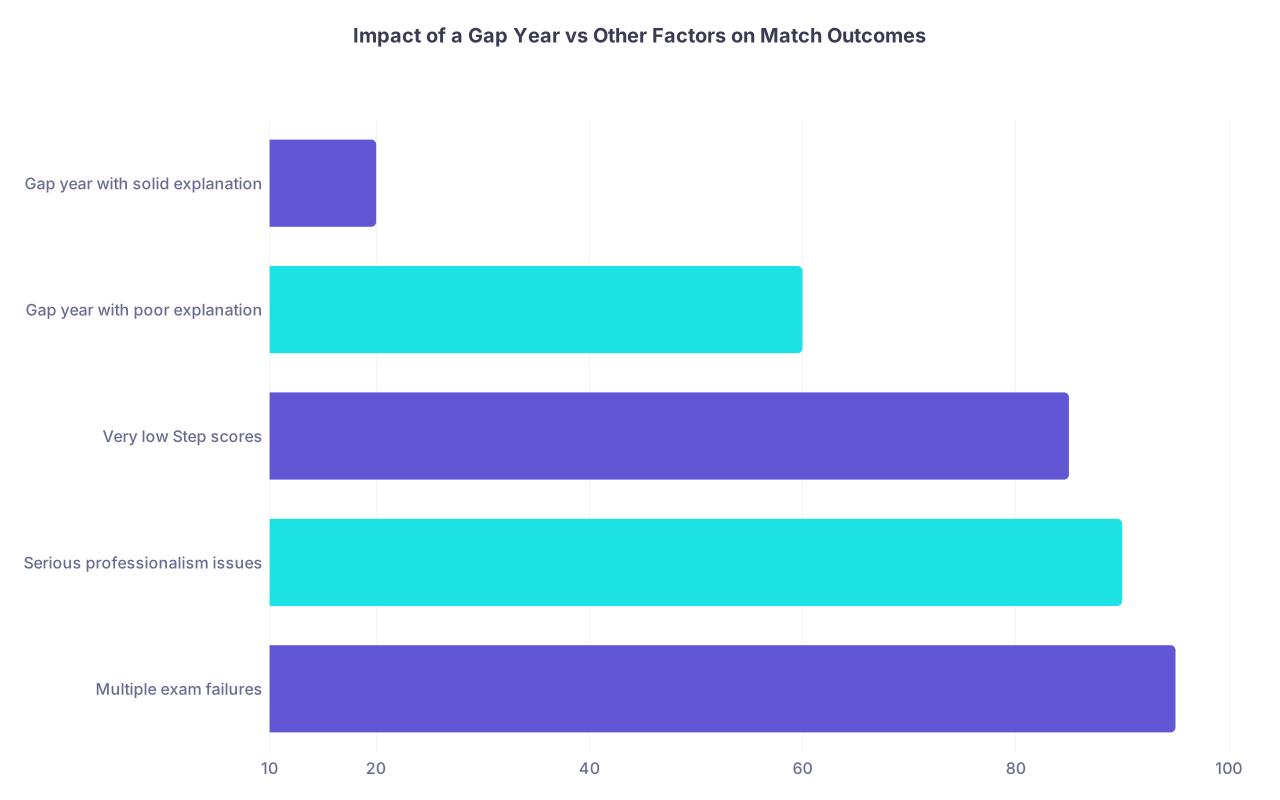
| Category | Value |
|---|---|
| Multiple exam failures | 95 |
| Serious professionalism issues | 90 |
| Very low Step scores | 85 |
| Gap year with poor explanation | 60 |
| Gap year with solid explanation | 20 |
The stuff that wrecks applications consistently:
- Repeated Step failures with no improvement
- Probation, professionalism flags, major conduct issues
- Really low scores and no compensating strengths
A gap year by itself sits way lower on that threat list. Especially if you can explain it clearly and show you did something, anything, constructive.
Is it a free pass? No. But it’s absolutely not the apocalyptic event your brain has decided it is at 2 am.

So what do you do right now?
If you’re in the middle of a gap year or still have some time left:
- Add one clearly clinical thing, even if it’s tiny: a weekly clinic, shadowing, free clinic volunteering.
- Add one structured commitment: research project, QI initiative, consistent job.
- Start writing your 3-part answer (reason–activities–takeaway) and practice saying it out loud.
If your gap year is mostly done and you can’t change the past:
- Stop rewriting history in your head.
- Write your actual timeline on paper, month by month.
- Group it into 2–3 phases with short labels (recovery, work + study, clinical engagement, etc.).
- Craft your one anchor sentence and your interview script.
You’re not trying to prove you’re perfect. You’re trying to show you’re moving forward, intentionally, with your eyes open.
Years from now, you won’t remember how many nights you laid awake obsessing over whether your gap year made you look lazy; you’ll remember whether you had the courage to own your story and tell it honestly, even when it scared you.


