

The fear of running out of money in your gap year is not irrational. It’s a very real, very reasonable panic.
You’re not crazy for lying awake doing mental math at 2 a.m.
Rent + utilities + food + exam fees + applications + random emergencies… against a bank account that looks more like a countdown timer than a safety net.
Let me say this bluntly: hoping it “somehow works out” financially is how people end up putting the exam on a credit card the week before their test date. Or delaying Step 3. Or pulling out of interviews they can’t afford to travel to. I’ve seen all of that.
You need a plan that assumes things go wrong. Because some of them will.
Let’s build that.
Step 1: Accept That Your Brain Is in Survival Mode
You’re not just “stressed.” You’re in that specific med-student-brand panic where:
- You’re terrified of failing exams
- You’re terrified of not matching
- And now you’re terrified of not making rent
Financial uncertainty makes everything feel worse. Studying feels impossible when your brain is screaming: “What if your card gets declined at the grocery store next month?”
So first, normalize what you’re feeling:
- No, you’re not behind because you don’t have a “high-paying gap year job.” A lot of people are scraping by with scribe work, tutoring, or part-time gigs.
- No, you’re not the only one who didn’t realize how expensive ERAS + exams + moving would be until way too late.
- Yes, you can still have a solid application year even if money is tight, but only if you stop pretending the money piece is optional.
The anxiety gets louder when things are vague. The fix is not “be less anxious.” The fix is: hard numbers, ugly truths, clear plan.
We’re going there next.
Step 2: Do the Scary Math Once (So It Stops Haunting You Nightly)
You know what’s worse than seeing the real number? Not seeing it, and imagining it’s infinitely worse.
You need a one-page, brutally honest financial snapshot:
- your timeline,
- your monthly living costs,
- your one-time exam + application costs.
Let’s layout a typical gap-year-before-residency schedule.
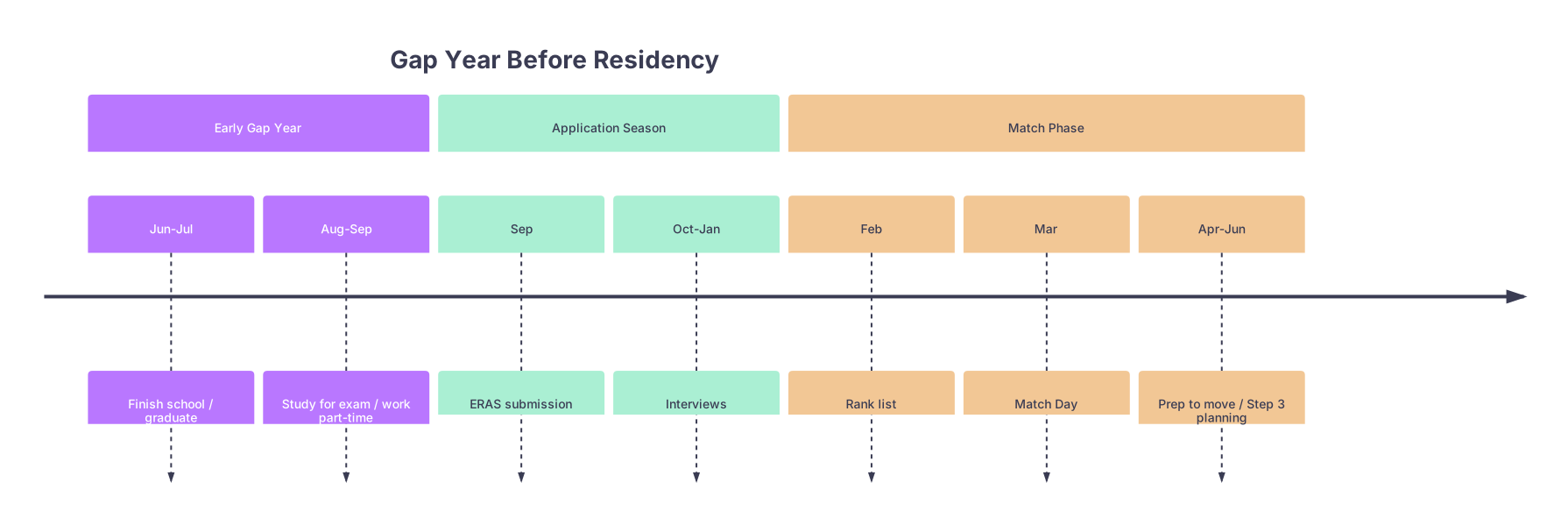
| Period | Event |
|---|---|
| Early Gap Year - Jun-Jul | Finish school / graduate |
| Early Gap Year - Aug-Sep | Study for exam / work part-time |
| Application Season - Sep | ERAS submission |
| Application Season - Oct-Jan | Interviews |
| Match Phase - Feb | Rank list |
| Match Phase - Mar | Match Day |
| Match Phase - Apr-Jun | Prep to move / Step 3 planning |
Now plug the gap year into money language:
- How many months until first residency paycheck? (Think: July 1 start → first check often mid/late July)
- How many months of rent is that?
- How many exam/application fees hit before you start getting paid?
Let’s put some example numbers on paper so your brain sees a structure instead of a void.
| Category | Estimated Monthly Cost |
|---|---|
| Rent | $900 |
| Utilities & internet | $150 |
| Food & groceries | $300 |
| Transportation | $150 |
| Phone & basic subscriptions | $80 |
| Misc / emergencies | $120 |
That’s about $1,700/month.
If your gap year is 12 months → $20,400 just to exist. No exams. No ERAS. No flights. Just breathing.
Now look at exam + application costs. This is the part everyone underestimates.
| Expense | Rough Cost (USD) |
|---|---|
| USMLE Step 2 CK or COMLEX Level 2 | $725–$1,300 |
| USMLE Step 3 | ~$895 |
| ERAS fees (20–50 programs) | $500–$1,600 |
| Interview travel (if in-person) | $500–$3,000+ |
| Moving for residency | $1,000–$3,000+ |
Is this depressing? Yes.
Is it better to know now than three weeks before ERAS? Absolutely.
The anxiety has less power once you have a number to aim at, even if the number is big.
Step 3: Build a “Worst-Case” Budget Instead of a Fantasy One
A lot of people make what I call “fantasy budgets”:
- “I’ll probably spend like $200 a month on food.” (No you won’t.)
- “I’ll only apply to 15 programs.” (No you won’t.)
- “I’ll stay with friends for all interviews.” (You might. You also might not.)
You need a worst-case budget that assumes:
- You spend slightly more on food than you think (because you will).
- You apply to more programs than you emotionally want to admit.
- You have at least one unexpected cost (car repair, medical thing, family emergency, whatever).
Here’s what that looks like in practice:
- Take your real monthly spending from the last 3 months.
- Round up. Not down.
- Add a small “oh crap” buffer every month ($100–$150).
So if your real spending is around $1,600, call it $1,800 in the budget.
Now layer that over your gap year months.
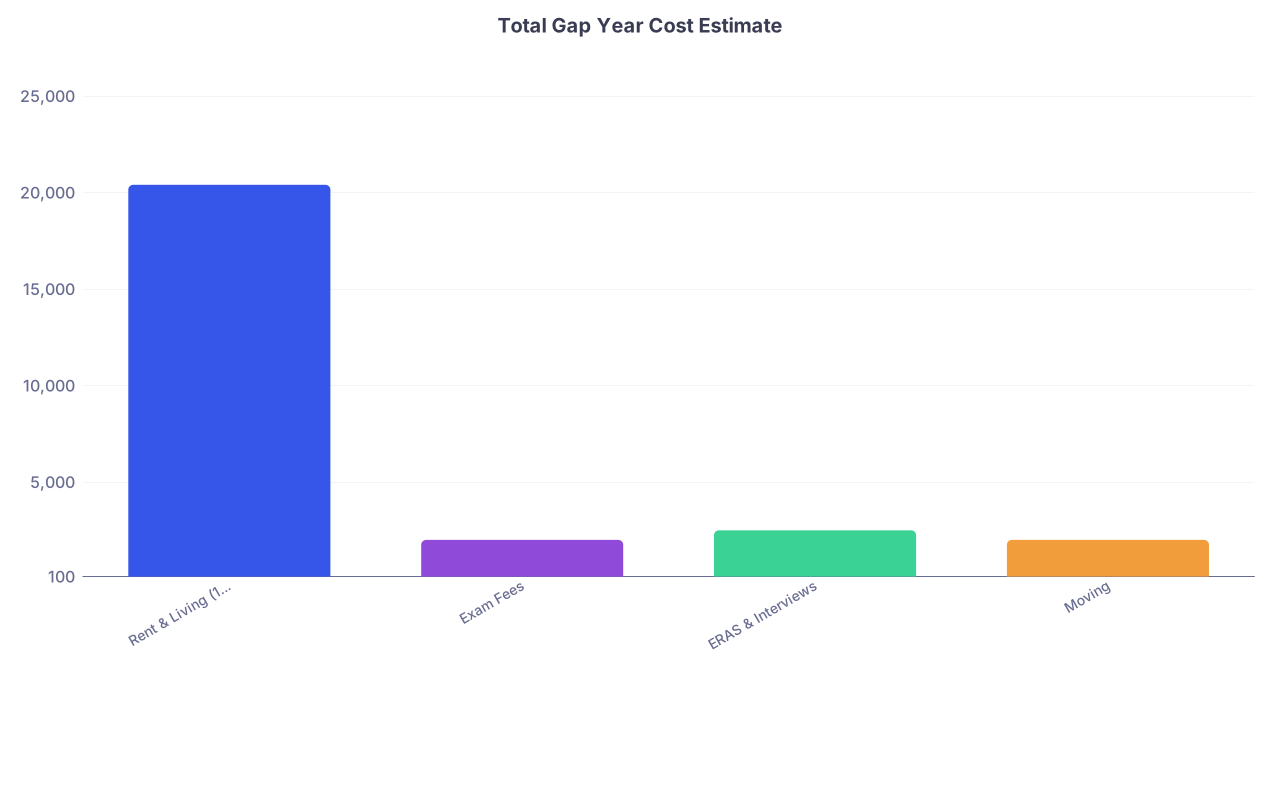
| Category | Value |
|---|---|
| Rent & Living (12 mo) | 20400 |
| Exam Fees | 2000 |
| ERAS & Interviews | 2500 |
| Moving | 2000 |
In this example, a “safe” target for the whole year might be around $26,900.
Will your number be different? Of course. But you need your version of that bar chart in your head.
Once you have this, the question shifts from, “What if I end up homeless?” to “How do I close a $X gap between what I have and what I need?”
Way less vague. Still stressful. But actually solvable.
Step 4: Attack the Two Levers You Actually Control
You only control two big things:
- How much money leaves your account
- How much money enters your account
You don’t control exam fees. You don’t control ERAS structure. You don’t control that rent is absurd in 2026.
Lever 1: Lower your “survival cost” without wrecking your life
This is where your brain goes straight to: “Do I need to move home? Get four roommates? Live in a basement with no windows?”
Sometimes, yeah, the answer is: you might need to sacrifice comfort for one year to not be constantly terrified. I’ve watched people:
- Move back with parents/family for 6–12 months to save literally $800–$1,200 a month.
- Take a smaller/older place closer to work/library instead of the nice building they wanted.
- Sublet a room instead of signing their own lease, especially between match and residency.
These are not glamorous choices. They are “I want my brain available for Step and ERAS, not for rent panic” choices.
If you can drop your monthly costs by even $300–$500, that’s $3,600–$6,000 over a year. That’s exam + ERAS + part of moving right there.
Lever 2: Increase income in a way that doesn’t destroy your exam scores
Everyone fantasizes about a high-paying gap-year research job or a cushy remote position. Sometimes you get lucky. Often you don’t.
What does actually happen a lot:
- Scribing in ED/clinic
- Medical assistant work
- Tutoring for MCAT/Step/school subjects
- Tele-scribing or remote charting
- Part-time non-clinical jobs that are predictable
The trap is this: packing your schedule so full of work that you can’t study, then having to repeat an exam.
Repeating Step 2 or Step 3 is way more expensive—emotionally and financially—than earning a bit less for a few months but actually passing comfortably.
Think in phases, not all-or-nothing:
- Heavier studying, lighter work in the 2–3 months before your big exam
- Heavier work, lighter studying right after exams, before ERAS, etc.
Step 5: Plan for the Real Financial Punch: Applications + Interviews
People always obsess about the exam fee. The real chaos often hits during interview season.
Even with virtual interviews, costs add up:
- Better internet / headset / clothes
- Lost income from taking days off if you’re working
- Extra childcare or travel if hybrid/in-person
If interviews are in-person, the numbers jump quickly:
- Flights
- Hotels/Airbnb
- Food while traveling
- Ubers/Lyft
You can’t predict every invite, but you can build a structure:
- Pre-set a “per-interview” budget ceiling (e.g., “If a single interview will run me over $600, I need to think hard about whether it’s worth it based on program fit + geography.”)
- Aggressively use:
- credit card points
- staying with friends/family
- grouping interviews in the same region
If your worst fear is: “What if I get an interview I love and can’t afford to go?” then your action item is: protect a small emergency “interview fund” now. Even $500–$1,000 set aside for that scenario will calm your brain a lot.
Step 6: Use Short-Term Sacrifices to Avoid Long-Term Disaster Debt
Let me be blunt: high-interest credit card debt is the enemy.
A lot of people tell themselves, “I’ll just put this on a card and pay it off as an intern.” Intern pay is not magical fairy money. It goes fast.
Yes, sometimes credit is the only bridge when support is limited and savings are low. I’m not pretending that doesn’t happen. But treat it like a last-resort tool, not your plan A.
Before you swipe your way through the year, consider:
- Can I cut $150/month in “nice but not essential” items for this year only? (DoorDash, random Amazon purchases, subscriptions I forgot about)
- Can I delay big purchases (new phone, new laptop, new furniture) until I’m getting a paycheck?
- Can I use 0% intro APR cards strategically (with a payoff plan) instead of racking up 25% interest?
You’re not failing at adulthood if you’re broke in your gap year. You are setting yourself up for years of extra stress if you pretend future-you will magically make all this credit card debt disappear without a plan.
Step 7: Build a Simple One-Page Plan So Your Brain Can Shut Up (Sometimes)
I’m not going to tell you to build a 17-tab Excel monstrosity. You won’t stick with it.
You need something you can look at when you’re spiraling at midnight.
One page. Something like:
- Months covered in gap year + first paycheck month
- Monthly living cost (rounded up)
- One-time exam/application/moving totals
- What you currently have (savings, family help, etc.)
- Expected income (work, side gigs)
- The gap you need to close
- 3–4 concrete actions you’re taking to close it
Example actions:
- Move to a cheaper room starting in August → saves ~$400/month
- Work 3 weekend shifts/month as a scribe → adds ~$400/month
- Tutor 4 hours/week at $30/hr → adds ~$480/month
- Cap food spending at X and track weekly
Keep that one page visible. On your wall. In your notebook. On your desktop.
Anxiety feeds on “I have no idea what’s going on.” That page is your receipt that you’re not just helplessly waiting for disaster.
Quick Reality Check: Are You Actually on the Edge… or Just Scared?
Both happen.
Sometimes when we finally do the math, it turns out: we’re actually okay, just freaked out. You might:
- Have more savings than you thought
- Have supportive family who can help if you’re honest with them
- Be overestimating certain costs because your brain loves drama
Other times, the math shows: no, you really do have a problem to solve.
Either way, the action is the same: get specific, then adjust.
Stop asking, “Will I be okay?” in a yes/no way. Instead ask: “What exact number do I need to feel okay, and what 3–5 moves can I make this month to get closer to it?”
You don’t have to fix everything this week. You do have to stop drifting.
FAQ (Exactly 4 Questions)
1. What if my family can’t help me at all and I feel completely alone financially?
You’re not the only one in that spot, even if it feels like it when classmates casually mention “my parents are helping with rent.” If family support is zero, your levers become: living cost reduction, income, and timing. That might mean moving to a cheaper city for the gap year, aggressively searching for paid clinical/remote work, or delaying one exam by a few months to work more and build a financial cushion. It’s not failure to adjust your timeline to survival. Better to take Step 3 three months later with less panic than rush it while wondering if you can pay your electric bill.
2. Is it ever reasonable to take out a personal loan for exams or ERAS?
It can be, but it’s not something to do casually. If the choice is literally “no ERAS this year” vs “a modest, clearly planned loan,” then yes, a small personal loan or 0% APR credit card can be a bridge. The key is: know the interest rate, know the exact monthly payment, and write down how you’ll pay it back within 12–24 months as a resident. If you’re stacking this on top of existing high-interest debt with no plan, that’s where it gets ugly fast.
3. How many hours a week can I realistically work while studying for Step/COMLEX without tanking my score?
There’s no golden number, but I start getting nervous for people once they go consistently above 20–25 hours/week in the 6–8 weeks right before an exam, especially if the job is physically or emotionally draining. Early in the gap year, you might handle 30+ hours and still study, but as you move into dedicated, you want margin. I’ve watched strong students burn out and underperform because they refused to cut shifts. If the job is flexible, front-load work before dedicated, then scale back hard for your final study push.
4. How do I handle the guilt of not being fully “independent” yet—financially or otherwise—before residency?
That guilt is common and honestly a bit unfair to yourself. You’ve just spent years in training that actively prevents you from earning a normal full-time income. You’re not behind; you’re doing exactly what the system forces trainees to do. Independence is a spectrum, not a binary. If you’re making thoughtful decisions, cutting what you can, and building toward stability, you’re not failing—you’re transitioning. If someone is helping you with a month of rent or covering an exam fee, that doesn’t erase your effort or your responsibility; it just means you’re human in a brutally expensive process.
Open a blank page or a note on your phone right now and write three numbers: your monthly living cost, your estimated exam + ERAS + moving total, and how many months until your first residency paycheck—then build your one-page plan around those numbers tonight.


