

Programs will absolutely judge your non‑medical gap year job — but not in the way you’re probably torturing yourself about at 2 a.m.
Let me be blunt: the idea that every residency director is sitting there thinking, “Wow, you did anything other than research or a prelim year? Red flag.” is wildly exaggerated in applicants’ heads. But the fear feels real because your brain is on “I ruined my career” mode.
Let’s walk through this like people who are actually trying to match, not like mythical perfect applicants who apparently knew they wanted to be neurosurgeons at age 12 and never did anything but shadow and pipette.
The Fear: “I Wasted My Gap Year… They’ll Think I’m Not Serious”
Here’s the tape that plays in your head:
- “Everyone else did research or a chief year. I worked at a regular job.”
- “What if they think I’m lazy or couldn’t get anything better?”
- “What if this one year ruins my chances forever?”
- “What if they ask me about it and I freeze and sound defensive?”
And then you go on Reddit and see stuff like “Any non‑clinical gap = death for competitive specialties” and suddenly you’re spiraling.
Let me say this clearly:
A non‑medical job in your gap year is not an automatic red flag. What matters is:
- Your overall application context
- How you frame and explain that experience
- Whether there are any actual concerning patterns (we’ll talk about those)
Programs don’t care that you worked a “non‑medical” job.
They care whether you:
- Disappeared from medicine entirely with no coherent explanation
- Show poor judgment or unreliability
- Can’t tell a convincing story of growth, responsibility, and commitment to residency
If your gap year was DoorDash + Netflix + ghosting your mentors… yeah, they’ll wonder what was going on. But that’s about patterns, not the job label.
What Programs Actually Look At (Not the Story in Your Head)
Let me flip this. Here’s what you think they see vs what they actually see.
| Perspective | What They Focus On |
|---|---|
| Anxious Applicant | Job title & ‘non-medical’ label |
| Program Director | Maturity, reliability, story, trajectory |
| Selection Committee | Pattern across 4–6 years, not 1 job |
| Interviewer | How you talk about it & what you learned |
Most programs care about:
- Are you going to show up, work hard, and not implode?
- Do you have the emotional maturity to handle residency?
- Did you use your time in some intentional way, or were you drifting?
They look at your Step scores, clinical evaluations, letters, MSPE, personal statement, and then your experiences. Your non‑medical job is one line among many. Not the entire narrative.
The only time it becomes a big deal is when:
- There are major gaps with nothing listed
- You can’t give a clear, calm explanation
- The job seems to contradict your specialty choice and you stumble over connecting the dots
That last part? That’s fixable. With prep. Not with self‑loathing.
Different Scenarios: How Bad Is Your Situation Really?
Let’s go through some actual situations I keep seeing people panic about and be brutally honest about how programs are likely to see them.
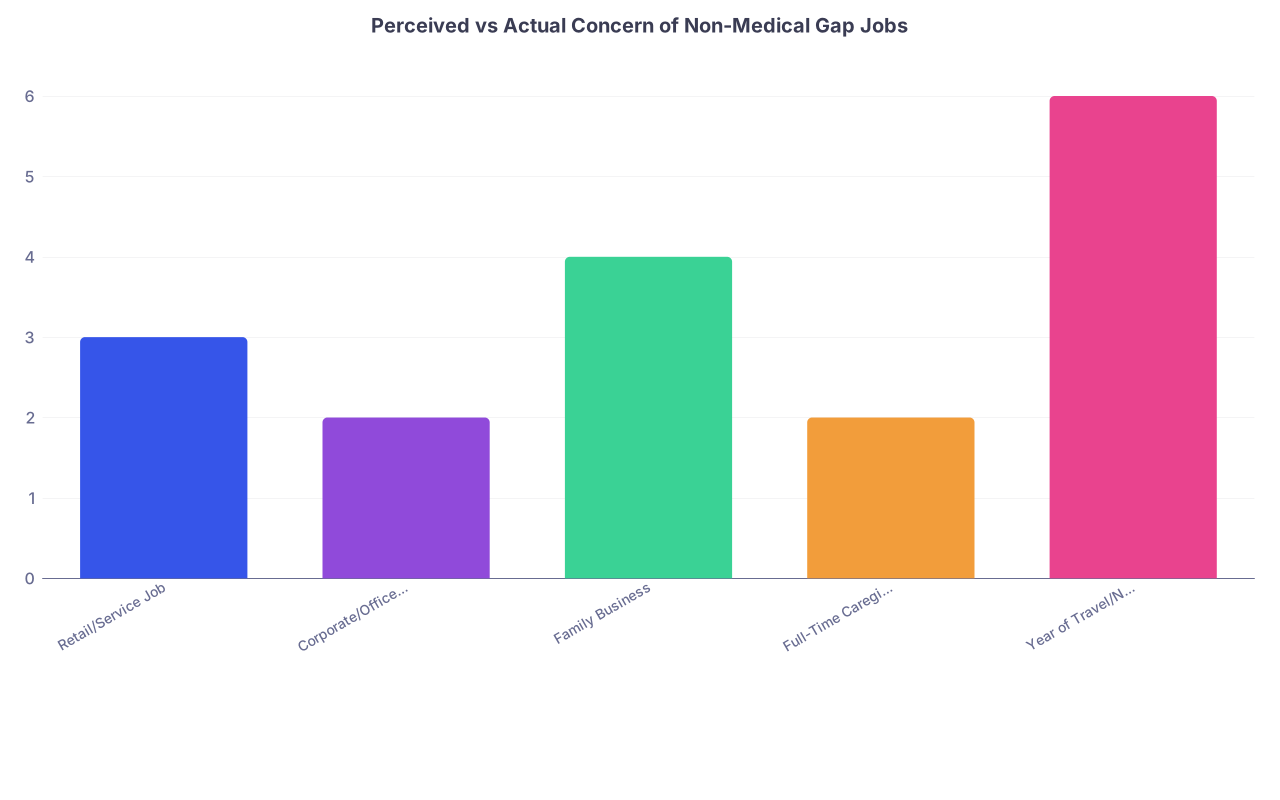
| Category | Value |
|---|---|
| Retail/Service Job | 3 |
| Corporate/Office Job | 2 |
| Family Business | 4 |
| Full-Time Caregiving | 2 |
| Year of Travel/No Job | 6 |
(Scale: 1 = basically no concern if explained, 10 = will raise eyebrows if poorly explained)
1. “I worked retail / food service / hospitality”
Example: barista, server, store associate, hotel front desk.
Your fear:
“They’ll think I’m not academic enough or I couldn’t find anything better.”
Reality:
Programs have seen this a million times. People work. People need money. Especially international grads or people with limited visas. Especially those supporting families. Nobody is clutching their pearls because you rang up groceries.
What matters is how you talk about it:
- Customer service → communication, de‑escalation, working with difficult people
- Schedule reliability → showing up on time, handling long hours, weekends
- Teamwork → shift work, covering coworkers, managing stress
If your application otherwise shows you’re clinically solid, this is a non‑issue when framed correctly.
2. “I took a corporate / office job”
Example: analyst, project coordinator, tech support, finance, consulting, admin job.
Your fear:
“They’ll think I abandoned medicine and I’m not committed.”
Reality:
This can actually look good if:
- You’re transparent and clear about why (financial, visa, burnout, waiting to match)
- You can articulate transferable skills: organization, leadership, systems thinking, working with stakeholders
- You still kept at least a toe in medicine (volunteering, per diem clinical, a small project, CME, shadowing)
Where it looks bad is if you:
- Say you want a super competitive specialty and your last meaningful clinical contact was 2+ years ago
- Sound like medicine is a backup plan after industry didn’t work out
So you need to be ready with: “Why did you take this job?” and “What made you decide to pursue residency now?”
3. “I worked in my family’s business”
Example: helping run a store, restaurant, small company.
Your fear:
“They’ll think my parents forced me or that I took the easy way out.”
Reality:
Running a small business is hard. Inventory, payroll, customers, conflict, long hours. Interviewers who’ve ever dealt with real life will respect that more than you think.
You just can’t downplay it or sound ashamed. You say:
- What you actually did (scheduling, budgeting, operations)
- What you learned (prioritization, responsibility, reliability)
- How that will make you a better intern (owning your tasks, following through, being dependable)
4. “I was a caregiver / stayed home for family reasons”
Example: caring for a sick parent, helping with siblings, your own health issues.
Your fear:
“They’ll think I can’t handle residency or that I’m ‘distracted’ by family stuff.”
Reality:
This can be one of the most understandable and least judged reasons for time away, IF you’re honest and not vague to the point of suspicious.
You can say something like:
“I spent the year caring for my father during chemotherapy. I managed appointments, medications, and coordination with multiple specialists. It’s given me a very personal view of what our patients and families experience.”
People on committees have parents. Kids. Illness. They get it.
The tricky part: make sure you can also show you’re ready to return full‑time, and the acute crisis has stabilized.
The Only Truly Concerning Pattern
Here’s when they raise eyebrows:
You have:
- 1+ years out of med school
- No clinical exposure at all
- No explanation beyond “personal reasons”
- Vague, evasive answers in interviews
- Weak or stale letters (nothing recent)
That combination makes them worry about:
- Skills atrophying
- Professionalism issues
- Serious academic or behavioral red flags
But even that’s not “you’re done forever.” It just means you need a more structured plan to get back into the clinical world and you can’t just throw ERAS at 100 places and hope.
How to Talk About Your Non‑Medical Gap Job Without Sounding Guilty
You probably replay imaginary interviews in your head where you ramble and say too much and watch the interviewer silently judge you. Let’s stop that.
You need a tight, calm, 3‑part structure:
1. Why you took the job
2. What you did and learned
3. How it fits your path to residency now
Example for a corporate job:
“After graduating, I accepted a position as a project coordinator at [Company]. I needed stable income while I was preparing to reapply and resolving some visa issues. I managed timelines across several teams, tracked deliverables, and communicated with multiple stakeholders under tight deadlines. It reminded me how much I enjoy working in fast‑paced, team‑based environments, which is part of what pulled me back toward residency. I’ve stayed connected to medicine through [X], and I’m excited to bring those organizational and communication skills to patient care.”
Notice what’s not there:
Apologies. Defensiveness. Ten paragraphs of justification.
You’re stating facts, owning your choices, and drawing a clean line to: “This made me a stronger applicant.”
Does Specialty Choice Change How Bad This Looks?
Short answer: a bit, but not as much as people dramatize.
| Specialty Group | How Scrutinized the Gap Is |
|---|---|
| Competitive Surgical (ENT, Ortho, Plastics) | High |
| Competitive Non-Surg (Derm, Rad Onc) | High |
| Mid-Competitive (EM, Anesthesia, Rads) | Moderate |
| Core (IM, FM, Peds, Psych) | Low–Moderate |
| Transitional/Prelim Only | Context-dependent |
High‑competition specialties have so many hyper‑polished applicants that any deviation feels fatal. But even there, if you’re an IMG or non‑traditional, they expect some non‑linear paths.
If you’re going for IM, FM, psych, peds, EM, anesthesia, etc., a non‑medical job in a gap year is very survivable as long as:
- Your clinical base is recent enough (not 4 years ago)
- You’re not hiding things
- You show genuine interest in the specialty in other ways (electives, letters, personal statement)
Concrete Steps to Make This Year Work For You, Not Against You
You can’t change the fact that you took that job. You can change how it looks on paper and in conversation.
Here’s how to salvage (and even leverage) it:
1. Put it clearly in ERAS
Don’t hide it. Don’t shorten the gap so it looks like an empty space. Use the experience description to highlight skills, responsibility, and growth.
2. Add at least one clinically-adjacent thread
Even a small one:
- A few hours/week volunteering (clinic, health fair, hospice)
- Occasional shadowing you can mention
- Doing some QI or chart review work with a mentor remotely
3. Get one recent-ish clinical reference if you can
Even a short letter from a preceptor or attending you reconnected with for a few days of observership can help prove you’re still clinically “there.”
4. Practice your explanation out loud
Not in your head. Out loud. Until it’s:
- Short (30–60 seconds)
- Calm
- Not oversharing but not evasive
- Align your personal statement
Don’t pretend the gap didn’t happen. You don’t need a long confession, but a short, grounded reference to what you did and what you learned makes you look honest and self‑aware.
Your Brain Is Catastrophizing. Let’s Reality-Check It.
You’re probably imagining that every interviewer is obsessed with this gap year. They’re not. They glance at your CV, circle a few things to ask about, and then they’re mostly trying to figure out: “Would I want this person on my team at 2 a.m.?”
If you can show:
- You’ve worked in the real world
- You understand responsibility
- You can work with difficult people
- You’ve thought seriously about why you’re coming back to medicine
Your non‑medical gap job becomes context, not a crime.
The applicants who actually sabotage themselves are the ones who:
- Apologize constantly for their choices
- Minimize what they did as “just a job”
- Sound like they’re waiting for the interviewer to punish them
You can’t show up like that. You have to meet them as an adult who made adult decisions under adult constraints.
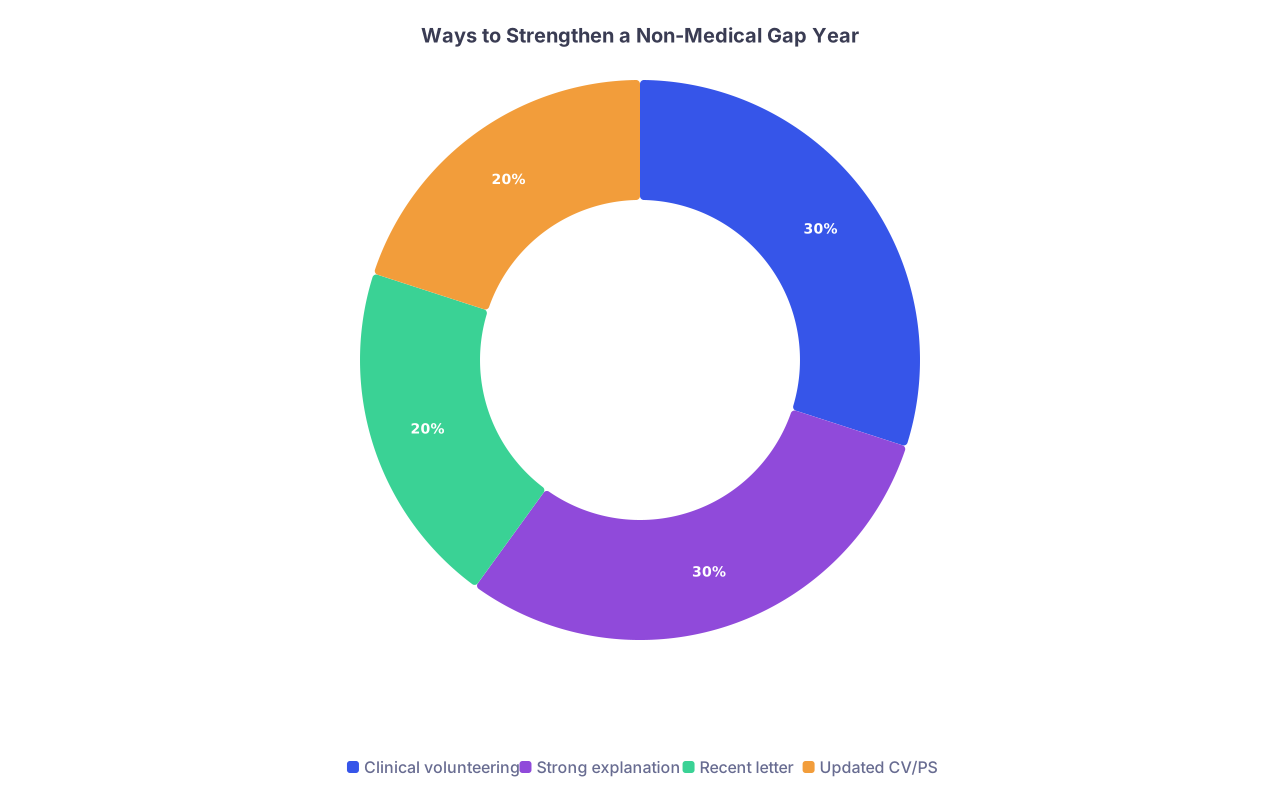
| Category | Value |
|---|---|
| Clinical volunteering | 30 |
| Strong explanation | 30 |
| Recent letter | 20 |
| Updated CV/PS | 20 |
A Quick Reality Timeline: You’re Not “Too Late”
If part of your anxiety is “It’s been too long, I’m done,” here’s roughly how programs think about recency:
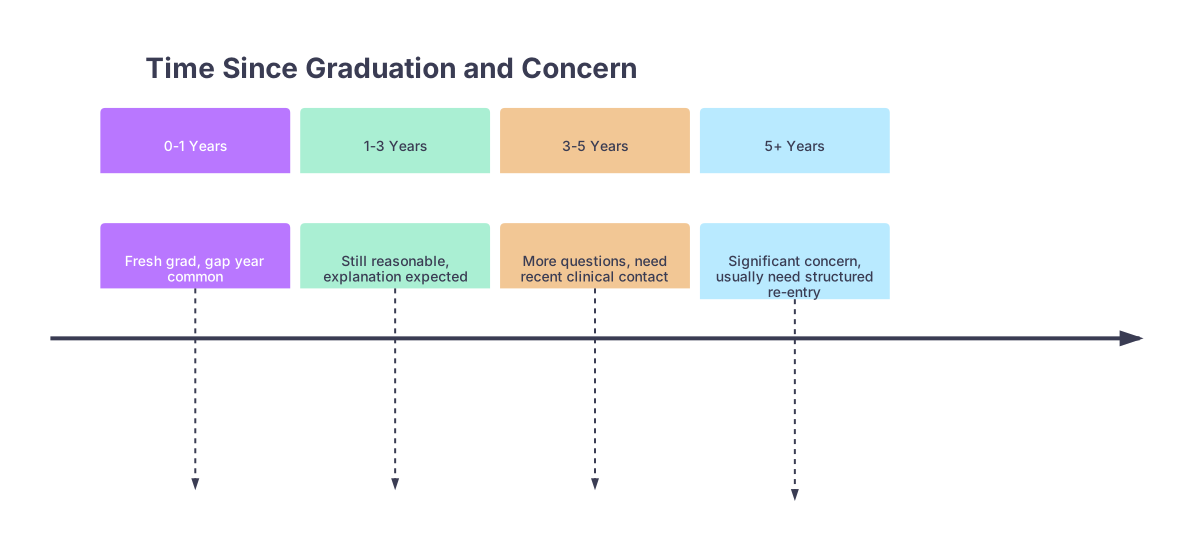
If you’re in that 0–3 year range with a non‑medical job? This is irritating and stressful, but not fatal.
If you’re 3–5+ years out, you need more than just explanation — you likely need fresh clinical work, observerships, or a formal program to show you’re up to speed. But again: the type of job alone isn’t what sinks you.
FAQ – Exactly the Stuff You’re Afraid to Ask Out Loud
1. Will programs reject me automatically if my gap year job wasn’t medical?
No. There’s no checkbox that says “Non‑medical job = auto reject.” They look at the whole application. A non‑medical job in a gap year is common, especially for people dealing with finances, visas, family obligations, or late decisions.
What hurts is hiding it, minimizing it, or failing to show any ongoing link to medicine the entire time.
2. Should I leave the job off my CV to avoid questions?
Don’t. Leaving a blank year looks worse. Program coordinators and PDs hate unexplained time holes. They immediately wonder if something problematic happened.
List it honestly, frame it well, and own it. A clear, ordinary job looks 100x safer than a mysterious gap.
3. How do I answer “Why didn’t you do anything medical during this time?”
You did do something: you worked, lived, handled life. Say what your constraints were (money, location, visas, family), what you chose to do, and how you’re now reconnecting to clinical work.
Example:
“I needed stable income to support my family, and the only options available locally were outside of medicine. I worked full-time as [X], and more recently I’ve been [volunteering/shadowing/studying], which has reaffirmed my commitment to residency.”
Short. Grounded. Not a confession.
4. Will this kill my chances at competitive specialties?
It might make it harder, especially if you’re already on the borderline (average scores, limited research), because every little thing matters more there. But “you worked a non‑medical job for a year” is rarely the deciding factor by itself.
If your heart is set on a very competitive field, you’ll probably need:
- Strong research or niche experience
- Excellent letters
- A very coherent story linking everything together
But your job alone isn’t the nail in the coffin.
5. Do I need to spin my job into some fake “medical” thing?
No, please don’t do that. Interviewers can smell forced spin. You don’t need to turn “I worked at Target” into “a deeply clinical adjacent systems-based practice role.”
Say what it was. Then pull out real skills: communication, working with the public, time management, balancing stress, learning from mistakes. Authenticity beats cringe spin every time.
6. What’s one thing I can do this week to make this gap year look less scary on my application?
Reach out to one clinical contact (old attending, clerkship director, community physician) and ask if you can:
- Shadow for a short period
- Help with a small project
- Get some recent clinical exposure you can mention
Then update your CV and personal statement to:
- Clearly list your job
- Add 1–2 sentences about what you learned
- Include one line about how you’ve re‑engaged with medicine recently
Do that, and your gap year starts looking a lot less like “I fell off the map” and a lot more like “I had a real life, then came back with more maturity.”
Open your ERAS/CV right now and edit the entry for your gap year job. Replace “generic job description” with 2–3 concrete bullet points that show responsibility, growth, and skills you’ll use as a resident. Don’t wait until September to fix the story you’re telling.


