

It’s January. Or maybe late November. Your ERAS is submitted, programs are sending out interview invites (or… not), and you’re in the middle of this “strategic” gap year you sold to yourself and your mentors. Research year. Or chief year. Or a random clinical job. Whatever it is, it looked good on paper.
But your stomach drops every time someone asks, “So how’s your gap year going?”
Because in your head, it’s not going. It’s… drifting. Or worse, it feels like you picked the wrong thing entirely.
You’re thinking:
- “I should’ve done more research.”
- “I should’ve taken that other job.”
- “I wasted half the year doing nonsense that doesn’t help my application.”
- “I can’t fix this now. It’s too late. I’m screwed for this Match and probably the next one too.”
Let me be blunt: you’re not the first person to have mid‑gap‑year regret, and you won’t be the last. I’ve watched people realize in December that their “perfect research year” is actually unpaid data entry. Or that their “great clinical job” is 80% prior auth phone calls. Or that their “mental health year off” turned into doomscrolling and two incomplete personal projects.
It feels catastrophic. It usually isn’t.
Let’s untangle this.
First: Are You Actually Screwed, Or Just Freaked Out?
There are two different problems people mash together:
- “My gap year isn’t what I imagined.”
- “My gap year is going to tank my residency chances.”
They’re not the same.
You can hate your day‑to‑day and still be totally fine on paper for residency. And you can technically have a “good” gap year on paper and be miserable and burned out. Both matter, but they’re different problems.
Ask yourself, honestly:
- If a PD looked at my CV today, would it look like I completely disappeared?
- Am I doing nothing relevant, or am I just doing something that doesn’t match my fantasy version?
If you’re still:
- in a research role (even if it’s boring),
- in a clinical job (even if it’s not glamorous),
- teaching, tutoring, or working in healthcare adjacent,
- or managing something explainable (family, health, immigration, etc.),
you’re probably not “unmatchable” because of this. You might just hate it. Which sucks, but is fixable.
If you truly have big blank holes — months of no obvious activity, no narrative, no explanation — that’s more serious. Still not terminal, but you’ll have to be intentional about how you explain it and what you do with the remaining months.
The Big Mid-Year Fears (And What’s Actually True)
Let’s go straight into the anxiety spiral you’re probably in.
Fear 1: “Programs will think I wasted my year.”
What they actually care about:
- Did you completely vanish from medicine?
- Does this year show growth, maturity, or at least something coherent?
- Can you talk about it like an adult, not like a victim of circumstances?
They don’t have a secret checklist like “must have 3 first‑author pubs + scribe job + MPH.” They look for patterns, consistency, and a story that makes sense.
If you spent 6 months flailing, but then pivoted into something meaningful and can describe what you learned from that chaos? That’s not death. That’s human.
Fear 2: “I picked the wrong kind of gap year. Everyone else did research.”
Programs don’t actually care if you did:
- research,
- a clinical job,
- teaching,
- a degree,
- or some mix.
They care more about:
- Are you engaged with medicine or skills that translate to medicine?
- Can you function in a team?
- Can you finish things?
- Are you actually ready to train?
I’ve seen people match into competitive fields from:
- a random hospitalist scribe job,
- an MA role in a community clinic,
- a year teaching MCAT full‑time,
- a year off to take care of family, plus some part‑time telehealth work.
And I’ve seen people with “dream” research years and 6 papers not match because they were terrible interviewers or had other red flags.
Fear 3: “It’s mid‑year; I can’t change anything now.”
No. You can’t redo the past 6 months. But you can absolutely change the next 6.
You’re not a tree. You’re not stuck.
You might not be able to magically get a brand‑new full‑time research job tomorrow, but you can:
- add side projects,
- adjust responsibilities,
- reframe your current role,
- and set up next steps that show direction.
Residency isn’t just judging your past, it’s also reading your trajectory.
Step 1: Diagnose What’s Actually Wrong With Your Gap Year
Before you “course‑correct,” you need to be brutally clear about what’s off.
A few common flavors of regret:
- Wrong content
“I did research but I hate research and it’s going nowhere.” - Wrong structure
“The job is fine but I have zero mentorship, zero letters, and I’m invisible.” - Wrong intensity
“I thought this would be chill, but I’m drowning and have no time for applications or Step 3.” - Wrong direction
“I’m applying to IM but my year is 100% derm research that doesn’t translate.”
Write down, literally, in a sentence:
“My gap year problem is mostly __________.”
If you can’t define it, you can’t fix it. And your brain will keep screaming “it’s all bad” when that’s not accurate.
Step 2: What You Can Still Change Mid-Year (More Than You Think)
Here’s the part people underestimate. You can layer, tweak, and pivot mid‑stream.

Layer, Don’t Burn
You don’t have to quit your current thing to make it “better” on paper. You can add:
- One or two small projects with your current PI/clinic.
- A QI project with a friendly attending.
- A teaching/tutoring side gig.
- A short‑term volunteer or telehealth role.
These can start now, even if your year feels half wasted already.
Turn Random Work Into a Story
You might think, “I’m just doing prior auths,” but if you zoom out:
- You’re learning system navigation.
- You’re seeing access issues.
- You’re understanding chronic disease patterns, insurance nightmares, social determinants.
Is it glamorous? No.
Can it become a coherent story? Absolutely, if you stop minimizing it as “just paperwork.”
Concrete example:
“I spent this year as a care coordinator in a primary care clinic. I got obsessed with why our diabetics kept falling through the cracks after hospitalization, so I helped our team build a follow‑up tracking system and patient call script. We reduced no‑show rates 15% in three months, and I want to bring that systems‑thinking mindset into residency.”
Same job. Different framing. Very different impact.
Step 3: Make a 3–6 Month Course‑Correction Plan
Let’s treat the rest of your gap year like a mini rotation block: salvage what you can, add what’s missing, and set up your next move.
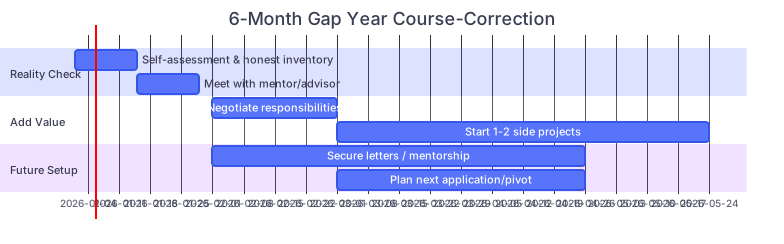
| Task | Details |
|---|---|
| Reality Check: Self-assessment & honest inventory | a1, 2026-01, 2w |
| Reality Check: Meet with mentor/advisor | a2, after a1, 2w |
| Add Value: Negotiate responsibilities | b1, 2026-02, 4w |
| Add Value: Start 1-2 side projects | b2, after b1, 12w |
| Future Setup: Secure letters / mentorship | c1, 2026-02, 12w |
| Future Setup: Plan next application/pivot | c2, 2026-03, 8w |
1. Do a ruthless inventory (2–3 days, not 3 weeks)
Sit down and list, without sugarcoating:
- What you’re actually doing day‑to‑day.
- What’s on your CV so far this year (even if you think it’s lame).
- Who actually knows you well enough to write a letter.
- What time you realistically have each week.
Then answer:
- What’s missing that matters for my specialty? (Letters? US clinical experience? Research? Just any sign of life?)
- What can reasonably be improved in the next 3–6 months?
2. Talk to someone who isn’t inside your head
Not Reddit. Not your equally panicked friend.
Find:
- a mentor from med school,
- a PD or APD you vaguely know,
- or a trusted resident in your target specialty.
Tell them the truth:
“I’m halfway through my gap year and it’s not going the way I hoped. Here’s what I’ve done. Here’s what I’m worried about. If you were me, what would you prioritize for the next 6 months?”
You need external calibration. Your brain will default to “everything is ruined.” A decent mentor will help you focus on the 1–2 moves that actually matter.
Step 4: Tactical Moves You Can Still Make (Depending on Your Situation)
Here are realistic mid‑year pivots based on the usual situations.
| Situation | Concrete Next Step |
|---|---|
| Boring, low-impact research | Ask for own small project or chart review |
| No strong letter writers | Increase facetime, volunteer for responsibilities |
| Non-clinical job and worried about CV | Add part-time clinical or volunteer role |
| Few or no publications | Aim for poster, abstract, or accepted manuscript |
| Big gaps in months of activity | Start any structured, explainable position/project |
If You’re in a Research Year and Regretting It
Classic scenario: you thought you’d publish 4 papers. You’re halfway in and barely have a draft.
You can still:
- Push for ownership of a small, clearly defined project:
- A small retrospective chart review.
- A case series.
- A side project with a fellow who actually gets things done.
- Get your name on an abstract or poster, even if it’s not first‑author.
- Turn the experience into:
- “I learned how to critically evaluate data and understand limitations,”
- instead of “I did nothing and hated it.”
And crucially: build a relationship with one attending/PI who can write,
“X showed persistence, improved a lot, and took increasing responsibility over time.”
Programs care about that more than your name being 6th on some random paper.
If You’re in a Clinical Job That Feels “Too Low-Level”
Scribe, MA, care coordinator, telehealth assistant. Feels small. Doesn’t have to be.
You can:
- Identify one problem in the workflow and quietly fix it or propose a solution.
- Offer to help with basic QI, patient education materials, or a tiny process change.
- Ask an attending if they’d be willing to let you shadow more formally and, if appropriate, eventually write you a letter.
Then in interviews, you can talk about:
- continuity of care,
- communication with patients,
- working in real teams,
- and seeing the messy, non-textbook side of medicine.
That’s all gold.
Step 5: If You’re Applying Now and Panicking About How It Looks
This is the extra fun layer: you’re not only regretting your gap year, you’re mid‑cycle.
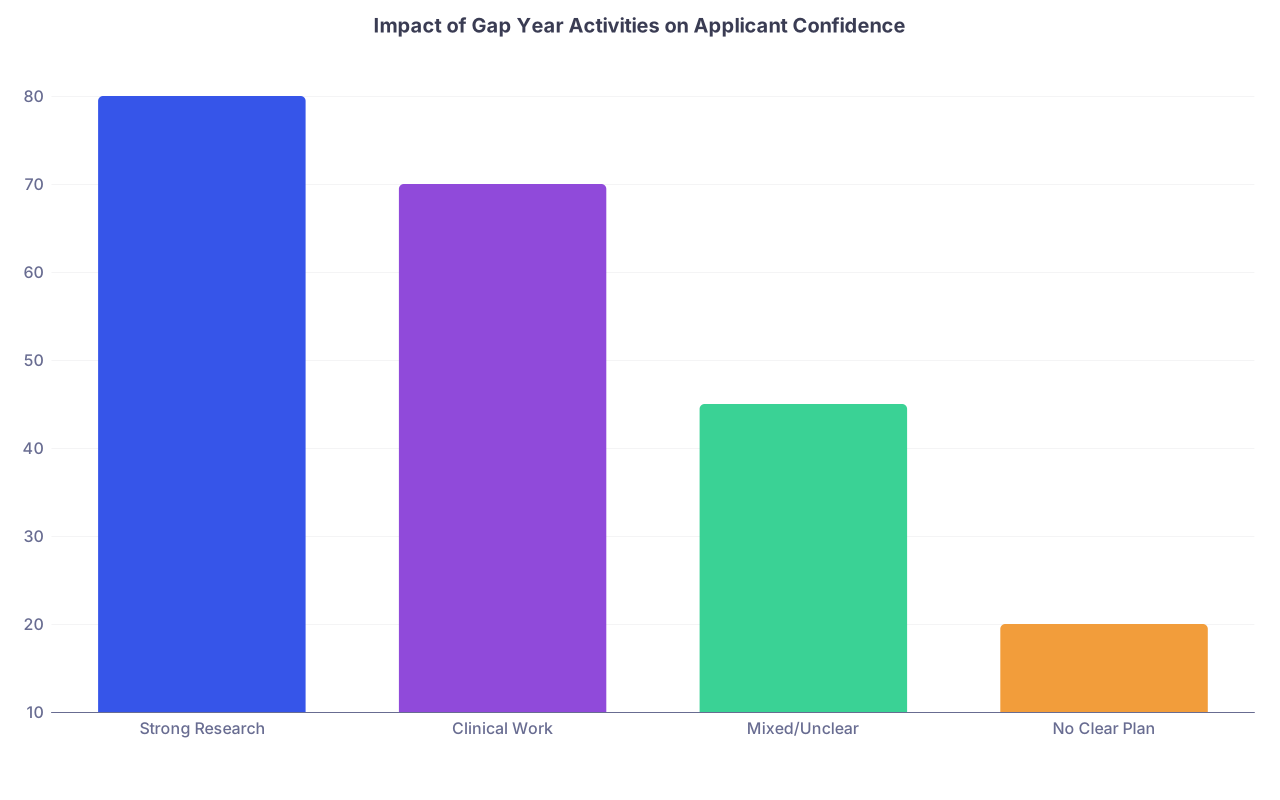
| Category | Value |
|---|---|
| Strong Research | 80 |
| Clinical Work | 70 |
| Mixed/Unclear | 45 |
| No Clear Plan | 20 |
Two separate tasks:
- Salvage this cycle (how you explain what you’ve done so far).
- Set up for next cycle (in case you don’t match).
For This Cycle
You can still:
- Update programs (if/when appropriate) with:
- new abstracts,
- new responsibilities,
- new roles or promotions.
- Be intentional in interviews with how you tell the story of your year:
- Why you chose it.
- What changed.
- What you learned.
- How it prepared you better than staying straight through.
You do not have to say:
“I regretted everything and panicked in January.”
You can say something like:
“I started the year heavily focused on X, and as I got deeper into the work, I realized I was especially drawn to Y. That pushed me to take on Z responsibility / project in the latter half of the year. It ended up being a real turning point in how I see my role as a future resident.”
That’s honest enough, without sounding unstable.
For Next Cycle (If Needed)
If part of your brain is already whispering “what if I don’t match,” don’t ignore it. Make a backup plan without assuming you’ve already failed.
Options:
- Extend or deepen your current role, but with:
- upgraded responsibilities,
- clearer outputs,
- and at least one strong letter.
- Pivot slightly:
- From unpaid to paid research.
- From generic clinic job to one in your desired specialty.
- Add:
- Step 3 (for IM/FM/psych, often helpful as a reapplicant),
- targeted electives/observerships if you’re an IMG or need USCE.
You don’t need everything. You need a coherent, forward‑moving story.
If Your Gap Year Was Derailed by Life (Not Just Bad Planning)
Sometimes it’s not “I picked the wrong gap year.” It’s:
- family illness,
- your own health,
- visa delays,
- financial crisis,
- or mental health collapse.
Programs are not heartless, but they also don’t read minds. You can’t just leave a giant black hole and hope they assume the best.
You don’t have to trauma‑dump. You do need some context. Something like:
“I initially planned a full research year, but mid‑year I needed to temporarily step back to support a sick family member. Once things stabilized, I returned to part‑time clinical work and continued to stay engaged in medicine through X/Y.”
The key:
- Own the decision.
- Show that you resumed forward motion.
- Be concrete about what you’re doing now, not just what went wrong.
Quick Reality Check: What Actually Matters to PDs
Let’s cut through the noise. PDs generally care about:
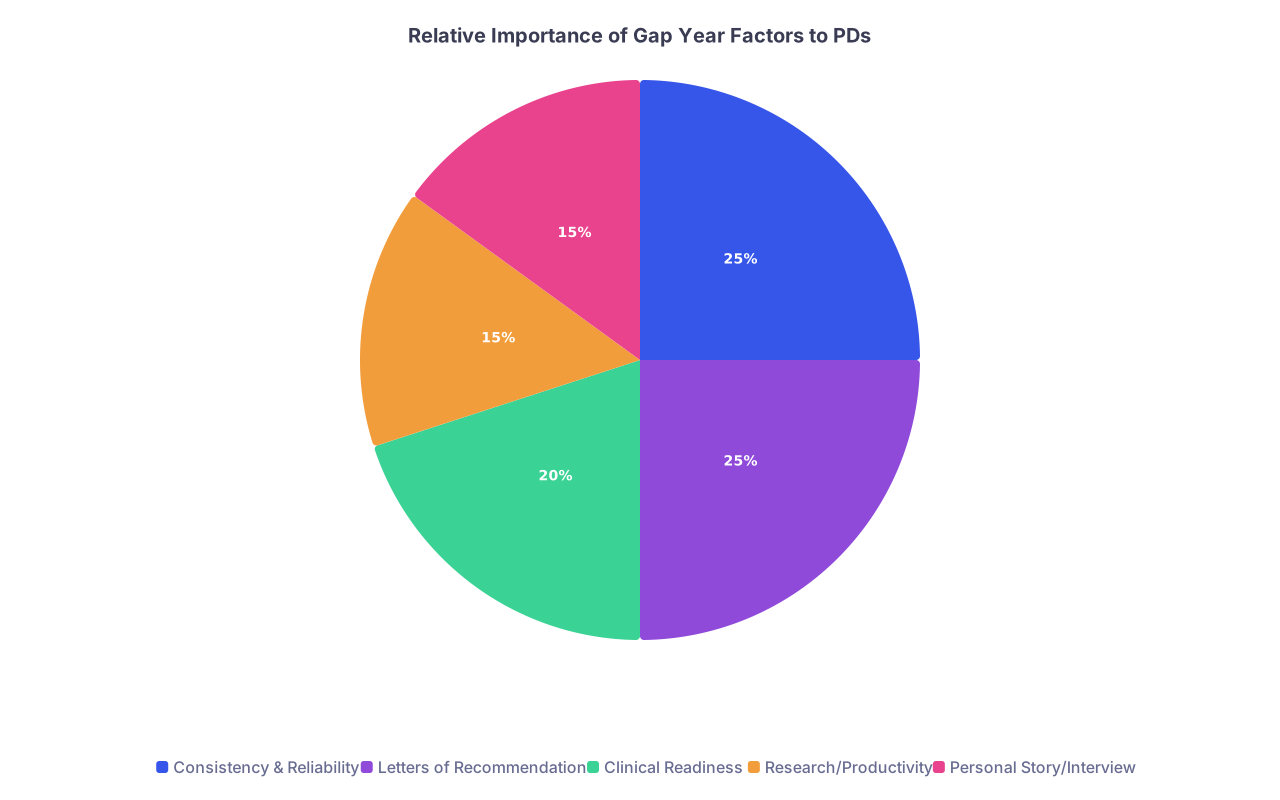
| Category | Value |
|---|---|
| Consistency & Reliability | 25 |
| Letters of Recommendation | 25 |
| Clinical Readiness | 20 |
| Research/Productivity | 15 |
| Personal Story/Interview | 15 |
Notice what’s not at the top: “Having the perfect, Instagram‑worthy gap year plan from Day 1.”
What matters:
- You didn’t vanish.
- Somebody senior is willing to put their name on a letter for you.
- You sound like you actually learned something and grew.
- You don’t crumble when talking about adversity.
You can still get all of that mid‑year.
FAQ: Exactly 6 Questions
1. Is it better to quit my current gap-year job and start something new, or stick it out?
If your current job is:
- abusive,
- giving you zero path to growth,
- or actively harming your mental health,
leave. No residency spot is worth your sanity.
If it’s just boring or not what you imagined, you’re usually better off:
- staying,
- adding responsibilities,
- and layering in side projects,
than blowing everything up and having to explain a short, abandoned role plus another transition. Stability + added value tends to look better than chaos.
2. I’m halfway through the year and have no publications. Am I doomed for competitive specialties?
You’re not doomed. But you’re behind the “typical” curve. For very competitive fields (derm, ortho, plastics, etc.), some tangible output helps.
You can still aim for:
- a poster or abstract at a national or regional meeting,
- a case report or case series,
- one tightly scoped retrospective project with a fast timeline.
Even one or two solid things, clearly yours, plus a strong letter from your PI, beats 5 low‑effort throwaway pubs where nobody really knows you.
3. What if my gap year isn’t directly related to my specialty? Will that hurt me?
Not automatically. It matters more how you connect it.
Example: doing general IM research while applying to cards is fine if you can say:
“I loved the complex, longitudinal care in IM, and over this year I found myself most drawn to the cardiac patients, especially in X context. That’s what pulled me toward cardiology.”
If the gap year feels completely random (e.g., general admin job) and you can’t connect it at all, that’s when PDs get confused. Your job is to make the through‑line visible.
4. I feel like I “wasted” the first half of the year. Can the second half really make a difference?
Yes, if you stop writing the whole year off as a loss. The second half can:
- get you your best letter,
- give you your only tangible project,
- shift your narrative from “drift” to “growth.”
I’ve seen people match after only really “waking up” in January and grinding from then on. Not ideal, but very possible. Programs care a lot about your direction by the time you apply.
5. How honest should I be in interviews about regretting my gap year path?
Don’t lie, but don’t self‑sabotage. Saying, “I completely regretted it, it was a disaster,” makes you sound impulsive and negative.
Better approach:
- Acknowledge it wasn’t what you expected.
- Focus on what you learned.
- Emphasize how you adapted and course‑corrected.
Something like:
“The year didn’t unfold exactly how I envisioned. Early on I realized X wasn’t as fulfilling as I’d hoped, so I actively sought out Y and Z to make sure I was still growing. It taught me to be more proactive about shaping my environment.”
That’s honest without sounding unstable.
6. What if I course-correct and still don’t match — does that mean the gap year ruined everything?
No. If you don’t match, it’s almost never just the gap year. It’s usually a combination: scores, letters, interview skills, specialty choice, number of programs, red flags, etc.
A mid‑year course‑correction actually helps you as a reapplicant because you can say:
- “Here’s what I changed.”
- “Here’s what I added.”
- “Here’s how I’m stronger this cycle.”
Programs like to see that you didn’t just run the same play twice and hope for a different result.
Bottom Line
- Mid‑year regret doesn’t mean your gap year is ruined. You can still add real value and reshape your story in 3–6 months.
- You don’t need a perfect path; you need a coherent one: visible growth, at least one strong letter, and some concrete outputs.
- Stop trying to undo the first half of the year. Treat the second half like your chance to prove you can adapt, course‑correct, and finish stronger than you started.


