

What if you take a year off to get your mental health together… and programs quietly blacklist you for it?
The ugly fear behind the question
Let me just say the thing you’re probably not saying out loud:
“I’m burned out, maybe depressed, maybe traumatized from clinicals, I can’t imagine starting intern year like this… but if I take a gap year for therapy/partial hospitalization/just not collapsing, are they going to see me as unstable and not match me?”
That’s the fear, right?
Not just, “Will they ask about it?”
But, “Will they assume I’m dangerous, unreliable, or a liability?”
You’re not crazy for thinking this. I’ve heard PDs say some pretty cold things. I’ve also seen residents crash hard because they didn’t take time off and came into internship already at a breaking point.
So let’s be brutally honest and also strategic about this.
How programs actually think about a “mental health” gap year
Most programs don’t care why you took time off as much as they care about three things:
- Are you safe to put on call and hand patients to?
- Are you reliable or going to disappear mid-year?
- Can you function at the workload residency demands?
The rest is… packaging.
They don’t get a big pop-up in ERAS saying:
“This person took a mental health year; proceed with caution.”
What they do see:
- A gap in training or a non-traditional timeline
- Whatever you or your dean’s letter or LOR writers say about that gap
- Your performance and narrative before and after that time
The risk isn’t the existence of a gap year.
The risk is how unexplained, chaotic, or poorly framed it looks.
And yes, there’s stigma. Less than there used to be, but it’s not gone. Some PDs are old-school: “If they needed time off now, how will they handle residency?”
Others are much more human and frankly relieved to see someone who took burnout seriously and came back stronger.
Both types exist. So your job is to make it very obvious you’re in the second category: the “I did what I had to do to be safe, stable, and ready” group.
Mental health gap year scenarios: which ones raise red flags?
There’s a difference between:
- “I used a structured year to get treatment, heal, and do something meaningful”
versus - “Everything kind of fell apart, and I can’t explain what I was doing.”
Here’s how programs instinctively sort this:
| Scenario Type | Program Reaction (Typical) |
|---|---|
| Structured, explained, with activities | Generally acceptable |
| Unstructured, vague, no documentation | Raises questions |
| Time off with clear improvement + strong letters | Often reassuring |
| Time off + ongoing major performance issues | Concerning |
| Honesty + maturity in explanation | Viewed positively |
If your year looks like:
- Actively in therapy / maybe on meds
- Possibly an IOP or PHP at some point
- Some combination of light research, part-time work, tutoring, caregiving, or volunteering when stable enough
That’s not career-ending. Not even close.
Where programs start panicking is when they see:
- Multiple failed attempts at returning to training
- Repeated leaves with no clear resolution
- Vague phrases like “personal issues” with zero context and no evidence you stabilized
- Bad or lukewarm letters after your return
So no, “I took a year to address depression/anxiety/burnout and I came back functioning well” is not automatic death.
But it does need to be handled very carefully.
How much do you have to disclose?
Here’s the part that keeps people spiraling at 2am:
“If I say it was for mental health, are they going to pry for details?”
“Do I have to mention hospitalization?”
“What if I’m still in treatment?”
Let me be blunt:
You don’t owe anyone your diagnosis.
You don’t need to write “I was treated for major depression with suicidal ideation” in your personal statement. Please don’t.
You can frame it more like:
- “I realized I was severely burned out and at risk of not being the physician I want to be.”
- “I took a planned year to focus on my health, work with a therapist, and rebuild sustainable habits.”
- “That time allowed me to return more resilient, more self-aware, and more effective clinically.”
That’s different from lying. You’re telling the truth at a professional level of detail.
Where you do have to be careful is disability and licensing forms down the line, but that’s a separate beast. Most residency applications themselves don’t require you to spell out diagnoses.
If you had a formal leave of absence from med school, that may be mentioned in your MSPE/dean’s letter. How it’s worded matters. If it says “personal leave” without drama and you’ve done well since, a lot of PDs shrug and keep reading.
If someone asks directly in an interview, you still don’t have to give your whole psych history. You can say something like:
“I hit a point in training where I realized I needed to address my own wellbeing to be safe and effective. I worked closely with my physicians, took a step back, and came back much more stable and functional. Since then, I’ve completed all rotations without issues and have strong support systems in place.”
You’re answering the real question they care about:
“Are you okay now and will you be okay under stress?”
Not: “Can you entertain my curiosity about your trauma?”
Will taking this year tank my match chances?
That’s the gnawing thing, right? Numbers.
Let me give you the uncomfortable answer:
It can hurt if:
- You were already borderline for your specialty (low scores, weak letters, no home program)
- You add a gap year with nothing to show for it and no clear story
- You reapply with the same application, no obvious growth, and just “time passed”
But a mental health-focused year can actually help you if:
- You were on the verge of failing, getting terrible evals, or imploding on rotations
- You used the time to heal and then gathered strong fresher letters after returning
- You can now function like a decent human again instead of a hollowed-out shell pretending to be fine
Think about it this way: one well-timed gap year that prevents you from crashing and burning in intern year is a thousand times better than starting residency barely hanging on, then needing leave, remediation, or even dismissal.
Programs hate mid-year disasters.
A candidate who did the hard work before starting is less scary to them than someone who white-knuckles their way into a catastrophic breakdown in November of PGY-1.
To visualize the trade-off:
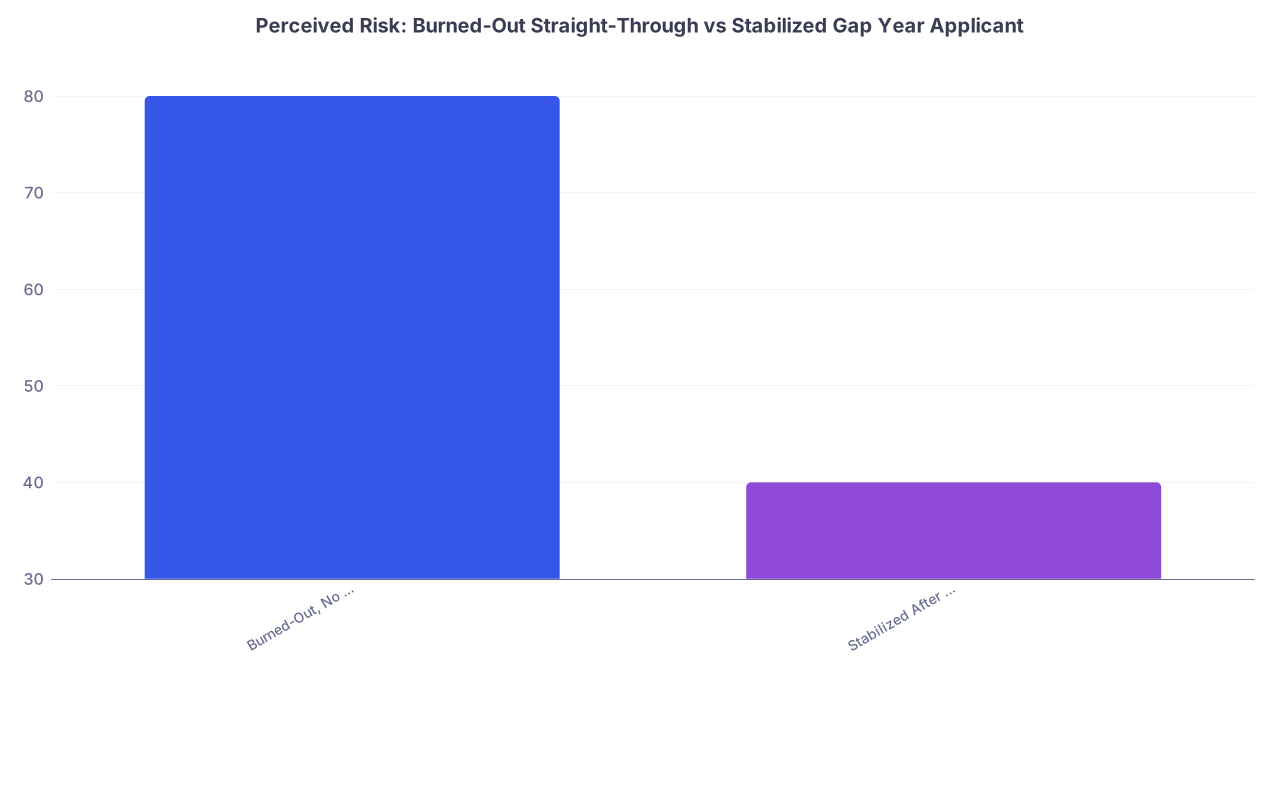
| Category | Value |
|---|---|
| Burned-Out, No Break | 80 |
| Stabilized After Gap Year | 40 |
That’s obviously conceptual, not real data, but it’s how a lot of experienced PDs think when they’ve seen enough interns crash.
How to structure a mental health gap year so it doesn’t look like a black hole
Here’s where you actually have control.
Your year doesn’t have to be a productivity contest. You are allowed to rest and recover. But from an application perspective, it helps if, once you’re stable enough, your time has some shape.
This doesn’t mean full-time anything. It means intentionality.
Things that tend to look good without killing you:
- Part-time research with a faculty member (even a simple chart review or QI project)
- Teaching/tutoring (MCAT, undergrads, STEP, etc.)
- Volunteer work, especially if it’s consistent
- Light clinical work in a supervised role (scribe, MA, health coaching, if appropriate and legal in your area)
- Course work in something genuinely useful: public health, bioethics, data science… or even something non-medical that shows you’re a human with interests
And mixed in there (obviously not spelled out in ERAS):
- Weekly therapy
- Medication management
- Sleep rehab, exercise, nutrition, basic life rebuilding
- Time spent reconnecting with friends/family so you’re not completely isolated
The point isn’t to “hide” that it was a mental health year. The point is to show:
“I got knocked down, took time to address it, and I can still build and contribute.”
Later, when you frame it, you can honestly say:
“During that year I focused on my health and also worked on X, Y, and Z, which helped me return to training ready to commit fully.”
If you’re planning this out, map it like a timeline. Something like:
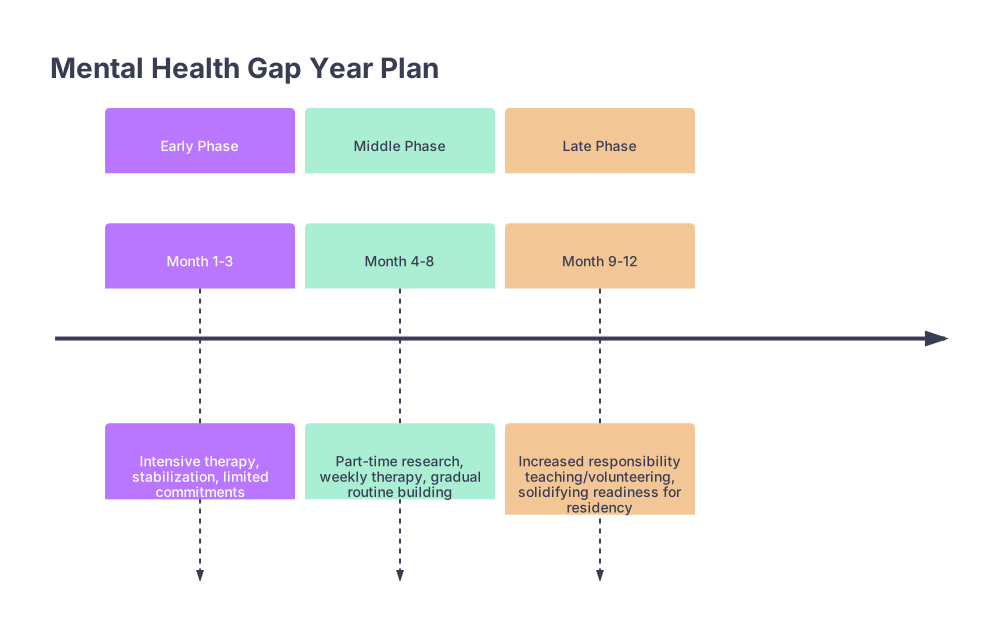
| Period | Event |
|---|---|
| Early Phase - Month 1-3 | Intensive therapy, stabilization, limited commitments |
| Middle Phase - Month 4-8 | Part-time research, weekly therapy, gradual routine building |
| Late Phase - Month 9-12 | Increased responsibility teaching/volunteering, solidifying readiness for residency |
It doesn’t have to be perfect. It just has to be intentional and survivable.
How to talk about it in your application without sinking yourself
You’re probably terrified of wording. That’s fair. Wording matters.
A few principles:
Don’t center your application on your suffering.
Your personal statement is not your therapy note.Do acknowledge the gap if it’s obvious.
Ignoring a 12-month hole is weirder than naming it.Focus on what you learned and how you’re different now.
Not just, “I was so burned out.” More like, “I built sustainable habits that make me more reliable and resilient.”
Example language (tweak, don’t copy-paste mechanically):
“After completing my core clinical rotations, I recognized I was struggling with burnout and not functioning at the level I expect of myself. In collaboration with my advisors and physicians, I took a planned year away from formal training to focus on my health, reflect on my goals, and reestablish a sustainable foundation. During this time, I engaged in regular therapy, participated in a quality improvement project on inpatient communication, and tutored pre-medical students. Returning to the wards afterwards, I found I could be more present with patients, handle stress more effectively, and contribute more reliably to my teams.”
Notice what’s not in there: diagnoses, medications, crisis details.
What is there: maturity, insight, specific things you did, and a clear “before vs after.”
If you’re still symptomatic but functional (which is very common), the key is: can you honestly say you’re ready for residency-level stress with the supports you have in place? If the answer is “barely” or “probably not,” you might need more time. And that’s not weakness; that’s not wanting to collapse halfway through intern year and have to explain that to future programs.
Worst-case scenarios (because I know you’re already imagining them)
Let’s walk through the nightmares:
Nightmare 1: “They reject me just because of the gap year.”
Some will. You’ll never know. They’ll just filter for “continuous training” or prefer straight-through students. You can’t control that.
But plenty won’t care as long as the rest of your app is coherent and strong. I’ve seen people match with 1–2 year gaps for health reasons and still land in solid university programs.
Nightmare 2: “They grill me in the interview and I freeze.”
Very possible that 1–2 interviewers ask. You can prep a 2–3 sentence, steady answer you’ve rehearsed. Practice it out loud until your voice doesn’t shake as much. You’re not obligated to bleed emotionally for them.
Nightmare 3: “They think I’m fragile and unsafe.”
They will judge based on your current performance and how you present. Strong post-gap letters, solid clinical performance, and a calm explanation go a long way. If your letter writers say you come early, stay late, communicate clearly, and handle stress well, that speaks louder than your one-year pause.
Nightmare 4: “I never match because of this.”
If your scores are within reasonable range, your specialty isn’t insanely competitive, and you apply smartly and widely, this is unlikely. Could it take more strategy? Yes. Should you talk to a trusted advisor or PD about targeting realistic programs? Absolutely.
But “I took a year for mental health so my career is over” is just not how this actually plays out in the majority of cases.
FAQ (exactly 5 questions)
1. Should I explicitly say “mental health” in my application, or keep it vague like “personal reasons”?
You don’t have to use the phrase “mental health,” but an overly vague “personal reasons” with a whole year gone tends to raise eyebrows. Something like “health and wellbeing” or “burnout” is often enough. Then focus on what you did during that time and how you came back stronger. The goal is to be honest without oversharing.
2. Will a documented mental health leave show up in my MSPE or transcripts?
Often yes, in some form. Many schools include “student took a leave of absence from X to Y for personal reasons.” Sometimes they specify health, sometimes not. You can ask your dean’s office exactly how they phrase it; you’re allowed to see your MSPE. If it sounds really ominous, that’s worth a calm conversation with them about neutral wording.
3. Do I need to have “productivity” (research, work, etc.) during my gap year for it to be acceptable?
Not in the first months if you’re genuinely not functional. Survival and stabilization come first. But if the entire year has nothing structured you can point to, it’s harder to frame convincingly. Even modest, part-time commitments once you’re stable can change the story from “I disappeared for a year” to “I healed and slowly rebuilt.”
4. What if I’m still in therapy and on meds when I start residency? Do I have to tell anyone?
You don’t have to announce your treatment to your program unless a specific form requires certain disclosures for safety or licensing. Many residents quietly stay in therapy and on medication. The key is that your treatment is stable enough that you can function with resident-level workload. If you’re unsure, that’s something to talk through honestly with your psychiatrist/therapist, not just your anxiety.
5. Is it better to push through and start residency burned out than risk a “mental health gap year”?
No. That’s how people end up on prolonged leave, in crisis, or even dismissed. Programs would rather have someone who took time, stabilized, and is now consistent than someone who forced their way straight through and imploded as an intern. A well-structured, honestly framed mental-health-focused gap year is almost always less damaging than a full-blown breakdown mid-residency.
If you strip everything else away, here’s what matters:
- A mental health-focused gap year doesn’t automatically destroy your residency chances; a poorly explained, chaotic one might.
- The story you can truthfully tell after that year — with stable functioning and solid letters — matters more than the fact you stepped away.
And if taking that year is the difference between surviving residency and shattering in it, it’s not just “okay.” It’s the only sane choice.


