

Last week I got a text from a friend halfway through his “one simple research year.” It just said: “Do you ever forget how to be a doctor?” He was sitting in a windowless office surrounded by spreadsheets, trying to remember how to read an EKG without second-guessing every line. And I knew exactly what he meant.
If you’re taking a research gap year before residency, it’s weird. One day you’re on nights managing DKA and chest pain, and the next you’re arguing with RedCap, IRB language, and reviewers. And this loud little voice keeps whispering: “You’re getting rusty. Programs are going to see your skills decayed. You’re going to show up intern year and kill someone.”
Let’s talk about that voice. Because it’s not totally wrong… but it’s not right either.
The specific fear: “I’m going to forget how to doctor”
There’s the rational part: you know people take research years all the time. MD/PhDs disappear for years and then still match into neurosurgery. You know that. But your brain doesn’t care. It’s replaying worst-case scenarios on a loop:
- You show up to intern year and can’t remember the insulin sliding scale.
- Someone asks you to manage hyperkalemia and your mind just blanks.
- You’re on rounds and attendings realize you don’t remember basic exam maneuvers.
- Programs look at your application and think “Oh, they’ve been out of the hospital, probably useless now.”
I’ve watched people in research years avoid going back to the wards because they’re scared they’ll confirm they’ve forgotten things. Almost like not checking is safer than knowing.
Here’s the ugly truth: yes, some clinical rust is real. You will feel slower when you come back. You will need a few weeks to get your rhythm back.
But here’s the more important truth: the kind of decay that actually hurts you isn’t inevitable. It’s what happens when you let the year just… wash over you. No structure. No plan. “I’ll just read sometimes” (you won’t). “I’ll remember it when I need it” (you won’t, at least not smoothly).
You don’t have to be perfect. You just have to be intentional.
How much decay actually matters for residency?
Let me be blunt: programs are not scared you forgot the dose of ceftriaxone.
They’re worried about something else: are you still engaged with patient care? Or did you mentally check out for a year and now you’re coming back brittle, overwhelmed, and behind?
Here’s how I’ve seen PDs and attendings actually think about research years:
| Scenario | How Programs Usually See It |
|---|---|
| Research with some clinical involvement | Positive or neutral |
| Full-time research, no outreach, no clinical anything | Mild concern but fixable |
| Research plus clear teaching/mentorship roles | Strong positive |
| Research year with failed projects and no story | Red flag-ish if poorly explained |
| Research in their specialty with letters | Strong positive |
They expect you to be a bit rusty on day one. Everyone is. Even people who go straight through. That first intern month? Chaos for almost everyone.
What they care about more:
- Can you learn fast?
- Do you care about patients?
- Are you coachable?
- Are you still in the “clinical headspace” enough that the ramp-up doesn’t break you?
Staying “clinical” during your research year is less about memorizing UpToDate and more about keeping those muscles warm: the thinking, the pattern recognition, the communication, the comfort with uncertainty.
And yeah, you can absolutely do that in a research year—if you treat it as a real goal, not an afterthought.
Concrete ways to stay clinical (that actually work)
I’m not going to tell you “just volunteer a bit” and call it a day. That’s how you end up signing up for something aspirational that you abandon after two weeks.
You need things that are:
- Sustainable on top of research
- Structured
- Close enough to “real medicine” that your brain stays in doctor mode
1. Anchor yourself to one consistent clinical commitment
The people who come out of a research year the least rusty almost all have one stable clinical anchor.
That might be:
- One half-day clinic per week in your intended specialty
- A recurring ED shift once or twice a month as a sub-I-like role or “clinical assistant”
- Longitudinal student-run clinic supervision/participation if your med school allows grads to stay involved
The key is that it’s scheduled, not “I’ll go when I have time.”
If your PI or mentor pushes back (“But research is full-time”), be honest: “I’m worried about skill decay, and I want to be a safe, competent intern. One half-day a week will massively help that.” Most decent physicians respect that. If they don’t? That tells you something about them, not you.
2. Take call or shadow strategically, not randomly
You don’t need to live in the hospital. But 1–2 times a month, arrange to:
- Join a night float or call shift with a resident you know
- Shadow on rounds and actually pre-round on 1–2 patients
- Sit in sign-out and force your brain to process “sick or not sick, what would I do?”
You don’t even have to “do” much. Just listen, write fake notes, practice your differential in your head and compare it to what the team did. You’re rehearsing the thinking, not just the tasks.

| Step | Description |
|---|---|
| Step 1 | Start Research Year |
| Step 2 | Find clinic/ED role |
| Step 3 | Schedule Regular Shifts |
| Step 4 | Monthly Call/Shadow |
| Step 5 | Weekly Case Review |
| Step 6 | Refine Plan or Add Activities |
| Step 7 | Clinical Anchor Set? |
3. Turn your research into a clinical exercise
Even if your project is 90% data cleaning hell, you can force it to stay clinically flavored.
Things like:
- For every patient in your dataset, stop and ask: “If I met this person in clinic, what questions would I ask? What would I be worried about?”
- When you look at an outcome (AKI, ICU admission, readmission), force yourself to imagine the moment it happened. What could have been done earlier? What would I look for next time?
- If you’re doing chart reviews, actually read the H&Ps, not just the lab values. Notice how attendings structure their thinking. Who do you agree with? Who would you have managed differently?
You can also present your research at case conferences or M&M with a clinical spin instead of just statistics. That helps your brain practice translating data into patient care decisions.
Keeping your knowledge from leaking out of your head
Here’s the other panic you probably have: “All the stuff I crammed for Step 2 is evaporating.”
Spoiler: it is. That’s what brains do.
But again, you don’t need Step-2-level trivia. You need fluency with common bread-and-butter medicine. You can keep that alive without torturing yourself.
1. Weekly “mini-intern” sessions
Once a week, 1–2 hours. That’s it. But treat it like a standing meeting with yourself.
Pick one:
- Do 20–40 UWorld/AMBOSS questions in your chosen field (or gen med if you’re unsure)
- Read one chapter/section from a real clinical resource (Sabatine, Pocket Medicine, your specialty handbook)
- Watch 1–2 high-yield videos on something you know you’re shaky on (vent management, fluids, acid-base, chest pain workup)
Then do the part most people skip: connect it to an actual patient you’ve seen or read in charts. “Oh, this hyperkalemia case. That reminds me of that CKD patient I saw on wards.” Story > random facts.
If you don’t schedule this, it will not happen. Your brain will always tell you research deadlines are more urgent.
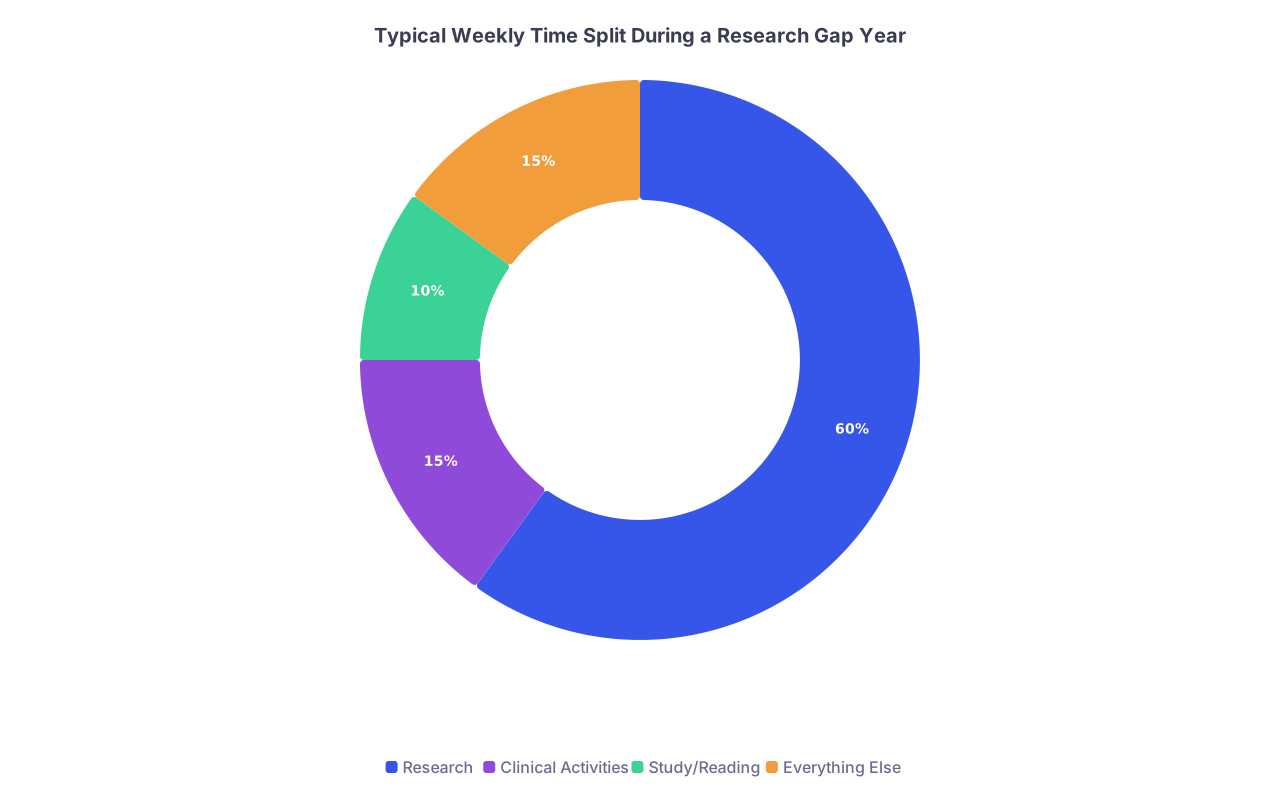
| Category | Value |
|---|---|
| Research | 60 |
| Clinical Activities | 15 |
| Study/Reading | 10 |
| Everything Else | 15 |
2. Case-based group sessions (even informal ones)
If you’re at an academic place, find other research-year people or MS4s doing electives and start a tiny, low-pressure group. Every 1–2 weeks, someone brings:
- One de-identified clinic patient or inpatient they heard about
- Or a complex Board-style case
And you spend 30–45 minutes talking like a team: differential, workup, what you’d do overnight, what you’d tell the family.
This keeps your “talking like a doctor” muscle from atrophying. That verbal reasoning is a big part of what feels rusty when people come back.
If you’re shy about organizing it, rope in a friendly fellow or resident. Most people like teaching more than you think.
3. Micro-learning: make your environment work for you
If you’re drowning in spreadsheets, sometimes the only realistic option is micro-learning:
- Keep one small pocket reference or PDF open on your desktop
- Read 1–2 pages while waiting for code to run, data to load, or emails to send
- Keep a “2-minute facts” list: tiny things you relearn and jot down briefly (common insulin regimens, COPD inhaler tiers, HF meds, etc.)
You’re not trying to be heroic. You’re just refusing to let a whole month go by with nothing clinical passing through your head.
Addressing the ugly what-ifs in your head
Let’s drag the worst fears into the light, because they’re running the show whether you admit it or not.
“What if programs think my research year means I’m afraid of real medicine?”
Then you have to deliberately show the opposite.
On your CV and in your ERAS experiences, don’t list your year as “Research Fellow, Department of X” and nothing else. If you did any of the things we talked about—clinic, call, case conferences, teaching—list them. Doesn’t matter if it was just 4 hours a week.
And when you write your personal statement or talk in interviews, don’t just say, “I did research because I love science.” Add: “I was also very aware of the risk of getting rusty, so I made sure to stay involved clinically through ___.”
Program directors like people who anticipate problems and fix them before they’re told to.
“What if I really do feel slow and stupid when I get back?”
You probably will, a bit. Everyone does. Your first admission after a year away might feel like you’re trying to write with your non-dominant hand.
What I’ve seen over and over: it comes back stupidly fast. Two to four weeks of consistent clinical immersion and suddenly your brain remembers it’s been here before. Especially if you didn’t completely ignore medicine during your year.
Expect that awkward phase. Normalize it. Warn your future self: “The first two weeks will feel rough. That doesn’t mean I made a mistake.”

“What if I did none of this and I’m already halfway through the year (or almost done)?”
Then no sugarcoating: you need a more intense on-ramp.
You can:
- Pack the last few months with more frequent shadowing, clinic, or electives if allowed
- Ask to join a sub-I or acting intern rotation late in the year, even unpaid, just to get reps
- Do a short bootcamp with a heavy mix of question blocks + bedside time + simulation if your school/hospital offers it
And you get really honest in applications: “I realized partway through my research year that I was too distant from patient care. I corrected that by ___, and it reminded me how strongly I’m drawn to clinical work.” Owning the mistake + showing the fix plays better than pretending you planned it this way.
Using the research year for residency, not against it
There’s one angle people forget: your research year can actually make you a better, safer intern if you use it right.
Things that actually translate:
- You get more controlled time to really understand guidelines and evidence, instead of blindly following order sets.
- You watch how disease plays out longitudinally in datasets or charts, which helps with prognostication and counseling later.
- You can build specialty-specific depth in at least one area (e.g., anticoagulation, IBD, heart failure, sepsis), so you’re not starting from zero.
If interviews come and you’re asked about the gap, don’t sound defensive. Don’t lead with “I know I’m rusty but—”. Instead: “I knew a research year could risk some clinical rust, so I did X, Y, Z to stay close to patient care. It actually gave me space to build stronger foundations in ___, which I think will help me as an intern.”
You’re showing that you understood the risk and managed it, which is exactly the kind of thinking they want when you’re cross-covering 40 patients at 2 a.m.
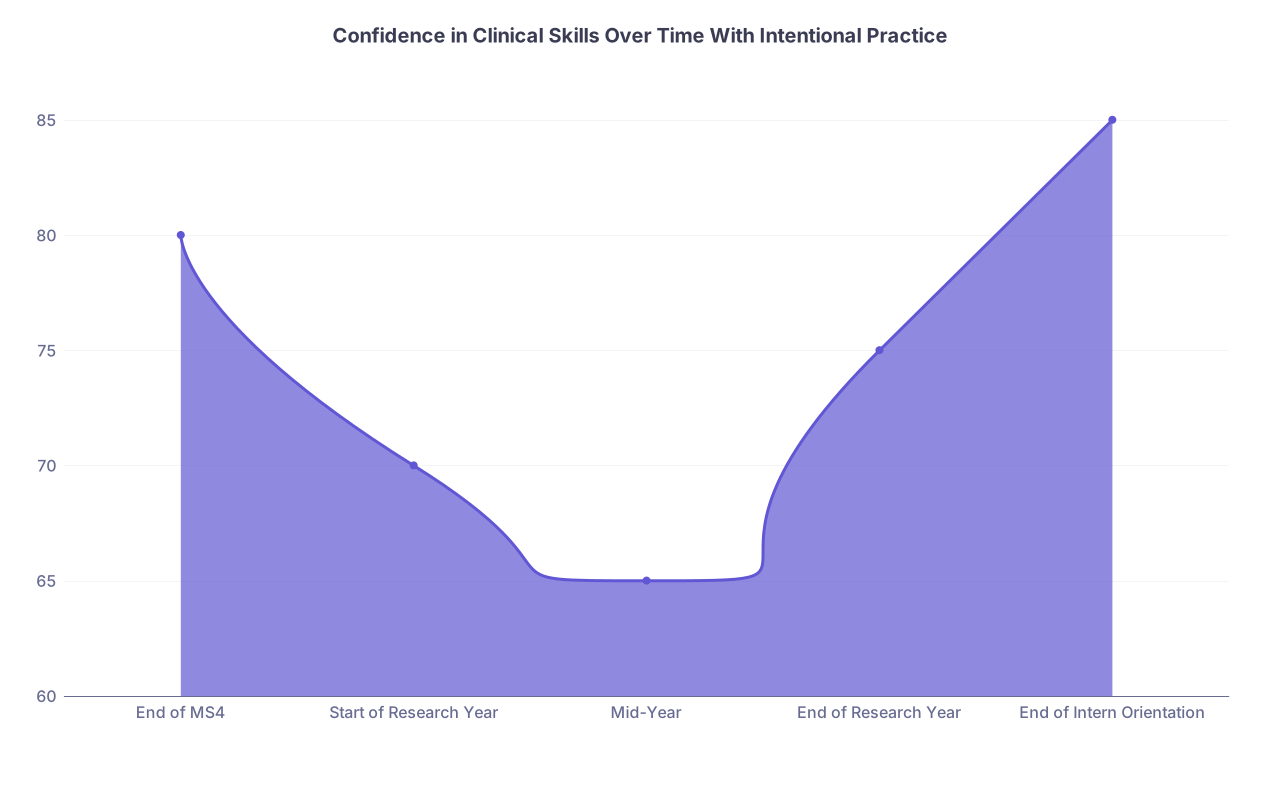
| Category | Value |
|---|---|
| End of MS4 | 80 |
| Start of Research Year | 70 |
| Mid-Year | 65 |
| End of Research Year | 75 |
| End of Intern Orientation | 85 |
How to know if you’re doing “enough”
This is the part that keeps you up at 3 a.m., scrolling forums: “Am I doing enough? Is my friend doing more? Are they going to be better prepared?”
Here’s the rough sanity check I’d use. You’re probably fine if:
- You have one ongoing clinical anchor (clinic/ED/call/case conference)
- You do some structured studying or questions at least once a week
- You can still talk through a chest pain or SOB case without completely freezing
- You don’t feel a wave of panic at the idea of going back on the wards—just normal nerves
If all of that is true, are you going to be slightly slower on your first admission? Sure. So is everyone who hasn’t been on nights in months.
If none of that is true, then don’t spiral. Make a plan for the next 2–3 months and start now. Not “after this deadline,” not “next rotation.” Now.

The bottom line if your brain is screaming doom
You’re not crazy for worrying about skill decay. You should respect it. It’s real if you ignore it.
But the disaster scenario your brain is playing—showing up as a useless, unsafe intern because you did a research year—is almost always fiction if you stay even moderately intentional.
Three things to walk away with:
- You don’t need to be perfectly sharp; you just need consistent, small, structured clinical contact and case-based thinking through your year.
- Programs care far more that you stayed engaged with patient care and can talk like a clinician than whether you remember every drug dose on day one.
- If you’re behind, it’s not fatal. Own it, fix it now with concentrated clinical exposure and honest reflection, and you’ll still be okay.
You’re allowed to take a research year and still be a good doctor. You just have to choose, on purpose, not to step completely out of medicine while you do it.


