
What if you take a gap year before residency and… nothing meaningful happens? No real research, no publications, no clear story. Just an awkward blank on ERAS that you have to explain with a forced smile in every interview.
That’s the nightmare, right?
Not just “I took a break.” But: “I drifted for a year while everyone else moved forward.”
Let me say this upfront: an unstructured gap year absolutely can hurt you. I’ve seen it. People with solid stats and no coherent explanation for a year (or more) of vague “clinical experience” and “personal growth” that doesn’t translate into anything concrete. Program directors read that stuff and mentally hit the eject button.
But that doesn’t have to be you.
This isn’t about hustling 24/7 or manufacturing some fake “passion project.” It’s about avoiding the two actual killers of a gap year:
- No clear plan
- No receipts (nothing to show for what you did)
So let’s walk through it like we’re sitting in a coffee shop, you’re staring at your calendar, and you’re asking: “How do I not screw this up?”
Because you’re not crazy for being scared. You’re just early enough to fix it.
The Real Worst-Case Scenarios (And Why They Happen)
Let’s actually name the monsters under the bed instead of vague “I’m worried.”
Here are the gap-year horror stories I’ve seen up close:
The “research assistant” who mostly answered emails
Job title sounded great. But the PI never met with them, no projects were really theirs, nothing got submitted, and in September they had exactly zero abstracts, zero manuscripts, zero strong letters. Their ERAS read like: “Research assistant – duties: data entry.” Programs were not impressed.The “I just needed a break” applicant
They did some part-time clinic work, traveled, “reflected,” and… that’s it. When asked, “So what did you do during your gap year?” they gave vague answers about “self-care” and “burnout.” Do programs hate that? Not exactly. But they want evidence that you still live in the world of medicine. This person didn’t have it.The “planned too late” person
They decided on a gap year in April, assumed something would work out, and by July they were still emailing random people for research and getting “we’re full this year” responses. They spent most of the year trying to get something, instead of doing something.
In almost every bad case, the problem wasn’t that they took a gap year. It was that the year just… happened to them. No structure. No milestones. No narrative thread.
Programs don’t hate gap years. They hate ambiguity.
So your job is to make your year painfully, boringly unambiguous.
Step One: Define a Clear “Headline” for Your Year
If I stopped you in a hallway on interview day and asked:
“So what did you do during your gap year?”
You need a one-line answer that sounds intentional, not accidental.
Something like:
- “I spent a year doing outcomes research in cardiology and working part-time as a hospital scribe.”
- “I worked as a clinical research coordinator in heme-onc and completed a quality improvement project in the infusion center.”
- “I focused on emergency medicine: I worked as an ED scribe, volunteered with a street medicine team, and completed two QI projects with the ED director.”
That’s the “headline.” Everything you do should support that line.
What you don’t want:
- “I did some research, some clinical stuff, some tutoring, and also traveled… it was kind of a mix.”
Your brain will push you toward that scattered version because you’re anxious and want to keep all doors open. But residency app readers don’t reward chaos. They reward coherence.
So pick:
- 1–2 main buckets: usually research + clinical, or clinical + teaching, or research + QI/leadership
- 1–2 secondary things you do less intensively (side volunteering, tutoring, etc.)
Then commit. On paper, at least.
Step Two: Put Actual Structure on the Timeline
Your anxiety is probably telling you, “What if none of this works out? What if I get no research, no job, nothing?”
Fine. Let’s be paranoid and organized at the same time.
You need a simple timeline from now until the next ERAS submission. Not in your head. Written down.
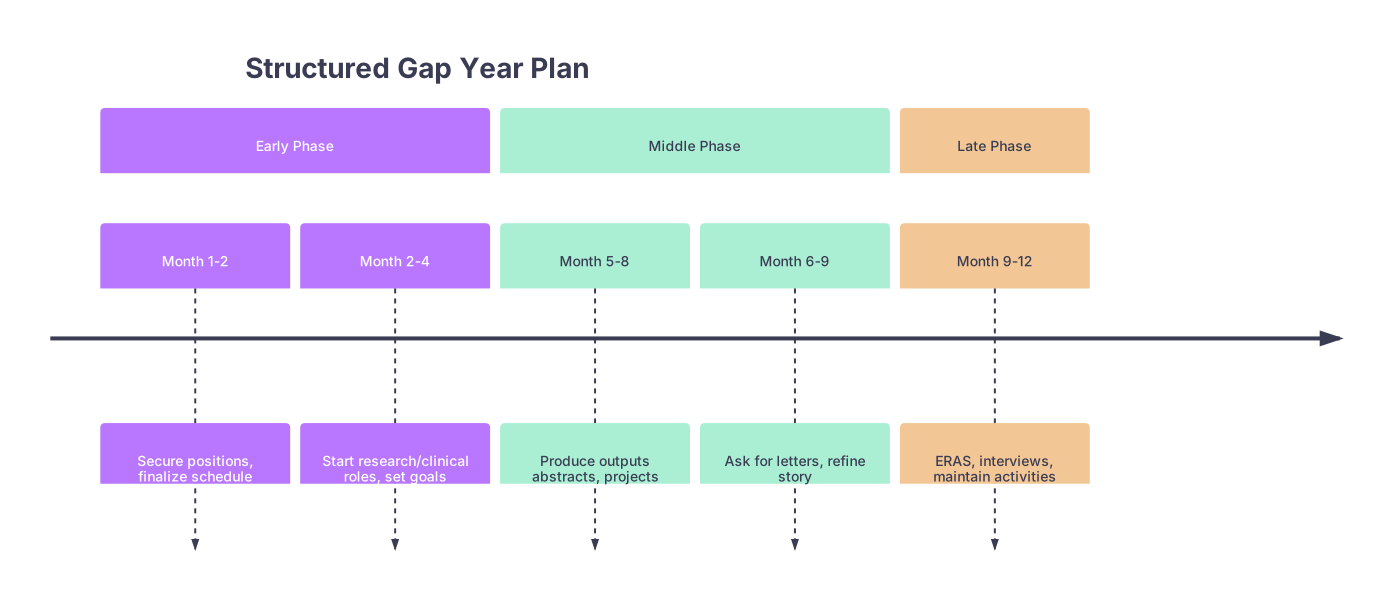
| Period | Event |
|---|---|
| Early Phase - Month 1-2 | Secure positions, finalize schedule |
| Early Phase - Month 2-4 | Start research/clinical roles, set goals |
| Middle Phase - Month 5-8 | Produce outputs abstracts, projects |
| Middle Phase - Month 6-9 | Ask for letters, refine story |
| Late Phase - Month 9-12 | ERAS, interviews, maintain activities |
Roughly, it looks like this:
First 1–2 months:
Get anchored. Secure at least one consistent role (research position, clinical job, etc.). If you’re already in one, clarify expectations and deliverables.Middle 6–8 months:
Actual productivity phase. You’re collecting data, writing abstracts, doing QI projects, stacking experiences that will appear as bullets on ERAS.Final 2–3 months:
Lock in letters, finalize ERAS entries, keep things going enough that you can honestly say you stayed engaged.
You’re terrified of “wasting time” because the year feels like this amorphous blob. Time passes in blobs. Careers are built in weeks and months.
So break the blob.
Step Three: Choose Activities That Actually Translate on ERAS
Here’s the harsh part: not every “good” thing is application-good.
Some stuff sounds nice in real life but looks like fluff on ERAS. Like “shadowed 4–5 different specialties for a few weeks each.” Or “helped out with admin at a clinic.”
You want things that create:
- Entries on ERAS
- Quantifiable outputs (posters, manuscripts, QI projects, teaching hours)
- People who can write you real letters
Let me make it less abstract. Assume you want at least 2–4 “solid” entries on ERAS from your gap year. Here’s what that might look like side by side:
| Type | Strong Version | Weak Version |
|---|---|---|
| Research | Named project, poster/submission, clear role | Vague “research assistant,” no output |
| Clinical | Paid job (scribe, MA, coordinator) | Occasional shadowing |
| Teaching | Formal course/MCAT tutor with hours tracked | Random informal tutoring |
| Volunteering | Long-term weekly role with responsibilities | One-off events, no continuity |
You don’t need everything to be perfect. But you do need some things to be tangible.
If an activity can’t answer these questions cleanly, it’s a red flag:
- What exactly did you do week to week?
- What did you complete or contribute that outlasts you?
- Who can vouch for you and how well do they really know your work?
If the answer is “Well… it’s kinda complicated,” I’d think twice before building your whole year around it.
Step Four: Protect Yourself From the “Fake Research Job” Trap
So many people fall into this.
You get a “research” title that sounds fancy. Your family is impressed. But in reality, you’re just doing data entry, chart reviews someone else designed, and nobody is mentoring you because they’re all “super busy this quarter.”
Months pass. You’re afraid to complain. You don’t want to burn bridges. You keep telling yourself it’ll pay off. Then suddenly it’s August and you have no poster, no paper, no letter that’s more than “X was responsible and punctual.”
You don’t have to accept that fate.
When you start a research position, ask for clarity up front. Yes, it’s awkward. Do it anyway. A normal, functioning research environment will not be offended by questions like:
- “Is there a project I could eventually present or be an author on if I do the work?”
- “How often can we meet to review my progress?”
- “Is there someone in the team who can mentor me more directly day to day?”
If the answer to all of that is vague hand-waving?
You treat that as data. Not a death sentence, but a sign that you need to:
- Either push harder to carve out your own discrete project
- Or diversify your year so that research is not your only “big thing”
You’re allowed to pivot. Sticking with a dead-end research role for 10–12 months because you’re scared of looking flaky is how you end up with the exact “wasted year” you’re terrified of.
Step Five: Balance Money, Sanity, and “Looking Good”
Let’s not pretend money isn’t an issue. Gap years are expensive. ERAS fees, applications, flights, rent. You can’t pay bills with “meaningful experiences.”
The anxiety cocktail is usually:
- “I need something impressive”
- “I need to not burn out more”
- “I also need to not be broke”
So aim for a mix that actually fits your life instead of some Instagram version of productivity.
For most people, something like:
- 1 main consistent job that pays (scribe, MA, research coordinator, nurse’s aide, whatever)
- 1–2 structured “boosters” (research project, QI, teaching, longitudinal volunteering)
That’s it. Not six part-time positions. Not a Frankenstein monster of commitments that make you miserable and unreliable for all of them.
If you’re already cooked from med school, then maybe your paid job is something not-24/7-medical (tutoring, non-clinical remote work) and your medical stuff comes from 1–2 focused commitments. That’s okay. Programs care that you stayed engaged in medicine, not that you lived in a hospital.
The biggest red flag isn’t “only worked part-time.” It’s “did nothing clearly medical for an entire year and can barely explain why.”
Step Six: Track Your Work Like Someone Will Cross-Examine You (Because They Might)
You’re scared of that awkward interview question:
“So tell me more about this research/volunteering you did.”
And then your brain short-circuits, because you remember vibes, not details.
Don’t put yourself in that position.
From day one of your gap year, keep a stupidly simple log. Not a novel. Just:
- Where you worked/volunteered
- How often (days/hours per week)
- What you did (specific tasks)
- Any outcomes (posters, manuscripts, projects, talks, leadership roles)
Once a week, spend 10 minutes updating it. That’s it.
Later, when you’re filling in ERAS and your heart rate spikes trying to remember what you actually did between February and June, you’ll have actual data.
This also saves you from accidentally exaggerating on your application out of panic. You don’t want to write “20 hours/week” and then in an interview casually mention you were there once a week for an afternoon. People notice.
Step Seven: Protect Against the “I Froze and Did Nothing” Cycle
Let me guess: part of you is scared you’re going to overthink everything so much that you end up stuck. Months go by, you’re “researching opportunities” and “working on emails” but not actually in any role yet.
Analysis paralysis is a huge gap-year killer.
So build yourself a rule: every week, something has to move from “idea” to “action.”
Send the email. Submit the job app. Follow up with the PI. Fill in the volunteer form. Book the call with career advising. One concrete thing.
If you catch yourself endlessly rewriting outreach emails because you’re terrified of being annoying, here’s the truth: PIs, clinics, labs, and coordinators ignore perfect emails and sloppy emails equally. Silence doesn’t care how many times you edited.
Volume and persistence matter more than perfectly crafted wording.
A Quick Reality Check on How Programs Actually See Gap Years
Your brain is probably catastrophizing like this:
“If my gap year isn’t insanely productive, programs will assume I’m lazy or unserious and never rank me.”
No.
Here’s the more accurate, less dramatic version:
- A well-structured, productive gap year = clear positive
- A decent, coherent gap year = neutral to slightly positive
- A messy, unstructured, vague gap year = mild negative, bigger negative in competitive fields or if other parts of the app are weak
- A gap year filled with obvious avoidance of medicine = bigger negative, especially if unexplained
Most PDs are not sitting there with a red pen looking to destroy you. They just need to answer three questions:
- Are you still engaged with medicine?
- Can you commit to things and follow through?
- Did you use this time in a way that makes sense for your story?
If your year can support “yes” to those, you’re fine. Even if you don’t walk in with three first-author publications and a Nobel Prize.
What You Can Do Today (So This Year Doesn’t Haunt You Later)
Let’s bring this out of the future and into the next 24 hours.
Here’s what I’d have you do right now:
Open a blank page and write a one-line “headline” for your gap year:
“This year, I am primarily doing X and Y.” No hedging. Just pick something.Under that, write 3–5 concrete things you want to be able to list on ERAS next cycle.
Not dreams. Actual, plausible things like: “1 ED scribe job,” “1 submitted abstract,” “1 long-term volunteer role,” “2 strong letters from this year.”Look at your current reality and pick one action you can take in the next 48 hours that moves you toward that list:
Email a specific PI. Apply to a specific job. Fill in an application for a specific volunteer role. Not vague searching. A real action.
If you want to avoid wasting this gap year, don’t try to fix the entire year all at once. Just stop it from drifting this week.
So: pick your headline, write your 3–5 target outcomes, and send one concrete email or application today. Then tomorrow, open that document again and make sure what you’re doing still matches the story you want to tell.


