

Last August, I watched a friend frantically refreshing their email every ten minutes. Everyone else seemed to have something lined up—research, prelim year, some kind of “amazing opportunity.” Their own inbox was just spam and a rejection from a research coordinator position they were “perfect” for. They looked at me and said, “Did I just tank my entire career before it even started?”
If you’re sitting there right now, months into your “gap year,” with no real position, no structure, and way too much time to catastrophize… yeah, I know exactly what headspace you’re in.
Let’s tear into the scary questions you’re already asking yourself—and then I’ll show you what you can still do now, even if it feels embarrassingly late.
First: No, You Didn’t Ruin Everything (Even If It Feels Like It)
Let me say the part your brain refuses to believe:
You have not ruined your residency chances just because you don’t have a picture-perfect, full-time, neatly titled gap year position right now.
Are there people who had their research fellowships locked in 10 months ago at Mass General or Mayo? Sure. There are also people who matched with:
- A patchwork of part-time work
- Late-start research gigs
- A mix of volunteer and clinical work they cobbled together way after they “should have”
What programs care about in a gap year is not a fancy name. They care about:
- What you did
- What you learned
- How you explain it
Yes, a branded, prestigious position makes that easier. But it’s not the only version of a “valid” year.
Your fear is: “PDs will see this blank year and just toss my application.”
Reality: They’re going to ask, “So tell me what you did during your time off,” and you need a story that doesn’t sound like, “Uh… mostly panicked and scrolled Indeed.”
That’s what we’re going to fix.
Timeline Check: Is It “Too Late” Depends on What You Expect
Let’s anchor this to reality, not just vibes.
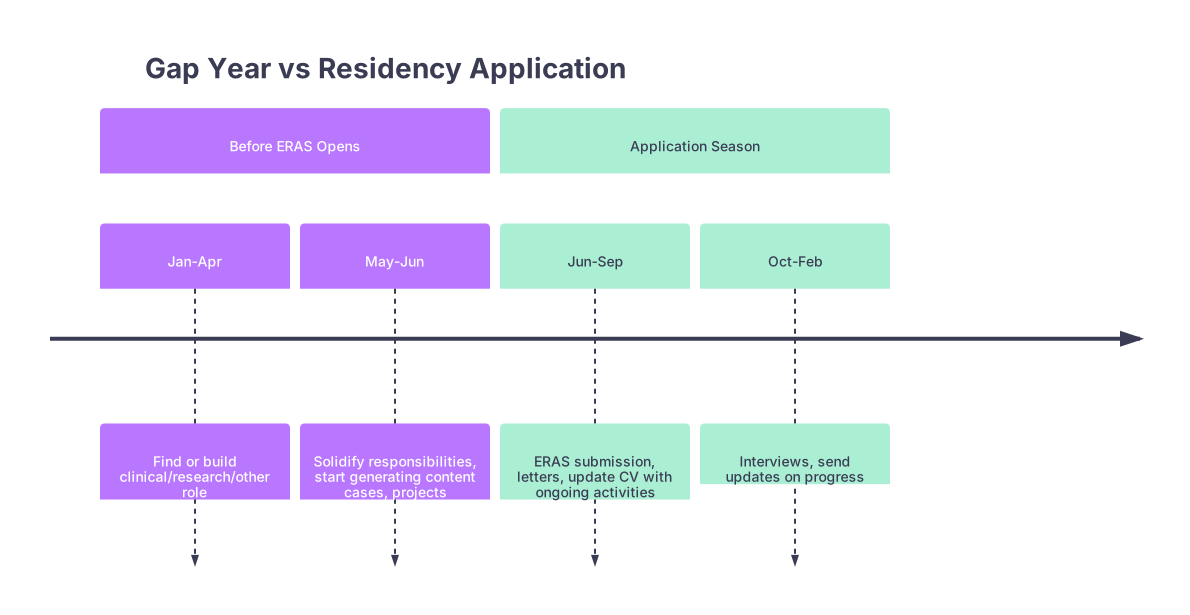
| Period | Event |
|---|---|
| Before ERAS Opens - Jan-Apr | Find or build clinical/research/other role |
| Before ERAS Opens - May-Jun | Solidify responsibilities, start generating content cases, projects |
| Application Season - Jun-Sep | ERAS submission, letters, update CV with ongoing activities |
| Application Season - Oct-Feb | Interviews, send updates on progress |
Even if you’re reading this:
- In January–March of your gap year: You still have decent time to build something tangible.
- In April–June: You can still start something, but you’ll need to be more aggressive and focused.
- In July–September (already submitting ERAS): You can’t rewrite the whole year, but you can still shape the narrative and pick up something “in progress.”
The brutal truth:
You probably won’t land a 12‑month NIH-funded research fellowship starting next week. But you don’t need that to salvage this year. You just need:
- Enough activity to avoid a scary blank space
- At least one thing you can talk about with genuine ownership
- Something that makes sense relative to your target specialty
What Programs Actually Want to See From a “Productive” Gap Year
Your brain is probably pushing one of these scripts:
- “If it’s not research at a big-name institution, it’s worthless.”
- “If it doesn’t have a formal title and salary, PDs will think I’m lazy.”
- “If it’s not exactly aligned with my specialty, it won’t count.”
These are exaggerated. And honestly, they’re holding you back from options that are still on the table.
Here’s the reality: program directors mostly look for three things:
Continued engagement with medicine or something intentional
Not: “I disappeared.”
Yes: “I was still in the ecosystem somehow” (clinical, research, teaching, QI, even meaningful non-clinical work).Trajectory
Does what you did make some sense in the story of who you say you are as a future physician? It doesn’t have to be perfect; it just can’t be random nonsense you can’t explain.Evidence you’re reliable & productive
Are there concrete outputs?- An abstract/poster
- A submitted paper
- A QI project
- A leadership role in a clinic or organization
- A course completed (with some depth, not “I watched a Udemy video once”)
Here’s how different gap‑year setups stack up for residency:
| Type of Activity | How Programs Usually See It |
|---|---|
| Full-time paid research | Strong, especially academic |
| Part-time research + clinic | Good, shows balance |
| Scribe/MA/clinical job | Solid, especially for primary care, EM |
| Unpaid but structured research | Fine, if there’s output |
| Purely non-clinical work | Neutral to slightly negative unless well-framed |
Notice what’s missing?
“Perfectly polished, brand-name, 1-year fellowship with 3 publications” as the only acceptable path. Because it’s not.
If You Still Don’t Have Anything: Concrete Moves You Can Make Now
Let’s assume worst case: it’s late, you’re empty-handed, and your CV looks like a cliff dive after graduation. Here’s where you can still move the needle.
1. Micro-Research or QI Projects (The Fastest “Real” Output)
Stop waiting for a formal job posting. You’re not applying for a dream career right now. You’re trying to get material.
Email faculty you already know (or alumni from your school in your specialty of interest) with something like:
- Short subject line: “Med grad seeking small project help – [Specialty]”
- Brief intro: who you are, what you’re applying to
- One line: “I’m currently in a gap year and don’t yet have a structured position. I’d love to help with ANY small research or QI project that needs an extra pair of hands—chart review, data entry, lit review, case reports, anything.”
You’re not asking for salary. You’re asking for work.
Things that can realistically come out of that in a few months:
- Case report or case series
- Retrospective chart review with you as middle author
- Abstract/poster for a regional meeting
- QI project: sepsis bundle, discharge instruction improvement, etc.
Do enough of these and you can legitimately say:
“I spent my gap year contributing to several quality improvement and research projects in [field], focusing on X and Y. We submitted an abstract to [conference] and are preparing a manuscript.”
That sounds… pretty normal. Not desperate.
2. Clinical Work That Doesn’t Require a Miracle to Get
Would a formal clinical research coordinator job be ideal? Sure. But those hire early, and they’re picky. Right now, you want something that checks boxes:
- Patient contact
- Teamwork
- Reliability
- Some responsibility
Realistic “late” options:
- Scribe (ED, outpatient, hospitalist groups frequently hire rolling)
- Medical assistant (if state rules allow with training)
- Telehealth care coordinator
- Vaccine clinic, community health clinic, free clinic roles
You might be thinking: “But that’s not research / it’s not prestigious.”
You know what it is? Not an empty year.
And if you can connect it to your specialty—scribe in EM for EM, MA in primary care for FM/IM, etc.—even better.
3. Volunteer + Self-Directed Work: The Patchwork Strategy
Is this ideal? No. Does it still beat “nothing?” Absolutely.
If you truly can’t land paid or formalized positions, build a stack of things:
- 1–2 half-days per week at a free clinic, health outreach program, hospice, etc.
- One ongoing remote research or QI project (even small)
- A structured educational piece: e.g., completing a reputable online course in biostatistics, health policy, medical education, or whatever actually relates to your future plans
Then, your “nothing” year becomes:
“I combined clinical volunteering in an underserved clinic, ongoing research support in [field], and structured coursework in [topic] to strengthen my skills before residency.”
Is it shiny? No.
Is it respectable and defensible? Yes.
4. Building an Explanation That Doesn’t Sound Like an Excuse
Programs will ask: “Tell me about your gap year.”
You cannot answer: “I couldn’t find anything” and then trail off.
You need a clean, honest, controlled version of the story, something like:
“I initially applied to several full-time research and clinical positions, but due to [timing / location constraints], many of them had already been filled. Once I realized that, I shifted my focus to [what you actually did].
Over the past X months, I’ve been involved in [project/role], where I [specific responsibilities]. I’ve also [second activity], which helped me develop [skills] that I think will be valuable in residency, like **[examples].”
That’s not lying. It’s choosing which part of the chaos to highlight.
Red Flags You’re Probably Overestimating vs What Actually Spooks Programs
Let’s sort your fears into “annoying but fixable” vs “actually a problem.”
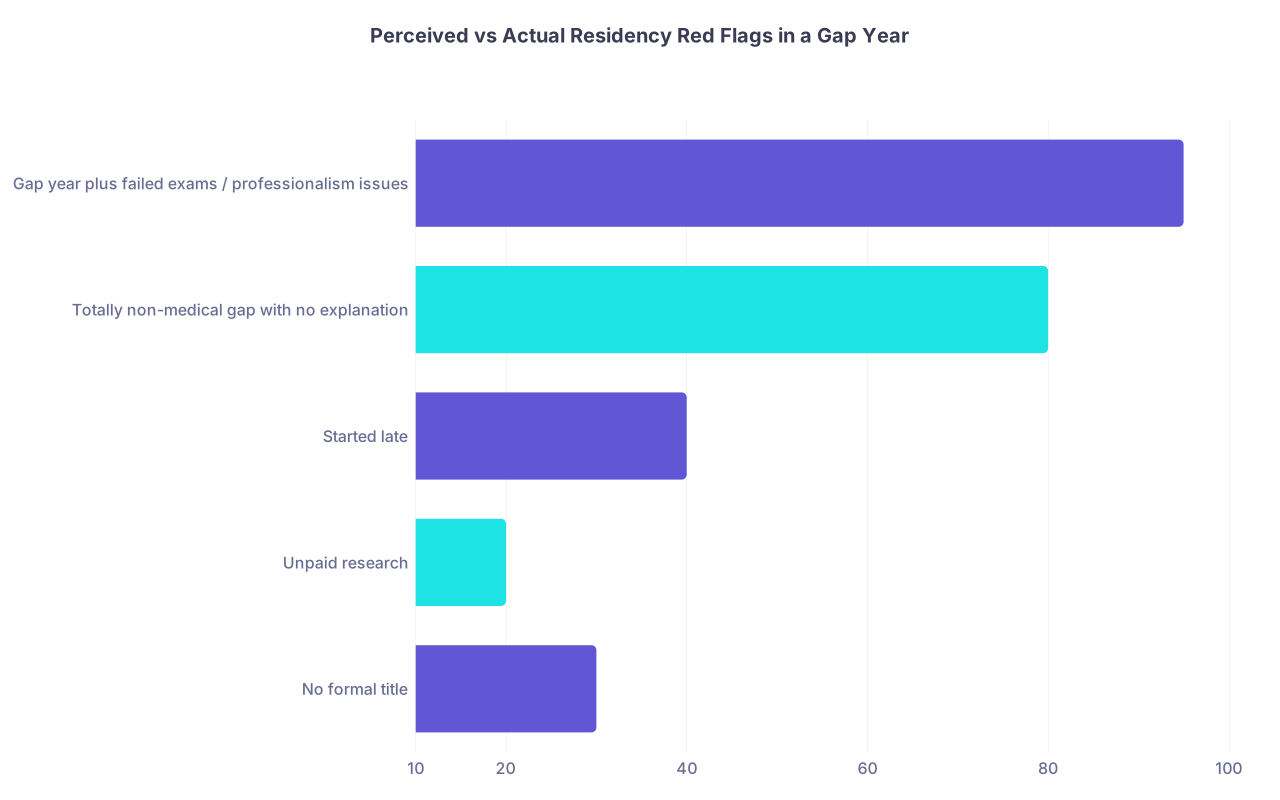
| Category | Value |
|---|---|
| No formal title | 30 |
| Unpaid research | 20 |
| Started late | 40 |
| Totally non-medical gap with no explanation | 80 |
| Gap year plus failed exams / professionalism issues | 95 |
Left side (lower numbers) = what you are panicking about.
Right side (higher numbers) = what actually raises eyebrows.
Things that sound bad in your head but are fixable:
- “My research is unpaid.” Programs don’t care about your paycheck.
- “I didn’t start until a few months into the year.” Fine, if you’ve done something since.
- “It’s a small community hospital, not a big-name center.” Fine. Outputs and mentorship beat logos.
Things that really need careful handling:
- You did literally zero medical or structured work for an entire year, and you can’t explain why.
- You disappeared due to exam failures, major professionalism concerns, or disciplinary issues and never addressed or remedied them.
- You seem vague or defensive when asked what you did with your time.
If you’re not in that bottom category, your situation is uncomfortable, not catastrophic.
How To Turn a Messy Gap Year Into a Coherent Narrative
This is where you salvage things.
Step 1: Write down everything you’ve done in the last 6–12 months
Even if it feels stupid or small:
- Random volunteer shifts
- Helping a resident with a poster
- Tutoring premeds or medical students
- Helping a clinic translate forms
- Work in a completely different field (bartending, tech, family business)
Dump it all out. No filtering.
Step 2: Group them into themes
- Clinical exposure
- Research / QI / academic work
- Teaching / mentoring
- Personal responsibilities (family care, financial needs)
- Skills-building (courses, certifications, language learning)
Step 3: Pick 2–3 pillars
These become your “official” gap year story. For example:
- “Clinical experience with underserved patients”
- “Research productivity in [specialty]”
- “Financial and family responsibilities + part-time clinical work”
Step 4: Write 3–4 sentences tying it together
Something like:
“My gap year ended up being less traditional than I initially planned. After struggling to secure a formal full-time position, I pieced together several roles that actually aligned well with my long-term goals. I’ve been working as a scribe in an urban ED, volunteering once a week at a free clinic, and helping with a small retrospective study on [topic]. Together, these experiences have sharpened my clinical reasoning, exposed me to a wide range of patients, and kept me actively engaged in medicine while I prepare for residency.”
Now you don’t sound like a disaster. You sound like someone who adapted when Plan A collapsed.
What You Can Still Do This Week To Make This Year Less Scary
Let’s get uncomfortably practical. In the next 7 days you can:
- Email 10–15 faculty / residents / program alumni about small research or QI projects.
- Apply to every scribe/MA/care coordinator job within commuting distance, even if it’s not glamorous.
- Reach out to a free clinic, FQHC, or community org and ask when you can start volunteering.
- Pick one credible online or in-person course that you can finish in 1–2 months and actually list on your CV.
This isn’t about transforming your application into a blockbuster. It’s about making sure that by the time ERAS opens, you’re not still saying, “I’m looking for something.” You’re saying, “I’m currently doing X, Y, and Z.”
And then you keep doing them—enough that, by interview season, you’ve got outcomes or responsibilities to talk about.



FAQ: The Anxious-Brain Edition (Exactly What You’re Worried About)
1. “My gap year is half over and I still don’t have a ‘real’ job. Should I delay applying a year?”
Probably not—unless there are multiple significant issues (low scores, no letters, big gaps, failed exams, etc.).
If your main problem is “my gap year doesn’t look Instagram-worthy,” you can still apply, as long as you:
- Start something (anything legitimate) now
- Get 1–2 strong letters from this year’s activities if possible
- Can articulate why you’re ready for residency despite the chaos
If everything else in your application is already borderline, then, yes, waiting a cycle and turning this into a truly productive year can make sense. But don’t default to that just because your gap year isn’t pretty.
2. “Will programs judge me for not having a prestigious research position?”
Some will quietly favor applicants with big-name institutions. That’s the reality. But most care more about:
- Your performance where you are
- The quality of your letters
- Whether your work shows commitment to the specialty
I’ve watched people match into competitive fields (even things like Derm and Ortho) with non-fancy research gigs at community hospitals—as long as they had strong mentorship and real contributions. Prestige helps. It is not mandatory.
3. “Is it better to take a non-medical job than to stay ‘unemployed’ while I keep looking?”
Between “completely nothing” and “non-medical job” → the non-medical job wins. But only if you’re also doing at least some medically relevant work (even small):
- Volunteering a few hours a week
- Helping with remote research
- Shadowing or clinic support roles
Then your story becomes:
“I had significant financial responsibilities, so I worked in [field] to support myself while staying involved in medicine through [X and Y].”
That’s way better than, “I was just kind of at home waiting for something to fall into my lap.”
4. “What if I do start something now, but by the time I apply, I won’t have any publications or big outcomes?”
Programs know research and projects don’t magically turn into PubMed entries in 3 months. It’s normal to have:
- “Manuscript in preparation”
- “Abstract submitted to [conference]”
- “Ongoing QI project with interim results”
On your application and during interviews, you can say:
“I started this project in [month], and so far we’ve [done X]. We’re currently [analyzing data / submitting abstracts / drafting a manuscript].”
They’re looking for engagement and follow-through, not instant glory.
Open your calendar and your email right now. Give yourself 60 minutes to do three things: list what you’ve already done this year, send at least five emails asking for small projects, and apply to at least five concrete roles (clinic, scribe, MA, volunteer). It’ll feel small, maybe even pointless—but this is exactly how people quietly turn a “wasted” year into something they can stand behind when interview season comes.


