

The obsession with publications before residency has gotten out of control.
If you’re sitting there with a “research gap year” and… nothing. No PubMed ID. No first-author paper. Maybe not even an abstract. It’s really easy to jump to: “I wasted a year. Programs will think I’m a joke. My research gap year is a failure.”
You’re not the only one thinking that. I hear this exact panic over and over:
- “What if they ask, ‘So… where are the publications?’”
- “Will they think I’m lazy or incompetent?”
- “Did I just tank my chances at matching?”
Let’s walk through this honestly. No sugar-coating, but also no catastrophizing beyond what’s actually true.
The Harsh Reality: Programs Do Notice… But Not How You Think
Let me be blunt: no, your gap year isn’t automatically a failure because you don’t have publications at application time.
But also: no, programs won’t completely ignore that you took a research year and have zero obvious output on paper.
They’ll ask themselves a few questions:
- Did this person actually do anything during that year?
- Can they explain the lack of publications in a way that makes sense?
- Did they gain skills or depth, or did they just “hang around a lab”?
Here’s the part that most anxious applicants get wrong:
Programs don’t only care about the endpoint (PubMed paper). They care about the story and the trajectory.
A research year with:
- Strong letters from serious researchers
- Clear, specific projects you can talk about
- Concrete skills you picked up
- Works-in-progress that sound legit
…is far better than a random med student with one low-impact middle-author paper they barely remember.
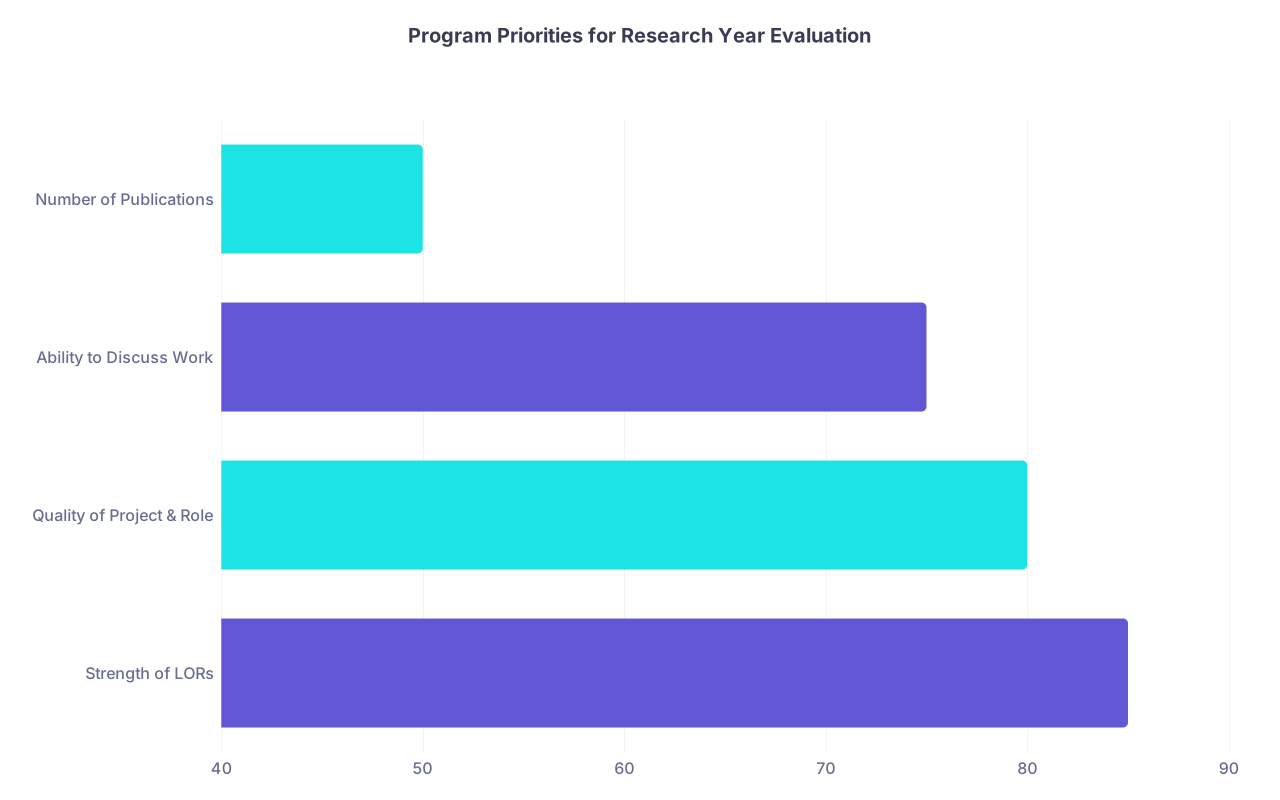
| Category | Value |
|---|---|
| Strength of LORs | 85 |
| Quality of Project & Role | 80 |
| Ability to Discuss Work | 75 |
| Number of Publications | 50 |
Does the number of publications matter? Yes.
Is it the only thing that matters? Not even close.
Why You Might Have No Publications (And Why That Doesn’t Doom You)
Let’s be honest: research timelines are brutal and indifferent to ERAS.
You can do everything “right” and still have:
- Projects that are mid-data collection
- Manuscripts stuck in the “we’ll write it soon” vortex
- A PI who moves slowly or is overcommitted
- Revisions dragging out past the ERAS deadline
None of that shows up in that neat little “Publications” box.
Common perfectly real scenarios I’ve seen:
You joined a brand-new project that required:
- IRB submission
- Database design
- Long recruitment So you spent all year setting it up, and the study won’t mature until 1–2 years later. Your fingerprints are all over it, but your name isn’t on PubMed yet.
You inherited a messy dataset and:
- Cleaned it
- Built code to analyze it
- Identified major design or data issues
End result? Study gets redesigned. Scientifically correct, but you get no quick paper.
You worked in basic science:
- Animal models
- Bench work
- Long experiments and failed protocols
One publication might take 2–3 years. Your support is real, the timeline just doesn’t care about ERAS.
None of these = laziness. But to an outside reader skimming your ERAS, it can look like: “research year, no pubs.”
That gap is where you have to do the work. Not by magically producing publications, but by controlling the narrative.
How Programs Will Judge Your “No Publications” Gap Year
Let’s stop guessing and break down what’s actually going through their heads.
| Factor They See | Best Interpretation | Worst Interpretation |
|---|---|---|
| No publications listed | Long-term or slow projects | Lack of productivity |
| Strong research LORs | High effort, strong contribution | N/A (this rescues you a lot) |
| Specific project descriptions | Deep involvement, real experience | N/A |
| Vague or generic descriptions | Minimal role, padding CV | Possibly inflated experience |
| Works-in-progress clearly listed | Real momentum, reasonable trajectory | Overpromising if wildly exaggerated |
If you want to know whether your gap year looks like a failure or not, look at these things:
Letter quality
Are your letters saying:- “They were here and did tasks”
or - “They drove this project, were critical, asked great questions, and I’d take them as a resident any day”?
- “They were here and did tasks”
Specificity of your role
When you describe your research, can you say:- What the question was?
- What methods were used?
- What you personally did?
- What the results roughly showed (if any yet)?
Evidence of movement
Are there:- Submitted abstracts?
- Conference posters?
- Manuscripts in draft or under review? Or is it all, “We plan to submit…” with nothing concrete?
That’s the line between “this was a legitimate research year caught in slow timelines” vs “this person floated through 12 months and has nothing to show.”
How to Talk About a Research Year With No Publications (Without Sounding Defensive)
The worst thing you can do is show up to an interview acting guilty about it. They smell that from a mile away.
You need a calm, structured explanation. Something like:
“During my research year, I worked full-time in Dr. X’s lab on [brief project description]. My primary responsibilities were [X, Y, Z]. The project is a long-term study, so while the manuscript isn’t submitted yet, I was heavily involved in [design / data collection / analysis], and we’ve presented preliminary data as [poster/abstract/ongoing manuscript draft].”
You’re doing a few things here:
- Admitting the reality: no manuscript yet
- Showing concrete work: design, analysis, data
- Pointing to visible output: posters, abstracts, drafts
- Talking like someone who actually knows their project
Red flags that make you sound worse:
- “We were going to submit, but…” followed by a vague excuse
- “My PI was really busy and never got to it”
- “We did a lot, but nothing is really written up yet”
- “I don’t remember the exact hypothesis, but it was something about…”
If you treat your year like something embarrassing, they will too. If you treat it like a serious academic experience with a long runway, they’re more likely to respect it.
How Much Does “No Publications” Really Hurt You by Specialty?
Let’s cut to what you’re really scared of:
“Am I not going to match now?”
It depends a lot on how research-heavy your chosen specialty is.
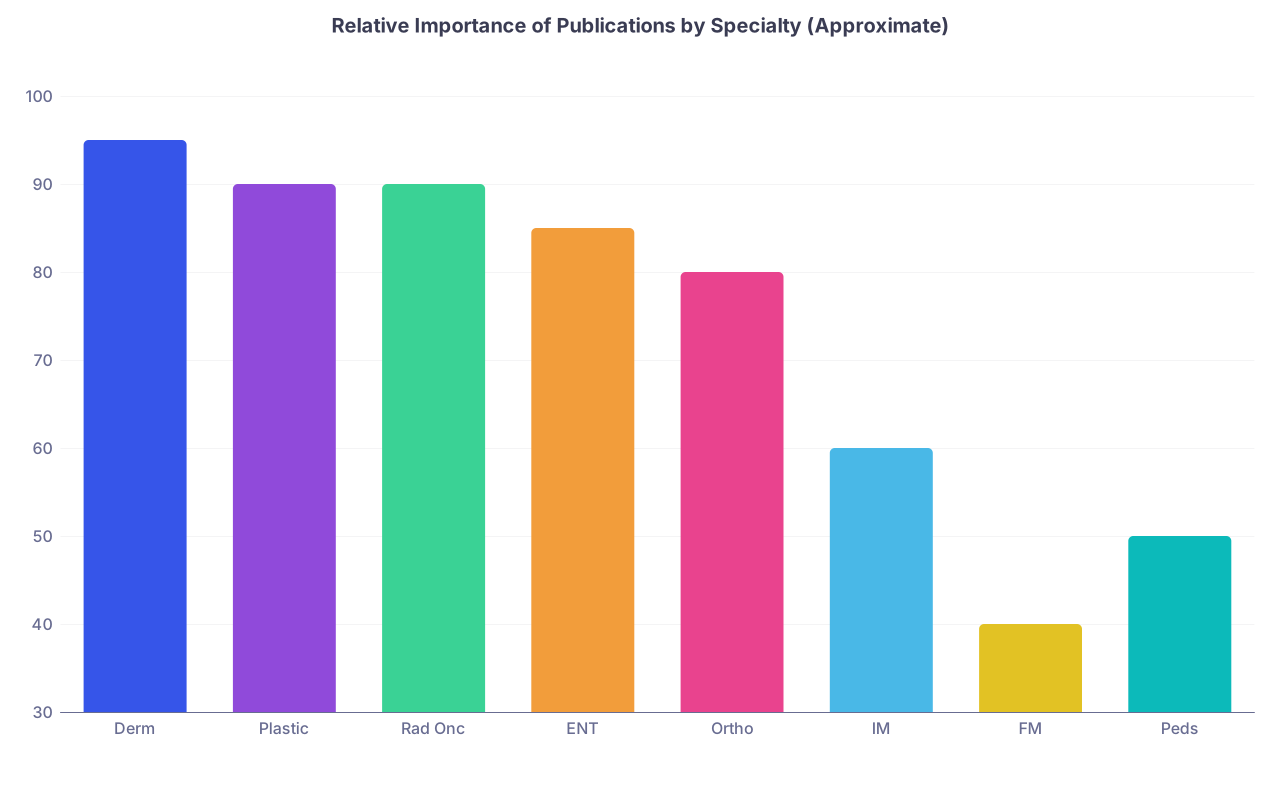
| Category | Value |
|---|---|
| Derm | 95 |
| Plastic | 90 |
| Rad Onc | 90 |
| ENT | 85 |
| Ortho | 80 |
| IM | 60 |
| FM | 40 |
| Peds | 50 |
Rough translation:
Ultra-competitive research-heavy (Derm, Plastics, Rad Onc, ENT):
They really like to see tangible output. But even here, one solid, late-appearing publication or strong research letters can carry more weight than three meaningless middle-author case reports.Competitive but less obsessed (Ortho, Anesthesia, EM, some IM programs):
Strong research year with good letters and presentations can still be viewed positively, even without a PubMed ID at application time.Primary care and many community programs (FM, Peds, many IM):
They’re not counting your papers like baseball stats. They mostly want to see you didn’t just disappear for a year and that someone vouches for your work ethic.
So no, “no publications by ERAS” doesn’t automatically equal “no match.” It does mean you need to:
- Extract every bit of value from what you did do
- Make sure your letters and descriptions tell that story
- Avoid looking like you wasted the year
Turning Your “Failed” Research Year into Something Defensible
Let’s assume worst case: you truly have no abstracts, no posters, no submitted manuscripts. Just one big unfinished or slow project.
Is it salvageable? Yes. But not by wishful thinking—by action.
Here’s what I’d do this week:
Meet with your PI and be very direct
“Applications are coming up, and I’m concerned about showing productivity during my research year. Could we:- Define my role clearly for future letters?
- Outline realistic abstracts or analyses I could complete soon?
- Identify at least one piece that’s close enough to be presented or drafted?”
Nail down concrete “works in progress”
You want at least:- 1–2 specific manuscripts in draft with working titles
- Maybe an abstract submitted to a conference, even if far away On ERAS, “Manuscript in preparation” is weak if everything is “in preparation.” But 1–2 specific, believable items are better than a blank space.
Get a strong, detailed research letter
This is non-negotiable. A generic letter kills you. You want:- Details about your responsibility
- Mentions of initiative, independence, reliability
- A line that basically says “I’d trust this person as a resident”
Rewrite your research descriptions
No more: “Worked on clinical research in cardiology.”
Instead: “Full-time research year focused on a retrospective cohort study of X. Led data extraction of N patients, performed preliminary statistical analysis using [software], and contributed to study design and IRB submission. Manuscript in draft form with plans for submission to [journal tier/field].”
Your goal: make it obvious you were doing real work, publication or not.
What If You Truly Did Waste A Lot of the Year?
Let’s be very honest for a second. Maybe you:
- Started late
- Weren’t that engaged early on
- Took a long time to ramp up
- Had some personal stuff going on that derailed you
So now you feel like you did waste it, and you’re terrified that someone will see through the fluff.
The way out isn’t to lie or artificially inflate your role. That almost always backfires. The way out is:
Compress what did happen into its clearest, most legitimate form
You don’t have to tell them you only started taking things seriously in month 6. ERAS isn’t a day-by-day diary.Reflect on what changed
You can frame it as: “Initially, I struggled with [X], but I learned how to manage [Y], and by the end I was independently handling [Z].” Programs do respect growth, if you can talk about it with some self-awareness.Don’t double down on research in your narrative if it’s not your strength
If your research year is your weakest point, stop making it the headline of your application.
Lean into:- Clinical performance
- Step scores (if strong)
- Leadership/teaching
- Personal qualities your letters back up
Quick Sanity Check: Was Your Research Year Actually a “Failure”?
Let’s run a brutal little checklist. Answer honestly.

| Step | Description |
|---|---|
| Step 1 | Did you work full-time or near full-time on research? |
| Step 2 | Year will look weak. Focus on honesty & growth. |
| Step 3 | Did you contribute meaningfully to at least one real project? |
| Step 4 | Can your PI write a strong, specific letter? |
| Step 5 | Major risk. Seek another research mentor letter if possible. |
| Step 6 | Not a failure. Needs careful framing. |
| Step 7 | Yes? |
If you worked, contributed, and have someone who will strongly vouch for you?
Your year is not a failure. It’s just not matured into a publication yet.
The paper might hit PubMed after you’ve already submitted ERAS. Or even during interviews. Programs understand that research doesn’t obey the residency calendar.
What You Should Do TODAY
Don’t just sit with the anxiety. Do one concrete thing.
Here’s a one-day action plan:
Open your CV and ERAS draft.
Rewrite every research entry to:- Clearly state the question
- Show your specific role
- Indicate current status (even if it’s “data collection ongoing”)
Email your PI:
Ask to set up a short meeting to:- Discuss upcoming timelines for abstracts/manuscripts
- Confirm they’re comfortable writing you a strong letter
- Clarify how they view your contributions
Start a one-page “research talking points” doc:
For each project, write:- 2–3 sentences on background
- 1–2 on methods
- 2–3 on what you did
- 1 on what you learned or how it shaped your interest in that specialty
That alone will make you sound 10x more competent and less like “person who wasted a year.”
FAQ (Exactly 4 Questions)
1. Will programs think I lied about doing a research year if I have no publications?
Not automatically. They’ll think that if:
- Your descriptions are vague
- Your letters are generic or lukewarm
- You can’t talk intelligently about your work in interviews
If you can clearly explain your role, describe the project in detail, and have a strong letter from your mentor, they’ll see it as a long-timeline project, not fraud.
2. Is it even worth listing “manuscripts in preparation” on ERAS? Or does that look desperate?
List them only if they’re real. That means:
- There is an actual, organized draft (or close), not just “we might write this someday”
- Your name is expected to be on it
- You can give a plausible target journal or direction
A couple of honest “in preparation” entries look fine. Ten of them with nothing submitted? That looks like padding.
3. Should I delay my application a year to get the publications out first?
Usually no. Delaying an entire application cycle just to wait for PubMed IDs is rarely worth it unless:
- You’re going for an ultra-competitive specialty
- Your entire application is weak except for potential future research output
Even then, it’s a gamble. Most of the time, you’re better off applying with what you have, framing your research year well, and updating programs later if/when papers get accepted.
4. What if interviewers directly ask, “Why no publications after a research year?”
Own it calmly. Something like:
“I understand that’s a common expectation. My primary project was a long-term [type] study, so most of the year was spent on [design/data collection/analysis]. The manuscript isn’t submitted yet, but I took a lead role in [specific tasks], and we’ve [submitted an abstract/drafted a manuscript/are finalizing figures]. The experience deepened my understanding of [field] and taught me [X, Y].”
They’re judging more how you respond than the literal absence of a PubMed ID.
Open your ERAS activities section right now and look at your research entries. If a stranger read them, would they understand what you actually did for that year—or would it look like filler? Rewrite just one entry tonight so it sounds like the work of a real, thinking, contributing researcher. Then do the next one.


