

What do you do when the PI you rearranged your entire life for during your gap year might tank your residency application with a lukewarm letter?
Because that’s the fear, right? Not just “no letter.” The nightmare is the vague, bland, ‘they showed up and did their job’ letter that quietly kills your chances while you never see it.
Let’s walk straight into that fear instead of pretending it’s not there.
First: How Bad Is It Really If Their Letter Isn’t Strong?
Let me say this bluntly: one lukewarm letter will not destroy your entire application, especially if the rest are solid and your PI isn’t some hyper-famous name everyone expects you to have.
Programs don’t read letters like:
- “Strong letter? Admit.”
- “Mediocre? Reject.”
They read them like puzzle pieces. Patterns. They’re looking for consistency.
Here’s the real hierarchy that actually matters:
| Situation | Impact on Application |
|---|---|
| Missing letter but strong others | Mild–Moderate |
| Mediocre letter + strong others | Mild, unless repeated pattern |
| One clearly negative letter | Severe |
| Multiple lukewarm/generic letters | Moderate–Severe |
| No research PI letter but good clinical | Usually Mild |
The real disaster scenario isn’t “my PI thinks I’m fine but not amazing.”
The killer is: “My PI subtly implies I’m unreliable, difficult, or unsafe.”
Most faculty won’t do that unless there’s an actual incident or they truly think you shouldn’t go into medicine. What they’re more likely to do if they’re not thrilled? Say no. Or write a generic, neutral-sounding letter.
Neutral letters feel catastrophic when you’re spiraling at 1 a.m. But in context, they’re usually just… one data point.
Still. You’re not wrong to be scared. You invested a full gap year with this person. You probably thought: “This is my big-name research letter that will seal the deal.” And now you’re wondering if it’ll be the thing that quietly sinks you.
Let’s go step by step.
Step 1: Do You Actually Know They Won’t Write a Strong Letter?
A lot of us catastrophize before we have any data. (Yes, I’m including myself.)
Ask yourself:
- Has your PI ever complimented your work?
Even a “nice job on that presentation” or “that was really helpful today”? - Have they trusted you with more responsibility over time?
Taking over a project, handling data independently, presenting at lab meeting? - Have they given you any constructive feedback that you turned into improvements?
If yes to any of these, you might be underestimating yourself. Many PIs are just emotionally constipated when it comes to praise. They’ll say “That’s fine” when they mean “You’re reliable and I trust you.”
Annoying, but true.
On the other hand, pay attention if:
- They’ve criticized your reliability or professionalism (late, not responsive, sloppy).
- They’ve seemed annoyed when you mention residency, letters, or timelines.
- They’ve openly favored other gap year students and sidelined you.
Those are real yellow flags. Not proof they’ll destroy you. But enough to say: be cautious.
If you’re still guessing, you need to stop guessing.
You have to ask them one specific question.
Step 2: The Only Question That Really Matters
You don’t ask:
“Can you write me a letter?”
You ask:
“Would you feel comfortable writing me a strong, supportive letter of recommendation for residency?”
That word “strong” is doing a lot of work.
Faculty who are honest and ethical (a lot of them, actually) will hedge if they can’t do that. They’ll say things like:
- “I can write you a letter, but I’m not sure I’m the best person for a strong one.”
- “I can speak to your time in the lab, but I don’t know you as well clinically.”
- “I’d be happy to describe your work, but you may want to consider someone who supervised you more closely.”
Those are signals. That’s them saying: my letter will probably be neutral, not glowing.
If they say something like:
- “Yes, I’d be happy to. You’ve been a strong member of the team.”
- “Definitely. You’ve done great work here.”
- “Sure, send me your CV and I’ll put something together.”
That doesn’t guarantee a phenomenal letter, but it’s way better than a lukewarm half-hedged “I guess so.”
I know asking this feels terrifying. Your brain is probably going:
- “What if they say no and hate me?”
- “What if they say no and that confirms I’m actually terrible?”
- “What if they say yes but lie and write something bad anyway?”
Let me be blunt: asking with the word “strong” is your only defense against a surprise weak letter. It forces them to give you at least a hint of their real position.
Step 3: Worst-Case Scenarios — And What You Can Do
Let’s walk through the actual nightmares.
Nightmare 1: They Say “No, I Can’t Write You a Strong Letter”
Your stomach drops. You replay every lab mistake from the last year.
But here’s what that actually means:
You just dodged a bullet.
A PI who tells you “I’m not the best person for a strong letter” is doing you a favor. Quietly. Instead of handing a vague landmine to your application, they’re giving you a chance to redirect.
You respond with:
“Thank you for being honest, I really appreciate that. Would you be comfortable if I still listed my research experience and mentioned working in your lab, even without a letter from you?”
Most will say yes. They’re not trying to erase you, just not overstate you.
Then you:
- Lean hard on strong clinical letters.
- Make sure anyone who does adore you (attendings, clerkship directors, mentors) writes for you.
- Emphasize your research experience in your ERAS, personal statement, and interviews, without pretending the PI loves you.
For most non-fellowship-level research-heavy specialties, having no PI letter is survivable if your clinical letters are rock solid.
Nightmare 2: They Say Yes, But You Don’t Trust Them
This is trickier. You’re worried they’ll say yes out of politeness and secretly mail a “they existed in my lab, the end” letter.
A few ways to lower the risk:
Give them ammo that points them toward your strengths:
- One-page summary of your projects
- Bullet points of concrete contributions (“Designed data collection forms,” “Led weekly data checks,” “First author poster at X conference”)
- Your personal statement or a short paragraph on your career goals
Ask them (casually but clearly):
“Are there particular strengths you feel comfortable highlighting so I can make sure my application aligns?”
If they say things like, “your reliability,” “your work ethic,” “your analytic skills,” that’s somewhat reassuring. If they fumble and say stuff like, “Well, I can say you worked here,” that’s… not as reassuring.
If you don’t feel great after that conversation, you do not have to use them as a primary or marquee letter. You can:
- Use them as an optional extra letter for research-heavy programs only
- Or skip them entirely and rely on other letters
You are not required to use every possible recommender just because they exist.
Nightmare 3: They Already Submitted and You’re Panicking About What They Wrote
This is the worst mental space because you have no control and your brain fills the vacuum with doom.
Reality check:
- You’ll never see the letter. You’ll never know exactly how good or mid it was.
- Program directors see a range of letter quality. They’re not shocked by neutral letters.
- What kills applicants is patterns, not one slightly underwhelming letter.
If your other letters are enthusiastic, and your PI letter is… fine, that does not sink you by itself.
Use your anxiety as fuel for the part you still control: interview performance, personal statement, how you talk about your gap year if they ask.
Step 4: What If Your Gap Year Was Built Around This PI?
Here’s the real emotional hit: you didn’t just do a side project. You took a whole year (or more!), maybe delayed graduation, maybe moved cities. You thought:
“I’ll get publications, great mentorship, and a killer letter.”
Now you’re sitting here thinking: “Was this whole year a mistake?”
No. And here’s why that’s not just feel-good nonsense:
Programs care about:
- Can you commit to something for more than 5 minutes?
- Can you function in a team without destroying it?
- Can you be trusted with responsibility?
- Do you have some academic curiosity or scholarly engagement?
You can show that even if your PI isn’t your biggest fan.
On your ERAS you still get to list:
- The lab
- Your role
- Any posters, abstracts, or manuscripts (even “submitted” or “in progress”)
- The hours and length of time
You can also talk about:
- Technical skills you learned
- How you handled a tough project
- Times you had to problem-solve or own mistakes
Sometimes a “non-storybook” research year actually makes you sound more mature in interviews because you can discuss:
- Frustration
- Imperfect supervision
- Learning to advocate for yourself
- Figuring out what kind of environment you thrive in
You’re not broken because one authority figure isn’t obsessed with you.
Step 5: If You Haven’t Asked Yet — Here’s Exactly What to Do
Use something like this (edit to sound like you):
Email or in-person:
“Dr. X,
I’m starting to put together my residency application and I’ve really appreciated the chance to work in your lab this year. I was wondering if you’d feel comfortable writing me a strong, supportive letter of recommendation for residency, focusing on my work here.
I’d be happy to send my CV, a draft of my personal statement, and a short summary of my projects and responsibilities to make it easier.
If you feel you’re not the best person for a strong letter, I completely understand and would still be very grateful for your honesty.
Thank you for considering this,
[Your Name]”
Yes, that last line is scary. But it protects you.
And if they say no? You pivot. Immediately.
Step 6: Diversify Your Letter Portfolio (So One Person Can’t Sink You)
You never want your entire destiny attached to a single human being who may or may not remember your last name.
For residency, you want a mix like this:
| Letter Type | Ideal Writer |
|---|---|
| Core clinical letter | Attending from key rotation (medicine/surgery/etc.) |
| Second clinical letter | Another attending or clerkship director |
| Specialty-specific | Faculty in your intended specialty |
| Optional research | PI or research mentor |
If your PI letter is shaky or missing, your clinical letters need to be as strong as possible. That means:
- Show up early, stay engaged on rotations
- Ask for feedback before you ask for letters
- Ask specific attendings who actually saw you work, not just big names who barely know you
Your gap year PI becomes part of your story, not the center of it.
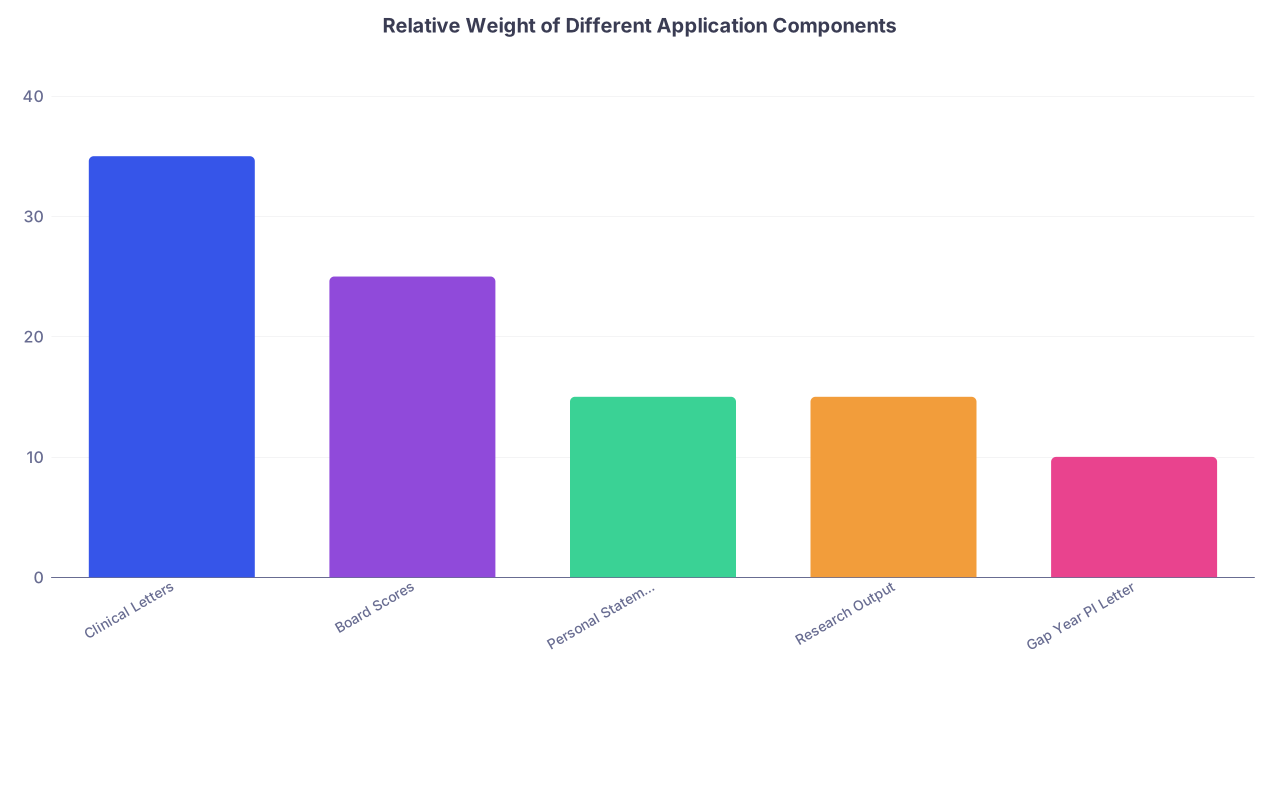
| Category | Value |
|---|---|
| Clinical Letters | 35 |
| Board Scores | 25 |
| Personal Statement | 15 |
| Research Output | 15 |
| Gap Year PI Letter | 10 |
See that? In most fields, your gap year PI letter is one slice of the pie, not the whole thing.
How to Talk About a PI Who Wasn’t Your Biggest Fan
If someone asks about your research year during interviews and you know your relationship with the PI wasn’t magical, keep it clean and neutral:
- “I worked in Dr. X’s lab on [brief description]. I focused on [your actual contributions]. We were able to [poster/presentation/data analysis/etc.].”
If they ask, “Did you get a letter from your PI?” (rare, but possible), you can say:
- “I prioritized letters from people who worked with me most directly in clinical environments, since they could best speak to my readiness for residency. My research year was still very valuable in terms of learning [skill/insight].”
You don’t trash your PI. You don’t overshare. You just reroute.
FAQ: Gap Year PI Letters and Residency Panic
1. Do I have to get a letter from my gap year PI?
No. There’s no universal rule that you must get a letter from your PI. Some programs like to see it for super research-heavy specialties (Derm, Rad Onc, some IM academic tracks), but even there it isn’t always mandatory. If the letter would be weak, it’s often better to skip it and lean on strong clinical letters.
2. What if my PI barely knows me — will their “big name” still help?
Honestly? Not much. A short, generic letter from a famous PI who can’t describe you beyond “worked in my lab” is less helpful than a detailed letter from a mid-level attending who can say, “I saw them manage complex patients and they’re ready for residency.” Name matters a little. Specific praise matters a lot more.
3. How many letters can be mediocre before I’m in trouble?
One neutral letter in a sea of strong ones is fine. Two or three vague, generic letters that all sound like they barely know you? That’s a pattern. Programs start wondering if you never really impressed anyone. Your goal: at least 2 letters that are clearly enthusiastic and specific. The rest can be “fine.”
4. Should I tell programs if my PI refused to write a letter?
No. Do not volunteer that. It just creates questions you don’t need. You’re not obligated to explain why any single person didn’t write for you. Use your application space to highlight what is strong, not draw attention to what’s missing.
5. Can I ask to see the letter or ask them what they wrote?
You usually waive your right to see letters for residency, and you should. Programs take confidential letters more seriously. You can’t (and shouldn’t) ask to read it. You can ask beforehand, “Do you feel you can write a strong, supportive letter?” and use their reaction to decide whether to use it.
6. What if this whole experience made me hate research — will that hurt me?
Not really, as long as you’re honest but tactful. You don’t have to pretend you loved every second. You can frame it as: “The year taught me that I enjoy some aspects of research, but I’m most energized by direct patient care.” Plenty of residents feel like that. Programs don’t expect everyone to be a future R01 machine.
Open your email drafts right now and write out the exact message you’d send your PI asking for a strong, supportive letter. You don’t have to send it yet, but get the words on the screen so you’re not starting from zero when it actually matters.


