
The fastest way to tank a specialty switch is to wander into it with a vague “I found my passion” story and no receipts.
You want to use a gap year to change your intended specialty and not set off alarm bells. That is absolutely doable. But you need a tight plan, disciplined execution, and a story that makes logical sense to program directors, not just to you.
Let me walk you through exactly how to do that.
Step 1: Get Honest About Your Starting Point
Before you design the “perfect” gap year, you need a brutally clear inventory of what you are working with and what you are up against.
Here is what programs quietly worry about when they see a specialty switch plus a gap year:
- “Are they running away from something?”
- “Were they unsuccessful in the previous match?”
- “Are they indecisive or impulsive?”
- “Is there a professionalism / performance problem hidden in here?”
- “Will they just switch again?”
Your job over the next 12–18 months is to produce hard evidence that:
- You are moving toward a better fit, not fleeing a disaster.
- You can commit.
- You are competent and reliable in clinical environments.
- People in the new specialty actually know you and vouch for you.
Start by answering these questions on paper. No sugarcoating.
- What was your previously intended specialty?
- How visible is that in your record?
- Prior away rotations?
- Letters already uploaded?
- Personal statement drafts?
- Research / leadership heavily branded to that field?
- Why do you actually want to switch?
- Not the inspirational version. The real one.
- What objective exposure do you already have to the new specialty?
- Who in the new specialty knows you well enough to write a LOR right now?
If your answers are:
- Previous specialty is all over your CV
- New specialty exposure = maybe one rotation, no letters
- No mentors in new field
…then you need a more aggressive, structured gap year. That is fine. You just cannot pretend this is a minor pivot.
Step 2: Choose the Right Type of Gap Year Work
Random research or “time to explore” is exactly how you make programs nervous. Your gap year activities must scream three things:
- Commitment to the new specialty
- Clinical competence and work ethic
- Maturity and stability
Here are the main gap year “modes” and how they signal to programs:
| Option Type | Risk to Raise Concerns | Best Use Case |
|---|---|---|
| Research in new specialty | Low | Academic or competitive fields |
| Clinical fellow / scribe | Low–Moderate | Need bedside proof & letters |
| Non-ACGME clinical jobs | Low | FM, IM, psych, EM, some IM subs |
| Generic research (any) | Moderate–High | Only if you can rebrand strongly |
| Travel / non-medical work | High | Only with extremely strong backstory |
Best-case options for a clean specialty switch
Dedicated research year in the new specialty
- Especially powerful for:
- Dermatology
- Radiation oncology
- ENT
- Ortho
- IR
- GI, cards, heme/onc (if you are planning IM → subspecialty path)
- Must-haves:
- Full-time, in-person
- Direct faculty mentor in the target specialty
- Some clinical exposure (clinics, conferences, tumor boards)
- Clear plan for at least 1–2 submit-able projects before ERAS
- Especially powerful for:
Non-ACGME clinical job within or adjacent to the new field
- Examples:
- Internal medicine prelim or transitional year followed by EM switch
- Non-ACGME surgical prelim doing heavy floor/OR work
- Hospitalist scholar year if moving to IM or IM subspecialty
- Clinical trials coordinator embedded in the specialty’s clinic
- Must-haves:
- You are seen by attendings who can write detailed, credible LORs
- No pattern of poor evaluations or professionalism issues
- Enough clinical contact to discuss cases at interview
- Examples:
Hybrid: 0.5–0.7 FTE research + 0.3–0.5 FTE clinical support
- Particularly good if your new field values both (e.g., academic IM, EM, psych)
- You can say: “I intentionally structured the year to build both scholarship and hands-on experience in X.”
High-risk options (avoid unless forced)
- A pure “travel and find myself” year right before residency with minimal clinical continuity.
- A research job unrelated to either your old or new specialty.
- Jumping between multiple short, unrelated roles in 12 months.
These can work if you already have strong mentors and clinical evaluations in the new specialty. But as a primary strategy for switching? Weak.
Step 3: Build a One-Page Gap Year Blueprint Before You Start
Do not just accept “a research position in cardiology” and call it a day. You need a designed year with objectives and deliverables that directly support your switch.
Write this as a one-page blueprint. You do not submit this anywhere. It is your steering document.
Structure it like this:
Goal Statement (2–3 lines)
- “Use a dedicated year in [specialty] to confirm long-term fit, strengthen clinical skills, and generate strong mentorship and scholarly output that support a focused, credible application to categorical [specialty] positions.”
Clinical Exposure Plan
- Amount: “At least 1 full day per week in [clinic / OR / ED / service].”
- Activities:
- Outpatient clinic sessions
- OR observation and note-writing (surgery)
- ED shifts (EM)
- Rounding / admissions (IM/FM/psych)
- Outputs:
- Documented clinical evaluations
- One letter from direct clinical supervisor
Scholarly Plan
- Target: “3+ active projects; at least 1 submitted manuscript and 1 poster/abstract at a field-relevant meeting by ERAS submission.”
- Types of projects:
- Chart review
- QI project embedded in clinical service
- Case series or case reports that you can actually finish
- Deadlines: Backwards-plan from ERAS (September)
Mentorship Plan
- Primary mentor: [Name, title, specialty]
- Secondary mentors: [2–3 names]
- Standing meetings: “Monthly check-in to review progress and get feedback on fit and career direction.”
Professional Narrative Plan
- One paragraph on:
- How you will explain the original interest
- What you did during this year
- Why this now looks like a deliberate, mature decision, not a panic pivot
- One paragraph on:
That blueprint is also what you discuss with your future letter writers and mentors. It signals maturity and intention.
Step 4: Fix the Paper Trail: Letters, CV, and Narrative
You can do an excellent gap year and still look suspicious on paper if you do not control the story.
You need to align four things:
- Letters of recommendation
- Personal statement
- Experiences section in ERAS
- And what you say in interviews
Letters of recommendation: non-negotiables
For a specialty switch with a gap year, you want:
- At least 2 strong letters from attendings in the new specialty
- 1 additional letter that:
- Either also from the new specialty, or
- From your prior core clerkship / sub-I showing you are clinically solid
If your previous intended specialty is highly visible, you also want at least one mentor in that field who is willing to say something like:
- “Initially, they were very interested in [old field], but over the course of working together, it became clear that their strengths and long-term goals aligned better with [new field]. We discussed this transition extensively, and I fully support their decision.”
That single paragraph kills a lot of program director anxiety about “this person failed to match / burned bridges / is fleeing something.”
During the gap year, consciously build toward those letters:
- Show up on time, every time
- Say “yes” to the less glamorous tasks
- Ask for feedback early, fix what they tell you
- Let them see you with patients and the team repeatedly over months
Then, when you ask for letters:
- Give them your CV
- A 1-page summary of what you did with them
- And a draft of your personal statement so they understand your narrative
Personal statement: how to explain the switch without sounding flaky
You get one page to convince strangers that:
- You explored the original field seriously
- You discovered a mismatch based on direct experience, not vibes
- You deliberately sought out the new field
- People in that new field have worked with you and think you belong there
A clean structure:
Short opening with a present-focused scene in the new specialty.
- Not your childhood dream. A specific moment with a patient, case, or clinic day during your gap year or final rotations in the new field.
Brief, non-dramatic explanation of prior interest.
- “I entered medical school drawn to [X] because [2–3 concrete reasons]. I pursued [rotations / activities] in that field and expected to build a career there.”
Pivot moment grounded in clinical reality.
- “On [rotation / service], I noticed that what engaged me most was [concrete aspects that clearly align with the new specialty]. Over several months, my day-to-day experiences began to align more with the work of [new specialty] colleagues.”
Deliberate exploration, not impulsive jump.
- “Before changing direction, I did [rotations, shadowing, meetings with advisors in the new specialty]. I arranged a dedicated gap year working with [mentor] in [institution/department] to test this fit in depth.”
What you actually did in the gap year.
- Clinical exposure – specifics
- Research / projects – specifics
- Lessons learned about fit and your role in that field
Future-looking close.
- Show that you understand the life, demands, and realities of the specialty
- Connect it to your strengths and concrete experiences
Two things that kill credibility:
- Overly emotional language (“I just fell in love with…”) unbacked by tangible work
- Trashing your previous intended specialty to justify the switch
Stay respectful. Focus on alignment, not negativity.
Step 5: Make Your Timeline Look Strategic, Not Chaotic
Program directors often see only fragments. Your job is to make the sequence of events look like a planned evolution, not a scramble.
Use this mental model: Exploration → Decision → Consolidation → Application
Now map your actual timeline to it and fill any obvious gaps with your gap-year activities.
Here is what a clean 2-year turnaround can look like:
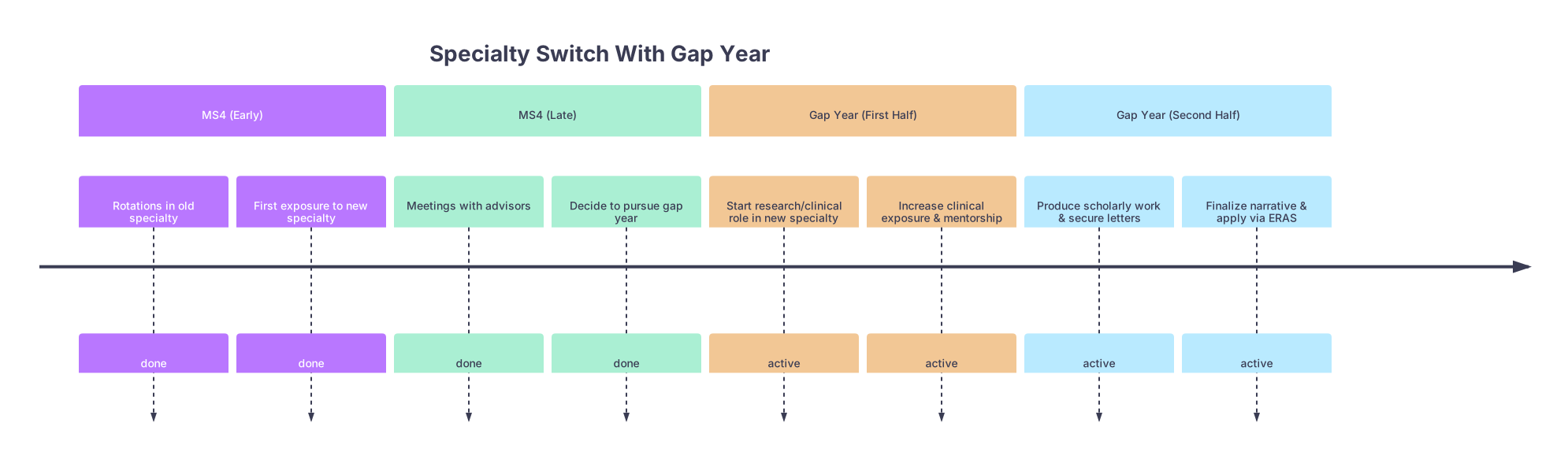
| Period | Event |
|---|---|
| MS4 (Early) - Rotations in old specialty | done |
| MS4 (Early) - First exposure to new specialty | done |
| MS4 (Late) - Meetings with advisors | done |
| MS4 (Late) - Decide to pursue gap year | done |
| Gap Year (First Half) - Start research/clinical role in new specialty | active |
| Gap Year (First Half) - Increase clinical exposure & mentorship | active |
| Gap Year (Second Half) - Produce scholarly work & secure letters | active |
| Gap Year (Second Half) - Finalize narrative & apply via ERAS | active |
During interviews, describe your path using that same framework:
- “I explored [old specialty] seriously…”
- “I then had X experiences that led me to reconsider…”
- “I deliberately structured a gap year to test and consolidate my interest in [new specialty]…”
- “During that time I did A, B, and C, and it confirmed that this is where I can contribute long term.”
Align your ERAS experiences section with this story:
- Put your gap year role under Work/Research with clear, detailed bullets that show:
- Clinical responsibilities
- Concrete outcomes
- Leadership / initiative
Avoid vague entries like “Research assistant, 2025–2026”. Spell out what you actually did.
Step 6: Manage Red Flags Proactively
If you are switching specialties, there are usually complications. You might have:
- A prior unsuccessful match
- A leave of absence
- Lower board scores
- Weak clinical grades in the new specialty during med school
You cannot hide these. You can frame them intelligently and show growth.
Prior unsuccessful match
Programs will sniff this out immediately. Do not dodge it.
Explain it like this:
Own it, briefly.
- “I applied to [old specialty] during [cycle] and did not match.”
Give a grounded reason that is not purely self-pity.
- Overly narrow program list
- Late decision with weak specialty-specific foundation
- Insufficient mentorship
Connect it to your re-evaluation and gap year.
- “That outcome forced me to re-examine my long-term fit. I took structured advice from [advisors]. Through [X rotations / experiences], it became clear that [new specialty] matched my strengths better, so I arranged a year dedicated to working in that field.”
Show what changed.
- Deeper clinical exposure in new specialty
- Stronger letters from leaders in the field
- Scholarship / QI work that did not exist before
- Improved evaluations and evidence of reliability
Low scores or academic bumps
Tie them to specific improvements during the gap year:
- “While my Step 1 was [score], during my gap year I took on [complex clinical responsibility, QI project, teaching role] that required consistent preparation and performance, and my evaluations reflect that growth.”
The key idea: do not let the reader supply their own negative story. Give them a better, believable story that matches your paper trail.
Step 7: Anchor Yourself in the New Specialty’s Community
Programs are much more comfortable ranking you when you already feel like one of “their people.”
During your gap year, you should:
- Attend every departmental conference you can:
- Grand rounds
- Morbidity and mortality
- Journal club
- Join the specialty’s national organization as a student/trainee member
- Submit at least one abstract or poster to a field-relevant meeting
- Volunteer for small but visible tasks (e.g., help run journal club, assist with resident teaching materials)
This does two things:
- Gives you natural, specific language when you talk about the specialty.
- Gives letter writers and interviewers concrete evidence that you have been living in their world, not window shopping from the outside.
If you are switching into a competitive specialty, this step is almost mandatory. You need people in that field to recognize your name and face.
Step 8: Script How You Explain the Switch in Real Time
You will be asked some version of “So tell me about your path to [specialty]” at almost every interview.
You do not want to improvise that answer in the moment.
Your explanation should be:
- 2–3 minutes
- Calm
- Fact-based
- Rehearsed but not robotic
Use this 5-sentence skeleton and adapt:
- “Coming into medical school, I was most drawn to [old specialty] because [1–2 specific reasons].”
- “I pursued that seriously – I did [sub-I, research, etc.], and I learned a great deal from it.”
- “During [rotation/experience], I had sustained exposure to [new specialty] and realized that the parts of medicine that energized me most were [concrete aspects clearly tied to new field].”
- “Rather than make a rushed decision, I chose to take a structured gap year working with [mentor] in [department/institution], where I [clinical + scholarly highlights].”
- “That year confirmed that [new specialty] is the best match for my strengths and how I want to practice long term, and my mentors in both fields have been very supportive of this transition.”
Then stop talking. Let them ask follow-ups.
Step 9: Keep One Eye on Reality: Competitiveness and Backup Plans
A gap year specialty switch is not magic. If you are moving from a less competitive field into something like dermatology, plastics, ENT, or ortho, you must be realistic about your baseline.
Look at your:
- Step/COMLEX scores
- Class rank
- Med school reputation
- Prior honors and research
Then compare that to what is typical for the new field.
| Specialty | Relative Competitiveness | Typical Step 2 for Matched (approx.) |
|---|---|---|
| Family Med | Low | 230–240 |
| Psych | Low–Moderate | 235–245 |
| IM | Moderate | 235–250 |
| EM | Moderate–High | 240–255 |
| Derm/ENT/Ortho/Plastics | Very High | 250+ |
If you are reaching up, your gap year must be aggressive:
- High-output research
- Strong institutional name
- Multiple letters from respected people in that field
- Genuine evidence you belong in the top tier
And you still need a rational backup plan that you would actually be willing to pursue. Programs can sense when you are gambling without a parachute.
Step 10: Month-by-Month Action Plan for a 12-Month Gap Year
Here is a concrete structure so you do not drift.
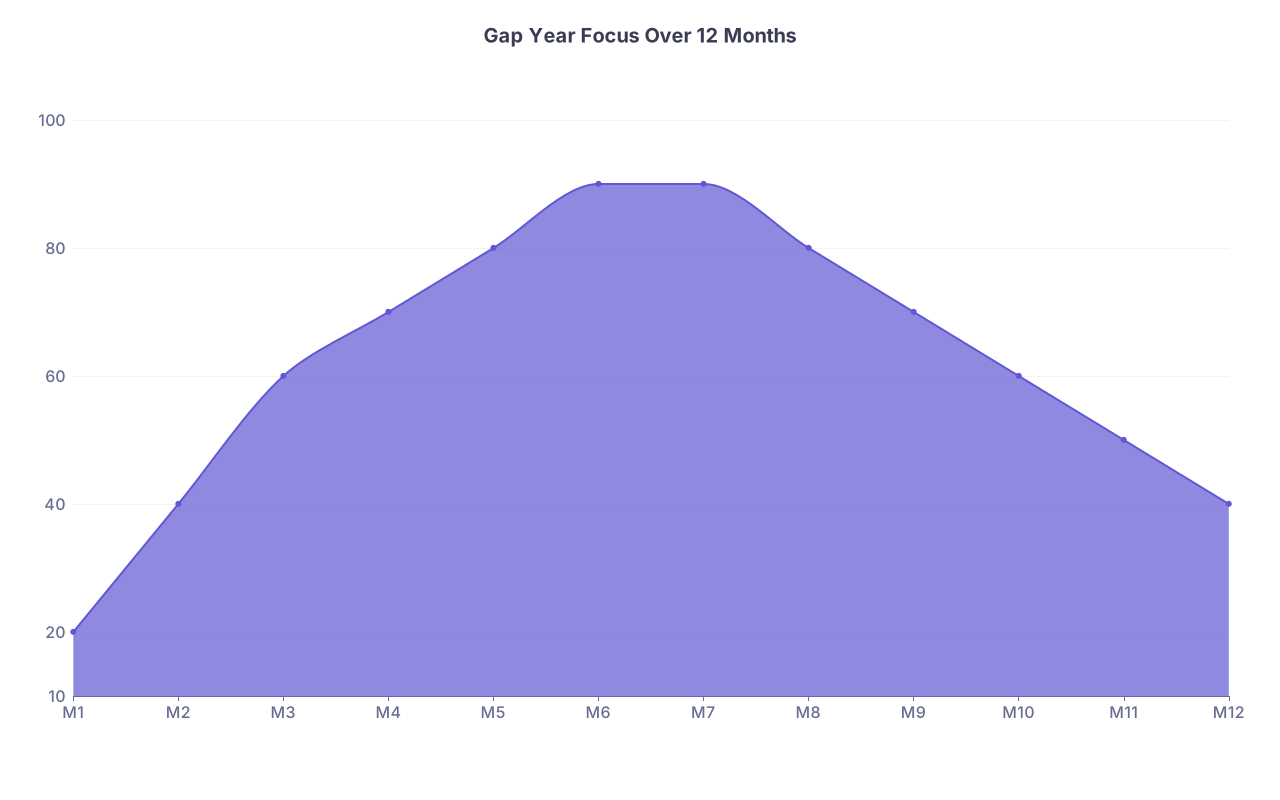
| Category | Value |
|---|---|
| M1 | 20 |
| M2 | 40 |
| M3 | 60 |
| M4 | 70 |
| M5 | 80 |
| M6 | 90 |
| M7 | 90 |
| M8 | 80 |
| M9 | 70 |
| M10 | 60 |
| M11 | 50 |
| M12 | 40 |
Interpretation: 0–100 scale of how intensely you are pushing on application-related outputs.
Months 1–2
- Secure your role and define scope with supervisor
- Draft your one-page blueprint and review it with your mentor
- Start shadowing/clinic days immediately
- Identify 2–3 concrete projects you can realistically complete in 6–9 months
Months 3–4
- Lock in your first abstract / poster plan
- Ask for informal feedback on your performance so far
- Start tracking specific clinical experiences and responsibilities for your CV and ERAS bullets
- Attend every departmental conference you can, start asking smart questions
Months 5–6
- Push to have at least one project near submission
- Request first formal evaluation / brief feedback email you can save
- Identify your likely letter writers and mention your intent early (“If things continue to go well, I would love to ask you for a letter in a few months.”)
Months 7–8
- Finish at least one manuscript or major abstract
- Draft your personal statement and share with 1–2 trusted mentors for feedback
- Confirm letter writers and give them:
- CV
- Draft personal statement
- Bullet list of what you did with them
Months 9–10
- Enter ERAS data carefully, aligning with your narrative
- Apply broadly, including a sensible safety net if needed
- Continue to show up and work – do not fade once ERAS is in
Months 11–12
- Prepare and rehearse your “specialty switch” explanation
- Continue collecting small wins (case reports, QI updates) that you can mention on interview day
- Do not mentally quit your gap year job; your current mentors still talk to programs
Step 11: Specific Pitfalls That Make Programs Nervous
Avoid these like the plague:
- Rotating back into your old specialty during the gap year “just in case” without a clear strategy. It muddies your story.
- Trash-talking your old specialty or prior mentors in any setting. Word gets around.
- Overstating your role in research or QI projects. People do check.
- Long gaps of no clinical exposure (6+ months) right before starting residency.
- Multiple, unconnected short-term gigs – looks unstable and unfocused.
Stability + clarity beats inflated achievements with a messy story.
Step 12: If You Are Starting Late, Compress the Same Logic
If you are already 3–6 months into an unstructured gap year and only now realizing you need to pivot, the playbook is the same, but faster:
- Immediately anchor yourself in the new specialty:
- Ask for clinic time
- Attend conferences
- Attach yourself to an attending who can see you regularly
- Reframe any ongoing generic research toward questions relevant to the new field if possible
- Get at least 3–4 months of consistent, visible work with at least one potential letter writer before ERAS opens
- Cleanly explain the delay as:
- “I initially used this time for [X], but as I gained more exposure to [new specialty], I recognized that this was the right direction and deliberately reoriented my efforts.”
Do not pretend you had a perfect plan from day one. Show that when reality shifted, you adapted intelligently.
What You Should Do Today
Open a blank document and write three things:
- A brutally honest paragraph about why you are switching.
- A list of names of people in the new specialty who actually know you. Even if the list is short.
- A rough weekly schedule for your ideal gap year (how many hours clinical, how many research, which conferences).
Then, send an email to one attending in the new specialty:
- Ask for a 20–30 minute meeting to discuss your interest in the field and how to structure your gap year to be a strong applicant.
- Bring that one-page blueprint draft to the meeting.
You are not trying to be perfect. You are trying to be intentional, visible, and credible. Do that consistently for 12 months, and a specialty switch with a gap year stops looking risky and starts looking like exactly what good physicians do: reassess honestly, then commit fully.


