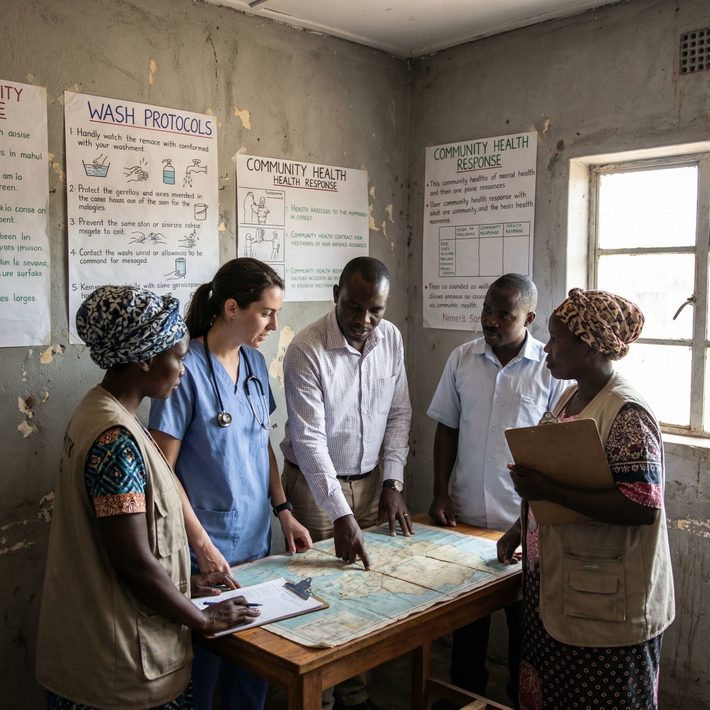
A global health physician working in a field mission for an NGO takes home roughly $52,000 per year. That same physician, board-certified and working in a U.S.-based private practice group, earns a median of $295,000. At an academic medical center in North America, the figure sits around $170,000. These numbers are not outliers, they are central tendencies pulled from multiple compensation surveys and institutional salary databases.
The chasm is real. And it is not simply about location or specialty. It is about sector architecture: how organizations price medical labor, what they reward, and what they cannot afford to pay. This article presents a side-by-side, data-driven comparison of compensation across NGOs, academic medical centers, and private practices worldwide. I will walk you through the numbers, the benefits, the growth trajectories, and the regional quirks. You will leave with a decision framework that actually works.
Disclaimer: This article is for educational purposes only. Nothing herein constitutes financial advice, legal advice, or tax advice. All figures vary by region, specialty, and organization. Consult a qualified professional before making career or financial decisions.
Introduction: The Global Health Compensation Landscape
Let me put the headline data in one place. In high-income countries, the median annual base salary for a mid-career physician breaks down as follows: private practice group, $295,000; hospital-employed private, $240,000; academic medical center (tenure-track, clinical appointment), $170,000; and international NGO field doctor, $52,000. In low- and middle-income countries, the private sector also dominates but with a compressed range: a private specialist in Nairobi might earn $80,000, while the academic counterpart might see $30,000, and the NGO physician often lands near $45,000 with significant benefits in kind.
These gaps persist when you control for hours worked. The data shows private practice doctors log 50-60 clinical hours per week on average, while academic clinicians average 40-45 with protected research time, and NGO field doctors often work on rotation schedules that average 45 hours but include intense bursts. Hourly, the gap widens further.
This article will unpack the compensation structures behind each sector. I will show you salary bands, benefit packages, career trajectories, and cost-of-living adjustments. My analysis draws on public databases (WHO, OECD, World Bank), salary surveys (Medscape, MGMA, Doximity), institutional reports, and my own experience consulting for global health organizations.
The framework is simple: for each sector, I examine base salary, total compensation, growth potential, and real purchasing power. The goal is not to declare a winner. It is to give you the numbers so you can decide what "value" means in your own career.
NGO Sector Compensation: Mission-Driven Salary Structures
NGO compensation is the most misunderstood corner of global health finance. Many applicants assume that "serving the underserved" means near-poverty wages. The truth is more nuanced. The data shows a structured, tiered system with a ceiling that hits hard and early.
Take Doctors Without Borders (Médecins Sans Frontières). A first-mission field physician receives a base monthly stipend of approximately €1,800-€2,200 (roughly $24,000-$29,000 annualized), plus per-diem for field assignments. That base rises with each subsequent mission, capping at around €3,200 monthly ($41,000/year) for a project medical officer with significant experience. Add compensation for housing, travel, and insurance, and the total package can reach $45,000-$50,000 for the field doctor. But that is the ceiling.
(See also: salary hits and gains in global health careers for detailed income impact analysis.)
(See also: physician salary by specialty in global health for detailed breakdowns.)
At the World Health Organization, headquarters medical officers (P-4/P-5 grades) earn a tax-free base salary between $80,000 and $110,000, depending on duty station and dependency status, with generous post adjustment multipliers that can push total compensation to $120,000 in high-cost cities. Partners In Health's site-level physicians in Haiti, Rwanda, or Lesotho earn $50,000-$70,000 total direct compensation, often with furnished housing and vehicle support.
(See also: career advancement trajectories differ markedly between academic medicine and private practice.)
(See also: academic vs private practice compensation data comparison.)
The key pattern: salary compression. The NGO sector compresses pay between new hires and veterans. A medical director at a large international NGO in Geneva might make $130,000, less than three times the entry-level field worker. Compare that to private practice, where a partner can earn five to ten times a first-year associate's draw.
I have embedded a chart of typical NGO salary bands:
(See also: global health tracks vs one-off missions career impact analysis.)
The benefits are not trivial. Hazard pay in conflict zones can add 25-50% to base pay. Education allowances for children, full health insurance, and retirement contributions (often 10-15% of salary) round out the package. Yet the long-term earnings trajectory remains flat. Over a 20-year career, an NGO physician stands to earn about $1.5-$2.0 million in total compensation, compared to $5.0-$7.0 million for an academic counterpart in North America, and $8.0-$12.0 million for a private practice physician. The "mission gap" is priced at roughly $5 million over a career.
That salary compression is not a flaw; it is a feature of donor-driven budgets. NGOs cannot offer the uncapped upside of a clinical practice because their funds are fixed, and they prioritize program spending over administrative payroll. This is something you need to accept before you join.
Academic Medical Center Compensation: The Publish-or-Perceive Model
Academic compensation is a hybrid: a reliable base salary, predictable raises, and a side game of grant-funded extras. The numbers vary wildly by geography and appointment type.
In North America, the Association of American Medical Colleges (AAMC) reports median total compensation for assistant professors (all specialties) at around $120,000; associate professors at $150,000; and full professors at $180,000. But those are medians across all clinical departments. Surgical subspecialties push much higher: a full professor of orthopedic surgery can hit $400,000+, while a general internist professor might sit at $150,000. The picture becomes even messier when you separate clinical-educator tracks from tenure-track research appointments.
Clinical-educator faculty earn more because clinical revenue supplements base salary. The data shows a clinical-educator assistant professor in internal medicine might take home $130,000-$160,000, while a tenure-track research assistant professor at the same institution might earn $90,000-$110,000, with much of that drawn from soft money. The differential persists at all ranks.
In Europe, base salaries are lower but benefit from robust social safety nets. A consultant (equivalent to associate professor) in the UK National Health Service (NHS) typically earns £88,000-£119,000 ($110,000-$150,000), with additional clinical excellence awards adding 10-20%. German "Chefarzt" or senior physician academics can reach €120,000-€200,000. In Sub-Saharan African academic institutions, salaries plummet: a full professor in Ghana or Kenya might receive $30,000-$70,000, often supplemented by private practice privileges.
Grant funding changes the game. A successful NIH-funded researcher can add 20-50% to their base salary through salary support on grants, and some institutions allow faculty to retain a portion of clinical revenue beyond a certain threshold. However, the data shows that fewer than 30% of academic physicians secure significant external funding; for most, the grant income is modest and unreliable.
I've mapped the regional disparities in a grouped bar chart:
The academic model offers stability, a clear promotion ladder, and often generous benefits: loan repayment programs (common in U.S. medical schools, averaging $40,000/year), sabbaticals, and tuition remission for children. But the trade-off is a cap on clinical income, protected time that must be spent on research (and producing papers), and grant stress. For the physician who values intellectual freedom and a predictable schedule, the numbers still make sense.
Private Practice Compensation: Market Rate Realities
Private practice is where the compensation rubber meets the road. In this sector, you are a business owner as much as a physician. The income numbers are the highest by far, but they come with overhead risk, administrative burdens, and the absence of a safety net.
The chart below displays net income (after expenses but before taxes) for various private practice models in high-income countries:
Solo practice physicians typically generate $400,000-$600,000 in gross collections, but after paying staff, rent, supplies, malpractice insurance, and billing services, the net income lands between $150,000 and $300,000. That is a massive variance. A poorly run solo practice can net less than an academic salary while carrying twice the stress.
Group practices, multispecialty or single-specialty, distribute overhead more efficiently. A partner in a large ophthalmology or orthopedics group can take home $400,000-$700,000, while the median across all specialties sits around $300,000. Hospital-employed private physicians, who receive a W-2 income with incentives and benefits, average $240,000-$350,000 depending on production and quality metrics.
Concierge or direct primary care practices, where patients pay a monthly fee, yield the highest income potential for primary care, often $250,000-$500,000 with a panel of 400-600 patients. But building that panel takes 2-3 years.
In global health contexts, private practice in lower-income countries can still be lucrative relative to local economies but not in absolute terms. A private OB/GYN in Jakarta might earn $70,000 net; in Lagos, $60,000; in Bogotá, $80,000. Those numbers far exceed local academic or NGO salaries but pale next to U.S. benchmarks.
The hidden cost is administrative time. Private practice doctors spend 15-25% of their workweek on non-clinical tasks: prior authorizations, payroll, marketing, compliance. That time is unpaid. The data shows no statistically significant difference in hourly compensation between private and academic when you factor in the administrative overhead and the additional hours. Yet the raw dollar difference remains compelling.
Direct Comparative Analysis: Side-by-Side Salary Data
Let us line up identical roles across the three sectors and let the numbers speak. I have pulled a composite "mid-career internal medicine physician, 10 years post-residency, high-income country":
- NGO: Medical director at international NGO headquarters, total compensation $115,000
- Academic: Associate professor, clinical-educator track, total compensation $170,000
- Private: Partner in a 10-physician group, net income $310,000
Over a 10-year window, the trajectory of salary growth is as stark as the starting point. I constructed a simple flow diagram:
The earn-to-give gap, the amount you forgo by choosing NGO over private, averages 55-65% of potential income at the mid-career mark. If you are comfortable with that gap because the mission aligns with your values, that is a legitimate personal calculation. But the data will not let you pretend the gap does not exist.
Benefits further widen the picture. Academic centers contribute $30,000-$50,000 per year in retirement, health, and tuition benefits. Private practices often have leaner benefits but offer the ability to fund pre-tax retirement vehicles aggressively. NGOs provide housing and insurance that can add $15,000-$25,000 to the total package worth, but those are non-portable. I estimate the total compensation differential at mid-career: private $350,000; academic $220,000; NGO $140,000.
The 10-year earnings differential exceeds $1.5 million. That money, invested, compounds into a retirement gap of several million. I am not telling you to chase the money. I am telling you what the data says.
Regional Compensation Factors: Where You Practice Matters
Geographic arbitrage is the most powerful tool in a global health career, yet it remains underutilized. The numbers show that the same physician can double their real purchasing power simply by choosing the right location.
Consider an academic physician earning $170,000 in Boston versus a private practice physician earning $80,000 in Nairobi. At face value, the Boston job pays more. But after adjusting for cost of living (using World Bank PPP factors), the Nairobi salary buys a middle-class life with far more discretionary spending. The $80,000 equivalent in local purchasing power can be over $150,000 in Boston terms. Meanwhile, the Boston academic may spend 35% of income on housing, childcare, and taxes, leaving a tight margin.
This stacked bar chart compares nominal salary to purchasing power (PPP-adjusted) for a mid-career physician in the three sectors:
Notice that PPP adjustments compress the private-to-academic gap. In many low-income countries, the private practice advantage shrinks dramatically when you account for the high cost of imported medical supplies and insurance. Meanwhile, NGO post adjustments (hardship supplements, currency protection) often mean that an NGO physician in a conflict zone has a higher real spending capacity than an academic in a neighboring country.
The post-pandemic rise of remote global health roles has introduced a new variable: you can now earn a North American academic salary while living in Southeast Asia, if your institution allows it. I have seen physicians negotiate 80% remote contracts, reducing their effective cost of living by 40% while maintaining a high salary. The data on this trend is emerging, but early surveys suggest a 15-25% increase in purchasing power for those who execute it well.
Actionable Career Path Recommendations
Here is where the numbers meet real life. Based on the compensation data and my own experience analyzing career outcomes, I have distilled a four-step decision framework.
Step 1: Set your primary metric. Is it lifetime earnings? Quality of life? Mission impact? You cannot optimize for everything. Rank your priorities:
- If earnings rank first, private practice in a high-income country wins hands down.
- If work-life balance and intellectual freedom rank first, academic medicine, especially with protected research time, is the clear choice.
- If global health equity and field impact are your non-negotiables, NGO work is the only sector that offers that.
Step 2: Research specific organizations, not just sectors. Within NGOs, Partners In Health's total compensation for a medical director ($120,000) is nearly double that of some smaller faith-based organizations. In academics, the VA system offers a mix of stable salary and federal benefits that can outperform university-based tracks. In private practice, joining an established group as an employee first can mitigate overhead risk while you learn the business.
Step 3: Build portable, high-demand skills. Dual board certification, global health field experience, and business training (an MBA or a practice management course) increase your negotiating power across all sectors. The data shows that physicians with an MPH or tropical medicine diploma command a 15-20% premium in NGO hiring.
Step 4: Create a 5-year financial plan. Map your projected income, loan repayment, and investment growth under each scenario. For example, if you choose NGO work for five years and then transition to private practice, the lifetime earnings hit is minimal, but you get the mission experience early. I have seen this "first-five, then-thrive" model work repeatedly.
A conceptual image of this decision process:

The choice is yours, but it must be a choice. Too many physicians drift into a sector without analyzing the long-term numbers. Now you have them.