
Understanding Physician Salary by Specialty in Global Health
When medical students and residents consider a global health residency track or a career in international medicine, the questions they ask almost always include: “Will I be able to pay my loans?” and “What does physician salary by specialty look like if I work in global health instead of a purely domestic practice?”
This guide unpacks how physician salary by specialty interacts with global health career paths, how compensation models differ from traditional U.S. practice, and how to strategically plan a sustainable, meaningful career at the intersection of specialty practice and global health.
We will focus on:
- How physician income is structured for global health roles
- Doctor salary by specialty in typical U.S. practice vs. global health–focused paths
- Which specialties tend to be highest paid specialties (and how that changes when you add global health)
- How to choose a specialty, structure your training, and negotiate compensation if you want global health to be a core part of your career
1. How Global Health Careers Change the Usual Salary Equation
Before comparing doctor salary by specialty, it’s crucial to understand how global health changes the fundamentals of compensation.
1.1 Conventional U.S. Physician Salary vs. Global Health–Oriented Income
In a traditional U.S. context, physician salary is largely driven by:
- Specialty (e.g., orthopedic surgery vs. family medicine)
- Practice setting (private practice, hospital-employed, academic)
- Geographic region and cost of living
- Productivity (RVUs, procedures, patient volume)
In global health–oriented careers, income can be shaped by a different mix:
- Academic appointments with partial salary support for international work
- Grants and project-based funding (e.g., NIH, NGOs, foundations)
- NGO or international organization employment (e.g., MSF, WHO, UNICEF)
- Government, military, or public health agencies
- Hybrid models: domestic practice + protected time abroad
As a result, headline salary figures for “global health physicians” can be misleading—often a physician’s total compensation is a blend of a domestic base salary and funded global health time, stipends, or supplemental income.
1.2 Typical Compensation Models in Global Health
Here are the most common structures:
Academic Physician with Global Health Track
- Core salary from a U.S. (or other high-income country) academic institution
- RVU-based or salaried clinical duties at home institution
- 10–50% FTE for global health: funded by grants, departmental support, or external contracts
- Income often looks similar to academic peers in same specialty, sometimes slightly lower if less clinically productive
Domestic Clinician with Periodic International Work
- Full physician salary from domestic practice (academic, hospital, or private)
- Short-term trips: often unpaid or vacation/leave time, or modest stipends from NGOs
- Financially, these physicians earn mostly standard specialty-level income, with global health as a side commitment
Full-Time Global Health / NGO / International Organization Physician
- Employed by NGOs (e.g., MSF), UN agencies, ministries of health, or large global health programs
- Salaries typically lower than private practice in high-income countries, but can be offset by benefits, housing, and tax considerations
- Often closer to academic-level pay for primary care specialties, even for proceduralists
Hybrid Entrepreneurial or Consulting Pathways
- Combination of telemedicine, locums, consulting, training programs, and global health project work
- Highly variable income; can approach high domestic specialty income if structured well, but requires deliberate planning and business savvy
2. Doctor Salary by Specialty: Baseline Benchmarks
To understand how global health affects income, start from the baseline: doctor salary by specialty in a typical U.S. setting (approximate, aggregated from public survey data as of recent years; actual numbers vary by survey and market).
Primary care and generalist specialties (academic/community combined ranges):
- Family Medicine: ~$230,000–$270,000
- General Internal Medicine: ~$250,000–$290,000
- Pediatrics (General): ~$220,000–$260,000
- Medicine-Pediatrics: ~similar to Internal Medicine / Pediatrics depending on mix
Hospital-based and cognitive subspecialties:
- Hospitalist (Internal Medicine): ~$270,000–$330,000
- Infectious Disease: ~$260,000–$320,000
- Pulmonary/Critical Care: ~$380,000–$450,000
- Neurology: ~$300,000–$350,000
- Psychiatry: ~$280,000–$340,000
Procedural and surgical specialties (often highest paid specialties):
- Emergency Medicine: ~$350,000–$450,000
- OB/GYN (General): ~$330,000–$400,000
- General Surgery: ~$350,000–$450,000
- Anesthesiology: ~$380,000–$470,000
- Orthopedic Surgery: ~$550,000–$700,000+
- Cardiology: ~$500,000–$650,000
- Gastroenterology: ~$480,000–$600,000
- Dermatology: ~$450,000–$550,000
- Radiology (Diagnostic): ~$450,000–$550,000
These numbers represent domestic practice, often full-time clinical, and are substantially influenced by procedures and RVU-heavy work.
Key point for global health: The more your income depends on high-volume procedures in private or hospital systems, the larger the potential income gap if you shift to a global health–dominant career.
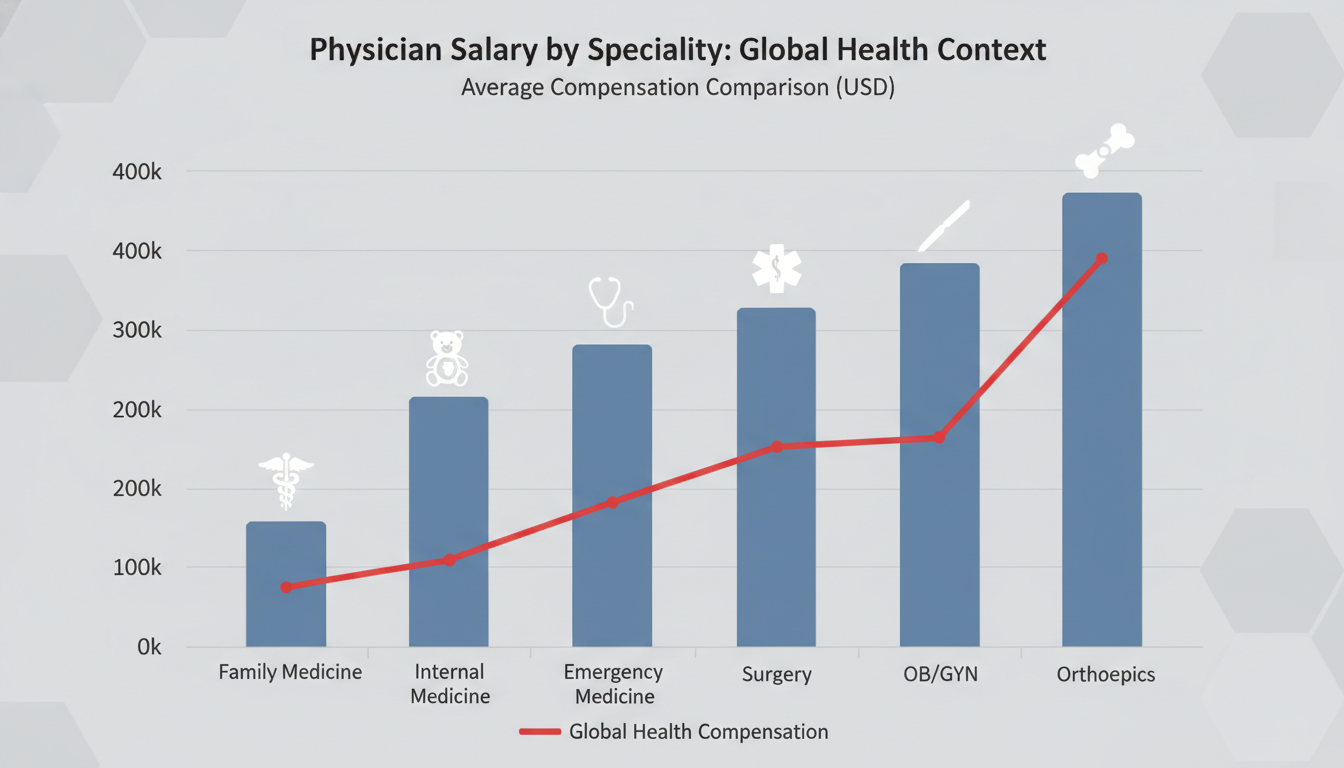
3. How Global Health Affects Physician Salary by Specialty
Now, let’s overlay global health on these baseline numbers. Rather than exact dollar figures (which vary by institution and country), we’ll focus on relative changes and typical patterns across specialties important to global health.
3.1 Primary Care and Generalist Specialties
Relevant specialties: Family Medicine, Internal Medicine, Pediatrics, Medicine-Pediatrics
These are the foundational specialties for many global health residency track programs.
Domestic baseline:
- Moderate physician salary compared to highest paid specialties
- Strong demand in underserved areas
In global health–oriented careers:
Academic global health tracks:
- Salary often similar to academic peers in same specialty, sometimes 5–15% lower if less clinically productive due to protected global health time
- Example: An academic internist earning $260k clinically might earn $230–250k if 20–30% of time is funded at lower grant-based rates
NGO/International roles:
- Compensation can range from modest (e.g., $60k–$120k with benefits for some NGOs) to more competitive (e.g., $150k–$200k+ for leadership roles in large organizations or global health programs)
- May include housing, travel, education stipends, or hardship pay
Long-term in low- and middle-income countries (LMICs):
- If employed by a local institution, salary may be aligned with local scales (often substantially lower than U.S. income), unless supported by external grants or contracts
Takeaway: For primary care physicians, choosing global health often does not dramatically reduce income compared to standard academic or safety-net practice, especially if a portion of work remains domestic.
3.2 Infectious Disease, HIV Medicine, and Public Health–Focused Subspecialties
Relevant specialties: Infectious Disease, General Internal Medicine with HIV focus, Preventive Medicine, Public Health
These are classic global health specialties.
Domestic baseline:
- Infectious Disease and Preventive Medicine typically earn less than procedural subspecialties and sometimes less than general internal medicine.
In global health–oriented careers:
Academic centers with global health programs:
- ID physicians often secure grant-funded time for research, implementation science, and capacity building abroad
- Total compensation may be similar to or slightly below academic general internal medicine peers, but global health content is built into the job description
NGOs and global programs:
- Salaries can be competitive with academic ID compensation, especially in leadership roles (medical director, program director, regional advisor)
- Compensation packages may include generous benefits, mission-driven perks, and opportunities for advancement
Takeaway: For ID and similar fields, a global health–oriented path may not represent a major financial sacrifice compared to domestic academic or public health roles, though it will not approach the income of the highest paid specialties.
3.3 Emergency Medicine and Critical Care
Relevant specialties: Emergency Medicine, Pulmonary/Critical Care, Anesthesiology (for resuscitation and OR capacity building)
Domestic baseline:
- Emergency Medicine and critical care are well-compensated, often in the upper mid-range, though not always at the very top of physician salary by specialty.
In global health–oriented careers:
Academic EM with global health residencies/fellowships:
- Salary often similar to academic EM peers, with some RVU tradeoff for international work
- Protected global health time may be funded at lower rates than clinical time
NGO/acute humanitarian work:
- Compensation often significantly lower than domestic EM practice
- May be structured as shorter-term contracts with room, board, travel, and modest stipends
- For longer-term roles, pay can approach mid-level academic salaries but rarely matches high-earning domestic EM physicians
Hybrid models (e.g., U.S. EM + periodic missions):
- Many EM physicians maintain full domestic income and integrate short humanitarian deployments using vacation blocks or flexible scheduling
- This allows them to keep high EM incomes while contributing meaningfully to international medicine
Takeaway: If you want to preserve a high Emergency Medicine salary while doing global health, a hybrid or academic model is often more financially sustainable than full-time NGO work.
3.4 Obstetrics & Gynecology and Surgery
Relevant specialties: OB/GYN, General Surgery, Trauma Surgery, Orthopedics, Surgical Subspecialties
These are among the highest paid specialties in typical U.S. practice, especially orthopedics and some surgical subspecialties.
Domestic baseline:
- Strong physician salary driven by procedural volume, call pay, and high RVU reimbursement.
In global health–oriented careers:
Academic global surgery / global women’s health:
- Academic OB/GYN and general surgery salaries with some reduction for protected global health time (similar pattern to other specialties)
- More emphasis on teaching, capacity building, and systems work than personal procedural volume abroad
Full-time mission or NGO surgical roles:
- Often substantially lower income than U.S. private practice, particularly for high-paying surgical subspecialties
- Compensation may be similar to or below generalist academic salaries, even for highly trained surgeons
- May include in-kind support (housing, schooling for children, travel) that partially offsets cash salary
Hybrid: high-acuity domestic surgery + scheduled global trips:
- Many surgeons maintain a largely domestic practice with 2–8 weeks/year abroad
- Financially, this is the only model that typically preserves the income advantages of the highest paid specialties while supporting global health engagement
Takeaway: For proceduralists and surgical specialists, full-time global health roles usually mean a substantial pay cut compared to high-income domestic practice. A hybrid or academic career can soften this gap.
3.5 Psychiatry, Neurology, and Other Cognitive Specialties
Relevant specialties: Psychiatry, Neurology, Rheumatology, Endocrinology, etc.
Their global health footprint is expanding, especially in mental health and neurologic disease in LMICs.
Domestic baseline:
- Moderate physician salary; generally higher than primary care but lower than top procedural fields (with local variation).
In global health–oriented careers:
Academic roles with global mental health or neuro programs:
- Similar tradeoff to other academic specialties: some reduction in salary for non-clinical, grant-funded global health time
- However, well-funded programs can support competitive compensation
NGO and WHO-style positions:
- Salaries can be competitive by academic standards, particularly in policy and systems roles
- May include international civil service benefits and allowances, particularly in UN settings
Takeaway: For cognitive specialties, global health often fits naturally into academic, policy, and program work with moderate financial impact compared to other academic pathways.
4. Strategic Career Planning: Balancing Mission and Money
4.1 Choosing a Specialty with Global Health in Mind
When exploring doctor salary by specialty in the context of global health, think beyond just top-line income:
Alignment with global health needs
- High global demand: Family Medicine, Internal Medicine, Pediatrics, OB/GYN, General Surgery, Anesthesia, Emergency Medicine, Infectious Disease, Psychiatry
- Growing needs: Neurology, Oncology, Cardiology, Critical Care, Palliative Care
Flexibility of practice models
- Can you easily do locums or telemedicine to fund intervals of international work? (EM, IM, FM, Psychiatry often excel here.)
- Is your specialty transferrable to low-resource settings?
Realistic income expectations
- Are you comfortable with academic-level pay vs. private practice pay if you want significant protected global health time?
- Are your financial obligations (loans, family, location) compatible with lower or more variable income?
Practical example:
- A resident passionate about global maternal health may choose OB/GYN, anticipating an academic salary with periodic international work and possibly global health research—rather than maximizing RVU-based private practice income.
4.2 The Global Health Residency Track and Long-Term Earning Power
Enrolling in a global health residency track can:
- Enhance your competitiveness for academic roles with a global health focus
- Connect you with mentors who have navigated financing, grants, and hybrid careers
- Provide early exposure to NGOs and international institutions
In terms of income:
- Residency itself doesn’t change your resident salary; the impact is downstream in job type and structure
- A global health track signals you may be geared toward academic, public-sector, or NGO roles—often at slightly lower compensation than purely private practice
- However, it may also accelerate your path to grant funding, leadership positions, and sustainable global health roles that can stabilize or enhance income over time

4.3 Building a Financially Sustainable Global Health Career
These strategies help align your global health mission with financial reality:
Consider dual training or complementary skills
- Example: Internal Medicine + Infectious Disease + MPH; or EM + Critical Care; or OB/GYN + Family Planning Fellowship
- Added expertise can attract better-funded roles and leadership positions.
Leverage domestic clinical income strategically
- Work part-time or per-diem shifts in high-paying settings (e.g., EM, hospitalist, locums) to fund significant unpaid or lightly paid global health work
- Use telemedicine or short, intensive locums to maintain specialty income while abroad
Learn basic grant writing and project budgeting
- Many global health academic physicians build part of their income from funded research and implementation grants
- Understanding how to budget your own salary into grants is crucial
Negotiate protected global health time in job contracts
- Ask for a defined percentage of FTE for global health with transparent funding sources
- Clarify whether this time is salaried, grant-dependent, or contingent on RVUs
Manage debt and cost of living early
- Consider loan repayment programs (e.g., NIH LRP, NHSC, or institutional programs)
- Avoid lifestyle inflation early in your attending years if you plan a lower-paying global health pivot later
Case vignette:
Dr. A is an Internal Medicine–Pediatrics physician with a global health fellowship. They work 0.6 FTE as an academic hospitalist earning ~$210k and 0.4 FTE on global health projects funded by grants and institutional support, adding ~$60k. Total compensation: ~$270k—similar to full-time academic hospitalist peers, with nearly half their time devoted to global health.
5. Comparing Global Health Paths Across Specialties
5.1 Best-Fit Specialties for Career-Long Global Health Work
If your priority is to maximize global health time, and you’re comfortable with moderate (not top-tier) income:
- Family Medicine / General Internal Medicine
- Pediatrics
- Infectious Disease
- OB/GYN (academic/women’s health focus)
- Emergency Medicine (academic with global health focus)
- Psychiatry (global mental health)
These paths allow you to have global health integrated into your job description without extreme financial loss compared to domestic academic peers.
5.2 Best-Fit Specialties for High Income Plus Meaningful Global Health
If you want to maintain a higher physician salary by specialty while still engaging substantially in global health:
- Emergency Medicine: flexible shifts permit blocks of time abroad
- Anesthesiology and CRNA supervision roles: high domestic pay, periodic global anesthesia missions
- Orthopedic Surgery or other high-end surgical fields: high domestic earnings that can fund self-supported or partnered surgical trips
- Radiology and some tele-specialties: remote work/telemedicine can subsidize global health projects
The tradeoff is that much of your global health activity may be episodic rather than continuous.
5.3 Specialties Where Full-Time Global Health May Involve the Biggest Pay Cut
Relative to their domestic earning potential, these specialties often experience the largest income drop if moving into full-time global health roles:
- Orthopedic Surgery
- Neurosurgery
- Cardiology and Interventional Cardiology
- Gastroenterology
- Dermatology
- Plastic Surgery
For these, global health is often most financially sustainable as part-time or through academic positions with limited but meaningful global engagement.
6. Actionable Steps for Residents and Students Interested in Global Health
6.1 During Medical School
- Seek electives and rotations in global health and health equity
- Talk to mentors in multiple specialties about their actual day-to-day work and finances
- Analyze your likely loan burden and calculate realistic repayment scenarios under different specialties and incomes
- Consider MD/MPH or MD/PhD with global health focus if you lean toward research or policy
6.2 During Residency
- Join (or create) a global health residency track or pathway if available
- Ask faculty mentors about:
- Their salary structure (clinical vs. global health time)
- How they fund their international work
- What tradeoffs they’ve made
- Use electives to:
- Build LMIC-compatible clinical skills
- Meet NGOs or organizations that might later employ you
- Attend global health conferences and networking events to understand career and funding landscapes
6.3 Transitioning to Your First Job
When evaluating offers:
Clarify the salary base and incentives
- How much is fixed salary vs. RVU or productivity?
- Is global health time written into the contract?
Ask specific questions about global health support
- Amount of protected time
- Source and stability of funding
- Expectations for clinical RVUs vs. academic output
Compare trajectories, not just the first-year offer
- Private practice may pay more initially but offer little room for sustained global health time
- Academic roles may pay less but can develop into funded global health leadership positions
Plan for contingency
- If a grant or project ends, what happens to your salary?
- Is there a guaranteed clinical FTE you can fall back on?
FAQs: Physician Salary by Specialty in Global Health
1. Do global health physicians always earn less than domestic-only physicians in the same specialty?
Not always, but often. If you move from high-RVU private practice to full-time NGO or academic global health work, you will almost always earn less. However, many physicians maintain domestic clinical roles (especially in Emergency Medicine, hospitalist medicine, and primary care) that allow them to earn comparable incomes while devoting a significant portion of time to global health activities.
2. Which specialties are best if I want to do global health and still pay off my loans comfortably?
Family Medicine, Internal Medicine, Pediatrics, Emergency Medicine, OB/GYN (academic), and Infectious Disease are among the most common and sustainable choices. They align well with global health needs and have viable academic and hybrid models. High-income specialties like Orthopedics, Anesthesiology, and Radiology can also work well if you envision a hybrid model (high-paying domestic work + periodic global health engagements).
3. Can I get loan repayment or financial incentives for working in global health?
Formal U.S. loan repayment programs are more common for domestic underserved work than for overseas work. However:
- Some institutions provide loan assistance as part of recruitment for global health faculty roles.
- Grants can sometimes budget your salary while you work on global projects.
- Certain military and government roles focused on global health may offer loan repayment or bonuses.
Always ask potential employers and mentors about institution-specific programs.
4. Does doing a global health residency track reduce my future income?
The track itself does not directly reduce your income. The impact comes from the types of jobs you are likely to choose afterward—often academic or NGO/agency roles rather than high-RVU private practice. That said, a global health track can also position you for competitive academic roles, leadership positions, and funded projects that provide a stable and fulfilling career. If income is a major concern, you can intentionally pursue hybrid models that preserve much of your specialty’s earning potential while still engaging deeply in global health.
By understanding how physician salary by specialty interacts with global health career structures, you can make deliberate choices that honor both your commitment to equity and your financial realities. Thoughtful planning—starting as early as medical school or residency—allows you to build a career in international medicine that is not only impactful, but also sustainable for you and your family.