Two applicants. Same school, same Step 2 score, same September deadline.
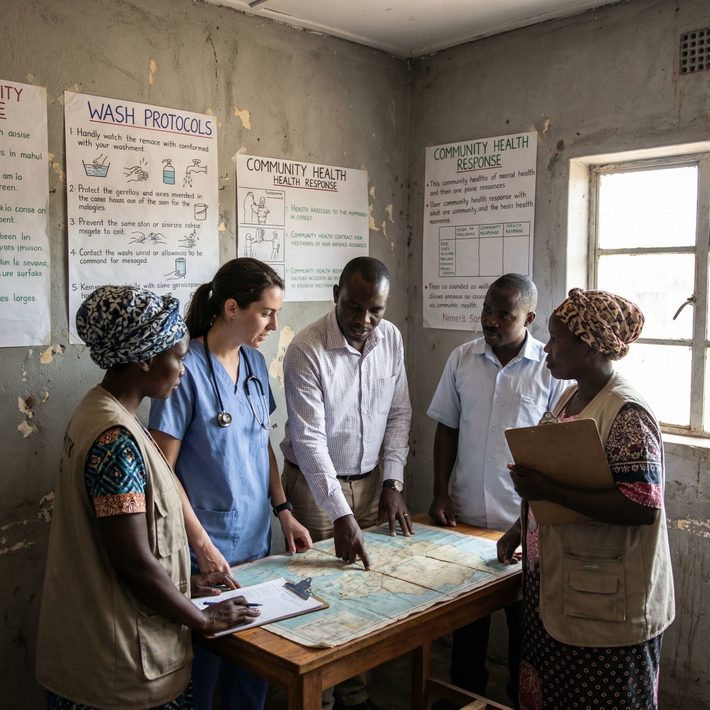
Applicant A spent fourteen months with a community health organization in rural Guatemala, hypertension screenings, training local promotoras, an IRB-approved quality-improvement project tracking blood pressure control across three villages. Zero publications.
To navigate the balance between these two priorities, read How Global Health Experience Actually Plays in Residency Rank Meetings.
Applicant B spent eighteen months in a cardiology outcomes lab at a big-name institution. Two middle-author papers, one first-author manuscript under review, three posters. Never left the country. Never particularly wanted to.
Who gets ranked higher? Here's the answer you're looking for: the one whose file tells a coherent story. That's the whole game, and most students get it wrong because they're optimizing for a checklist that doesn't exist.
I've sat in rank list meetings. Nobody holds up your ERAS and says, "This one has 400 global health hours, clearly superior to 400 lab hours." What they actually say is: "What did this person do, and can they talk about it like it mattered?"
Let's break down how rankers really weigh these two currencies, and how you should spend your limited hours.
This article is for educational purposes only. It is not financial advice, not legal advice, and not tax advice. Figures vary by individual circumstances, so consult a qualified professional before acting.
The Scenario: The CV Crossroads
The crossroads feels binary: serve abroad or publish at home. Pick wrong, and you've wasted a summer. Pick right, and you're "well-rounded."
Wrong framing. Both halves of it.
The myth of the perfect applicant. Students believe there's a secret rubric: X research hours plus Y volunteer hours plus Z leadership title equals ranked-to-match. There isn't. Rank lists get built by tired faculty in a conference room with bad coffee, pattern-matching for residents they'd trust at 3 a.m. Nobody's tallying hours. Everybody's reading for signal.
For those unsure if their background supports their goals, see I've Never Worked Abroad, Will Programs Take My Global Health Interest Seriously?.
So what signal do rankers actually extract from your file? Three things:
If you are worried about whether your background aligns with future training, see What Global Health Fellowship Directors Really Look for in Applicants.
- Academic productivity. Evidence you can start scholarly work and, this is the hard part, finish it.
- Cultural competency and mission alignment. Evidence you'll fit their patient population and their program's identity.
- Longitudinal commitment. Evidence you tolerate boring, repetitive, unglamorous work for longer than a vacation.
Now score our two candidates. The two-week mission trip, the classic version, scores zero on productivity, near-zero on commitment, and a soft maybe on cultural competency. The eighteen-month lab stint scores high on productivity and commitment, zero on mission. Neither is complete. One of them, though, speaks the language the rank meeting runs on.
The Hierarchy of Value: Research vs. Global Health
Let's be blunt about the exchange rates.
To better understand the career trajectory of these choices, review Do Global Health Tracks Change Career Paths? Longitudinal Outcome Data.
Research is hard currency
Publications are countable, verifiable, and comparable. You can't fake a PubMed ID. And since Step 1 went pass/fail, programs lost their favorite filter, so research output became the proxy for sorting competitive applicants. The NRMP's own Charting Outcomes data shows matched applicants in dermatology, neurosurgery, ENT, and plastics averaging research items in the double digits. In those fields, publications aren't a bonus. They're table stakes.
Research also buys you the thing nobody talks about: letters with specifics. A PI who watched you grind for a year writes, "She rebuilt our database, survived two rejected manuscripts, and drove the third revision herself." A mission trip leader writes, "He was enthusiastic and wonderful with patients." One of those letters moves you up a rank list. The other one is wallpaper.
Global health pays a dividend, but only at the interview
When does international work actually move the needle? When it signals leadership, resilience, and adaptability, and when it matches the program's mission. Family medicine, pediatrics, med-peds, emergency medicine with an international EM interest, community and county programs serving immigrant populations: these programs genuinely light up for sustained global health work.
But notice the timing. The global health dividend pays out at the interview, not the screen. Nobody screens in "went to Ghana." They screen in "founded," "led," "sustained," "measured." And a warning: rankers are savvier than they used to be. The two-week trip where a second-year "assisted" with procedures they'd never be allowed near stateside? Programs with real global health tracks actively hold that against you. Scope-of-practice tourism isn't character-building. It's a red flag with a passport stamp.
How rankers actually calculate ROI
Here's the uncomfortable math. A faculty reviewer spends somewhere between 90 seconds and 3 minutes on your file at the screen stage. What pops in that window? Numbers and titles. "3 publications, 1 first-author" pops. "Volunteer, various clinics, 2022-2024" does not.
Read that chart carefully, because it explains everything:
- Global health wins early. Fifty hours abroad signals initiative and humanism, more than fifty pipetting hours does.
- Then it plateaus. Without an output, data, a curriculum, a poster, a sustained role, hour 500 of mission work tells a ranker nothing that hour 50 didn't.
- Research starts slow and compounds. The first six months of lab work produce nothing visible. Then the outputs start, and every hour retroactively gains value because it converted into a line on PubMed.
One more edge case rankers notice: research with zero output reads worse than no research at all. Five hundred lab hours and not even a poster? Now I'm wondering whether you finished anything. That file raises questions the applicant never gets to answer.
The Decision Framework: Where Do You Spend Your Time?
Enough theory. Here's the diagnostic tool, run yourself through it before you commit another summer.
Step 1: Name your target specialty's research culture.
- Research-mandatory (neurosurgery, derm, ortho, ENT, plastics, rad onc, ophtho, and competitive academic internal medicine): research wins. Period. Passion for global health doesn't override a publication gap, and wishing otherwise won't change the rank list. If the average matched applicant in your field carries double-digit research items, that's the bar.
- Balanced (anesthesia, radiology, general surgery, OB/GYN): either currency works if it's deep and productive.
- Mission-forward (family medicine, community peds, psychiatry, med-peds): sustained global health and service work carry real weight, especially when it matches the population that program actually serves.
Step 2: Name your target program tier. Academic university programs speak research. Community and county programs speak service, resilience, and mission fit. Same applicant, different exchange rates.
Step 3: Audit your gap. Zero publications and aiming research-heavy? Lab. Now. Three or more publications already banked? That's when the global health rotation transforms you from "another productive applicant" into "the interesting one we want to interview."
The Sustainable Commitment rule. Two hundred hours in one lab beats twenty hours in ten clinics, every time, in every specialty. The only thing a one-off activity proves is that you showed up once. Continuity proves you tolerated boredom, setbacks, and difficult people. Which is, not coincidentally, the entire job description of residency. Longitudinal roles are also the only ones that produce the three things applications actually run on: letters, leadership titles, and outputs.
The storytelling element. Every activity on your CV must answer one question: so what? Watch the difference:
Weak: "Volunteered at a clinic in the Dominican Republic."
Strong: "Working with promotoras in Monte Cristi taught me why patients stop taking their blood pressure meds, which is exactly the skill I'll use managing diabetic patients in your safety-net clinic."
Weak: "Research assistant, cardiology lab."
Strong: "Chart-reviewing 800 heart failure admissions taught me how messy real-world data is, and why I read guidelines with a skeptic's eye."
If you can't write the "so what" sentence, the activity was decoration. Rankers know decoration when they see it.
Closing: Actionable Steps to Optimize Your Application
You can't redo your summers. You can absolutely fix how your file reads. Do these four things before you certify your application.

1. Audit your CV for longitudinal gaps. List every activity with start and end dates, plus an "output" column. Anything under six months with no output is a candidate for cutting or consolidating. Ten scattered short stints look like restlessness. Two deep ones look like identity.
2. Reframe the narrative, own the trade-off. If global health crowded out your research time, say so, with spine. "I chose depth in service over the lab, and here's what it built", followed by concrete evidence of rigor: data you collected, a protocol you wrote, a QI project you ran. Never apologize for the choice, and never dress a trip up as research if it wasn't. Rankers smell the inflation instantly, and it poisons everything else on the page.
3. Convert one experience into one scholarly output. This is the single highest-value move left on the board. A poster on your screening data. A curriculum you authored for the clinic. A QI abstract. It takes far less time than starting a new lab project from scratch, and it fuses both currencies into one line item. That's the golden path, research rigor plus global health character, in a single bullet.
4. Run the final checklist.
- At least one 12+ month commitment somewhere on the file
- Every activity has a "so what" sentence you can say out loud
- At least one tangible output: paper, poster, protocol, or curriculum
- At least one letter writer who watched you work for a full year
- The coherence test: does the whole application read like one person with one mission?
Key takeaways:
- Research is the language of academic medicine; global health is the language of clinical character. Know which language your target programs speak.
- Depth beats breadth every single time. Programs prefer one long-term project over three short-term check-the-box activities.
- In research-heavy specialties, research takes precedence regardless of passion. Neurosurgery and dermatology don't care how meaningful your trip was if the publications aren't there.