
How Much Global Health Is ‘Enough’ on a CV to Be Taken Seriously?
How many weeks abroad, how many projects, how many buzzwords do you actually need before people stop seeing your “global health interest” as a hobby and start seeing it as real?
Here’s the short version: there’s no magic number of trips or hours. But there is a clear threshold between “vacation with scrubs” and “serious global health trajectory.” Most committees, mentors, and hiring panels can spot which side you’re on in about 15 seconds.
Let me walk through how they think and what “enough” actually looks like at different stages.
What People Really Look For (Not What You Think)
They’re not counting stamps in your passport. They’re looking for three things:
- Continuity – Do you show up once, or do you come back (literally or figuratively)?
- Substance – Were you actually doing something with defined goals, or just “observing”?
- Reflection and ethics – Do you understand power, equity, and harm, or are you still in “I want to help the poor” mode?
If your global health story hits those, the absolute “amount” can be surprisingly modest and still be taken very seriously.
If it does not, you can do multiple months abroad and still come off as superficial.
What “Enough” Looks Like at Different Career Stages
Let’s put some stakes in the ground.
| Stage | Minimum to Look Serious |
|---|---|
| Preclinical med student | 1–2 sustained projects or 1 solid summer |
| Clinical years | 1–2 rotations + ongoing related work |
| Residency applicant | Coherent story + a few tangible outputs |
| Fellow / early faculty | Track record: projects, outputs, roles |
| Career global health | Portfolio: leadership, grants, impact |
Preclinical / Early Medical School
At this stage, “enough” is one or two things done well, not ten random experiences.
Serious enough often looks like:
- One structured 6–8 week summer program (e.g., Fogarty-style project, university GH elective, long-term partner site) with:
- A clear role (data collection, quality improvement, curriculum development).
- A named mentor.
- Some follow-up (poster, reflection, continued involvement during the year).
or
- Consistent domestic global health–relevant work:
- Longitudinal clinic with refugees or migrants.
- Work with indigenous communities.
- Policy or advocacy on access, equity, or health systems.
You don’t need both international and domestic early on. But you do need to avoid the “I did a 1‑week mission trip and put it in 3 sections of my CV” trap. Faculty see right through that.
Clinical Years / Senior Medical Student
By your final year, “enough” global health to be taken seriously usually looks like this:
- At least one full clinical or research rotation (4+ weeks) in a well-structured program, and/or
- A multi-year commitment to a specific population or theme (e.g., migrant health, TB, maternal health, health systems).
The key sign of seriousness here: you can tell a coherent story.
Example of serious:
- MS1: Summer research with a partner hospital in Uganda (malaria diagnostics).
- MS2–3: Continued data analysis and Zoom meetings, abstract at a conference.
- MS4: 4-week clinical elective at the same site or another similar resource-limited setting.
- Ongoing: Tutor first-years in global health course, help run GH interest group.
Example of superficial:
- MS1: 10-day trip to Honduras.
- MS2: Different 1-week trip to Haiti.
- MS3: Shadowed one afternoon at a refugee clinic.
- No outputs. No theme. Just a collection of passport stamps.
Guess which one reads as “this person is going to keep doing this work,” and which one reads as “gap year tourism in scrubs.”
For Residency and Fellowship: What Program Directors Actually Want To See
Most residency and fellowship programs are not trying to select for “international tourists.” They’re trying to spot people who will:
- Show up reliably.
- Not create ethical or safety problems abroad.
- Build something over time (curriculum, research, partnership).
For them, “enough” usually means:
Depth in one or two experiences, not breadth in ten.
At least one tangible output:
- Poster or abstract at a conference.
- Co-authored paper.
- Protocol, curriculum, or guideline you helped create.
- Quality improvement project that changed a process.
Evidence of systems thinking, not just storytelling:
- You can articulate how your work related to local priorities and partners.
- You can talk about funding, sustainability, and equity—not just “we helped so many people.”
If your CV shows 1–2 serious experiences plus an output and thoughtful reflection, you’re solid. You don’t need five electives across four continents.
The Hidden Ethical Threshold: When “More” Starts to Look Worse
There’s a point where “more global health” on your CV actually becomes suspicious.
I’ve seen files like this for residency/fellowship:
- Three different short-term trips, each 1–2 weeks.
- Described as “providing care in underserved areas” with no mention of supervision, scope, or partners.
- No mention of language, cultural humility, or local health systems.
- No outputs. No continuity. Just adventure stories.
That reads as:
- Poor ethical awareness.
- Possible scope of practice violations.
- A risk for future harm if allowed on a program’s global health track.
So what’s the ethical “enough”?
Ethically serious global health experience usually has:
- Clear roles and supervision – You do not oversell what you did.
- Acknowledgement of power, colonial history, and structural issues, not just “gratitude for the experience.”
- Emphasis on partnership – Local co-authors, local leadership, or at least locally defined priorities.
Volume without ethics is not “more impressive.” It’s just more concerning.
Concrete Benchmarks: Time, Outputs, and Roles
You probably still want numbers. Fine. Here’s a rough sense of what moves the needle.
Time
For people to start to view you as genuinely engaged in global health (not just visiting):
Serious interest level (student/resident):
- 6–8 weeks total of structured, mentored GH work plus
- Ongoing remote or local engagement over ≥ 6–12 months.
Emerging career trajectory in global health:
- Multiple months (not necessarily contiguous) in a specific region or partner setting.
- 2–3 years of consistent work around a theme (HIV, emergency care systems, NCDs, etc.).
You can easily waste months in unstructured, badly mentored settings and still look unprepared. Time is necessary but not sufficient.
Outputs
One solid output is more credible than five vague “projects.”
Useful outputs:
- First- or co-author on any peer-reviewed paper (even small).
- Abstracts or posters at:
- CUGH
- ASTMH
- Specialty-specific GH meetings (e.g., AFEM for EM, FIGO for OB/GYN).
- Developed teaching materials, protocols, or curricula that are still in use at the partner site.
- Meaningful contributions to a local project documented by a letter from a partner.
Again, you don’t need a stack of publications. One concrete, verifiable contribution can establish seriousness.
Roles
The further along you are, the more your role should evolve:
- Early student: data collection, survey administration, shadowing with structured reflection.
- Senior student / early resident: small project ownership, QI projects, teaching small groups.
- Senior resident / fellow: co-leading a project, helping manage an elective, writing sections of grants.
- Faculty: PI or co-PI roles, formal leadership positions (GH director, partnership lead).
If your role never matures beyond “I was an observer,” people will not see you as on a real GH track.
How To Make Your Existing Global Health Look More Serious (Without More Trips)
You might not need more travel. You might need better framing and follow-through.
Here’s what you can do with what you already have:
Name your theme.
Don’t say “I like global health.” Say, “I’m focused on health systems for refugees” or “on emergency care development in LMICs.” Even if it’s early, stake out a focus.Connect the dots.
In your CV and personal statement, explicitly link:- Your international work.
- Your domestic work with marginalized populations.
- Your research, advocacy, or teaching.
Show it’s one trajectory, not a random assortment.
Get one concrete output.
Take that old project and:- Turn it into a poster.
- Write it up as a brief report with a mentor.
- Present it at your institution’s research day.
A single well-documented output massively boosts credibility.
Get letters from the right people.
A letter from a partner site PI, clinic director, or NGO collaborator who can say:- That you showed up.
- That you listened.
- That you added value.
That letter is worth more than your 500-word essay about “what I learned.”
How To Structure the Global Health Section of Your CV
Stop burying the good stuff.
You want your GH work to look intentional, not accidental.
Consider:
- A dedicated section: “Global Health and Health Equity Experience.”
- Under each item, specify in 2–3 lines:
- Role.
- Location and partner (include local institution, not just “country”).
- Duration.
- Output or impact (even if small: “Co-authored abstract,” “Developed and delivered 3-session curriculum”).
Bad entry:
- “Medical mission to Guatemala, June 2023”
Better:
- “Clinical elective, Guatemala – Partner: Hospital Nacional de [X] (4 weeks)
Worked under local internal medicine preceptors; contributed to a small QI project on hypertension documentation, presented findings at local grand rounds.”
This reads as grounded, supervised, and collaborative.
Visualizing a Coherent Global Health Trajectory
Here’s how a serious (but not overloaded) student path can look:

| Step | Description |
|---|---|
| Step 1 | MS1 Summer - Research elective |
| Step 2 | MS2 - Ongoing data work |
| Step 3 | MS3 - Refugee clinic continuity |
| Step 4 | MS4 - Global health clinical elective |
| Step 5 | Residency - Join GH track |
Notice: not a dozen random trips. Just consistent, connected steps.
Choosing Between “More Global Health” vs “Deeper Global Health”
You might be wondering whether you should do another trip, another rotation, another elective.
Ask yourself:
- Can you deepen what you already started?
- Can you return (physically or virtually) to the same team, population, or theme?
- Can you move one level up: from participant to contributor, from contributor to co-leader?
If the answer is yes, deeper is almost always better than more.
New site + no continuity + no output = looks weaker.
Same site or same theme + continuity + growing role = looks serious.
Quick Sanity Check: Are You “Enough” Yet?
You’re likely “enough to be taken seriously” for your stage if:
- You can clearly answer: “What aspect of global health are you actually interested in?”
- You have at least one experience that:
- Lasted ≥ 4–6 weeks or
- Was part of a longer-term commitment.
- You contributed to something that lived beyond your presence.
- At least one mentor or partner would vouch for both your ethics and your reliability.
If all you have is a 1–2 week trip and a lot of earnest enthusiasm, you’re not there yet. It’s fixable. But don’t pretend it’s more than it is.
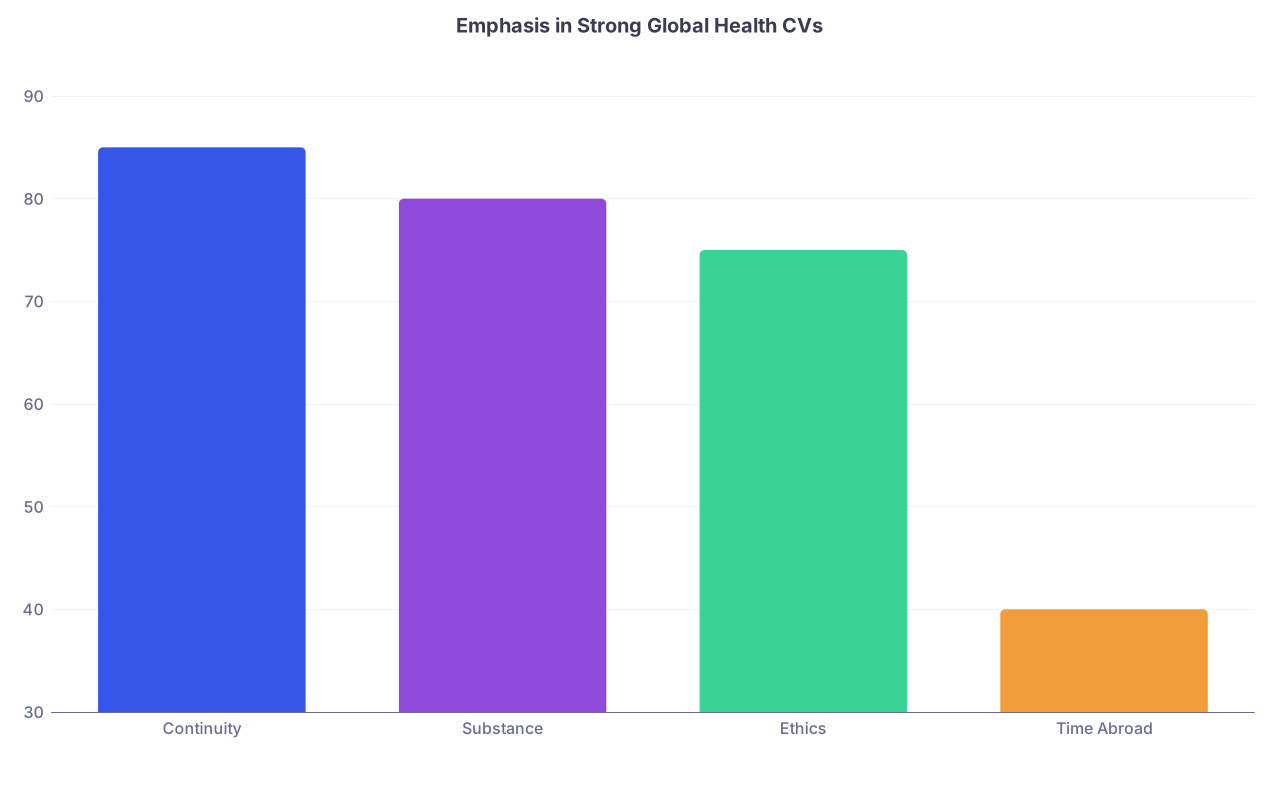
| Category | Value |
|---|---|
| Continuity | 85 |
| Substance | 80 |
| Ethics | 75 |
| Time Abroad | 40 |
Time abroad matters, but not as much as the other three. That’s how experienced reviewers subconsciously “score” you.
FAQ: Global Health CV Questions
1. Do I need international experience to be taken seriously in global health?
No. You can build a very serious global health profile entirely through work with:
- Refugees and migrants
- Indigenous communities
- Undocumented patients
- Communities facing extreme structural marginalization
If you show continuity, substance, and ethical reflection, that counts as global health. Some of the best GH folks I know had minimal early international work but deep domestic engagement in equity and systems.
2. Is a 1–2 week medical mission worth putting on my CV?
Yes, but with caveats. You should:
- List it honestly and briefly.
- Avoid overinflating your role (“provided care” when you mostly observed).
- Ideally contextualize it as a starting point, not the centerpiece of your GH story.
If that’s your only experience and you’re applying for a GH-track position, you’re underpowered. Use it as motivation to pursue something more sustained and ethical, not as your flagship.
3. How many publications do I need to be competitive in global health?
There’s no fixed number. For a student or resident, one to three global health–related abstracts or papers is plenty to signal seriousness. The key is that:
- They’re credible (not predatory journals).
- You can clearly explain your role.
- The work connects to your stated interests.
After fellowship, sure, more output matters. But early on, one strong, well-understood project is better than five papers you barely touched.
4. Will programs think I’m not committed if I only worked in one country or one site?
No. If anything, that often reads as more committed. Depth beats breadth. Seeing you grow within one partnership or theme is more convincing than hopping between multiple sites with no continuity. Just be ready to articulate how you understand transferable lessons and avoid acting like an expert on that country based on limited time.
5. How do I talk about global health ethically in interviews?
Focus on:
- What you learned about systems and structures, not only about “how grateful people were.”
- Your limitations and mistakes, and how you grew from them.
- The role of local partners and your commitment to not overshadowing them.
- How you think about sustainability, power dynamics, and benefit to the host community.
If you find yourself talking mostly about “how it changed me,” reframe. You’re centering yourself too much.
6. What’s one thing I can do this year to make my global health CV more serious?
Pick one existing global health–adjacent activity and deepen it. For example:
- Turn a short elective into a small QI project with a defined question and outcome.
- Convert a past project into a poster and submit it to a conference.
- Reconnect with a partner site and offer to help with data analysis or curriculum design remotely.
Do that before chasing a new trip. Depth this year will impress far more than another stamp in your passport.
Open your CV right now and find the global health section. Ask yourself: does this read as a scattered set of trips, or as one growing trajectory with a clear theme? Rewrite one entry today so it shows continuity, a concrete role, and a real output.


