
Transitioning from medical school to your first year of residency is one of the most intense adjustments in your medical career. The intern year compresses steep learning curves, new responsibilities, long hours, and emotional stress into a very short time. It can feel like you’ve been dropped into the middle of a storm and told to start steering the ship.
Yet amid the chaos, it is possible to create structure, build effective habits, and protect your well-being. The goal is not to engineer a perfect life but to develop realistic Internship Strategies that help you function safely, learn efficiently, and maintain some sense of yourself outside the hospital.
This guide breaks down practical approaches to building routine, protecting Work-Life Balance, and strengthening Stress Management, all while sharpening your Clinical Skills during your first year as an intern.
Understanding the Intern Year: What You’re Really Signing Up For
The first step in creating a workable routine is understanding the environment you’re operating in. The intern year is demanding not because you’re doing something wrong, but because the structure of Medical Residency is inherently intense.
Core Realities of Intern Year
As a first-year resident, you can expect:
- Rotations through multiple services (medicine, surgery, ICU, emergency, subspecialties)
- 60–80+ hour work weeks, depending on specialty and rotation
- Call shifts or nights that disrupt sleep and normal routines
- High cognitive and emotional load: orders, consults, pages, procedures, new diagnoses
- Constant evaluation by residents, attendings, nurses, and even patients
Understanding these realities helps you create strategies that are rotation-proof—flexible enough to work whether you’re on wards, nights, or clinic.
Common Challenges Interns Face
These challenges are not personal failures; they are predictable stressors that nearly every intern encounters:
- Long Hours and Fatigue
- Extended shifts and night float disrupt circadian rhythm
- Recovery time between shifts may be limited
- Emotional and Mental Stress
- Responsibility for seriously ill patients
- Fear of making mistakes
- Chronic exposure to suffering, death, and family distress
- Steep Learning Curve
- New EHR systems and hospital workflows
- Rapid on-the-job acquisition of Clinical Skills and decision-making
- Navigating hierarchy and team dynamics
- Work-Life Balance Strain
- Less time for family, friends, hobbies, sleep, and exercise
- Guilt about time away from patients and from loved ones
- Difficulty turning “doctor brain” off when you go home
Recognizing these patterns early allows you to proactively design routines that help you cope, not just react.
Building a Sustainable Core Routine in an Unpredictable World
You can’t fully control your schedule, but you can create a flexible core routine that follows you from rotation to rotation. Think of this as your “minimal viable structure”—the essential scaffolding for your days.
1. Protecting Sleep in a 24/7 Job
Sleep is your most valuable performance enhancer and mental health tool during residency. It affects clinical judgment, empathy, memory, and physical health.
Practical Sleep Strategies for Interns
- Aim for total weekly sleep, not perfection every night
- Some nights will be short. Focus on catching up on off days and lighter evenings.
- Create a pre-sleep wind-down ritual (even if it’s only 10–15 minutes)
- Examples:
- Quick shower
- Phone on Do Not Disturb (with emergency exceptions)
- Light stretching or 5–10 minutes of guided meditation
- Reading a non-medical book or listening to calming music
- Examples:
- Optimize your sleep environment
- Blackout curtains or eye mask (especially for post-call day sleep)
- White noise machine or app
- Cool room temperature
- Avoid bright screens in the 30 minutes before bed when possible
- Napping strategically
- Power naps of 20–30 minutes before night shifts or between shifts can meaningfully improve alertness
- Avoid very long naps late in the day that disrupt your next night’s sleep
- Recovering after night shifts
- After your last night shift, consider a short “bridge” nap (1–2 hours) in the morning, then stay awake until a reasonable bedtime to reset your clock
- Don’t pressure yourself to be highly productive on post-call days—recovery is the priority task
If you notice persistent insomnia, racing thoughts, or severe sleep disruption, talk with a trusted physician, resident wellness office, or mental health professional early.
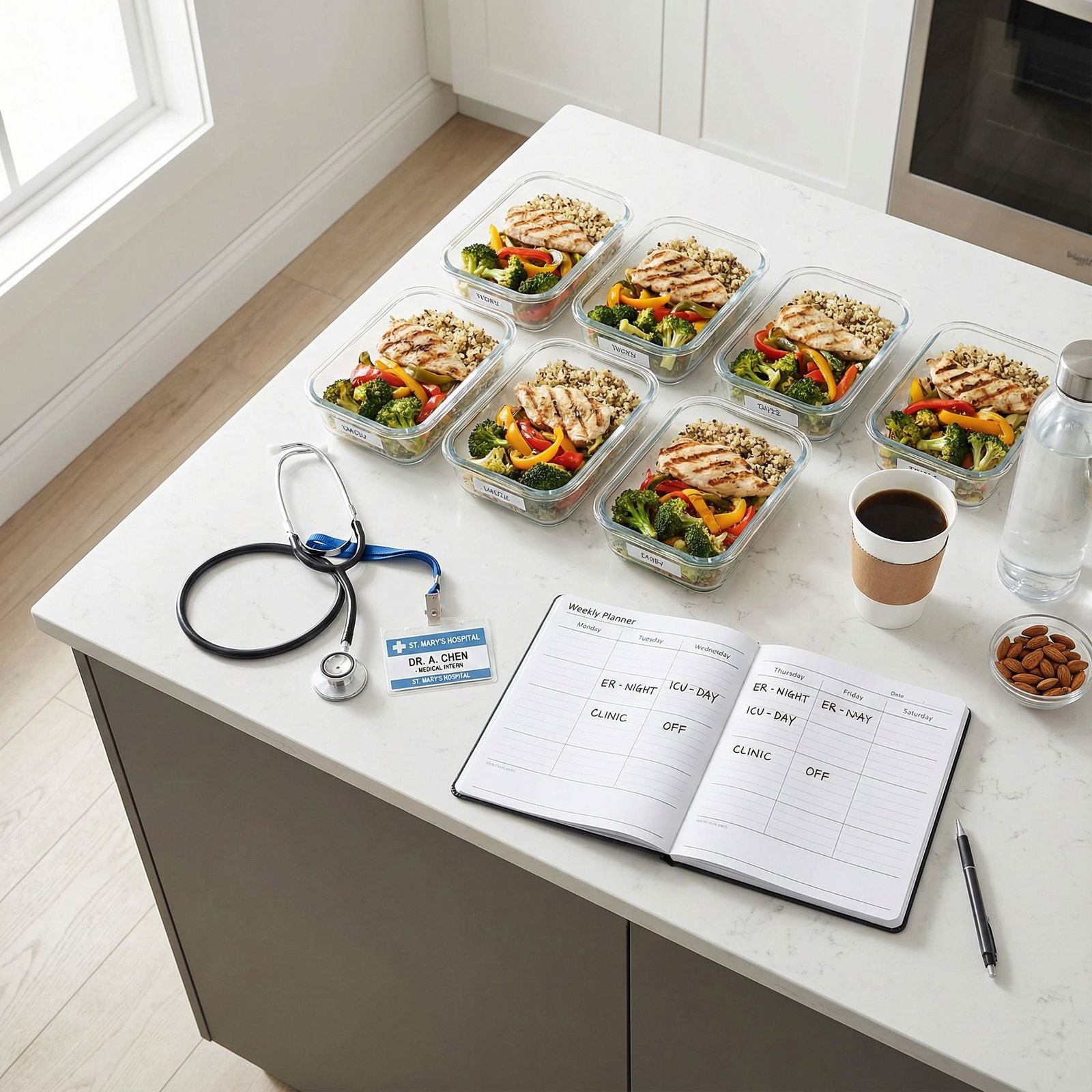
2. Nutrition and Meal Prep: Fueling Your Brain and Body
When you’re exhausted, it’s easy to default to vending machines and fast food. Over time, that can worsen fatigue, mood, and focus. Smart nutrition doesn’t need to be complicated or time-consuming.
Meal Prep for Busy Residents
- Pick one “prep window” per week
- Common choices: Sunday afternoon or your first lighter day of a rotation
- Prepare 2–3 basic meals in bulk that hold up well (e.g., grain bowls, stir-fries, roasted vegetables and protein)
- Think in building blocks, not recipes
- Proteins: grilled chicken, tofu, beans, lentils, eggs
- Complex carbs: brown rice, quinoa, whole wheat pasta, sweet potatoes
- Add-ons: pre-washed greens, frozen veggies, hummus, nuts, fruit
- Pack smart, portable options
- String cheese, yogurt, nuts, trail mix, cut fruit, baby carrots, granola bars (low in added sugar), nut butter packets
- A durable lunch bag and reusable containers can be worth the investment
- Hydration habits
- Keep a refillable water bottle on you; sip regularly between pages and tasks
- Limit reliance on high-sugar energy drinks—consider coffee/tea or water with electrolytes instead
Consistency is more important than perfection. A “good enough” packed lunch three days a week beats an idealized plan you never follow.
Staying Physically and Mentally Strong: Movement and Stress Management
You don’t need a perfect fitness plan or a one-hour daily workout to maintain your physical and emotional resilience. Small, strategic actions add up.
3. Integrating Physical Activity into an Overloaded Schedule
Exercise is one of the most powerful non-pharmacologic tools for Stress Management. It improves mood, concentration, and sleep quality.
Making Movement Realistic in Residency
- Aim for consistency, not intensity
- Target: 2–4 short sessions (15–30 minutes) per week
- On brutal rotations, even 10 minutes can be a win
- Use “micro-workouts”
- 5–10 minutes of:
- Bodyweight squats, push-ups, lunges, planks
- Short yoga or stretching sequences (there are free 10-minute videos designed for healthcare workers)
- 5–10 minutes of:
- Leverage incidental movement
- Take stairs instead of elevators when feasible
- Park a bit farther away (if safe) to add a short walk
- Walk laps on the unit while on call if you’re stuck inside
- Use your environment
- If your hospital has a gym, know where it is and when it’s quiet
- At home, keep a yoga mat and resistance bands available in a visible spot
Think of exercise as “maintenance for your nervous system” rather than another thing to achieve perfection in.
4. Mindfulness and Psychological Stress Management
Burnout in Medical Residency is common but not inevitable. Developing internal tools to manage feelings of overwhelm, self-doubt, and sadness is crucial.
Practical Mindfulness Tools for Interns
- One-minute reset between tasks
- Before entering a patient room or calling a family:
- Pause
- Take 3–5 slow, deep abdominal breaths
- Remind yourself: “One thing at a time.”
- Before entering a patient room or calling a family:
- Micro-meditation on breaks
- Use a 3–5 minute guided meditation app (e.g., Headspace, Calm, Insight Timer) during a meal break or before bed
- Journaling or “mental download”
- Spend 5–10 minutes a few nights a week writing:
- 2–3 things that went well
- 1–2 things you’d do differently next time
- Any emotions that feel “stuck”
- This supports learning and emotional processing
- Spend 5–10 minutes a few nights a week writing:
- Naming your feelings
- Labeling emotions (“I feel guilty,” “I feel scared,” “I feel overwhelmed”) can reduce their intensity and help you respond more deliberately
- Professional support is not failure
- If you notice:
- Persistent sadness or hopelessness
- Loss of interest in things you used to enjoy
- Significant anxiety, panic, or intrusive thoughts
- Thoughts of self-harm
- Reach out to your PCP, program leadership, or confidential counseling resources. Early support is a sign of insight and professionalism, not weakness.
- If you notice:
Time Management, Workflow, and Clinical Skills: Working Smarter, Not Just Harder
Routine for interns isn’t only about self-care; it’s also about making your work more organized and efficient. Better systems reduce stress and create space for learning.
5. Designing a Structured Daily Schedule (That Actually Survives the Wards)
You can’t script your entire day, but you can build anchor points around which the chaos flows.
Daily Planning for Interns
- Create a 5–10 minute planning ritual
- At the start or end of each day:
- Review tomorrow’s patient list, key tasks, and any deadlines (notes, discharges, family meetings)
- Identify your top 3 priorities (e.g., “Finish all notes by 5 pm,” “Pre-round thoroughly on new admits,” “Review sepsis guidelines tonight”)
- At the start or end of each day:
- Use digital tools intentionally
- Calendar apps for:
- Call schedules
- Deadlines for evaluations, modules, and conference presentations
- Task apps (Todoist, Notion, Trello, or a simple Notes app) to:
- Track “must-do” clinical tasks
- Keep a running study list of topics that come up on rounds
- Calendar apps for:
- Time-blocking for sanity
- On more predictable days:
- AM: Pre-rounds, notes, orders
- Midday: Rounds
- Afternoon: Follow-ups, discharges, teaching
- Evening: 20–40 minutes of reading or board review, then off-duty time
- On unpredictable days:
- Use smaller blocks (e.g., “10 minutes after rounds” to enter key notes or return calls)
- On more predictable days:
Remember: time management is a clinical safety skill. Timely notes, accurate order entry, and organized follow-up protect your patients and your license.
6. Building Clinical Skills Efficiently During Intern Year
Intern year is a prime time to build a solid foundation of Clinical Skills that you will use for the rest of your career. A deliberate approach can make your learning much more efficient.
On-the-Job Learning Strategies
- Adopt a “question capture” habit
- Carry a small notebook or use an app note titled “Things to Look Up”
- When a question arises on rounds (e.g., “Best second-line treatment for COPD exacerbation?”), jot it down
- Aim to look up 2–3 of these each evening, not all
- Structure your bedside learning
- For each new patient:
- Clarify their primary problem in one sentence
- Ask yourself: “What do I need to know to not miss something dangerous?”
- Focus your reading on:
- Initial evaluation
- High-risk red flags
- First-line management
- For each new patient:
- Use attendings and seniors intentionally
- Ask focused questions:
- “In this patient with X, what’s the one thing you absolutely don’t want to miss?”
- “What’s your mental checklist when you see Y?”
- Ask focused questions:
- Link practice to guidelines
- When time allows, skim high-yield summaries:
- Society guidelines (e.g., ACC, ATS, IDSA) or trusted review resources
- Capture 1–2 key points per condition in your notes
- When time allows, skim high-yield summaries:
Feedback as a Learning Accelerator
Feedback can feel uncomfortable, but it’s one of the most powerful accelerators of your growth.
- Ask for specific, timely feedback
- After a presentation or procedure:
- “One thing I did well and one thing I can improve?”
- After a rotation:
- “What should I focus on for my next block?”
- After a presentation or procedure:
- Normalize feedback for yourself
- Treat it as data, not judgment
- Incorporate one small change at a time (e.g., “organize my presentation by problem list,” “practice closing the loop with nurses more clearly”)
Relationships, Support Systems, and Work-Life Balance in Residency
You are not just an intern; you are also a partner, friend, sibling, parent, or simply a person who needs connection. Your relationships are not “extra”—they are protective factors against burnout.
7. Building and Using a Support System
A strong support network improves resilience, performance, and long-term satisfaction in medicine.
Peer and Professional Support
- Connect with co-interns and residents
- Attend program social events, even briefly
- Form informal “debrief” groups after difficult cases
- Share practical tips (favorite food spots, best ways to navigate specific rotations)
- Identify at least one mentor early
- This could be:
- A senior resident you respect
- An attending who seems approachable
- Ask: “Would you be open to occasional check-ins about my career development and intern year?”
- This could be:
- Know your institution’s wellness resources
- Resident support groups
- Confidential counseling services
- Wellness workshops or retreats
Maintaining Connections Outside Medicine
- Set expectations with family and friends
- Explain:
- Your schedule may be unpredictable
- You might be slow to reply, but you still care
- Ask for flexibility and understanding up front
- Explain:
- Use small, regular touchpoints
- 5-minute calls on commutes
- Weekly text check-ins (“Thinking of you; this week is hectic but I’m okay.”)
- Shared photo albums or group chats to feel present even when you can’t attend every event
- Protect at least one non-medical activity
- It can be tiny: one TV episode with your partner, a weekly walk, a few pages of a novel
- The goal is to remember you’re a human being, not just a physician-in-training
8. Embracing Flexibility and Self-Compassion
Internship Strategies work best when they are flexible and forgiving. Rigidity breaks under the pressure of residency; adaptability holds up.
Adapting to Constant Change
- Expect your schedule to shift
- Build “Plan A” and “Plan B”
- Plan A: Ideal day if things go smoothly
- Plan B: Minimum non-negotiables when everything goes sideways (e.g., “eat once, drink water, 5 minutes of quiet before bed”)
- Build “Plan A” and “Plan B”
- Redefine success
- Instead of all-or-nothing thinking:
- “I didn’t work out all week” → “I took the stairs and walked to the car; next week I’ll aim for one 15-minute session”
- “I didn’t study everything on sepsis” → “I learned three key points; that’s progress”
- Instead of all-or-nothing thinking:
- Practice self-compassion
- Intern year involves:
- Making mistakes
- Feeling inadequate at times
- Being slower than you want
- Respond to yourself as you would to a struggling colleague:
- Acknowledge the difficulty
- Affirm your intention to learn
- Identify one small next step
- Intern year involves:
The interns who thrive are not the ones who never struggle; they are the ones who adjust, ask for help, and keep going without destroying themselves in the process.

FAQs: Common Questions About Surviving and Thriving in Intern Year
How can I prevent burnout during my intern year?
Preventing burnout starts with realistic expectations and consistent small habits:
- Protect basic needs: sleep, nutrition, hydration, and some movement.
- Build a support system of peers, mentors, and people outside medicine.
- Use Stress Management tools such as brief mindfulness exercises, journaling, and scheduled downtime.
- Maintain at least one identity outside of being a physician (e.g., partner, musician, runner, parent).
- Seek professional help early if you notice persistent mood changes, anxiety, or loss of motivation.
You won’t eliminate stress, but you can prevent it from progressing to full burnout.
How can I improve my time management and stay organized on busy rotations?
- Start each day with a brief planning session to define your top 3 priorities.
- Use checklists for pre-rounding, sign-out, and daily tasks.
- Keep a running to-do list and update it throughout the day (tasks, phone calls, consults).
- Batch similar tasks (e.g., writing multiple notes back-to-back, placing all labs at once).
- Use your commute or end-of-shift time to quickly review what went well and what you could streamline tomorrow.
Remember that good time management improves patient care and reduces your stress.
What should I focus on during my first rotations as an intern?
Focus on building a strong clinical and professional foundation:
- Clinical Skills
- Taking efficient yet thorough histories and performing focused exams
- Recognizing unstable patients and escalating care appropriately
- Developing initial assessment and plan frameworks for common conditions
- Teamwork and Communication
- Clear, concise presentations
- Respectful collaboration with nurses, consultants, and ancillary staff
- Reliable follow-through on tasks
- Professional Growth
- Learning from feedback and reflecting regularly
- Identifying areas for focused improvement (e.g., notes, presentations, procedures)
Think of intern year as building your “core operating system” as a physician.
How can I maintain Work-Life Balance when my schedule feels impossible?
Perfect balance is unrealistic in Medical Residency, but you can create a sustainable rhythm:
- Accept that balance will look different month-to-month depending on your rotations.
- Protect small, regular blocks of personal time (even 20–30 minutes a day).
- Communicate proactively with loved ones about your schedule and needs.
- Learn to say “no” to non-essential extra commitments when you’re overwhelmed.
- Use lighter rotations to recharge and invest more in relationships and hobbies.
Aim for “work-life alignment” instead of a 50/50 split every day.
Where can I find peer support and community during intern year?
- Within your program:
- Co-interns and senior residents
- Chief residents and program leadership
- Formal wellness groups or residency retreats
- Outside your program:
- Specialty-specific resident groups (local or national)
- Online communities (forums, social media groups for residents and interns)
- Alumni networks from your medical school
Sharing experiences with people who understand the realities of residency can reduce isolation and normalize what you’re going through.
Your intern year is demanding, but it is also a remarkable period of growth. By developing realistic routines around sleep, nutrition, movement, Stress Management, and learning, you are not only protecting yourself—you are becoming a safer, more effective, and more compassionate physician.
You won’t get it right every day. That’s expected. Keep adjusting your Internship Strategies, maintain curiosity, ask for help, and remember: you are allowed to be both a dedicated doctor and a human being.