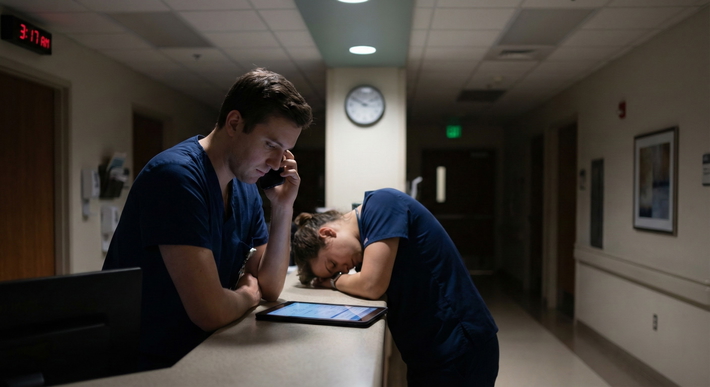
You think you're being a good doctor. You're not. You're just being a tired one doing the exact same job twice.
Every first-year intern falls into this trap. You finish morning rounds, feel the adrenaline crash, and tell yourself you'll "clean up the notes and double-check the plans" at the end of the night. It sounds responsible. It feels safe. But it's actually a massive cognitive hazard.
Let's define the difference between legitimate post-round wrap-up and end-of-night "re-work." Wrap-up is closing loops while the clinical context is fresh in your brain. Re-work is duplicating tasks, rewriting plans, and re-verifying orders hours later because you didn't finish the job the first time.
The core hazard here is simple: cognitive overload combined with documentation drift equals doubled tasks and delayed care. When you re-work at 2 a.m., you aren't being thorough. You're just exhausted, prone to errors, and actively delaying care for patients who actually need you.
Watch for the red flags. If you're writing the same note twice, changing orders without a clear new clinical rationale, or repeatedly chasing the same pending labs you already checked at noon, you've slipped into the trap. Stop.
This article is for educational purposes only. It is not financial advice, not legal advice, and not tax advice. Figures vary by individual circumstances, so consult a qualified professional before acting.
Know the Terms: Post-Rounds Wrap-Up vs End-of-Night Re-Work
You need to know exactly what you're doing and when you're doing it.
Post-round wrap-up is what the job actually requires. You finalize the plan, verify your tasks, and close loops while the attending's reasoning is still echoing in your head. You put in the orders. You write the plan. You tell the nurse. Done.
End-of-night re-work is the shadow shift you accidentally created. This looks like redoing documentation, rechecking orders from scratch, and rewriting plans because they didn't "stick" in your brain earlier. You open the chart at 6 p.m. and realize you don't remember why you ordered the Lasix, so you rewrite the assessment.
Why does this trap happen? Because you start the day with false urgency. You rush through rounds to "just get the orders in," deferring the actual thinking. Later, you pay a massive "interest fee" through rework. You spend an hour at night trying to reconstruct the logic you skipped in the morning.
The safety-first principle is non-negotiable: changes must be traceable (who/what/why), not retyped at 2 a.m. If you didn't document the rationale at 9 a.m., typing it at 9 p.m. doesn't make it safer. It just makes it redundant.
The "Doubling Tasks" Pattern: How Rework Multiplies Through Documentation Drift
Here is the exact mechanism of how you ruin your own night: incomplete handoffs lead to repeated checks, which lead to duplicated note edits.
I've watched brilliant interns crash and burn because of documentation drift. You place an order for a heparin drip, but you forget to update the plan section of your note. Now the chart says "DVT prophylaxis" while the MAR shows a therapeutic infusion. The night float resident gets confused. The nurse pages you. You spend 20 minutes fixing a problem you created by not closing the loop at noon.
Or consider clinical drift. You change a heart failure patient's plan from diuresis to fluid restriction in the middle of the day because their creatinine bumped. But your end-of-night task list still says "check I/Os and push for 2L negative." You are now working off a ghost plan.
The human factor makes this worse. Anxiety causes "redoing" instead of "confirming." You feel uneasy about a patient, so instead of just checking their vitals and confirming the current plan is holding, you rewrite the entire daily progress note to soothe your own anxiety.
Red flags are everywhere if you look for them. The same problem list grows overnight. Multiple versions of the exact same plan exist in the chart. You find yourself copy-pasting your own morning text into your evening addendum. That's not medicine. That's data entry.
Common Mistake #1: Waiting to "Fix It Later" Instead of Completing the Loop Now
Don't make the mistake of deferring. If a task affects patient care or handoff clarity, it needs closure before you leave the rounding room.
"Fix it later" is a lie you tell yourself to avoid the hard work of thinking in real-time. When you defer, you lose the context. You forget the attending's exact phrasing. You forget why you chose cefepime over piperacillin-tazobactam.
How to avoid this? Use a rigid "loop closure checklist." Every single patient needs three things verified before you move on: orders placed, pending results identified, and who acts on what.
Use practical micro-templates in your brain or on your scratch pad. One line for the follow-up plan. One line for the contingency. For example: "If K < 3.5, replete 40mEq PO and recheck in 4h." Write it once. Put it in the note. Put it in the orders. Tell the nurse. Done.
The ultimate red flag behavior is leaving rounds thinking, "someone will handle it." No one will. It's your patient. Close the loop.

Common Mistake #2: "End-of-Night Re-Work" Masquerading as Safety
Let's get one thing straight: safety is targeted verification, not blanket rework.
I hear interns justify their 7 p.m. charting binges by saying they are "just being safe." Nonsense. Rework harms patients. It steals your attention away from new, acute patient issues. It increases charting errors because you're fatigued. It creates conflicting notes when you accidentally overwrite a good morning plan with a vague evening summary.
Avoid the trap by changing your internal dialogue. Ask yourself: "What changed since I last knew this patient?" Do not ask: "What do I need to rewrite?"
If the answer to the first question is "nothing," then close the chart. Go see a sick patient. Eat dinner.
Watch for the red flags of masquerading rework. If you are making multiple chart entries with zero new clinical information, you're failing. If you are changing the wording of your assessment without actually changing the clinical decisions, you are wasting time and polluting the medical record. Stop typing.
The Guardrails: A 15-Min Post-Rounds System That Prevents Night Doubling
You need a system. Willpower fails when you're post-call.
Give yourself a realistic timebox. 15 minutes per complex patient to close loops immediately after rounds. Then stop reworking unless new data arrives.
Here are the steps.
- Scan orders vs note consistency. Did the orders you just placed actually match the plan you just typed?
- List pending labs/imaging. Write down the expected turnaround time.
- Confirm tasks assigned to the right role. Did you actually page the consult? Did you tell the nurse about the new diet?
- Communicate critical changes. Give the 1-2 vital updates to your senior or the outgoing resident.
Use "one source of truth." The plan section of your note or the active order set. Avoid writing two competing versions in the HPI and the Plan.
Set a hard rule for yourself: documentation after you leave morning rounds must be strictly event-driven. New results. A new clinical decision. A new risk. If there is no event, there is no documentation.
End-of-Night Check Without Re-Doing: What to Look For and What to Ignore
When 6 p.m. rolls around, you still have to check on your patients. But you must check them correctly.
Prioritize the things that kill people or delay discharges. Look at vitals trends. Check critical pending results. Review safety monitoring parameters (like neuro checks or bleeding risks). Look at tasks nearing strict deadlines.
What to ignore? Ignore the urge to revise plans that haven't changed. Ignore the temptation to restate the same assessment phrasing just to make the note look "full."
When you do write end-of-night updates, keep them brutally efficient. "Since last check, creatinine improved to 1.2 → plan updated to resume home lisinopril." That's it. One sentence. Actionable. Traceable.
Ensure your sign-out is crystal clear. List outstanding items, expected data, and explicit thresholds for action.
And here is the escalation rule: if you find yourself considering major plan edits at the end of the night, pull your senior resident for input. Do not improvise major changes in isolation just because you feel like you need to "do something" before you sign out.
When It's Not a Trap: Legitimate Reasons for Night Updates
Let's be fair. Sometimes it's not a trap. Real changes occur.
A critical troponin results. A patient becomes hypotensive. The ID consult finally calls back with a recommendation to switch antibiotics. These require timely, accurate documentation.
How do you avoid converting these legitimate updates into a re-work nightmare? Document only what changed and why. Align your new orders with the updated plan. Do not rewrite the entire note. Add an addendum or update the active plan section with a timestamp.
Team communication is vital here. Notify the right person promptly. Don't try to fix a deteriorating patient entirely alone just to avoid waking your senior.
Watch for red flags that you've crossed the line from a simple update into dangerous rework. If you are creating multiple conflicting plan elements, if your thresholds for action are unclear, or if you are placing orders without a documented rationale, you are flying blind. Stop and get help.
Reminder Close: Protect Your Night, One Plan, One Loop, No Duplicate Work
Protect your time. Protect your brain. Protect your patients.
The strategy is simple: complete loop closure before you leave rounds, then verify only at night. Embrace the intern-level safety mindset. Clarity beats thoroughness every single time. Traceability beats a rewrite.
Do a self-audit right now. If you are sitting at the workstation at 7 p.m. redoing your notes, ask yourself what actually changed. If nothing changed, close the laptop. Go home. Get some sleep. You have to do it all again tomorrow, and you can't afford to do it twice.

Key Takeaways
- Don't confuse safety with rework: End-of-night checks should be targeted verification of changes, not a blanket rewrite of what hasn't changed.
- Prevent doubled tasks by closing the loop right after rounds: Secure your orders, pending queue, and who-acts-when immediately, then rely strictly on event-driven night updates.