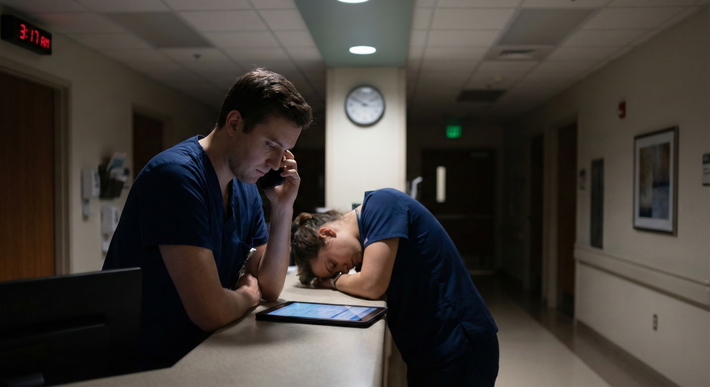
It’s 3:27 a.m. You’re on your first real overnight call as an intern. The floor is finally quiet, your pager hasn’t gone off in 25 minutes, and you’re sitting in a call room chair staring at your notes. Your eyes start burning. You tell yourself, “I’m just going to close them for 30 seconds.”
And your brain whispers the nightmare question:
What if I fall asleep?
What if someone crashes and I don’t wake up?
What if this is the moment I ruin my career?
Welcome to the club. Every sane new intern has had this fear. The fact that it scares you? That’s actually a good sign.
Let’s lay it all out: what really happens if you fall asleep on call, how dangerous it actually is, what systems are there to catch you, and what backup plans you can put in place so this doesn’t turn into your personal horror story.
First: Are You Even Allowed to Sleep on Call?
Let’s clear up one confusing thing: you’re not a security guard. You’re not expected to sit in a chair for 28 hours straight staring at a wall staying “alert.” On most call shifts, you are supposed to sleep when you can.
Most programs have something like:
| Shift Type | Expected Sleep? | Where You Sleep | Typical Length |
|---|---|---|---|
| 24+4 In-house Call | Yes, if possible | Call room | 24–28 hours |
| Night Float | Sometimes, limited | Workroom/Call room | 10–14 hours |
| ICU Call | Often minimal | Call room | 24 hours |
| ED Overnight | Usually no | N/A | 8–12 hours |
You’re allowed — and honestly expected — to rest when things are quiet. Attendings say stuff like “Try to get some sleep after midnight if it’s calm” for a reason. A completely sleep-deprived intern is dangerous.
The real fear isn’t “I might sleep.” It’s “I might sleep through something important.”
That’s the part we need to dissect.
What Actually Happens If You Fall Asleep and Miss a Page?
Let me spell out the worst-case sequence your anxiety is probably imagining:
- You fall asleep in the call room.
- A nurse pages you about a sick patient.
- You don’t wake up.
- The patient crashes.
- Everyone realizes you didn’t answer.
- You get reported.
- You’re fired, reported to the board, and your career is over.
That’s the nightmare reel.
Here’s what actually tends to happen in real life, based on what I’ve seen, heard, and watched happen to other interns:
Scenario 1: You fall asleep, miss one non-urgent page
The nurse pages again in 5–10 minutes, or calls the operator, or pages the senior. You wake up to repeated pages, feel like trash, apologize, and handle it. Worst consequence: maybe an annoyed nurse, mild embarrassment, your senior says, “You really need to keep the pager on loud.” That’s it.
Scenario 2: You miss multiple pages over a longer window
This is more serious, but there are still safety nets. The nurse escalates:
- Pages again
- Calls the charge nurse
- Calls the on-call senior or night float
- Uses a rapid response or code team if it’s serious
You might get pulled aside in the morning: “What happened? Your pager wasn’t answered for 40 minutes.” You might get written up or formally counseled. It sucks, but people do not get kicked out of residency over one rough night.
Scenario 3: Something serious happens and you’re completely unreachable
This is the one everyone is terrified of. Here’s the truth:
If a patient is actually crashing, the system does not rely on a single intern waking up to a single page for that person to survive. There are:
- Rapid response teams
- Code buttons in rooms
- Bedside monitors with alarms
- Charge nurses who have the authority to escalate without you
Do you want to miss that? Obviously no. Could it lead to a serious review of what you were doing? Yeah. But the hospital is built with the assumption that people are human and sometimes don’t pick up.
The career-ending, “you’re fired on the spot” scenario usually requires a pattern of unsafe behavior:
- Repeatedly unreachable
- Ignoring pages while scrolling your phone in the call room
- Lying about what happened
- Showing no insight afterward
Falling asleep unintentionally during a brutal call and missing one or two pages? Extremely common. Not ideal. But fixable.
The Safety Nets You Don’t Realize You Have
You feel like it’s just you and your pager between the patients and disaster. It’s not. Medicine has layers of backup specifically because they know people get exhausted.
Here’s what’s quietly protecting you while you spiral about falling asleep:
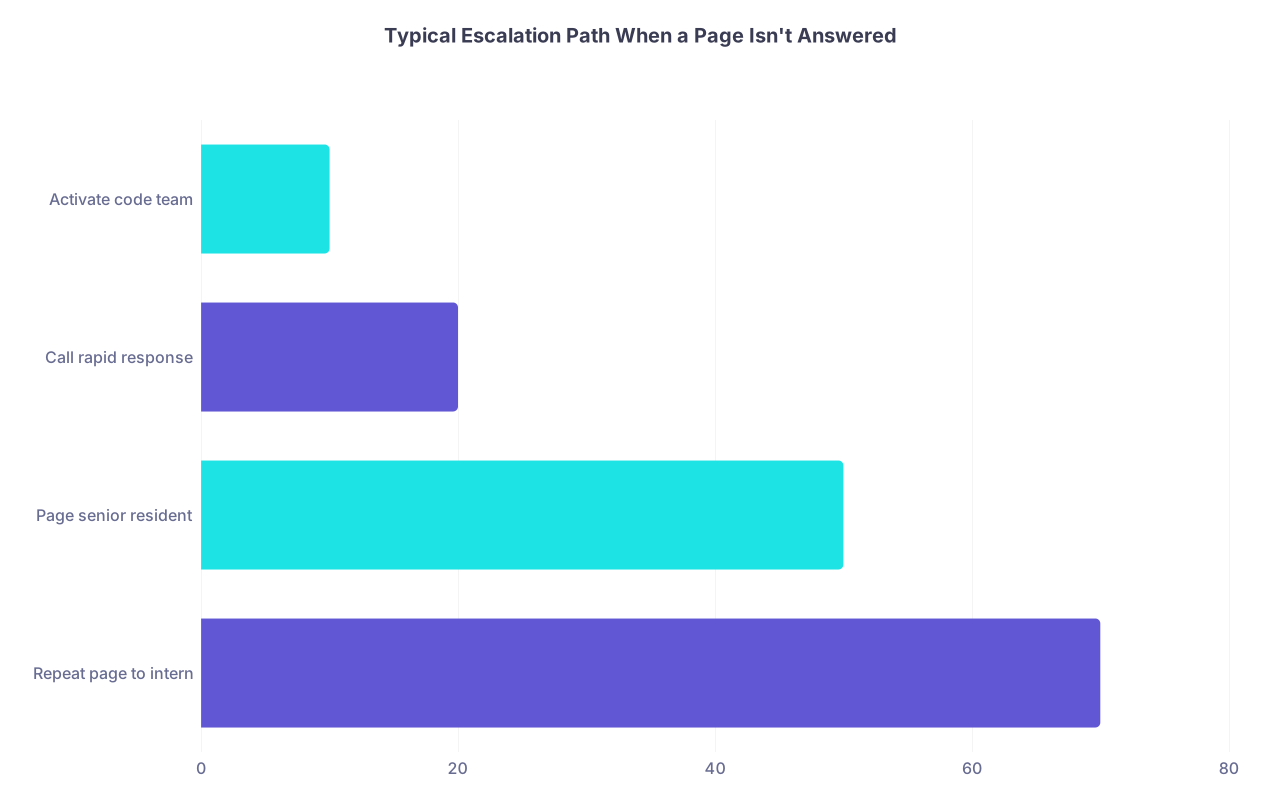
| Category | Value |
|---|---|
| Repeat page to intern | 70 |
| Page senior resident | 50 |
| Call rapid response | 20 |
| Activate code team | 10 |
Rough idea of how nurses escalate (numbers just to show relative use, not exact stats):
- Step 1: Repeat page to you
- Step 2: Page or call your senior
- Step 3: Get charge nurse involved
- Step 4: Rapid response / Code button
Notice something? You aren’t the end of the line.
Other safety nets:
- Seniors expect you to be tired. Many explicitly say, “If you’re going to crash for an hour, let me know and I’ll keep an extra eye on the boards.”
- Call rooms are usually within hearing range of overhead codes/rapid responses.
- Monitors don’t care if you’re tired. They scream at 3 a.m. just fine.
- Nursing staff are trained to escalate if they don’t get you.
I’m not sugarcoating this: if you repeatedly can’t be reached, people will talk. But isolated exhaustion on a brutal rotation isn’t you being reckless; it’s you being human in a system that knows this will happen sometimes.
How to Sleep on Call Without Completely Freaking Out
You’re going to have to sleep at some point. White-knuckling it all night, multiple nights in a row, doesn’t make you safer. It makes you stupid.
Here’s how to do rest on call in a way that respects your anxiety and limits the risk.
1. Treat sleep as part of your job, not a failure
You’re not a hero for staying awake 28 hours. You’re a future problem.
The programs that actually care about patient safety say things like, “Please sleep if things are quiet after midnight.” They’ve watched enough zombies try to write orders.
If your mindset is “I might fail by sleeping,” you’re going to crash harder and more unpredictably. Decide up front:
I’m going to take short, intentional rest breaks when safe. That’s part of doing good work.
2. Double up your wake-up systems
Do not trust just your pager in your scrub pocket while you’re horizontal.
Use redundancy:
- Pager on LOUD and on vibrate
- Put it on a hard surface near your head so the vibration is obnoxious
- Use your phone as backup: set a 20–30 minute alarm if you’re lying down “for a bit”
If the hospital has overhead code announcements that you can’t hear in the call room, that’s a problem. Ask seniors where people usually sleep so they can still hear important things.
3. Coordinate with your senior
This part feels awkward as a new intern, but it helps a ton.
Say something like:
“Hey, around 2 or 3 a.m., if things are dead, is it okay if I lay down for a bit? I’ll keep the pager by my head and set alarms, but if there’s a better time, let me know.”
A decent senior will:
- Tell you when the usual “quiet window” is
- Warn you if it’s a unit/ED where you basically never get to rest
- Sometimes even say, “You sleep now, I’ll catch up on notes; I’ll sleep later”
Now someone else knows when you might be out of the main workroom. You’re not disappearing.
The Real Risks: Where Things Actually Go Sideways
Let me be blunt. The biggest risk isn’t that you close your eyes for 20 minutes and miss one page. It’s that you push yourself so far beyond exhaustion that everything you do becomes unsafe.
Here’s where I’ve watched people get into trouble:
- Writing dangerous orders because they were half-asleep and didn’t double-check doses
- Not going to see a patient because they were “too tired” and trying to manage by phone
- Lying about what happened when they missed pages or delayed care
- Showing zero insight: “Well, I was tired, what do you expect?” instead of “I need to change something.”
Falling asleep is human. Denying responsibility afterward is what makes faculty angry.
If something happens — you miss a page, there’s a delay — the right move is:
“I fell asleep harder than I meant to. I missed your first couple of pages. I’m really sorry — I’ve changed my pager setup and will have my senior looped in tonight so this doesn’t happen again.”
Accountability + concrete fix. People are surprisingly forgiving about that.
What Happens If a Bad Outcome Does Overlap With Your Sleep?
Here’s the actual adult version of the horror story, not the anxiety TikTok version.
A patient decompensates. You were asleep and didn’t answer one or two early pages. Rapid response is called. Patient goes to ICU or worse. The case gets reviewed.
Questions they ask:
- Were there other missed signs earlier in the evening?
- Was the plan appropriate before the night?
- How quickly did the system respond once it was clear something was wrong?
- Is there a pattern with you being unreachable, or is this isolated?
- What was your call structure (were you on hour 26, covering 80 patients solo, etc.)?
Sometimes, yes, you may get formally counseled or put on some kind of improvement plan. That feels humiliating. But improvement plan ≠ career ruined.
What will tank you long-term is:
- Defensiveness instead of learning
- Zero changes in behavior after feedback
- Multiple similar events
Residency programs don’t expect perfection. They expect growth and insight. Weirdly, one bad night that scares you and pushes you to redesign your whole call routine can actually protect you later.
Concrete Backup Plans So You’re Not Flying Blind
Let’s talk about things you can actually do, not just vibes.
Pager / Alarm Setup Checklist
- Turn pager volume up to max. Check it before every night.
- Put pager in the same place every time you lie down (near your head, not buried in your blanket).
- Use your phone alarms for “power naps” — 20–30 minutes tops.
- If your pager has a light or vibration intensity setting, max it out. Be obnoxious.
Communication Habits
- Tell the nurse: “If it’s truly urgent and I somehow don’t respond, please page the senior or call rapid response — don’t wait.”
- Let your senior know if you’re on hour 23 and barely seeing straight. Not as a complaint, as a safety heads-up.
- After a near-miss, don’t disappear. Go to the floor, be visible, and own it.
Personal Rules You Can Steal
You can make your own, but here are some that work:
- No lying down until all cross-cover tasks you know about are done.
- If a nurse sounds worried on the phone, I go see the patient in person. Always.
- If I wake up groggy and see multiple missed pages, my first move is: call back and check with senior about anything they heard while I was out.
These rules keep you anchored when your brain is mush.

| Step | Description |
|---|---|
| Step 1 | All tasks up to date? |
| Step 2 | Stay in workroom |
| Step 3 | Tell senior plan to rest |
| Step 4 | Set loud pager and alarm |
| Step 5 | Lie down in call room |
| Step 6 | Answer immediately |
| Step 7 | Wake at alarm, recheck tasks |
| Step 8 | Pages quiet 15 min? |
| Step 9 | Pager goes off? |
What No One Tells You: Everyone Is Terrified Of This At First
You’re not crazy for obsessing over this. You’re not dramatic. You’re just new and you care.
Things I’ve literally heard interns say:
- “I’m scared to even close my eyes. I’m going to hurt someone.”
- “I dream that my pager is going off and then I wake up to 4 missed calls.”
- “I sat upright in a chair the whole night because I didn’t trust myself in the bed.”
These are the people who end up being careful, thoughtful residents. The ones who scare me are the “Eh, whatever, if it’s important they’ll page again” types. You are not that.
And over time, here’s what happens: you start to learn the rhythm of your hospital. You start to know which nights are predictable and which rotations are consistently ugly. You learn how tired you can be and still function, and when your brain just stops working. You adjust.
The panic you feel now doesn’t mean you’ll be reckless. It means you’re going to build systems to make sure you’re not.

Quick Reality Check: How Likely Is Career-Ending Disaster From Falling Asleep?
Brutally honest answer: very, very low — if you:
- Use multiple wake-up systems
- Own it and adjust if there’s a near-miss
- Don’t make lying or minimizing your default response
Programs kick people out for sustained unprofessionalism, repeated patient safety issues with no insight, or egregious behavior. Not for one exhausted intern who missed a page and then overcorrected her entire life in response.
Will your anxiety stop instantly after reading this? Of course not. But you can shift from “I’m doomed if I fall asleep” to “Falling asleep is inevitable; letting it happen without a plan is optional.”
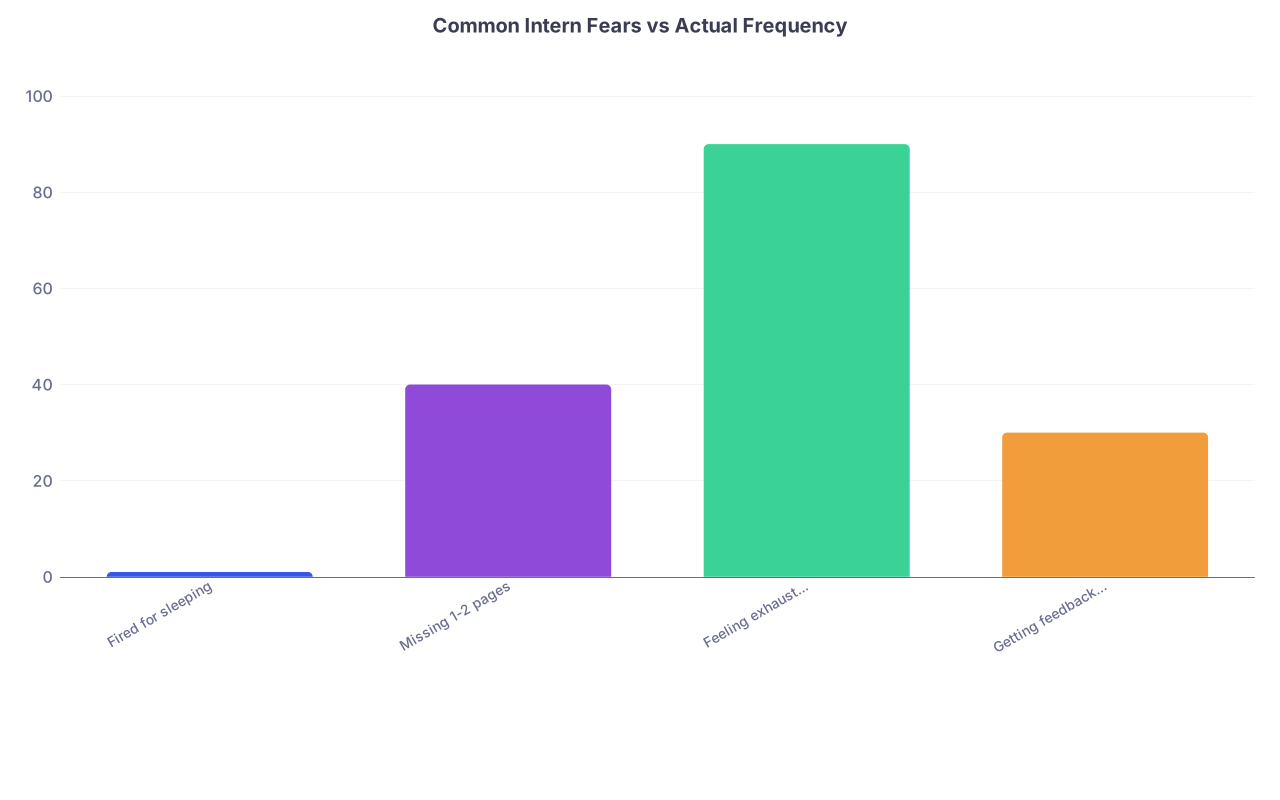
| Category | Value |
|---|---|
| Fired for sleeping | 1 |
| Missing 1-2 pages | 40 |
| Feeling exhausted on call | 90 |
| Getting feedback about pager use | 30 |
(You’ll feel exhausted almost every call early on. You’ll probably miss a page at some point. Getting fired over it? Extremely rare.)
FAQ: The 5 Questions You’re Probably Still Too Afraid to Ask
1. Could I actually get fired for falling asleep on call?
Not for simply falling asleep. You can get into big trouble if:
- You are repeatedly unreachable
- You ignore feedback
- There’s a pattern of patient harm linked to your inaccessibility
One-off “I overslept and missed a page” is usually handled with a conversation, maybe documentation, and expectations to change your behavior. If you show insight and fix your systems, this is survivable.
2. What if I literally sleep through a code for my patient?
Worst-fear scenario. If that happens:
- The code team will still come if someone pulls the alarm.
- There will be a case review — they’ll look at everything, not just you.
- Your behavior after matters a lot: honesty, reflection, and improvements.
You’ll feel awful. It might haunt you. But people have lived through really hard cases like this and gone on to be excellent physicians. It’s not automatic career death.
3. Is it safer to just not sleep at all on call?
No. That’s how you end up writing a 10x dose or missing a subtle sign of deterioration because your brain is fried. The goal isn’t “no sleep,” it’s “planned, protected small chunks of sleep with backup systems.”
Think 20–60 minute rests, strategically taken, instead of white-knuckle 24-hour marathons.
4. What do I say if a nurse or senior is mad I missed a page?
Something like:
“You’re right, I missed it. I had fallen asleep harder than I meant to and my pager setup wasn’t loud enough. I’ve already changed [X, Y, Z] so it doesn’t happen again. I’m really sorry for the delay.”
No long excuses. No defensiveness. Clear responsibility + clear fix. People respect that more than a shaky “Uh, I must’ve stepped out?”
5. How can I practice for this or prepare before internship starts?
You can’t fully simulate call, but you can:
- Start using alarms/pagers now in an obnoxious way, so you know what wakes you.
- Talk to upper-levels at your program and ask them: “What do you wish you’d done differently on call as an intern?”
- Decide your personal rules (like “always see the worried nurse’s patient in person”) ahead of time.
And honestly? Accept that you will be tired, you will mess something up at some point, and your job is to respond with maturity, not perfection.
Open your phone right now and set up a “call night” alarm system — one obnoxious sound, max volume, plus a backup vibration-only alarm. Label them “Pager backup 1” and “Pager backup 2.”
You can’t control everything that happens on call. But you can control whether you go in with zero plan or with a system that gives exhausted you a fighting chance.