
The way most interns try to time‑block their rounding schedule with multiple teams is broken.
Not inefficient. Broken. It creates near misses, angry attendings, unsafe handoffs, and the constant feeling that you are behind before 7:00 a.m. You are not “bad at time management.” You are making predictable, fixable mistakes in how you plan your time.
Let me walk you through the biggest ones before they burn you.
Mistake #1: Building a Schedule Around Best-Case Scenarios
The classic intern move: you sit down at 6:15 a.m., open your notes app, and map out a pristine morning.
- Pre-round: 6:20–7:10
- Team A rounds: 7:15–8:15
- Team B rounds: 8:20–9:15
- Finish notes: 9:20–11:00
Looks neat. Looks responsible. And it will collapse by 7:45.
You are planning as if:
- Every lab results on time
- No patient decompensates
- Each attending stays on schedule
- Transport, imaging, and consults arrive exactly as promised
That never happens. What you have actually built is a failure trap: a schedule that only works if the hospital stops behaving like a hospital.
The correct principle: Plan with friction
You must assume:
- Rounds will start late or early
- Someone will crash right in the middle of your “protected” task block
- One attending will love to talk for 12 minutes about each sodium value
- Radiology will call back when you are scrubbed, in the room, or on the elevator
Do not allocate every minute. Leave slack.
Try this instead:
- Estimate how long a block “should” take
- Add 25–50% buffer
- Make only 2–3 non‑negotiable time anchors (e.g., “Team A starts at 8 sharp, must be there”)
- Treat everything else as flexible blocks, not fixed appointments
Protect the anchors. Flex the rest. If your template cannot tolerate one rapid response or one attending going off on a tangent, it is a bad template.
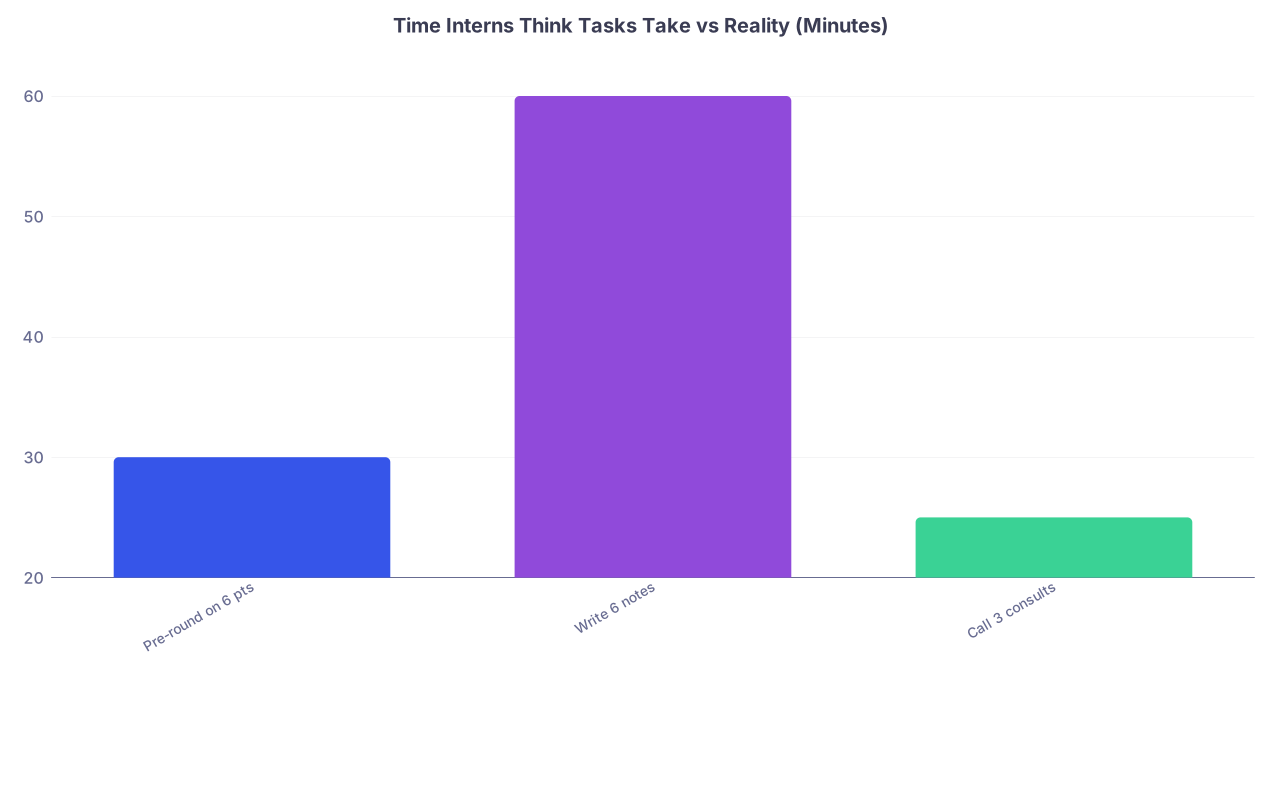
| Category | Value |
|---|---|
| Pre-round on 6 pts | 30 |
| Write 6 notes | 60 |
| Call 3 consults | 25 |
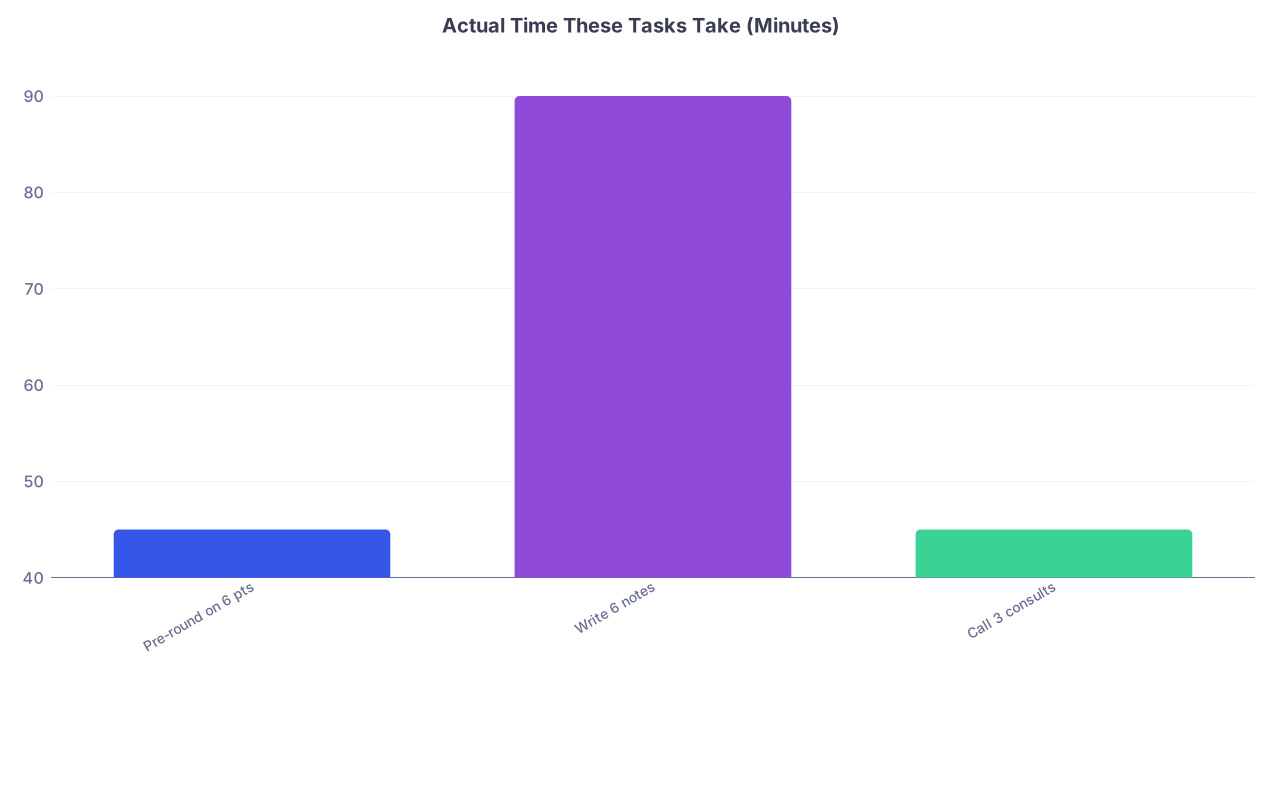
Now the reality:
| Category | Value |
|---|---|
| Pre-round on 6 pts | 45 |
| Write 6 notes | 90 |
| Call 3 consults | 45 |
That gap is why your “perfect” schedule keeps blowing up.
Mistake #2: Treating Multiple Teams Like Parallel Lines Instead of a Priority Stack
When you are cross‑covering or on a hybrid service, the trap is thinking:
“I round with Team Blue, then I round with Team Gold. Two separate things. I just have to go fast.”
No. You are one person with a single cognitive bandwidth, and both teams are pulling from the same pool.
The mistake is simple: you time‑block each team independently, as if the other group does not exist. Then:
- Both attending physicians want you at the bedside at the same time
- Both senior residents expect you to “just step out for a minute”
- You promise both you will “catch up” later
The result: you are physically present with one team and mentally panicking about what you are missing with the other. That is how details get lost and orders get delayed.
The correct principle: Declare a primary and secondary
At any given hour block, you must know:
- Which team you are primarily responsible to
- Which team you are on call for, not actively with
That means you do something most interns are too scared to do: you explicitly communicate your prioritization.
For example, before rounds even start:
“Dr. Smith, I am also covering Team Blue this morning. Your team is my primary from 7:30–9:00. If Blue rounds earlier than expected, I will step away briefly only for stat issues and catch them afterward for routine patients.”
Then do the same with the other attending, in reverse.
Most interns avoid this conversation because they are afraid it will sound like they are not committed. The opposite is true. Attendings would much rather know your reality than discover at 8:05 that their intern “slipped away” to another floor.
Mistake #3: Time-Blocking Tasks, Not Transitions
You obsess over rounding blocks and note‑writing blocks. Then you forget the hidden, time‑eating monster: transitions.
- Moving from one floor to another
- Logging into a different computer and opening the EMR views you need
- Calling the nurse, finding the nurse, then waiting for them to be free
- Grabbing a computer on wheels in a crowded hallway
I have watched interns plan “7:30–8:30 with Team A” when Team A rounds on 12th floor, and then “8:30–9:15 with Team B” when Team B starts on 3rd floor. Zero travel time built in. Guess what happens at 8:36 when you are still waiting for an elevator.
The correct principle: Time‑block movement as a real task
Whenever you’re splitting between teams, movement is part of the work, not dead space.
You need to start thinking:
- “We end on step‑down at 8:15. I need 10 minutes to get to MICU and find Team B. So my block is actually 7:30–8:05 with Team A, 8:15–9:00 with Team B.”
- “I will pre‑round geographically: hit Team Blue patients on 7th and 8th first, then Gold’s on 7th, and leave 5 minutes in between to move and reorient.”
Build this directly into your time‑blocks. Label it explicitly on your sheet or phone:
- “7:55–8:05: transit + reorient Team B”
If you do not name the transition, you will pretend it does not exist. Then you will look “late” when you are actually just walking like a normal human being in a big hospital.

Mistake #4: Blocking Time for Tasks That Do Not Deserve It
Another error: you try to “time‑block everything” because some productivity podcast told you to. So you block:
- “Check labs 6:20–6:35”
- “Update sign‑out 6:35–6:45”
- “Message social work 11:10–11:20”
This is fine when you are working for yourself on a quiet office day. It is delusional in a hospital during July of intern year when you are being paged every 4 minutes.
Certain tasks are too granular, too interruptible, or too low yield to earn their own protected blocks when you are juggling multiple teams.
The mistake here is confusing:
- Tasks you should batch and tie to a context (e.g., check labs whenever you are already in the EMR reviewing a patient)
- Tasks that truly require protected deep focus (e.g., critical note, tricky order set, calling a difficult family)
The correct principle: Reserve real time‑blocks for deep or fixed‑time work
When rounding with multiple teams, your non‑negotiable blocks are usually:
- The rounds themselves
- Pre‑rounding windows
- A couple of focused documentation windows where you can think straight
Everything else gets bundled:
- Check labs and imaging results during pre‑rounding, and then again immediately after rounds as part of your “stabilize the list” block.
- Message consults in a single batch right after rounds, not one at a time as they pop into your head.
- Update sign‑out as you finalize each note, not in some fantasy 20‑minute “sign‑out block” at 6:30 p.m. when you are already post‑call exhausted.
Cluttered micro‑blocking gives you an illusion of control and guarantees you will “fall behind” your own plan by 7:10 a.m.
Mistake #5: Not Using a Visual, Shared View of Your Morning
Rounding on multiple teams without a simple visual is like trying to fly instruments‑only on your first day as a pilot.
Many interns keep their time‑blocking in their head. Or worse, they scatter it:
- Some in their phone calendar
- Some in a paper list
- Some “I’ll just remember”
Then they wonder why, at 8:40 a.m., they cannot articulate to their senior where they are supposed to be.
You need one simple, visible artifact
I am not talking about a fancy Notion setup or 12‑color Gantt chart. You need a 4–6 line sketch of your morning that you can glance at in 3 seconds.
Something like:
- 6:15–6:45: pre‑round Blue (all), Gold (ICU only)
- 6:45–7:10: notes on sickest, check overnight events
- 7:15–8:15: Blue rounds (primary)
- 8:15–8:25: move to Gold, scan vitals/labs
- 8:25–9:15: Gold rounds (primary)
- 9:15–9:45: orders/consults for both teams, sickest first
You should be able to show this to a senior in 10 seconds and say, “Here is my plan. Where am I naïve?”
| Time | Focus | Priority Team |
|---|---|---|
| 6:15–6:45 | Pre-round, both lists | Both |
| 7:15–8:15 | Rounds | Blue |
| 8:15–8:25 | Transit + reorient | — |
| 8:25–9:15 | Rounds | Gold |
| 9:15–9:45 | Orders, sickest patients | Both |
If this is not written down somewhere (back of your sign‑out, margin of your list, small card in your pocket), you will default to reacting. Reactivity is how both teams start thinking “our intern is unreliable,” even when you are actually running the entire hospital’s scut work.
Mistake #6: Ignoring Dependency Chains (Tasks That Trigger Other People’s Work)
Time‑blocking as an intern is not just about your time. It is about how your work unlocks everyone else’s work.
Common blunder: you park key “trigger tasks” in whatever block feels convenient for you. Then:
- PT/OT cannot see the patient until your updated orders are in
- Social work cannot arrange placement until your discharge plan is written
- Pharmacy cannot verify meds until you reconcile them
- Your co‑intern cannot discharge their patient because your discharge summary is missing
On a single team this is annoying. When you are with multiple teams, it becomes chaos. You think you are “just an hour behind.” Actually, you have stalled 3 other people’s workflows on two different services.
The correct principle: Early‑day, early‑chain
Identify tasks that:
- Release another person’s work
- Affect throughput (discharge, transfer, OR, procedure timing)
Block those as early as reasonably possible, even if it costs you some personal comfort.
Examples:
- If Gold team has a likely 10 a.m. discharge to SNF that needs a detailed note for case management, you do that note in your first documentation block, not after you casually finish all your Blue notes.
- If Blue team’s patient is going to the OR at 11 and needs pre‑op stuff done, you build that into your blocks around rounds, not “whenever I get to it.”
Mark these clearly on your tiny morning map: “9:15–9:30: Gold – SNF d/c note FIRST, then Blue SICU note.”
Mistake #7: Failing to Anticipate the One Big Disruptor
There is almost always one predictable disruptor in your day:
- The attending who is never on time
- The family meeting scheduled smack in the middle of your other team’s rounds
- A daily 8 a.m. teaching conference
- The ICU transfer that always seems to happen at 7:55
Many interns behave like each day is totally random and therefore unplannable. That is wrong. Chaos exists, yes, but it has patterns. Certain disruptions repeat.
The mistake is treating these as “unavoidable surprises” you just react to each time, instead of designing your time‑blocks around them.
The correct principle: Design for the known pain point
If you know:
- Team A attending is chronically 15 minutes late starting rounds
- Team B attending is meticulously on time and hates late arrivals
You deliberately:
- Use that 7:30–7:45 “Team A is wandering toward rounds” window to quickly see 1–2 key Team B patients, or to place time‑sensitive orders for them.
- Time‑block arrival at Team B as non‑negotiable: “8:25 at bedside, no exceptions.”
If there is a teaching conference 8–8:30 three days a week, you do not pretend you can “catch up later.” You explicitly build:
- Pre‑conference micro‑rounding or chart review
- Post‑conference 20‑minute block that is only for processing what piled up during the conference

| Step | Description |
|---|---|
| Step 1 | Pre-round both teams |
| Step 2 | Team A rounds start |
| Step 3 | Pause rounds attend conference |
| Step 4 | Post conference catch-up block |
| Step 5 | Continue Team A rounds |
| Step 6 | Move to Team B |
| Step 7 | Team B rounds |
| Step 8 | Conference at 8 |
You are not trying to remove the disruptor. You are trying to contain the damage.
Mistake #8: Never Looping Back to Update Your Time-Blocks Mid-Morning
Another big one. Interns treat time‑blocking like setting a New Year’s resolution. They do it once at 6:15, then they feel guilty when reality shreds it.
By 9:30, your actual situation will almost never match your 6:15 plan. Someone codes. Someone transfers to ICU. An attending decides to “do teaching rounds at the bedside” and triples the time per patient.
Yet most interns:
- Either cling to the original plan and feel perpetually behind
- Or abandon the plan completely and free‑fall through the rest of the morning
Both are bad.
The correct principle: Micro‑replan at natural breakpoints
You need 60–90 second replanning checkpoints built in:
- After first team’s rounds
- Before you move to second team
- After second team’s rounds
At each checkpoint, answer:
- What must happen in the next 60–90 minutes for both teams?
- What can safely slide to afternoon or cross‑cover?
- What did I underestimate this morning so I can plan more realistically tomorrow?
Then you literally redraw your next few blocks. On paper. Not in your imagination.
This habit stops the classic 11 a.m. disaster: “I had four hours this morning; why am I still on my first three notes?”
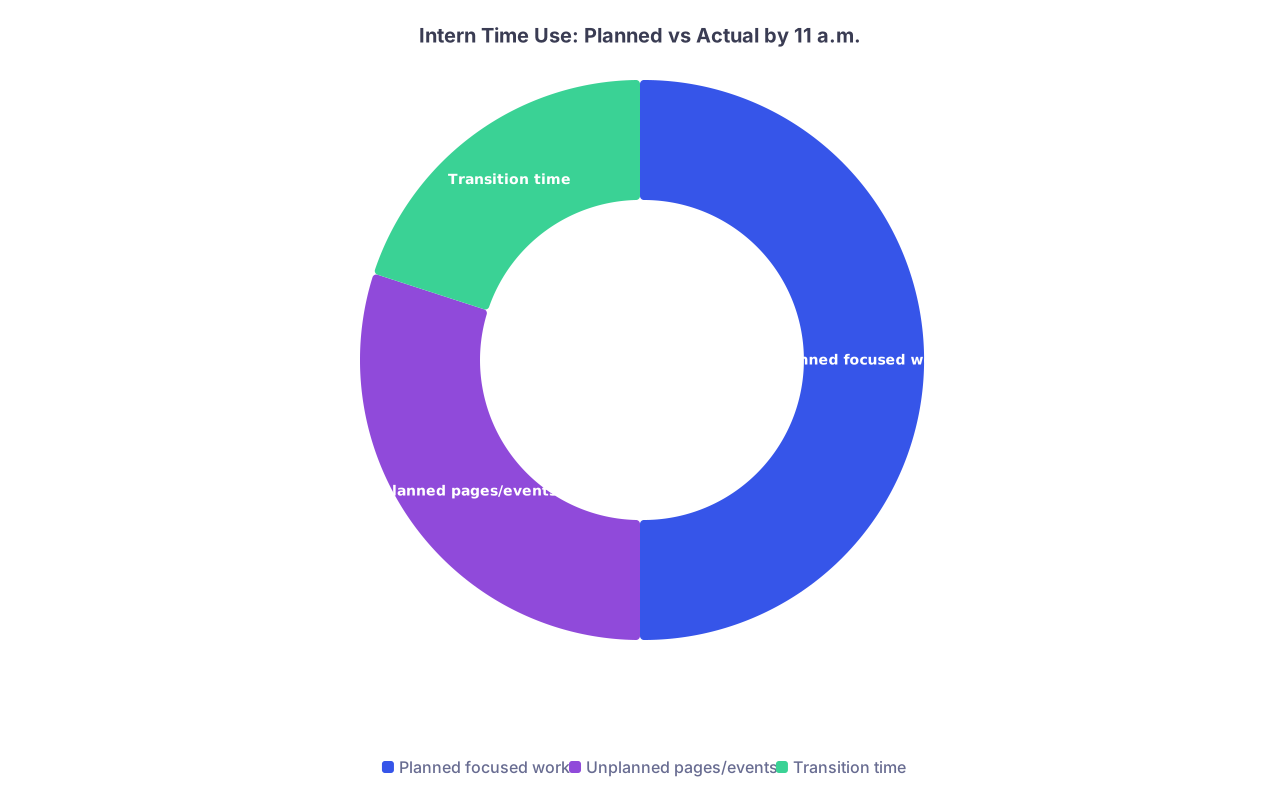
| Category | Value |
|---|---|
| Planned focused work | 50 |
| Unplanned pages/events | 30 |
| Transition time | 20 |
Mistake #9: Being Vague With Seniors and Attendings About Your Limits
The most dangerous mistake is not an EMR problem or a calendar problem. It is a communication problem.
You try to appear endlessly flexible:
- “Yeah, I can be there.”
- “I’ll figure it out.”
- “No problem, I’ll just catch back up.”
You never say, “If I do that, I will not be able to do this.” So nobody understands that they are double‑booking you across teams.
This is how you end up:
- Missing key teaching points with both attendings
- Being physically absent when a crucial plan is made about your own patient
- Having nurses escalate to chiefs because “we cannot reach the intern for Team X”
The correct principle: State tradeoffs clearly and early
You must get comfortable with sentences like:
- “If I join Gold for the whole family meeting at 8:30, I will miss the vent changes being discussed on Blue in the ICU. Which would you prefer I prioritize?”
- “If I start Blue rounds with you at 7:15, I will not have seen the post‑op patient on Gold yet. I can either pre‑round them first and join you 10 minutes into rounds, or I can come to rounds on time and accept that I will be seeing them cold. What works best for you?”
Notice: you are not whining. You are not saying “I can’t.” You are outlining consequences and asking for guidance. Good seniors will help you optimize. Bad seniors… well, at least their expectations are documented in front of witnesses.
FAQs
1. Should I use my phone calendar for time-blocking during rounds?
Use your phone sparingly. If you have a culture where attendings hate phones out, staring at Google Calendar on rounds makes you look disengaged. Better approach: rough schedule on paper (back of sign‑out, index card) and maybe a couple of alarms for hard anchors (e.g., “9:25 – go to Gold rounds”). The phone is for backup, not your primary dashboard.
2. How do I handle it when both teams absolutely insist I be at their rounds?
You push the problem upstream. Say to both seniors (or attendings if needed): “Both teams are asking me to be there at 8:15, and I cannot split myself. Can the two of you agree on where I should be first?” Forcing them to negotiate prevents you from quietly absorbing impossible expectations. Document the agreement in your own head as your primary priority block.
3. What if I am too new to estimate how long tasks take?
You guess, then you adjust aggressively. During week one, overestimate everything by 50–100%. After a few days, compare: “I thought 30 minutes for notes; it keeps taking 60.” Update your template. Ask a PGY‑2: “How long do you spend per note right now?” Their numbers are usually more realistic than your wishful thinking.
4. How do I prioritize when both teams have “sick” patients?
You rank by immediacy and reversibility. Who is more unstable right now? Who needs an urgent intervention that only you can trigger (order, call, exam)? That patient wins, even if they are on the “less important” team politically. Make sure both seniors know your reasoning: “I went to Blue first because that patient had rising pressor needs and was actively decompensating. Then I came straight to your GI bleed on Gold.” Most people respect transparent clinical prioritization.
5. Is it realistic to time-block as an intern on nights or cross-cover?
Yes, but the style shifts. Nights and cross‑cover are more reactive, so your blocks are bigger and looser: “19:00–21:00: cross‑cover checks + admissions if they come.” You still anchor known events (admission rush hours, planned transfers, scheduled OR returns), and you still replan every few hours. If you do nothing, nights will swallow you and you will feel like you “did nothing” for 12 hours except get paged, which is rarely true.
Open tomorrow’s patient list right now and sketch a 4–6 line morning plan that accounts for both teams, transitions, and one predictable disruptor. Then show it to your senior at sign‑out tonight and ask, “Where is this going to break?”