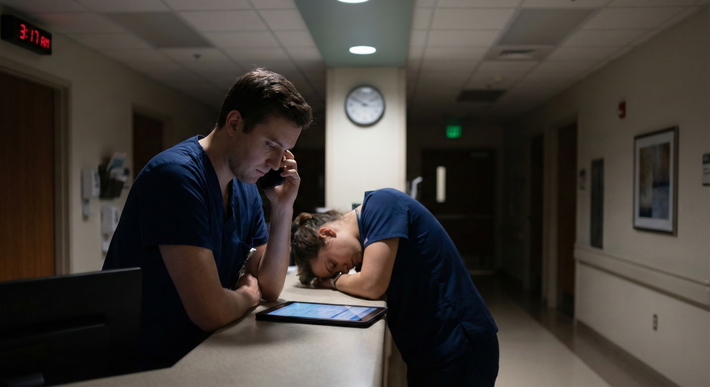
The fastest way for an intern to get a bad reputation is to mishandle weekend coverage.
Weekends expose every crack in your system. Thinner staffing. Fewer resources. Sicker patients who have already been in the hospital a few days. And you—the intern—often functionally become the front line for everything from chest pain to family updates.
I have seen sharp, hardworking interns tank their reputations in a single weekend because they made predictable, preventable mistakes. Not from lack of knowledge. From lack of preparation and judgment.
You are not going to make those same mistakes.
1. Walking Into the Weekend Blind
The most dangerous weekend mistake is simple: showing up Saturday morning without actually knowing your patients.
On paper, you are “covering cross-coverage lists.” In reality, you are taking responsibility for dozens of human beings whose names you barely recognize.
The interns who get burned:
- Skim Friday sign-out.
- Do not look at the EMR until they are physically on the unit.
- Assume “stable” means “safe.”
- Trust that the day team wrote “everything important” in one line of sign-out.
Then 3 a.m. hits. A nurse calls: “Room 842 is short of breath, pressure 86/54.” You are scrolling the chart for the first time. In crisis mode. That is how mistakes happen.
Do not do this.
What you must do before weekend coverage
The night before your weekend (or Friday afternoon if you are the weekday intern handing off):
Identify the high-risk patients
If your list is 30–60 patients, 5–10 of them are going to drive 80% of the calls. You need to KNOW who they are. Examples:- New GI bleed admitted Friday.
- DKA who just came off insulin drip.
- COPD patient weaning from BiPAP.
- Anyone with MAPs hovering in the low 60s.
- “Soft” sepsis. Still tachycardic. Still needing fluid.
Read enough to be dangerous, not perfect
You do not need to memorize every lab since admission. But you must know:- Why they are admitted.
- What could kill them tonight.
- What the plan is for the next 24–48 hours.
- Any serious pending results (CTPE, cultures, troponin trend, etc.).
Create a real safety hierarchy in your head
Decide before the shift:- Who gets seen on prerounds first.
- Who you will physically lay eyes on before noon.
- Who you would want in an ICU bed if they take a small step backward.
The worst interns walk in treating every patient as equal priority. The most dangerous patients quietly deteriorate while they spend 20 minutes adjusting bowel regimens.
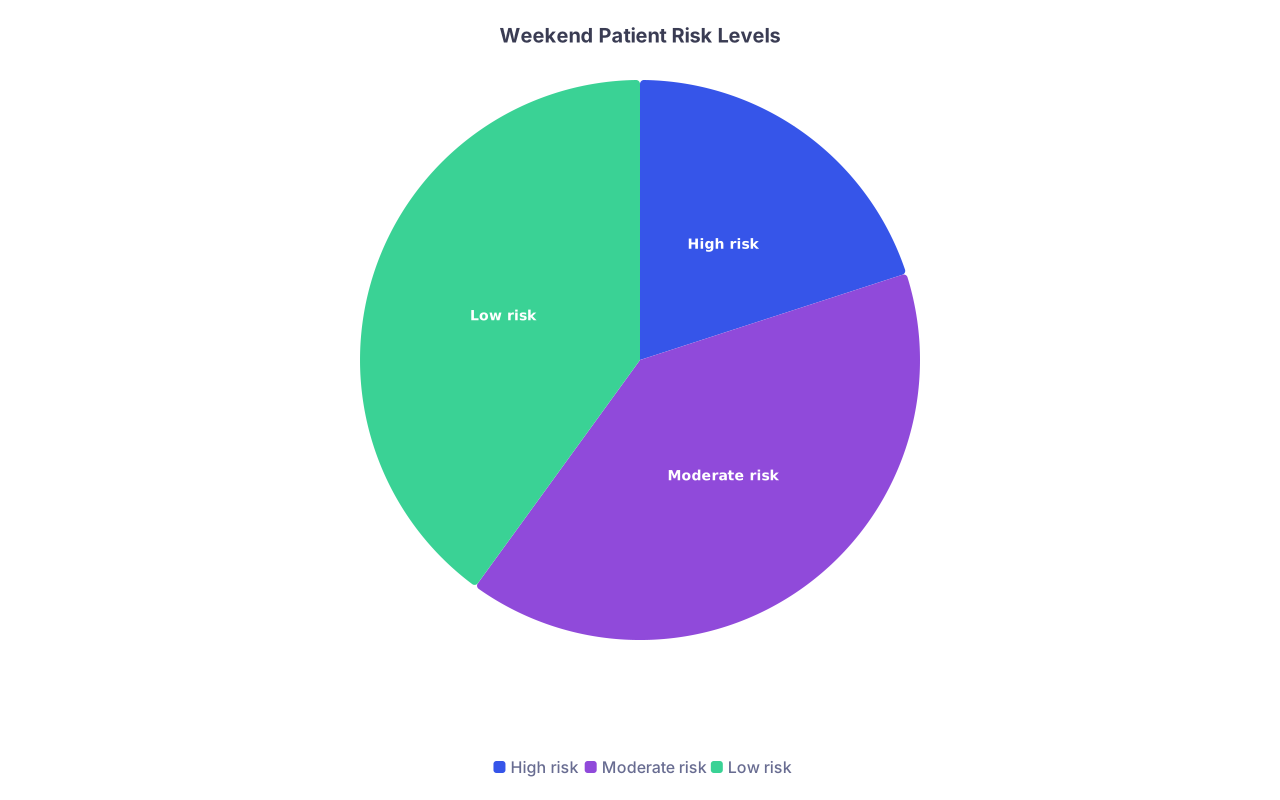
| Category | Value |
|---|---|
| High risk | 20 |
| Moderate risk | 40 |
| Low risk | 40 |
If you do not know exactly which 20% are high risk before the weekend starts, you are already behind.
2. Treating Sign-Out Like a Suggestion
Bad interns think sign-out is “extra.” Good interns treat it like a legal document and survival guide combined.
The mistakes that get people in trouble fast:
- Not reading the sign-out until the first nurse pages.
- Ignoring the “if/then” instructions from the primary team.
- Assuming the primary team will be “available by phone if anything comes up” (they usually are not).
- Failing to clarify unclear plans before the weekday team disappears.
Let me be blunt: by the time it is 10 p.m. on Saturday, you are the primary team, whether you like it or not.
What good sign-out should actually look like
Most interns think sign-out is passive: “Patient admitted with pneumonia, on ceftriaxone and azithro, improving.”
That is not helpful.
Sign-out that protects you—and the patient—sounds more like:
- “Watch for: worsening hypoxia, new fever after 48 hours on antibiotics, inability to wean from 4 L NC.”
- “If fever > 38.5 again tonight, draw cultures, lactate, blood gas, add vanc, and call the senior.”
- “If ongoing chest pain despite nitro and morphine, repeat EKG and troponin, page cardiology fellow, and call me.”
Notice the structure:
- What to watch for.
- What threshold should trigger action.
- What specific actions to take.
- Who to call.
As the weekend intern, your mistake is accepting vague, lazy sign-out like “stable, just monitor” on everyone.
You must push back on Friday:
- “What exactly are we watching for with this GI bleed?”
- “If his creatinine bumps again, what is our plan?”
- “Who is okay to go home if they are doing well on Sunday?”
If you do not fix sign-out up front, you will end up improvising at 2 a.m. with zero context. That is when bad judgments get documented forever in the chart.

| Step | Description |
|---|---|
| Step 1 | Friday Sign Out |
| Step 2 | Clarify with day team |
| Step 3 | Review chart before weekend |
| Step 4 | Identify high risk patients |
| Step 5 | Weekend coverage |
| Step 6 | Continue plan |
| Step 7 | Follow if/then + call senior |
| Step 8 | Clear if/then plans? |
| Step 9 | Acute change? |
3. Ignoring “Soft” Vital Changes Until They Are Hard Crashes
Interns do not usually get in trouble for missing a single blood pressure. They get in trouble for ignoring a dozen warnings over 8 hours.
The pattern is depressingly common:
- 4 p.m.: BP 96/58, MAP 63, HR 108. You are “aware.”
- 7 p.m.: BP 92/54, MAP 60, HR 112. “He has been like this all day.”
- 11 p.m.: BP 86/50, MAP 55, HR 120, new confusion. Now it is a code, and suddenly everyone wants to know who saw the 4 p.m. vitals and what they did about it.
If your name is in the chart with “no new orders,” you own part of that trajectory.
The mistake is thinking “not terrible yet” means “I can ignore this until it is obvious.” That is amateur thinking.
Weekend vitals that should make you act, not just acknowledge
You should be worried and do something when you see:
- Down-trending BPs: Even if technically “normal.”
- New tachycardia: Especially if persistent, not explained by pain/anxiety.
- Increasing O2 requirement: 2 → 4 → 6 L NC is not “fine” because sats are still > 92%.
- New confusion or agitation: Do not blame “sundowning” until you have ruled out real pathology.
- Repeated fevers on antibiotics: Particularly after 48+ hours of treatment.
Your job is early intervention, not heroic resuscitation after the cliff.
That means:
- Calling your senior earlier than feels comfortable.
- Ordering a small fluid bolus and watching response.
- Asking for a repeat lactate.
- Getting a chest x-ray before the patient is maxed on oxygen.
- Moving someone to a higher level of care before they meet ICU criteria.
The interns who get “talked about” on Monday are the ones whose name keeps showing up in the chart at the 4 p.m. borderline vitals, the 7 p.m. borderline vitals, and the midnight full crash.
4. Overcorrecting: Panicking and Ordering Everything
There is an opposite mistake that will also get you in trouble: panicking and shotgun-ordering everything on every call.
The worst weekend pages almost always involve one of two intern types:
- The Denier: Ignores or downplays everything.
- The Shotgunner: For every page, orders:
- CBC
- CMP
- Lactate
- Blood cultures
- Chest x-ray
- EKG
- Troponin
and paging three different consultants “just in case.”
By Sunday morning, the attending is looking at 40 unnecessary tests, 12 pages from night consult teams, and a bunch of confused families. Your name is all over it.
The problem is not that you cared. The problem is you showed you cannot discriminate urgency or think clearly.
Build simple internal rules instead of panicking
You are covering too many patients to reinvent the wheel each time. Use mental rules of thumb:
Chest pain
- Always: Vitals, quick bedside assessment, EKG.
- Labs (troponin, BMP, CBC) if:
- Not clearly reproducible musculoskeletal pain, or
- High-risk history (CAD, CKD, known cardiomyopathy).
Shortness of breath
- Always: Vitals, pulse ox, listen to lungs, quick exam.
- CXR if:
- New O2 requirement.
- New crackles/wheezes.
- Concern for pneumonia, edema, effusion.
Fever on antibiotics
- Usually: Blood cultures, lactate, repeat CBC, consider additional imaging based on source.
- But do NOT automatically broaden antibiotics on your own at 2 a.m. without:
- Talking to your senior, or
- Checking the existing culture data.
You do not need perfection. You need a rational, defensible thought process documented in the chart.
Write what you were worried about and why you did or did not escalate. The worst note is no note, followed by “patient stable” with no evidence you actually examined them.
5. Being Unreachable or Disorganized with Pages
Another career-limiting move: being the intern that no one can find on weekends.
I have watched charge nurses roll their eyes and say, “Do not bother paging that intern, they never answer. Go straight to the senior.”
That is how you lose trust.
Here is how interns sabotage themselves:
- Leaving the pager at the workstation.
- Ignoring pages while “just finishing this note.”
- Answering pages but not writing down the room number or issue, then forgetting halfway to the unit.
- Taking verbal sign-outs or updates with zero notes and later swearing “no one told me that.”
Systems that keep you out of trouble
You need boring, unglamorous systems:
One capture tool
Small pocket notebook, folded paper, or a single running note in the EMR. But one place only. Every page:- Time
- Room
- Issue
- Plan (once decided)
- Check mark when done
Callback discipline
If you miss a page:- Call back ASAP.
- Start with: “This is the intern. I saw your page about room X regarding Y. Can you update me?”
Do NOT pretend you already know what is going on if you do not. People can tell.
Prioritization on the list
As you get pages, mark the truly urgent ones:- New chest pain, acute SOB, hypotension, altered mental status → top of the list.
- Sleep meds, bowel regimen, mild pain control adjustments → lower.
The mistake is treating every page the same or handling them in random order. That is how a hypotensive patient waits 40 minutes while you enter stool softener orders.

6. Failing to Use Your Senior (Or Calling Them for the Wrong Things)
There are two weekend archetypes that seniors complain about constantly:
- The intern who never calls.
- The intern who calls for everything.
Both will harm your reputation.
Under-calling: Trying to be a hero
This is how you end up in serious trouble:
- You manage borderline sepsis yourself for 8 hours without telling anyone.
- You “keep an eye on” a GI bleed all night without trending labs or alerting the senior.
- You answer family questions about prognosis and goals of care without looping in the attending or senior.
Seniors would much rather you call them earlier in the decline than after a code has already been called.
Good rule: if you are hesitating more than 10–15 seconds about “should I call?”, just call.
Over-calling: Outsourcing every thought
On the flip side, if you call your senior for:
- Routine home med reconciliation.
- Whether to order a single dose of Tylenol.
- Every mild electrolyte abnormality.
- Every lab result that was expected (“we knew potassium would still be 3.3”)—
they will stop trusting you as a future colleague.
Your goal: call early on big problems, handle the small things yourself, and show your thinking when you call.
A good call sounds like:
“Hey, this is the intern on floor 6. Room 624 is our 68-year-old with pneumonia and CHF. She has been on 3 L NC, but over the last 4 hours has gone from 3 to 6 L with sats hovering at 90–92%. BP is stable, HR 105, RR 26, mildly increased work of breathing. I already:
- Checked for wheezing/crackles.
- Ordered CXR and repeat labs.
- Gave a small IV Lasix dose since she looks more volume overloaded. I am worried she might be failing the floor. Can you come see her with me and help decide if she needs stepdown/ICU?”
This shows:
- You know the patient.
- You have done an initial assessment.
- You have a hypothesis and some actions already underway.
- You know what you want from the senior.
That is how you earn trust while still asking for help.
7. Letting Discharges or “Stable” Patients Blow Up
Weekends are famous for one particular disaster: the “easy discharge” that is anything but.
Monday conversations often start with:
- “Why was this person still here on Sunday if they were this sick?”
- “Who cleared this discharge?”
- “Why did no one check X before sending them home?”
Your mistakes here fall into two patterns.
Mistake A: Rubber-stamping weekday discharge plans
Friday afternoon note: “Plan for discharge tomorrow if stable.”
You on Saturday: see the discharge summary in progress, patient says they “feel okay,” nursing eager to clear a bed. You print scripts and send them out.
Then:
- Their creatinine is 0.8 → 1.4 on the morning labs that you never checked.
- They are going home on new insulin without teaching.
- No follow-up arranged.
- Or they bounce back Sunday night, septic, with the same problem.
Never treat “probable discharge” as a guarantee. At minimum before a weekend discharge, confirm:
- No new overnight vitals/oxygen issues.
- No acute lab changes that are unexplained.
- New meds are actually feasible at home (anticoagulation, insulin, home O2).
- Follow-up and prescriptions are in place and understandable.
Mistake B: Forgetting that “stable” patients can decompensate
There is a dangerous mental shortcut on weekends: “Long LOS + no recent drama = safe.”
Patients who have been in for 7–10 days can still have strokes, MIs, delirium, new infections. The error is not screening them at all.
You do not need to re-work up every long-stay patient daily. But you should:
- Physically see them if they are on your list for the first time.
- Ask the nurse, “Anyone on this list you are worried about? Eating? Moving? More confused?”
- Check at least the last 24 hours of vitals and nursing notes.
Nurses will often tell you what the list will not: “He has been different since last night” or “She is just…off.” That sentence has saved more weekends than most interns realize.

8. Sloppy Documentation That Makes You Look Worse Than You Were
You can do 90% of the right things clinically and still get wrecked on Monday if your documentation is garbage.
What attendings see on Monday:
- The overnight cross-cover note.
- Your orders.
- The timeline of vitals, labs, and interventions.
If that record suggests you were passive, confused, or absent, that is all they need to form an opinion.
Common documentation mistakes:
- “Patient stable” with no exam, no vitals, no thought process.
- No note after significant events (rapid response, acute change, big intervention).
- Orders placed without reference in a note (e.g., stat CT head, no associated progress/update note).
- Critical conversations with family undocumented.
Better pattern:
- For any real event (rapid, big desat, hypotension episode, major change in exam), write a brief, time-stamped note:
- What triggered your involvement.
- Your exam findings.
- Differential or main concern.
- What you did.
- Who you discussed with (senior, attending, consultants).
It can be 5–7 sentences. But it should be clear that you saw the patient and thought about the situation.
| Situation | Weak Note | Strong Note (Concise) |
|---|---|---|
| Hypotension | "BP low, fluids ordered." | "23:40 – Called for SBP 82/50, MAP 58 in 64 y/o with sepsis. Pt awake, oriented, cool extremities, HR 112, on 2 L NC, lungs clear. Concern for under-resuscitation vs early shock. Gave 1 L LR bolus, repeated BP 15 min later 94/56, MAP 65. Discussed with senior; plan to trend vitals q1h and lactate with AM labs." |
| New fever | "Febrile, labs ordered." | "02:10 – New temp 38.9 in 72 y/o with pneumonia day 3 on ceftriaxone. HR 104, BP 118/64, sats 93% on 3 L NC. No new focal symptoms. Drew blood cultures x2, CBC, BMP, lactate. Ordered repeat CXR. No change to antibiotics pending results. Will sign out to day team to reassess for possible escalation of coverage." |
Who looks safer to you?
9. Burning Yourself Out on the First Weekend
One last mistake that quietly wrecks interns: trying to “prove yourself” by doing everything personally and never taking 5 minutes to reset.
Weekends are marathons, not sprints. If you spend the first 6 hours:
- Never sitting down.
- Never eating or hydrating.
- Keeping 20 unresolved tasks in your head.
Then by 2 a.m. your brain is mush. That is when:
- You transpose orders.
- Miss subtle vital trends.
- Forget to call the senior.
- Say something regrettable to a nurse or family member.
Taking short, controlled breaks is not laziness. It is risk management.
Simple rules that keep you functioning:
- Every 3–4 hours, take 5 minutes to:
- Sit.
- Drink water.
- Look at your running task list and reprioritize.
- Keep at least 1 quick snack in your pocket or work bag.
- When you feel your focus slipping, do not just keep running faster. Stop for 60 seconds, re-center, then tackle the highest-risk task first.

You are not impressive if you run yourself into the ground and start making dangerous errors. You are replaceable.
You are valuable when you are calm, organized, reachable, and predictable.
The Bottom Line: How Not to Be “That Intern” After a Weekend
If you want to avoid being the intern everyone is complaining about on Monday morning, remember three things:
Go into the weekend with a real plan.
Know your high-risk patients, demand usable sign-out, and build mental “if/then” rules for common issues. Do not show up blind and hope it will be fine.Act early on soft changes, and document your thinking.
Do not ignore down-trending vitals or confusing symptoms. See the patient, do a focused exam, take a reasonable step, and write a short note explaining what you did and why.Use your senior wisely and stay findable.
Answer your pager, keep a tight system for pages and tasks, and call your senior early for real problems—but only after you have thought it through and done the basics.
You cannot control how chaotic the weekend is. You can absolutely control whether your decisions look careless or careful when someone reads the chart on Monday.