
The way most interns handle workload is not “being a team player.” It is a straight-line path to burnout.
You do not burn out because residency is hard. You burn out because you adopt a set of predictable, fixable workload habits that grind you down month after month. I have watched smart, capable interns get crushed not by the sickest patient on the floor, but by their own patterns:
- Saying yes to everything
- Staying late “just to help”
- Being permanently available on their phone
- Never drawing lines around their time
This is preventable. Not with bubble baths and “self-care,” but with ruthless workload discipline.
Below are 10 specific workload habits that reliably push interns toward burnout—and exactly how to avoid making those same mistakes.
1. Saying “Yes” To Everything To Look Like A Hard Worker
This is the classic intern trap: you confuse “being helpful” with “being available for unlimited exploitation.”
What it looks like in real life:
- You pick up extra admissions after sign-out “because the senior looks stressed.”
- You agree to call every family because “I do not want to seem difficult.”
- You take on tasks that belong to night float because “I am already here.”
Short term, you look like a hero. Long term, you train everyone around you to expect an infinite workload from you. And they will take it.
Red flags you are in this trap:
- Your name is on every “Can someone do X?” request.
- You feel irrational guilt when you say no, even for good reasons.
- Other interns finish close to on time. You never do.
How to avoid this mistake:
Create a default answer:
When asked to pick up another task, say:
“Let me finish stabilizing my current patients, then I can help if I still have capacity.”
This buys you time and forces you to triage your own workload.Learn the magic phrase:
“I can do A or B safely, but not both right now. Which is higher priority?”
Make the senior own the decision. That is their job.Track your invisible work:
Start a simple note on your phone or paper list: calls made, extra tasks, favors.
This is for you, not to brag. When you see it, you will recognize when you are doing the work of 1.5 interns and can deliberately pull back.
Do not be the intern who mistakes overextension for professionalism. The system will not thank you. It will just keep taking.
2. Staying Late Every Day “To Finish Everything Perfectly”
You will feel this temptation in the first week. You are slower, notes take forever, orders feel stressful. So you stay an extra hour. Then two. Then three.
Suddenly, your “normal” day is 14 hours. That is not dedication. That is unsustainable.
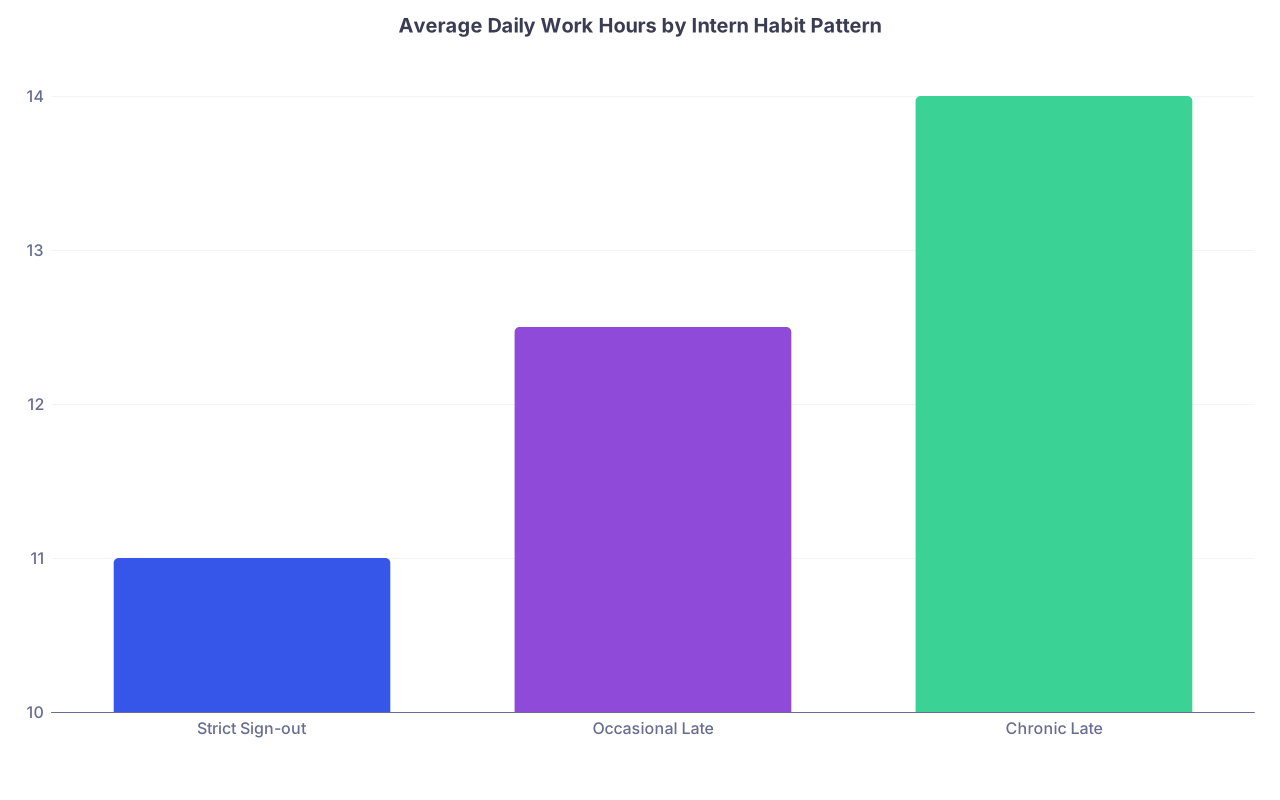
| Category | Value |
|---|---|
| Strict Sign-out | 11 |
| Occasional Late | 12.5 |
| Chronic Late | 14 |
Why this habit is so dangerous:
- You never learn to prioritize because you buy more time with your life.
- You normalize being the last one out. Others stop noticing or caring.
- You burn cognitive fuel when your brain is already fried, increasing errors.
I have seen interns proudly say, “I usually leave around 8:30–9.” On a 7 am start. They call it “caring.” I call it playing chicken with their own nervous system.
How to avoid this mistake:
- Set a “true hard stop” time in your head for most days (for example, 6:30 pm on a 7–5 shift). You will not always hit it, but you aim for it.
- Cut your notes, not your care. Short, accurate, problem-based notes beat essays written at 8:45 pm. Learn smart templates. Stop writing novels.
- Use the 3:00 pm check: At 3 pm, ask yourself: “What absolutely must be done before sign-out? What can safely be passed to night float?” If you are starting a new, low-yield task at 5 pm, you are setting yourself up to stay late.
There will be real late days. Codes. Crashes. Chaos. Do not turn every day into that.
3. Doing Work For Other Roles Because “It Is Faster If I Just Do It”
You will hear this all the time:
“I will just draw the labs myself.”
“I will just call transport.”
“I will just hang the blood.”
Sometimes that is appropriate in a pinch. The problem is when it becomes your default way of coping with a broken system.
What this habit does to you:
- You lose hours a week to tasks that are not physician work.
- You never learn how to escalate appropriately when the system fails.
- You train staff to expect you to “fix it yourself” instead of problem-solving together.
Example scenario:
- You: “I put in the stat EKG an hour ago.”
- Nurse: “Transport is slammed.”
- You: “I’ll just go get the machine and do it myself.”
Fine once. Not fine every other day.
How to avoid this mistake:
Use proper escalation chains:
- 1st: Re-communicate clearly (“This is time-sensitive because X. Can we do Y?”).
- 2nd: Charge nurse / unit lead.
- 3rd: Your senior if there is no movement.
Reserve “I’ll just do it” for real time-critical events where escalation will be slower than you walking in yourself (e.g., you are worried about a stroke).
Keep a mental rule: if you find yourself routinely doing X (phlebotomy, transport, EKGs) multiple times per week, something is broken. Talk to your chief, PD, or unit leadership. Quiet suffering does not fix system issues.
Being “helpful” is not the same as being a one-person fix-it service.
4. Never Protecting Any Uninterrupted Focus Time
Most interns work their entire day in reaction mode: pages, texts, calls, walking into rooms, then back to the computer, then back to the room.
Result:
- Notes take 45 minutes each instead of 12.
- You forget half of what you planned to do.
- You stay late finishing documentation that could have been done at 10 am.
The mistake: You treat every minute as equally interruptible.
How to avoid it: Create at least two protected focus blocks on typical days.
Example structure:
Block 1 (9:30–10:15 am):
- Sit down.
- Update notes on the sickest 3–4 patients.
- Put in backlog orders while the morning details are still fresh.
Block 2 (1:00–1:45 pm):
- Finish remaining priority notes.
- Clean up orders, flags, messages.
You will still get interrupted. That is fine. The point is you deliberately regroup and re-enter that block instead of permanently ping-ponging all day.
Basic rules:
- During a focus block, you:
- Answer critical pages (vitals, new symptoms, floor emergencies).
- Defer non-urgent calls (“I can call them back in 20–30 minutes.”).
- You do not:
- Chat at the desk.
- Scroll.
- Start low-yield chart archaeology.
If you never protect chunks of focus, the day will eat you.
5. Letting Your Phone Own You
Some interns act like being reachable within 10 seconds at all times is a moral duty. It is not.
What constant phone responsiveness does:
- Shatters your concentration every 3 minutes.
- Turns you into a reflex machine instead of a thinking physician.
- Increases anxiety because you never know when the next ping is coming.

Common mistakes:
- Leaving sound + vibration on max and reacting instantly.
- Joining every group chat and reading every message in real time.
- Answering routine questions from staff that could wait until you are back on the unit.
Better habits:
Simplify alerts:
- Distinct tone for genuine pages.
- Mute non-critical group chats during rounds and focus blocks.
Use “batch responses” for low-urgency issues:
- Glance at messages every 15–20 minutes. Respond in a cluster.
- If someone needs a real-time conversation, ask them to page.
Clarify expectations with your team:
Say on day 1:
“If it is urgent (hemodynamics, breathing, acute change), page me. For routine FYIs, secure chat is perfect and I’ll respond as soon as I can.”
Your nervous system is not designed to be on-call to eight channels of communication at once. Do not make that your baseline.
6. Overcomplicating Notes And Tasks To Look “Thorough”
Interns often believe thoroughness equals length. It does not.
I have seen progress notes so long that nobody reads them. Pages of copied text, labs pasted three times, consultants’ assessments buried somewhere in the middle.
Why this burns you out:
- Documentation time explodes.
- You feel like you “never have time” because you bury it in unnecessary work.
- You still get questioned on things you thought you “documented” because no one can find them in the mess.
Practical fixes:
Use a problem-based structure:
- Brief one-line summary.
- Bullet problems: each with assessment and concrete plan.
- Labs and vitals only as they relate to current decisions.
Stop copy-pasting entire prior notes.
Update. Prune. Shorten. If you rarely delete anything, you are doing it wrong.Time-box your notes:
Tell yourself: “Routine progress note in 10–15 minutes max.”
If it is taking 40 minutes, something about your template or process is broken.
Same with tasks. If you spend 20 minutes organizing your to-do list instead of doing the top three things, you are over-optimizing the wrong part.
7. Treating Every Task As Stat
Not everything is emergent. But many interns act like it is.
So they:
- Drop note-writing mid-sentence to respond to every “Can you call the family?”
- Run back to the unit for every routine lab value or diet question.
- Let anyone else’s sense of urgency override their own priorities.
Result: chronic adrenaline. Zero control over your day.

| Step | Description |
|---|---|
| Step 1 | Incoming Task |
| Step 2 | Do immediately |
| Step 3 | Schedule soon |
| Step 4 | Batch for later |
| Step 5 | Life or limb risk now |
| Step 6 | Time sensitive today |
How to avoid this: Run a fast mental triage on every new ask:
- Life/limb? Acute change in vitals, mental status, chest pain, stroke, sepsis concerns → drop what you are doing. Go.
- Time-sensitive today? Family conference, discharge step, urgent imaging form → schedule into your next free 15–30 minute block.
- Non-urgent? “Can you update the problem list?” irrelevant admin messages, med list clarifications that can wait → batch for later.
Training your brain to recognize what is truly urgent is a core residency skill. If everything feels urgent, you will burn out purely from the constant internal alarm.
8. Never Asking For Help Until You Are Already Drowning
The silent intern is not brave. The silent intern is unsafe.
I have seen interns delay asking for help because:
- They do not want to “bother” the senior at night.
- They think they “should be able to handle” 12 patients alone.
- They are afraid of looking stupid when they are behind on notes.
Then around 6 pm, it all blows up—sick patient, late discharges, incomplete orders, no sign-out written.
Better pattern: early escalation.
Signs you need to loop in your senior now, not at 7 pm:
- By noon, you are more than 2–3 patients behind on seeing and pre-charting.
- You have a patient making you uneasy and you cannot clearly articulate why.
- Your pager is blowing up and you have not written a single note by early afternoon.
What to say:
- “I am running behind. I have seen 6/10, and 2 are complex. Can you help me prioritize or redistribute?”
- “This patient is worrying me because X. I do not see a clear plan B if they worsen.”
Good seniors would rather adjust the workload at 11 am than discover at 6 pm that you are three hours behind and panicking.
You are not weak for asking. You are doing your job.
9. Sacrificing All Recovery Time “Just For This Rotation”
The lie sounds like this: “It is just this month on ICU. I can push through.”
But then it is:
ICU → Nights → Busy floor month → ED → Interview season → Holidays on call.
There is always another “just this rotation.”
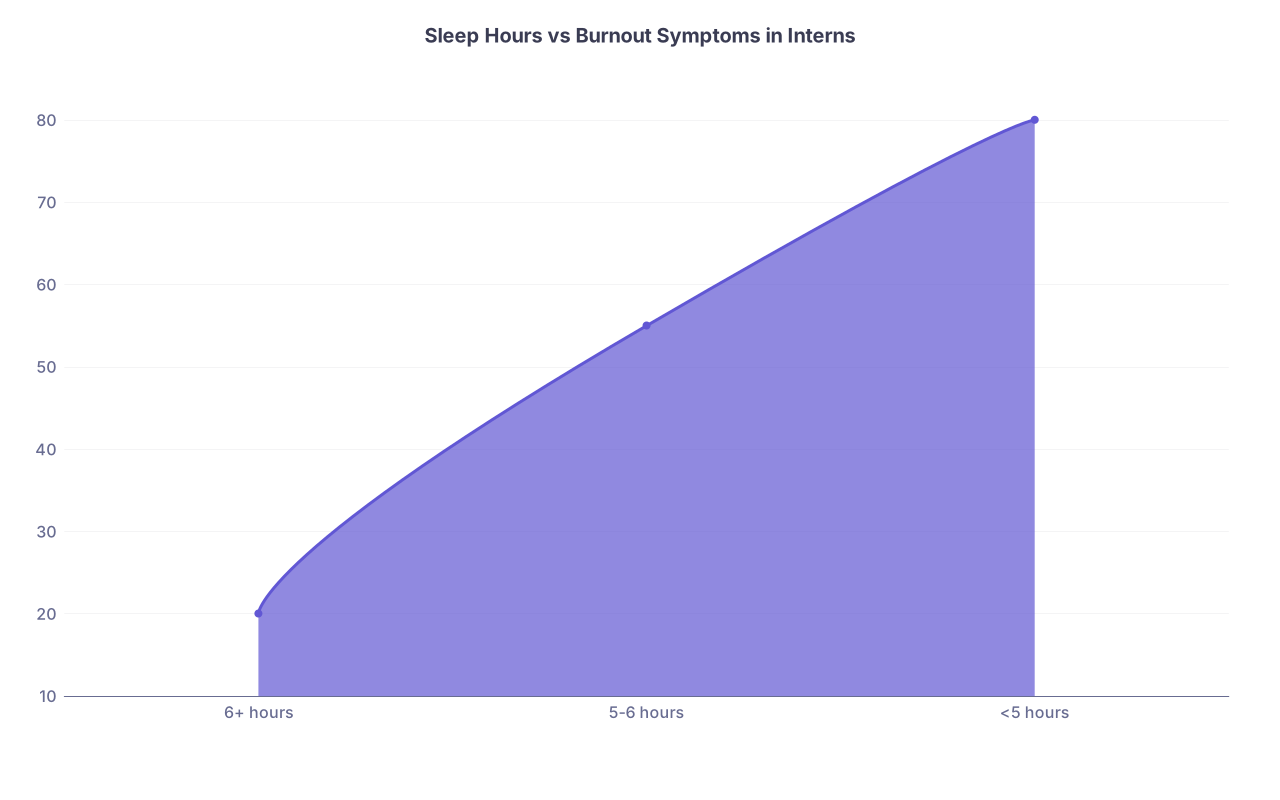
| Category | Value |
|---|---|
| 6+ hours | 20 |
| 5-6 hours | 55 |
| <5 hours | 80 |
(Burnout symptom percentages are approximate but the pattern is real: chronic sleep restriction wrecks people.)
Self-sabotaging patterns:
- Going out late on post-call “because everyone is going.”
- Volunteering for unnecessary research meetings after 6 pm.
- Spending off-days catching up on charting instead of demanding protected time to finish during work hours.
Minimum non-negotiables (unless the hospital is literally on fire):
- Some days you will get 4 hours. Fine. Over weeks, you must average meaningful sleep.
- At least one real off-day per week where you are not charting, emailing, or “just catching up” on work.
- Some form of decompression that is not alcohol or doom-scrolling in bed at 2 am.
If your schedule makes this structurally impossible, that is a program-level problem. Document it, talk to chiefs, use your CCC or PD. But do not pretend you can run indefinitely on fumes.
10. Tying Your Self-Worth To Productivity And Praise
This is the final trap. The most subtle. And the most corrosive.
If your sense of worth depends on:
- How many tasks you cleared today
- How your attending evaluated you
- Whether the nurses say you are “the best intern”
You are setting yourself up for a permanent identity earthquake.
Why? Because medicine will always give you mixed feedback:
- Some attendings love fast discharges. Others focus on perfect documentation.
- Some nurses prefer constant presence. Others prefer you not micromanage.
- Productivity can be blocked by system issues you cannot control.
You cannot let external chaos define your internal state.
Better mental frameworks:
Define 3 internal metrics that you control:
- “Did I show up prepared?”
- “Did I communicate clearly and respectfully?”
- “Did I ask for help when I was out of my depth?”
Keep a small log (paper or note app) of quiet wins:
- “Had a difficult goals-of-care conversation and did not avoid it.”
- “Recognized sepsis early, escalated quickly.”
- “Asked senior for help before getting overwhelmed.”
When you get negative feedback, treat it as data, not a verdict.
You are learning a complex job under pressure. No one doing that flawlessly is telling you the truth.
If your whole identity is “good intern,” any criticism will crush you—and you will work yourself into the ground chasing impossible universal approval.
Quick Comparison: Burnout-Feeding vs Burnout-Preventing Habits
| Area | Burnout-Feeding Habit | Burnout-Preventing Habit |
|---|---|---|
| Saying yes | Agree to every task | Triage and negotiate priorities |
| Work hours | Normalize staying very late daily | Aim for consistent, reasonable sign-out |
| Documentation | Long, copied notes | Short, targeted, problem-based notes |
| Help-seeking | Hide struggle until crisis | Early, clear escalation to seniors |
| Task urgency | Treat everything as stat | Explicit triage into urgent vs later |
FAQs
1. How do I know if I am actually burning out vs just tired from a hard month?
Watch for pattern and persistence. A rough week with some bad calls is normal. Worrisome signs:
- You dread going in every single day, even after a day off.
- You feel emotionally numb with patients or snap easily at staff.
- Sleep, food, or time off do not restore you at all.
If that sounds familiar, you are past “just tired.” Talk to someone you trust (chief, mentor, mental health professional) and treat it like the real problem it is.
2. What if my program culture expects “stay late, say yes, never complain”?
Many programs still run on outdated martyrdom culture. You will not fix that alone, but you can:
- Quietly protect your boundaries where possible.
- Use early escalation when patient safety or your own safety is at stake.
- Document truly unsafe workloads and communicate patterns to chiefs or PD.
You are allowed to be both professional and protective of yourself. Those are not opposites.
3. Is it normal that I am slower and need more time than co-interns?
Yes. Speed varies a lot early on. The mistake is trying to fix “slowness” by donating endless extra hours. Instead:
- Ask a senior or efficient co-intern to watch you do prerounds or notes and give concrete tips.
- Build checklists and templates that reduce thinking overhead.
- Focus on doing the right things consistently; speed comes when you stop reinventing your workflow every day.
Remember: you are not failing if you need structure. You are failing if you ignore the patterns that are clearly burning you out.