
The biggest lie you were told in orientation is that “you should always ask for help and time off when you need it.” That’s only half-true. The other half lives in the politics nobody explains to you until you’ve already stepped on a landmine.
Let me walk you through how asking for a single day off as an intern actually plays out behind closed doors—in workrooms, in chief chats, and in those whispered “what do you think about them?” moments that decide your reputation for the rest of the year.
The Unspoken Rules Behind “Just Let Us Know Early”
Program leadership loves to say, “We’re very supportive of wellness—just give us notice.” Sounds nice. It’s also incomplete.
Here’s what really happens.
The moment you ask for a day off, three questions start running through people’s heads:
- Who’s going to eat this work?
- Is this a pattern?
- Who is this intern to us?
They don’t say these out loud in front of you. But I’ve watched chiefs and attendings scroll the schedule and have the same conversation a hundred times.
“Can we spare them that day?” “Who else is on?” “Are they solid or kind of needy?”
That last one—your perceived reliability—matters more than anything you put in that ERAS application. Once people decide you’re solid, you can ask for a day off and nobody blinks. If they decide you’re fragile or flaky, every request becomes “a concern.”
The Timing Game: Not All Days Are Created Equal
You already know not to ask for a day off on a call day. But there’s more nuance.
On almost every service, there are “fat” days and “skeleton crew” days. You will not see that written anywhere. The senior knows. The chief knows. The coordinator knows. You usually don’t.
Example from a typical IM ward month:
- Mondays: Admissions heavy, clinic follow-ups, weekend fallout. Disaster to be short.
- Post-call days: Team already tired, cross-cover discharges to clean up.
- Fridays: Discharge madness, weekend planning, everyone grumpy.
You stroll in and ask for next Monday because you “have a personal appointment” and the senior looks like they swallowed a lemon. It’s not personal. They’re already picturing being alone with 18 patients and 7 new admits while answering every nurse call from three pods.
If you want to play this game like someone who plans to survive residency:
- Learn the “light” vs “heavy” days on each rotation.
- Ask seniors: “If I ever need a personal day this month, which days are less painful for the team?”
- Keep that mental list and pick from there.
That alone makes you look 200% more thoughtful than the average intern.
The Reputation Ledger: You’re Being Tracked (Informally)
Your program may or may not be tracking days off on a spreadsheet. Your co-residents and attendings definitely are—in their heads.
Here’s the ugly truth: you are being continuously sorted into one of three buckets.
| Category | How You’re Seen | Day-Off Reaction |
|---|---|---|
| Rock-Solid | Reliable, low-drama | “Of course, we’ll make it work.” |
| Average | Fine, replaceable | “Okay, but let’s check coverage.” |
| High-Maintenance | Needy, draining | “Again? This is becoming a pattern.” |
Nobody tells you when you slide between these buckets. But I’ve sat with chiefs at 10 pm scrolling through coverage requests for the month, and I’ve heard the lines:
- “Yeah, we’ll help her, she’s been killing it.”
- Versus: “He already swapped out of two weekends and left early three times—this is not sustainable.”
Same request. Different intern. Totally different outcome.
What Actually Moves You Between Buckets
Rock-solid doesn’t mean “never needs anything.” It means:
- You don’t create chaos for the team.
- You don’t surprise people.
- You fix problems you create (or at least try).
Example: Two interns both ask for a Friday off.
Intern A:
- Comes to the senior 3 weeks early.
- Already identified a co-intern who can cross-cover.
- Offers to pre-round on all their patients the night before, keep the list tight, and leave sign-out organized.
- Has a track record of staying late when others are drowning.
Intern B:
- Emails the chief 4 days before.
- No suggestions for coverage.
- Has a pattern of disappearing at 4:59 pm.
- Always “not feeling well” on high-workload days.
Same Friday. Chiefs will bend the universe for A. B gets a very different conversation, maybe even a “we need to talk about professionalism” meeting.
This is politics. Not policy.
Who You Ask Matters More Than You Think
Here’s another thing that’s never said out loud: the mechanics of who you ask can rescue or wreck your request.
There are four main players:
- Your senior
- Your attending
- Your chief resident
- The program coordinator / scheduler
Most interns run straight to the chiefs or coordinator with “I need this day off.” That’s one of the fastest ways to irritate your direct team.
The people in the team room—the senior and attending—are the ones who actually live with the fallout of your absence. If they hear about your request secondhand, you’ve just signaled: “I care about my need more than about how it hits the team.” That sticks.
The Order That Makes You Look Like an Adult
When possible, the lowest-friction way looks like this:
- Sense-check with a trusted co-intern or resident: “Hey, is it insane to ask for X day on this rotation?”
- Talk to your senior: “I have a personal thing on [date]. Is that a doable day for the team if I work out coverage?”
- Approach the attending only if your program culture expects it; some services want senior/chief to manage it.
- Then loop in the chiefs/coordinator with a concrete, specific plan, not a vague ask.
When your senior can say to chiefs, “We already talked, I’m fine with it, here’s the coverage,” it’s easy. When the chiefs have to go back and smooth things over with a pissed-off attending, they do not forget.
The Three Types of “Day Off” and How They’re Viewed
Not all requests get judged the same. On the surface, everyone says “no judgment,” but behind the scenes, there absolutely is.
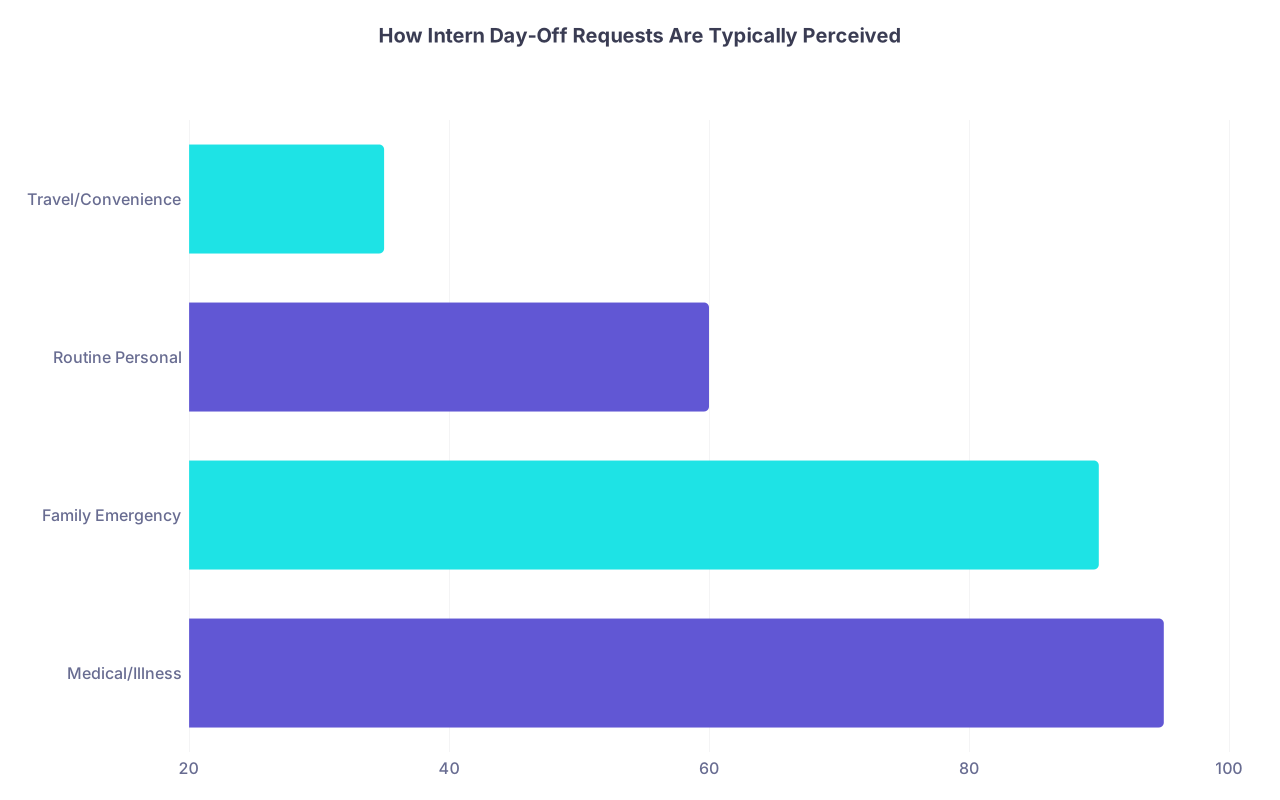
| Category | Value |
|---|---|
| Medical/Illness | 95 |
| Family Emergency | 90 |
| Routine Personal | 60 |
| Travel/Convenience | 35 |
Those numbers aren’t literal percentages; they reflect how “legitimate” people quietly rate each category.
Category 1: Medical / You’re Truly Sick
No sane attending wants a septic intern on rounds. If you have clear acute illness—fever, vomiting, COVID, something obvious—most programs flex without much moral judgment.
The problem is when you look “fine” but say you’re too sick to work. Chronic issues, vague “not feeling well,” repeated GI bugs before call days. That’s when people start doing mental math and connecting dots. Fair? Not always. Real? Yes.
If you have a serious, ongoing health issue:
You should absolutely protect yourself. But document it properly. Speak directly with chiefs and possibly the program director. Get a formal plan. Do not try to manage a chronic health constraint with a stream of “random” single-day call-outs. That’s how interns get labeled unreliable.
Category 2: Family Emergency
No one will say “no” to a genuine family emergency. The scrutiny comes later.
What counts in their minds as true emergency:
- Death in the family.
- ICU-level illness of a first-degree relative.
- Sudden unpredictable crisis.
What raises eyebrows:
- Third “family emergency” in two months, vague details.
- Canceling on short notice for something that could have been planned (grandparent’s elective surgery from months ago that “suddenly” requires travel).
You don’t need to spill your life story. But a simple, concrete statement is better than mysterious drama. “My dad is in the ICU; I need to fly out tomorrow.” Nobody argues with that.
Category 3: Routine Personal / Convenience / Travel
This is where politics really kicks in. Weddings, graduations, partner moving, visa appointments, religious observances, or straight-up “I need a mental health day.”
Here’s the uncomfortable truth: these are absolutely legitimate reasons for needing time, but the burden on you to be strategic and considerate skyrockets. Because these are the days your co-residents silently judge: “So I’m covering 18 patients so you can go to Cabo?”
It’s not that you can’t ask. You can. But if you do it clumsily, you pay for it in reputation—even if they grant the day.
How to Ask Without Tanking Your Reputation
Let’s get tactical. This is the script-level stuff I see top-performing interns do that nobody teaches.
1. Lead With Solutions, Not Problems
Bad version:
“I need Friday off for a personal matter. Can you please make that happen?”
Better version:
“I’m hoping to take Friday [date] for a personal commitment. I’ve already talked to [co-intern name] who’s willing to cover my patients, and I’ll pre-round and tighten my list Thursday night. Does that seem reasonable to you, or is there a better day that would hurt the team less?”
Now you’re not just consuming resources; you’re managing impact. That’s what people remember.
2. Be Honest but Bounded
You don’t need a confessional. But vague and dodgy reads worse than short and clear.
Instead of:
“I have some personal stuff I’m dealing with.”
Try:
“I have a close friend’s wedding that I committed to before the schedule came out,” or
“I have a legal/immigration appointment that I can’t move,” or
“I need a mental health day—things have been rough and my therapist and I agreed this would help.”
Short. Direct. Enough context to not sound like you’re just bailing because you’re bored.
3. Use Email Strategically, Not as a Shield
One of the most common intern mistakes: firing off a long, anxious email to chiefs begging for a day off without ever talking to the senior.
Email feels safer. It also feels colder and more transactional to the people receiving it.
Better pattern:
- First, quick in-person or Zoom talk with senior.
- Then send a concise email to chiefs looping in senior, summarizing the plan you already discussed.
That lets your senior advocate for you, instead of blindsiding them.
Mental Health Days: The Taboo Topic Everyone Tiptoes Around
This one lives in the gray area. Programs say they want you to take care of your mental health. In practice, some attendings still quietly equate “mental health day” with “weak” or “not cut out for this.”
Here’s the inside view.
When chiefs hear “mental health day,” they start asking themselves two things:
- Is this a one-off pressure release or a sign this person is actively unsafe?
- Do we need to involve the program director or GME officially?
If you’re burning out but still functional, and you just need one day to not be on the floor, you have two main options:
- Frame it as “personal day,” keep details minimal, and handle it quietly.
- Or be explicit, and accept that it may trigger more formal supports (which can be good, but has consequences—documentation, possible restrictions, follow-up meetings).
I’ve seen both strategies work. The key is this: if you’re at the point where you’re having thoughts of self-harm, you are past the “discreet day off” phase. You need to pull the emergency brake, and the right people need to know.
The politics there are real, but your life is worth more than your evaluations. Period.
How Chiefs Actually Talk About Your Requests
You should know what the conversation sounds like when you’re not in the room.
It’s rarely dramatic. It’s a few lines in between 50 other decisions:
“X needs next Friday.”
“Who’s on that day?”
“Senior is Y, they said it’s okay if we find coverage.”
“Has X asked for much else?”
“Not really, they covered New Year’s and stayed late twice for codes.”
“Okay, let’s work it out.”
Or the other version:
“Z wants another ‘personal day’ next week.”
“Again? This is their fourth this block.”
“Yeah, and last time the attending was pissed about how slammed the team was.”
“We should probably sit down with them. This is becoming a professionalism thing.”
That’s the line you do not want to cross: when a normal human need gets escalated to a “professionalism concern.” It’s not always fair. But once that word enters your file, everything you do gets seen through that lens.
Strategic Moves That Buy You Political Capital
You cannot avoid ever needing a day off. You can build credits that make your asks easier.
Concrete things that buy you goodwill:
- Be the person who volunteers to swap into an unpopular shift once in a while, not just out of them.
- When someone else is out, step up without whining. People notice.
- Clean sign-outs, accurate orders, doing your share of scut without complaining—this builds the “they’re solid” narrative.
- If you mess up (you forgot to tell anyone about your dentist appointment and bailed from noon conference), own it. Directly. “I handled that wrong. Next time I’ll clear it with the team early and make sure coverage is set.”
Your peers talk. Chiefs hear: “Yeah, she had to miss a day, but she always has our back.” That buys you far more forgiveness than you realize.
When to Push, Even If It Makes You “That Intern”
There are times when politics matter less than survival. Let me be blunt: do not martyr yourself to avoid annoying a chief.
You push, even if it’s uncomfortable, when:
- You are unsafe to practice—severe sleep deprivation with clear cognitive impairment, serious illness, panic attacks on the floor.
- You have a genuine, urgent, non-negotiable life event (death, legal deadline, visa, etc.).
- You are being exploited—asked to routinely come in on your days off, or repeatedly denied time others get without a clear reason.
In those cases, be direct and escalate as needed. Chiefs. Program director. GME. Whatever it takes.
Some attendings will label you “entitled” no matter what. Let them. Over a whole residency, the quiet respect you get for standing up when it matters will outweigh the grumbling—especially from people whose opinion you actually value.
A Simple Decision Flow Before You Ask
When you’re debating whether to ask for a day, run yourself through this quick mental flow. It’s what the savvy interns quietly do.

| Step | Description |
|---|---|
| Step 1 | Need a day off |
| Step 2 | Talk to senior today |
| Step 3 | Pick better day and plan coverage |
| Step 4 | Discuss pattern with chiefs/PD |
| Step 5 | Ask senior with concrete coverage plan |
| Step 6 | Loop in chiefs and coordinator |
| Step 7 | Urgent and non negotiable? |
| Step 8 | Can it be moved to lighter day? |
| Step 9 | Is this a recurring issue? |
You’ll still hit resistance sometimes. But you’ll avoid the rookie mistakes that make a reasonable request look selfish or disorganized.