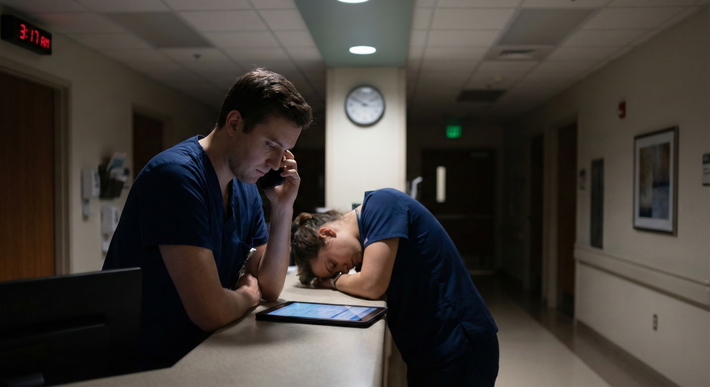
Chiefs are not counting how many notes you wrote. They’re watching how you fall apart. Or don’t.
Let me be blunt: every good chief can tell within a week which interns are drowning, which are barely treading water, and which are quietly carrying half the service. And it is not based on how many hours you stay, or how often you say you’re “super busy.” The story is written in a dozen small behaviors you think no one notices in the chaos of the workroom.
We notice. We talk about it. We remember.
You’re worried about “falling behind,” “not being fast enough,” “missing something life-threatening.” Chiefs are asking a different set of questions:
Is this intern safe?
Can I trust them at 3 a.m.?
Are they coachable or are they going to be a long-term problem?
Let me walk you through what’s actually being judged when you’re overwhelmed.
The First Red Flag: Silent Drowning vs. Early Signal
The biggest mistake struggling interns make is assuming they can “power through” and hide it.
Here’s the inside truth: we expect you to get overwhelmed. The volume is deliberately front‑loaded. July and August are a stress test, not just of your stamina, but of your judgment about when you’re beyond capacity.
There are two patterns chiefs and seniors watch like a hawk:
- The intern who quietly drowns
- The intern who signals early and specifically
The quiet drowning intern looks like this:
- It’s 3 p.m. and they still haven’t staffed morning admits.
- Their list is chaos: half-scribbled notes, no updated labs, meds wrong.
- Nurses are starting to call seniors directly because “I paged the intern three times.”
- They look panicked but insist “I’m fine, I’m just finishing one thing.”
This intern terrifies chiefs. Not because they’re slow. Because they’re opaque. We cannot protect patients if you won’t show us where the cracks are.
The early-signal intern is different. Around noon they’ll say to their senior, quietly:
“I’m behind on two discharges and haven’t seen the 11 a.m. admit yet. My bandwidth is maxed. Can you help me triage what to drop or delegate?”
That line? Golden. Program leadership loves that line. You’ve told us three critical things at once:
- You’re self-aware.
- You’re prioritizing safety over pride.
- You’re willing to be guided.
People think asking for help is a sign of weakness. At the intern level, failing to ask for help is the bigger red flag every time.
The Anatomy of Being “Overwhelmed”: What We Actually See
You think being overwhelmed is about number of patients. Chiefs know that’s wrong. We’ve watched interns drown with 4 patients and others calmly manage 16.
What matters is the pattern of your overwhelm.
When chiefs discuss struggling interns in those closed-door meetings with PDs and APDs, we don’t say “they’re slow.” We say things like:
“They lose situational awareness under pressure.”
“They can’t prioritize when everything hits at once.”
“They don’t close the loop on critical tasks.”
“They fragment—lots of half-done work.”
We’re tracking three things:
- Prioritization
- Follow‑through
- Communication
Prioritization: Who do you see first?
On a heavy day, you’ll get hit with this sequence:
- New admit with chest pain
- Discharge who “just needs paperwork”
- Nurse paging about a patient with low urine output
- Family at bedside wanting an update
- Senior asking you to call a consult
Watching how you handle that cluster tells us more than your entire application.
The overwhelmed intern does everything in order of who yelled last. They:
- Start discharge paperwork because “it has to be done by noon”
- Then answer nurse pages as they come
- Then wander into the new admit without checking vitals
- Then get pulled into the family meeting for 30 minutes
- Then realize no one’s checked the chest pain patient’s troponin
The intern we trust does something very different. They take 30 seconds to triage and say:
“New chest pain admit and a sick-sounding nurse page get attention first. Discharge and family talk wait. Consult can be delayed or delegated.”
We hear intern brains in how they talk out loud. The one who narrates their prioritization—briefly—is the one we know is thinking like a doctor, not a task robot.
Follow‑through: Do you close the loop?
Overwhelmed interns start tasks and never finish them. Over and over.
You call a consult, but never check if they actually saw the patient.
You order a critical lab, but never look at the result.
You write a beautiful note, but never update the med list or place the order that matters.
When we round the next morning and find three important loose ends from yesterday, we don’t think “they were busy.” We think:
“Their cognitive bandwidth collapses under load. That’s dangerous.”
The interns who manage heavy workload well have one consistent habit: they close loops before walking away from the computer. Quickly scan for:
- Any STAT orders pending
- Any pages you haven’t read
- Any life‑or‑limb plan that isn’t actually implemented
It sounds small. It’s not small at all. This is where misses live.
Communication: Who do you keep in the dark?
This is the underrated piece. When you struggle with workload, your communication habits either protect you or bury you.
Chiefs notice:
- Do you disappear on heavies days—no updates, no “I’m behind,” no plan?
- Do you keep nurses and seniors informed of delays and priorities?
- Do you own your backlog out loud or hide it?
If a nurse comes to me and says, “Your intern is super busy but they told me they’ll get to this after seeing the new febrile patient,” I’m not worried.
If I hear, “I can never find your intern, I don’t know what’s going on with my patient,” I’m very worried. Because that intern doesn’t just have a workload problem. They have a reliability problem.
What Chiefs Watch During Your Worst Days
Let me give you a scene we’ve all lived:
It’s post-call. The overnight cross-cover left you six new patients, the attending is in a mood, and transport just brought your sickest patient back from ICU step-down. You’re behind on notes, there’s a noon conference you’re “supposed” to attend, and the ED just called with a boarder that “has nowhere else to go.”
This is where chiefs really start the evaluation.
We’re not counting how many orders you placed. We’re watching:
- Do you get flustered and snappy with staff?
- Do you stop answering pages?
- Do you start cutting corners in documentation that actually matter (e.g., not reading consult notes, blowing off med rec)?
- Do you shut down emotionally or go into frantic overdrive?
Here’s the hierarchy in our heads:
- Safety – Are patients safe despite the chaos?
- Self-awareness – Do you know you’re beyond your limits?
- Adaptability – Can you accept real‑time restructuring of your day?
- Teachability – Do you learn from today’s train wreck, or repeat it next week?
If you panic and snap, but still escalate appropriately, ask for help, and keep the sickest patients front of mind—we can work with that. We expect some emotional leakage.
The interns who get labeled “problematic” are the ones who combine overwhelm with denial and poor insight. The “I’m fine” as everything burns behind them.
What We Don’t Care About as Much as You Think
There are myths that float through intern rooms like gospel. Let me kill a few.
“If I stay late every day, they’ll see how hard I’m working.”
No. Chiefs don’t give you points for martyrdom.
If you’re staying 2–3 hours late every single shift, what we actually think is:
“Something is broken in their workflow, or they can’t prioritize and let nonessential tasks go.”
We also know staying late is a setup for errors. Fatigued, hungry interns make worse decisions. Chronically staying late is not a flex, it’s a red flag.
“If I ask for help, they’ll think I can’t handle it.”
We do not expect interns to be able to handle maximal workload solo. That’s the whole point of residency structure—layers of supervision.
What program leadership remembers long term is not that you needed help. It’s when and how you asked. A midnight call to the chief saying:
“I’ve got two unstable patients, my pager won’t stop, and I don’t trust my judgment right now—can you help me triage this?”
That call is the sign of someone I’d later trust to be a chief themselves. Honestly.
“I have to go to every lecture or they’ll think I’m not committed.”
When I was chief, I explicitly told interns: if your team is drowning and skipping a lecture keeps patients safe and your team sane, skip the lecture. Tell us. Own it.
PDs care far more about your reputation on the floor than your perfect conference attendance. The chiefs are often the ones quietly telling the PD, “That intern stayed back to handle a crash day and let the rest of the team go learn. That was the right call.”
Use your judgment. If you use “workload” to dodge education every day, we see through it. But missing a lecture to stabilize a service? That’s called doing your job.
The Patterns That Worry Chiefs Long-Term
Let’s talk about the interns who end up on the radar for the wrong reasons. It’s never just “they’re slow” or “they had a bad month.” Everyone has a bad month. It’s patterns across rotations.
Here’s what consistently triggers closed-door “we need to talk about this” meetings.
1. Chronic disorganization
These interns always look like their hair is on fire. On every rotation.
They lose sign-out papers. They forget key follow-ups. Their list is a disaster. They always have “a lot going on” but when you dig in, half the “busy” was self-created inefficiency.
Chiefs can tell who’s having a bad week versus who fundamentally doesn’t know how to structure a workday. If multiple seniors from different services say, “They were nice, but disorganized and unsafe when busy,” that’s a problem.
2. Defensive, blame-shifting responses
The overwhelmed but coachable intern says:
“Yeah, I missed that. I was buried and I should’ve escalated sooner. How would you have handled it?”
The overwhelmed and dangerous intern says:
“Well, no one told me,”
“The nurse never called me,”
“The overnight team didn’t document anything,”
“The system is just broken.”
Listen, the system is broken. Chiefs know that better than you. But if every debrief is you as the innocent victim of everyone else’s incompetence, we stop hearing you and start documenting.
3. Emotional volatility as the norm
Everyone cries at some point intern year. I have seen residents break down in stairwells, call rooms, bathrooms. That’s not what I’m talking about.
What worries chiefs is interns who lash out—at nurses, at consults, at other interns—every time they’re overwhelmed. Rage and blame as the default coping strategy.
If staff start saying, “We hate working with X because when it’s busy they yell at everyone,” you’re not just “stressed.” You’re becoming a risk to team function. And once that label sticks, it’s very hard to shake.
What Impresses Chiefs When You’re Struggling
Now the part you actually need: what we quietly respect when we see an intern under real load.
Clear, concise updates
There is nothing more reassuring than an intern who, mid‑chaos, can say to their senior or chief:
“I’m behind on two discharges, I’ve seen the new sepsis admit and started fluids/antibiotics, I still need to call the ICU consult. My priority list is: stabilize sepsis, then dispo bed 12, then write quick notes on the stable patients. Can you take the family update on 16?”
That shows us three things: triage mindset, self-awareness, and willingness to delegate.
Strategic cutting of corners
Yes, you read that right. Interns who try to do everything perfectly on a nightmare day are as risky as the ones who stop caring.
The interns who get it know what to do:
- Accept that today’s notes may be sparse but safe.
- Know which labs they can batch-check and which need real-time eyes.
- Move a non-urgent family meeting or social issue to tomorrow without guilt.
- Tell the attending, “I focused more on stabilization and communication today than long notes—just flag anything you want me to expand.”
Chiefs and attendings would rather you write a mediocre note and catch the early decompensating patient than write a perfect novel and miss the crisis.
Visible growth after bad days
Here’s the real test. You get crushed on Monday. Discharges late, orders missed, senior frustrated.
On Thursday, are you doing the exact same thing?
The interns who rise fast are the ones who come in the next day and say something like:
“Yesterday was brutal. I tried a different to‑do list today—sickest first, then labs, then discharges. Can you watch how I’m structuring it and tell me what still looks off?”
You don’t need to magically fix it overnight. You just have to show a different curve: trending up, not flatlining in dysfunction.
A Quick Reality Check: Most Chiefs Are Rooting for You
You probably think chiefs are sitting around judging every stumble. They’re not. Most good chiefs are actually looking for ways to protect you from the worst of the system while still forcing you to grow.
In the chief room, the conversation about a struggling intern often sounds like:
“They’re drowning, but they work hard and they’re honest. We need to give them more structure.”
“Put them with Dr. X on wards next month—she’s patient but firm.”
“Let’s adjust their schedule so they’re not stacked with four heavy rotations in a row.”
We only move to a punitive tone when we see patterns of denial, blame, or refusal to engage.
So if you’re struggling with workload, but you:
- Tell the truth about it,
- Own your part,
- Ask for specific help,
- And try new strategies after feedback,
You’re not in the danger zone. You’re just… an intern.
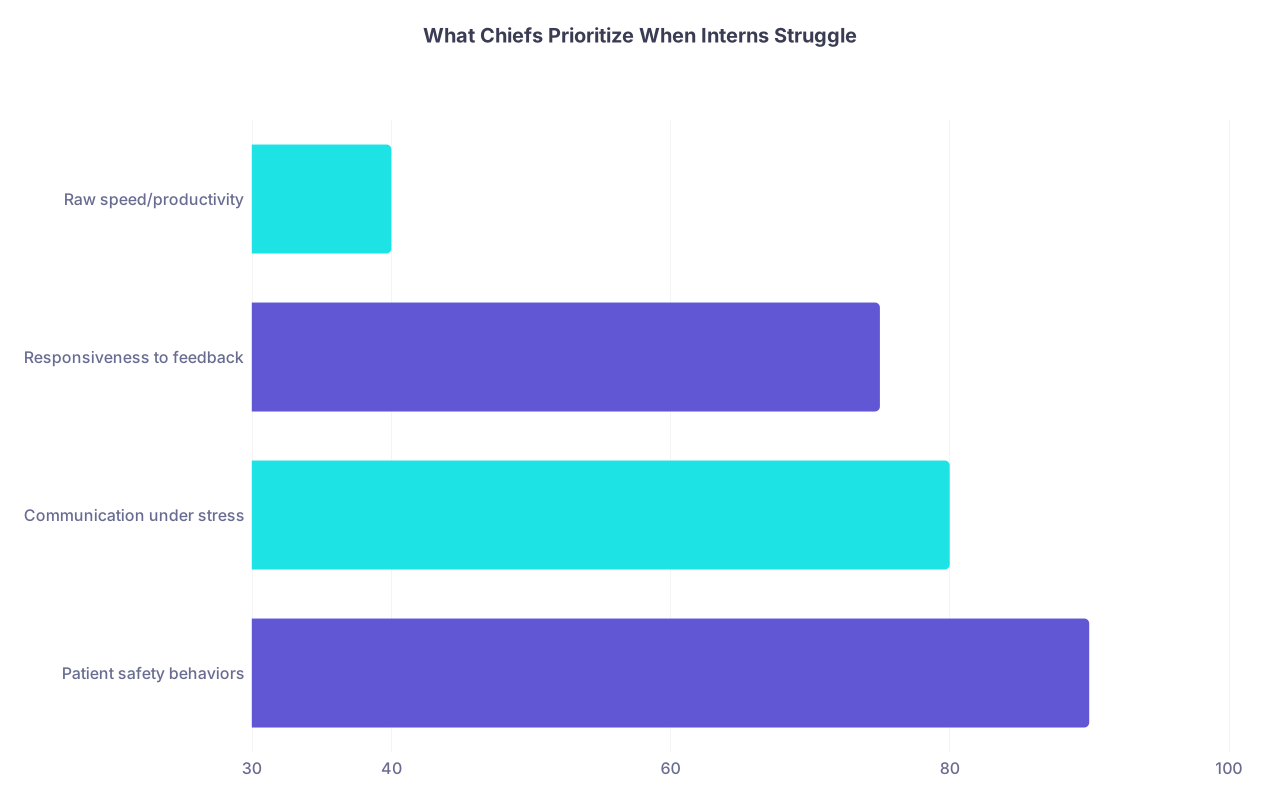
| Category | Value |
|---|---|
| Patient safety behaviors | 90 |
| Communication under stress | 80 |
| Responsiveness to feedback | 75 |
| Raw speed/productivity | 40 |
Practical Moves That Change How Chiefs Perceive You
Let’s translate all this into behavior you can actually use on Monday.
The 30-second “I’m overloaded” script
Use something like this with your senior or chief when you’re behind:
“I’m overloaded. I’ve done X and Y, still need to do A, B, and C. I think the immediate priorities are A and B for safety. Can you help me figure out what can wait or be delegated?”
That’s the trifecta: early warning, situation summary, and a proposed triage.
The pre‑rounds safety pass
On brutal days, before you even start writing notes, do a safety scan:
- Checked vitals and overnight events on the sickest patients
- Responded to any critical pages
- Reviewed new labs on anyone unstable
If a chief walks in and knows that, at minimum, your sickest patients are attended to, we breathe easier. We’re less interested in whether you’re done with every note by noon.
The “own your backlog” technique
When we ask, “How’s your list?” don’t say “fine” if it’s not. Try:
“I’m on top of the two sick ones, I’m behind on stable progress notes and one discharge. I’ll probably need an extra 30–45 minutes to finish after rounds.”
That’s not weakness. That’s transparency. Now we can decide to redistribute, drop a nonessential task, or protect you from another unnecessary admit.

| Step | Description |
|---|---|
| Step 1 | High workload day |
| Step 2 | Assess prioritization |
| Step 3 | Watch for missed tasks |
| Step 4 | Support and coach |
| Step 5 | Teach triage skills |
| Step 6 | Escalate concern |
| Step 7 | Monitor pattern over time |
| Step 8 | Intern asks for help? |
| Step 9 | Priorities reasonable? |
| Step 10 | Safety issues? |
What Chiefs Remember at Evaluation Time
Months later, when we sit in those cramped conference rooms reviewing intern evaluations, we don’t pull up a spreadsheet of how many notes you wrote.
We remember snapshots:
- The night you called at 2 a.m. because you were overwhelmed and worried about missing something—and you were absolutely right to call.
- The day you stayed an extra 45 minutes to make sure a vulnerable patient’s meds were correct, even though your notes could wait.
- The rotation where you started scattered and ended organized, because you actually listened to feedback and rebuilt your system.
We also remember the patterns:
- The intern who always blamed someone else when workload overwhelmed them.
- The one who vanished when things got busy and let everyone around them clean up.
- The one who never seemed to learn from last month’s chaos.
Your goal isn’t to never struggle with workload. That’s impossible. Your goal is to struggle in a way that shows us you’re safe, self-aware, and getting better.
If you’re reading this and thinking, “That’s me—I’m the disorganized one,” you’re already ahead of the real problem group. The dangerous ones are the ones who’d read this and say, “This doesn’t apply to me, my program just expects too much.”

FAQ: Chiefs and Intern Workload
1. How do I know when my workload is actually unsafe vs just “hard but normal”?
If you cannot reliably track vitals, labs, and critical changes on your sickest patients because of volume, that’s tipping into unsafe. If you’re delaying discharges or writing lighter notes, that’s usually just “hard but normal.” When in doubt, say to your senior, “Here’s what I’m not getting to—does any of this worry you from a safety standpoint?”
2. What’s the best way to tell my chief I’m struggling without sounding incompetent?
Be specific and structured. “I’m struggling” is vague. Try: “On heavy admit days like yesterday, I’m consistently missing timely discharges and following up on some labs late. I’d like help reworking my workflow so I don’t keep repeating that.” That sounds like a professional working on a performance issue, not someone melting down.
3. Does it hurt me long term if I call the chief at night because I’m overwhelmed?
If you’re calling once a week for things you should handle alone—yes, that will show up. If you call a handful of times a year for truly overloaded, high‑stakes nights, that actually helps your reputation. Chiefs remember who calls for the right reasons at the right time, not who tried to white‑knuckle their way through danger.
4. My senior is unsupportive and keeps telling me to “just be faster.” What do I do?
Document your own efforts and your own growth. Ask them: “Can you watch me for an hour and point out exactly where I’m inefficient?” If they still just say “be faster,” loop in a chief or APD and frame it as, “I’m getting feedback that I’m slow but not actionable advice—can someone help me break down my workflow?” Chiefs know some seniors are terrible teachers; we discount their blanket complaints when we see you actively seeking real guidance.
5. Will being known as ‘slow but safe’ hurt fellowship chances?
Almost always, “slow but safe and improving” is far less damaging than you think. Fellowship directors call chiefs and PDs and ask: “Are they safe? Are they reliable? Do they learn?” If the answer is yes to all three, some slowness intern year is noise. The only time it really hurts is if “slow” is paired with “defensive, disorganized, and unchanged across three years.”
Bottom line
Chiefs are not grading you on perfection. They’re watching how you behave when the system predictably overwhelms you. Three things matter most: you protect patient safety even when you’re buried, you’re honest and specific about your limits, and you actually learn from your bad days. Do those, and your “struggle with workload” becomes a growth story, not a problem file.