
The brutal truth is this: attendings decide if you’re “efficient” in the first 1–2 weeks, and that label will follow you all year.
Not fair. But real.
They’re not just watching whether you “work hard.” They’re watching how you move, how you think, and how much invisible work you create for everyone else. And they will never say half of what they’re actually noticing out loud.
Let me walk you through how the judgment really happens.
The First 5 Minutes of Rounds: Where They Slot You
Rounds start before anyone opens a chart.
Attendings form their first impression in that short window between “Good morning” and the first presentation.
They’re clocking things you do not realize you’re broadcasting:
- Do you have your list out, in order, with bed numbers updated?
- Are you already logged into the computer?
- Do you know where your patients physically are? (Radiology, dialysis, OR, etc.)
- Are you holding coffee… and nothing else?
There’s a quiet ranking that happens. I’ve heard versions of this in workrooms more times than I can count:
- “She’s on top of it.”
- “He’s slow.”
- “She’s organized but anxious.”
- “He’s going to drown on a heavy list.”
No one says that to your face. But once you’re in one of those buckets, every later action is filtered through that story.
If you present slowly but you’re always ready and your plans are tight, you get labeled “thoughtful.”
If you present slowly and you’re missing key data, you get labeled “inefficient.” Same pace. Different story.
Pre-rounding: Where Efficiency Starts (and Dies)
Most interns think efficiency is about speed on rounds. That’s wrong. Attendings judge your efficiency based on what you did before they ever showed up.
Here’s what attendings actually check for, even if they never say it out loud:
Did you actually see the patient?
Not “I saw that they were stable overnight.” Did you walk in, look at them, touch them if needed?
When an intern says, “Patient is in no distress” and the attending walks in to visible respiratory distress, the label flips immediately: unreliable, superficial, inefficient.Do you know the overnight story in one sentence?
“One-liner: 64-year-old with decompensated cirrhosis, now improved after paracentesis yesterday; no new overnight events.”
If you have to open three notes to figure out what happened since yesterday, you did not pre-round efficiently.Are your vitals and labs pre-digested or raw?
An efficient pre-round is not “I glanced at vitals.” It’s:- I know the trend in oxygen, heart rate, BP.
- I’ve already mentally marked abnormal labs and how they changed.
When you present, if you sound surprised by a K of 2.9 at 7 a.m., the attending knows what happened: you didn’t really look.
Have you already anticipated obvious orders?
I’ve seen attendings quietly lose respect because an intern waited until after rounds to order:- Morning CBC on the GI bleeder
- Repeat BMP for the patient on aggressive diuresis
- A troponin follow-up in a chest pain workup
The efficient intern has already ordered those before rounds, with a mental note to update the attending.
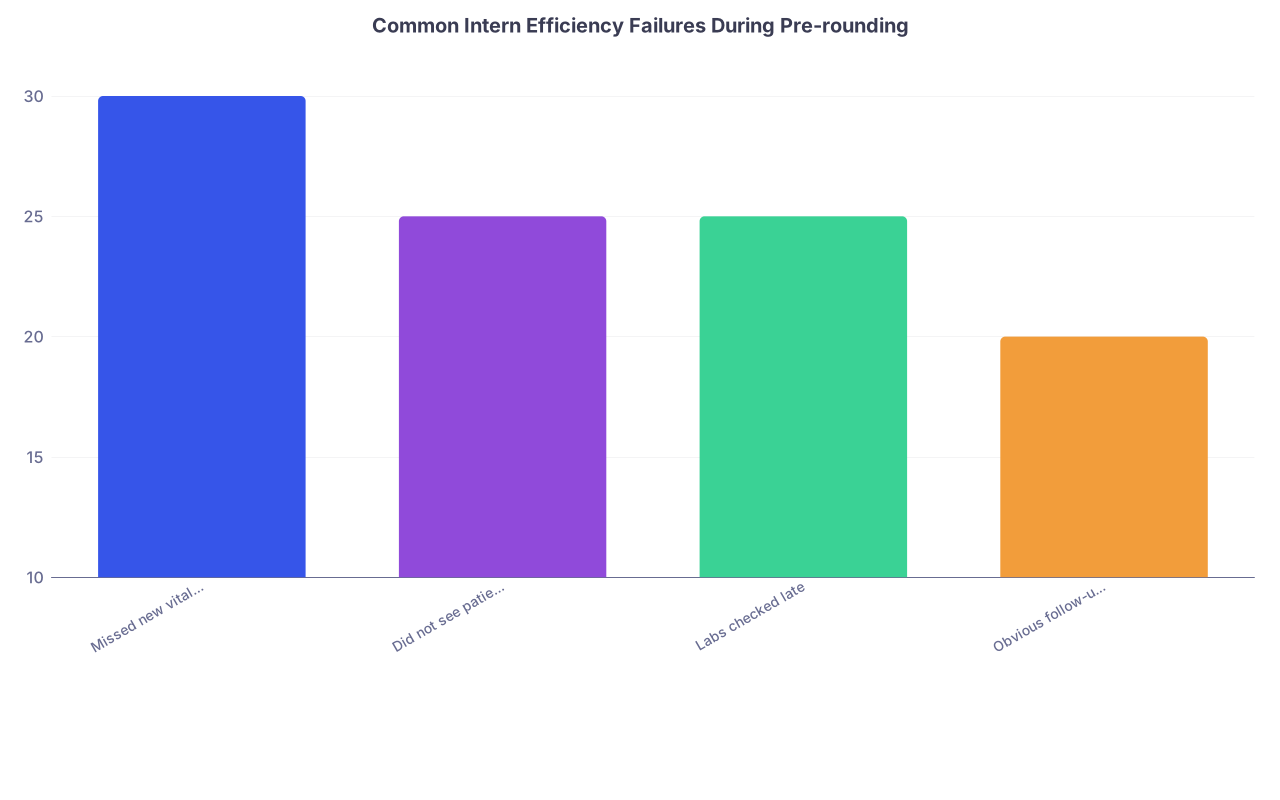
| Category | Value |
|---|---|
| Missed new vitals trend | 30 |
| Did not see patient in person | 25 |
| Labs checked late | 25 |
| Obvious follow-up orders delayed | 20 |
Most attendings won’t yell about this. They’ll just quietly conclude: “I can’t trust this intern to stay ahead. I need to double-check everything.” That is the death of your efficiency reputation.
How You Present: The Hidden Stopwatch
Attendings will never pull out an actual stopwatch. But they are absolutely timing you in their head.
Not how long you talk. How much value you produce per minute.
Here’s what efficient sounds like to an attending:
“Ms. Lopez, 58, COPD and HFpEF, here with acute on chronic hypercapnic respiratory failure, now improving on BiPAP. Overnight: no events, sats 92–94% on 2L, BiPAP weaned off at 4 a.m., no new fevers or chest pain. This morning she feels less dyspneic, walked to the bathroom with minimal assistance. Vitals stable, exam with improved air movement, still mild wheezing. Key labs: CO2 down from 68 to 60, bicarb 34 to 32, WBC downtrending. Plan: continue steroids day 3/5, switch from nebs to MDIs, trial down to 1L with ambulation check, PT evaluation today, likely home with RT support tomorrow.”
No fluff. No reading the entire overnight note. No reciting every lab in chronological order.
The inefficient version is easy to spot:
- Pages of verbatim lab values without interpretation
- Re-stating old history that everyone on the team knows already
- Long pauses because you’re discovering data as you present
What attendings are really asking themselves while you talk is:
- “Can I tell if the patient is better, worse, or the same?”
- “Do I trust that this intern knows what actually matters?”
- “Are they wasting everyone’s time with noise?”
If the answer is “no” to those, you’re judged inefficient regardless of how many hours you’re actually working.
Order Entry: Where You Win or Lose the Team
I’ve watched good interns look bad purely because of one thing: they are slow to translate words into orders.
You’ll hear attendings say, “We’ll do X, Y, Z,” and then move to the next patient. At that moment, they’re quietly grading you on a few things:
Lag time
Do orders appear in the chart within minutes after leaving the room? Or two hours later when nursing has already paged twice?Completeness
If the attending said, “Let’s start IV Lasix and check a BMP this afternoon,” and you only ordered the Lasix… that’s a serious ding. They now have to remember to re-order what you forgot. That’s inefficiency.Precision
- Right dose?
- Right frequency?
- Right parameters? (“Hold for SBP < 100,” “replete K if < 4.0,” etc.)
Every time the attending has to clarify something they think should be obvious, it quietly lowers your efficiency score.
Let me be blunt: a fast, sloppy orderer is not “efficient.” They’re dangerous. The gold standard is fast and accurate, and attendings absolutely notice when you hit that combination.
Your Relationship with Pages: The Real-Time Efficiency Test
If you want to know how attendings truly judge your efficiency, look at how you handle pages.
They listen for patterns:
- Do you batch your responses and prioritize, or jump at every single page without thinking?
- Do you call the nurse back and already have the chart open, or do you wing it blindly?
- Do pages about your patients slow down the entire team's rounding speed?
Here’s a common scenario attendings hate:
You’re presenting.
Your pager goes off.
You fumble, pull it out, lose your place, mumble something, disappear mentally.
Team momentum dies.
The efficient intern, on the other hand, does this:
- Quickly glances at the page
- Makes a 1-second decision: urgent vs not urgent
- Either:
- “Excuse me, I need 30 seconds; patient 12 is hypotensive.”
- Or: “Non-urgent nursing page, I’ll address right after this patient.”
The attending sees that and thinks: “Okay. They triage. They’re safe. They’re efficient.”
What they hate most is reactive chaos. Ten micro-disruptions to flow that add up to rounds ending 45 minutes late.
Notes: Why Your Documentation Style Screams Efficiency or Chaos
Most interns underestimate how harshly attendings judge their notes.
Not on grammar. On structure and signal-to-noise ratio.
They’re looking for:
- Can I understand this patient in 30 seconds from this note?
- If I come back tomorrow, does the note tell me what actually changed?
- Is the assessment and plan actionable, or is it just a repeat of the H&P?
The inefficient note has:
- Walls of text
- Copy-forward junk from three days ago
- Plans that say, “Continue to monitor” for everything
- No clear problem-based structure
The efficient note is lean:
- One-liner that actually evolves as the hospital course evolves
- Problem list with numbered issues
- Each problem has: what’s new, and what we’re doing about it now
Attendings will never sit you down and say, “Your notes are inefficient.” They’ll just start rewriting or editing your notes themselves, or give feedback like, “Just make it shorter,” which is code for “You’re drowning me in useless text.”
Physical Presence and Body Language: The Stuff You Don’t Think Matters
Here’s the part no one tells you in med school: attendings absolutely judge your efficiency based on how you physically move through the day.
I’ve heard these lines in workrooms:
- “He always looks lost.”
- “She’s always behind the computer, never at the bedside.”
- “He walks like he has no idea where he’s going.”
Do these sound petty? Maybe. But they’re proxies.
The resident or attending watching you walk slowly down the hall with your head buried in your phone assumes you’re behind. They’re often right.
Interns who look efficient:
- Move with purpose. Not frantic, not strolling. Just… decisive.
- Put the phone away unless it’s work-related.
- Have their list ready, not buried somewhere in a pocket.
- Stand near the computer or central workstation, not hovering at the edge of the group looking confused.
You’re broadcasting “I’m on top of things” or “I’m perpetually catching up” every minute you’re visible. People pick up on it faster than you think.
How You Handle Being Behind: The Biggest Telltale
Every intern gets behind. On busy services, everyone drowns some days. Attendings know that. They’re not grading you on never being behind.
They’re grading you on what you do once you realize you’re underwater.
There are two types of interns.
The Silent Drowner
This intern:
- Says nothing until 4 p.m. sign-out.
- Has half their notes unfinished.
- Orders from rounds are still pending.
- Nursing has paged three times about tasks that never got done.
- At sign-out: “Sorry, I’m just really behind today. I’ll catch up.”
Attendings and seniors hate this. Quietly. They feel blindsided and lose trust. They think, “If they’d told me at 11, I could’ve helped. Now the day’s wrecked.”
The Strategic Communicator
This intern, at 10:30 or 11:00 a.m., says to their senior:
“I’m a bit behind today. I’ve seen everyone, but I still need to finish notes on three patients and enter orders on two from late rounds. Can I prioritize anything differently?”
Or at 3 p.m.:
“Here’s what I have left: two notes incomplete and one family call outstanding. I’ll stay and finish them, but just want you to know where I’m at.”
That’s efficiency. Not because they magically did more work, but because they managed the work in a way that lets the team adapt.
Attendings vividly remember which intern was transparent, coachable, and proactive—and which one made the whole team stay late because they tried to hide the chaos.
Subtle Signals of a “High-Efficiency” Intern
Let me give you a snapshot of how attendings quietly recognize the efficient ones. None of this shows up on your evaluation forms as written, but it shows up in the “would absolutely work with again” comments.
They notice when you:
- Pre-check tomorrow’s consults or anticipated discharges and lay groundwork early.
- Have a plan B ready when plan A fails. Example: “If IR can’t do the paracentesis today, I’ve already checked that ultrasound-guided bedside is possible.”
- Pre-empt their questions: “I checked with pharmacy, this dose is okay given her renal function.”
- Anticipate discharge barriers by day 2. Not scrambling at 3 p.m. on day of discharge for DME, home O2, or SNF placement.
| Behavior | Attending Interpretation |
|---|---|
| Orders placed within 30–60 minutes after rounds | Reliable, low-friction teammate |
| Labs/imaging followed up without prompting | Self-directed, safe |
| Family updated before they track you down | Professional, organized |
| Pages triaged and batched | Understands workflow and priorities |
| Notes done before late afternoon | Ahead of the curve, not chronically behind |
None of these are heroic. They’re about thinking one or two steps ahead instead of reacting at the last second to everything.
What Attendings Actually Talk About Behind Closed Doors
You want the real behind-the-scenes? Here’s what’s actually said in post-rotation meetings and group texts among attendings and seniors:
- “She’s slow, but solid. I’d trust her with sick patients.”
- “He works hard but creates work for everyone else.”
- “She’s efficient—orders are always in, notes are done, patients know the plan.”
- “He disappears. I never know where he is.”
- “She learns from feedback fast; by week 2 she was flying.”
Notice what’s missing: “His fund of knowledge is encyclopedic.”
Knowledge matters. But on the ground, they’re obsessed with: Can I trust this person to keep the day from falling apart?
The intern who knows everything but is disorganized and slow is a headache.
The intern who asks questions, owns their tasks, and keeps the machine moving is gold.
How to Quietly Shift How You’re Judged (Starting Tomorrow)
If you’re reading this already in the middle of intern year, you might be thinking, “Great, I’ve already been labeled.” Maybe. But labels can change faster than you think if your behavior does.
For the next week, try this experiment:
Choose one metric to fix:
- All orders entered within 1 hour of rounds.
- Or: all notes done by 4 p.m.
- Or: page response time under 10 minutes.
Tell your senior your plan.
“I’m working on tightening up my orders today. If you see me missing something, can you tell me in real time?”Over-communicate once a day.
Give your senior a midday snapshot: “I’m done with notes on A/B/C, still pending D. Orders all in except X which I’m waiting on imaging for.”Pick one task to pre-empt.
Pre-call a family. Pre-message a consultant. Pre-request PT.
You’ll be shocked at how fast attendings notice. The comments will start sounding like:
- “You’ve really picked up your efficiency this week.”
- “You seem more on top of things.”
- “You look more comfortable now.”
That’s code for: “We’ve moved you from the ‘I worry about you’ bucket to the ‘I relax when you’re on’ bucket.”

| Step | Description |
|---|---|
| Step 1 | Arrive Pre-round |
| Step 2 | Pre-round on all patients |
| Step 3 | Review vitals labs imaging |
| Step 4 | See patients in person |
| Step 5 | Create mental plan |
| Step 6 | Round with team |
| Step 7 | Enter orders within 1 hour |
| Step 8 | Return pages and adjust plan |
| Step 9 | Write concise notes |
| Step 10 | Midday check with senior |
| Step 11 | Wrap up orders and follow ups |
| Step 12 | Sign out with clear updates |
That is what attendings want your day to look like. When it does, you’re “efficient” in their eyes—even if you still feel like you’re sprinting.
FAQs
1. What if I’m just naturally slower—am I doomed to be seen as inefficient?
No. There’s a difference between deliberate and disorganized. A “slow but structured” intern who always has complete information, anticipates follow-ups, and communicates clearly is respected. Cut things that don’t add value (extra note fluff, redundant exams, over-documenting), and keep being thorough where it matters.
2. How do I balance learning with being efficient? I don’t want to just be a robot.
You learn more, not less, when you’re efficient. When your basic tasks are under control, you actually have mental space to ask good questions and read. The worst learning environment is constant panic. Master the workflow first; then use the small pockets of time you free up to go deeper on one or two patients a day.
3. My attending never gives me feedback on efficiency. How do I know how I’m doing?
Ask very specific questions: “Do you feel like I’m getting orders and notes done in a reasonable time?” or “Is there anything I do that slows rounds down?” Vague “How am I doing?” gets you platitudes. Targeted questions force honest, actionable answers.
4. What’s the fastest way to improve my order-entry efficiency?
Create patterns. Use your EMR’s order sets intelligently (then trim them). For common problems—DKA, COPD exacerbation, GI bleed—build mental or written checklists. After each such patient, ask your senior, “Is there anything I missed that you always order for this?” You’ll standardize and speed up quickly.
5. How do I recover if I’ve already made a bad impression as inefficient?
You don’t fix it with apologies; you fix it with a different week. Tell your senior, “I know I’ve been behind; I’m working on being more efficient. Here’s my plan.” Then actually change visible behaviors: earlier pre-rounding, cleaner presentations, quicker orders, clearer communication. People in residency have short memories when they see genuine improvement. Your next block can look entirely different from your last.
With these lenses in mind, you’ll start seeing your day the way attendings do: as a series of chances to either create friction or reduce it. Learn to be the intern who quietly makes everything move smoother, and doors open. The next step is learning how to protect your efficiency without burning out—but that’s a conversation for another call night.