
The pager will eat your night if you let it.
Not hypothetically. Not “if you’re disorganized.” I mean you can walk in for a 12-hour call with a manageable list and walk out 14 hours later having done nothing but chase beeps, put out trivial fires, and miss the one patient who was actually crashing. That is the paging trap.
Let me walk you through the mistakes that guarantee this outcome—then how to avoid them.
1. Treating Every Page Like a Code Blue
This is the first and most expensive mistake: reacting to every single page as if someone is actively dying.
Half the interns I’ve seen on their first week of nights make this error. The pager goes off, they literally flinch, then sprint to a floor for “Tylenol for headache,” leaving an unstable patient or time-sensitive task behind.
Here’s the problem: not all pages are created equal. But if you act like they are, everything becomes urgent, and nothing gets done.
The hidden cost of “just checking”
Every time you:
- stop what you’re doing,
- walk to another floor,
- track down a nurse,
- open the chart,
- realize it was something minor you could have handled over the phone,
you’ve lost 15–30 minutes. Do that 20 times in a night. You’ve burned 5–10 hours on tasks that could’ve been resolved in 60–90 seconds.
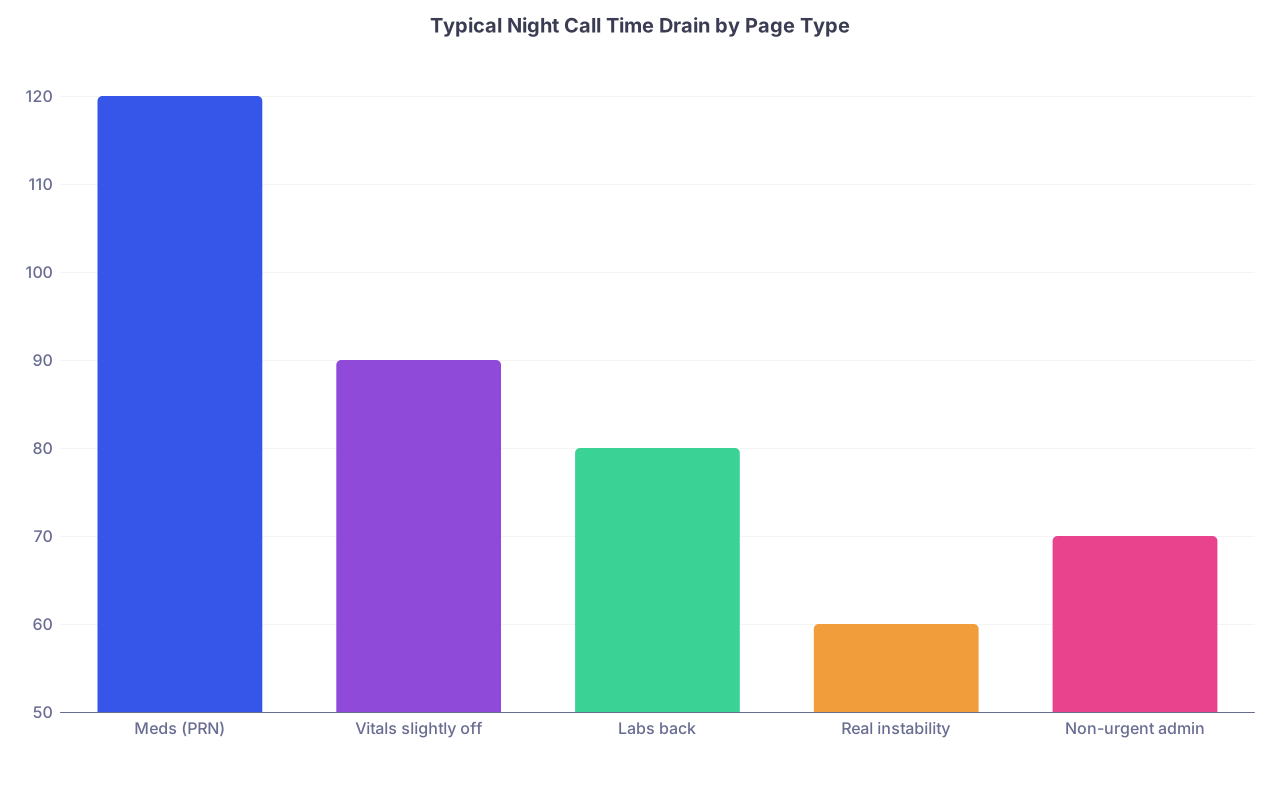
| Category | Value |
|---|---|
| Meds (PRN) | 120 |
| Vitals slightly off | 90 |
| Labs back | 80 |
| Real instability | 60 |
| Non-urgent admin | 70 |
Those numbers aren’t minutes per page. That’s total minutes per category over a single night that I’ve actually watched interns waste.
The paging trap here is simple: you feel anxious and inexperienced, so you move your body instead of using your brain. You go see everything “just to be safe” because you don’t yet trust your judgment. That sounds responsible. It’s not. It’s unsustainable.
How to avoid this
Do not answer pages passively. Triage over the phone first. Every time. A safe, structured approach on the phone prevents a ton of unnecessary walking.
You should be asking, in this order:
“Is the patient stable right now?”
You want: current vitals, mental status, any acute change.“What exactly prompted the call?”
New pain, new fever, new rhythm, abnormal lab, med request, family concern?“What have you already done?”
PRNs given? Fluids started? EKG done? Repeat vitals?“Where is the patient?”
Tele vs floor vs step-down vs ICU.
Only then decide:
- Phone order only (e.g., Tylenol, laxative, PRN antiemetic, hold BP med)
- Chart review + phone order
- Quick bedside check
- Immediate, drop-everything bedside assessment
If the nurse says: “Their BP is 90/58 but they’re asymptomatic, this is baseline, they’re sleeping,” that’s very different from “BP 90/58 from 140/80 earlier, HR 120, diaphoretic and confused.” Same number, different urgency.
Do not fall into the “I’ll just go see them to be safe” reflex without data. Ask first. Decide second. Move third.
2. Answering Pages in Random Order
Another classic intern move: you get 4 pages, you respond in the order they arrive instead of the order they matter.
So you call back:
- The page from 15 minutes ago for constipation.
- Then the page for a missing DVT prophylaxis order.
- Then the PRN anxiety med.
- Then, finally, the page for “patient with sats dipping to 86%, increased work of breathing.”
You’ve just inverted reality. You handled comfort issues before an airway issue. It might still work out most of the time. Until it doesn’t.

| Step | Description |
|---|---|
| Step 1 | Pager beeps |
| Step 2 | Scan all unread pages |
| Step 3 | Call back unstable page first |
| Step 4 | Sort by urgency |
| Step 5 | Safety issues - oxygen, vitals |
| Step 6 | Time sensitive orders - antibiotics, insulin |
| Step 7 | Comfort/paperwork last |
| Step 8 | Any clearly unstable? |
The mistake isn’t just slow response; it’s lack of a system. Nights are chaos by default. If you don’t impose your own triage structure, the pager will do it for you. And the pager is stupid.
How to avoid this
You need a working priority list in your head. Something like:
Airway / breathing issues
Low sats, new oxygen requirement, increased work of breathing, stridor, confusion + hypoxia.Circulation / hemodynamics
Hypotension, tachycardia with symptoms, chest pain, arrhythmia, bleeding.Neuro status changes
New confusion, new focal deficits, seizure, not waking up.Time-sensitive meds / labs
Antibiotics, insulin for DKA or very high sugars, anticoagulation, transfusion orders.Everything else
Pain meds, nausea, sleep meds, bowel meds, “family wants update,” missing diet order, etc.
When several pages drop at once, you:
- Read them all quickly.
- Mentally tag each as 1–5.
- Call back in order of risk, not order received.
If your attending ever asks, “Why did you see patient B before patient A?” and your answer is “Because the page came first,” you’re doing it wrong. The correct answer should sound like, “Because B had new hypoxia and tachycardia; A was a constipation page that could wait 20 minutes.”
3. Doing Zero Prep Before Calling Back
This one kills your efficiency and your credibility.
Here’s what I see all the time: pager goes off, intern immediately dials back while walking, no chart open, no clue who the patient is. The nurse answers and you’re trying to guess the diagnosis, meds, and code status from memory. You can’t. So you say, “Let me check and call you back.” Now you’ve wasted two calls.
The paging trap here is reflexive speed without preparation. You feel proud you called back “right away.” But you weren’t actually ready to make a decision.
How to avoid this
You can prep in 30–60 seconds and save yourself 10 minutes of confusion.
Before you call:
- Open the chart.
- Scan:
- Last 24 hours of vitals.
- Most recent note or H&P.
- Active problem list.
- Code status.
- Allergies.
- Relevant labs if you can guess the topic (K trending down? Cr high?).
Now when the nurse says, “BP is 88/54," you already know:
- They’re septic, were 100/60 all evening, lactate was up.
- They got 1L fluid 2 hours ago.
- They’re full code.
You can respond intelligently and quickly. You sound like you actually know the patient because, in that moment, you do.
And if you’re headed to the bedside, this 60-second check is non-negotiable unless the page explicitly says “code,” “patient not breathing,” or “found unresponsive.”
4. Never Grouping Tasks (The “Ping-Pong Intern” Problem)
If you want to waste an entire night, walk to the same unit over and over again for single, tiny tasks.
I watched an intern once:
- Go to 7E for a Tylenol order.
- Come back to the workroom.
- Ten minutes later, return to 7E for a bowel regimen order.
- Then again for “insert diet order.”
- Then again for “sign home meds reconciliation.”
Same unit. Same nurses. Each walk 5–10 minutes round-trip. She burned nearly 90 minutes on what could’ve been 20.
That’s the paging trap of fragmentation. The pager fractures your attention. And if you let it, your movement too.
How to avoid this
You have to batch.
Every 10–15 minutes, or every time you’re about to leave a unit, do a quick sweep:
- Check for any unread pages on that unit.
- Ask the charge nurse: “Anything else you’re waiting on me for while I’m here?”
- Check your to-do list by floor.
| Pattern Type | Description | |
|---|---|---|
| Ping-pong | Multiple single trips per unit | 60–120 min/night |
| Batched by floor | Cluster orders/assessments by unit | 20–40 min/night |
| Chartless calling | Call back with no prep | 30–60 min/night |
| Prepared calling | 30–60 sec chart review first | 10–20 min/night |
On the phone, when you handle something minor for a nurse, end with:
“Is there anything else for this patient while I’m in the chart?”
Then:
“Anything else on your other patients right now you want to bundle while we’re talking?”
Some nurses will say no. Some will absolutely bundle. It saves everyone time, especially at 3 am.
5. Accepting Every Non-Clinical Page as Your Job
You’re not just vulnerable to real clinical interruptions. You’re vulnerable to everything that comes through as a page because you’re afraid to say no.
You’ll get paged for:
- “Can you write the ‘okay to shower’ order?”
- “Family would like an update on when they’re going home.”
- “Patient wants the volume up on the TV.”
- “We need a diagnosis code for this admin form.”
If you treat all of these as your urgent responsibility, you’ll drown in nonsense. And the cruel part? You’ll still feel guilty you’re not doing “real doctoring.”
How to avoid this
You need a mental boundary line:
Safety vs Convenience vs Bureaucracy.
Safety issues (airway, breathing, circulation, neuro change, sepsis, acute pain, severe agitation) → these are absolutely yours.
Convenience issues (TV remotes, bed angle, “patient doesn’t like this flavor of juice”) → these can wait or be redirected.
Bureaucratic issues (some paperwork that’s not time-sensitive for discharge, non-critical coding, duplicate documentation requests) → often can safely wait for day team.
You are allowed to say, calmly:
- “That’s not urgent; let’s have the day team handle it so it doesn’t delay anything important tonight.”
- “For TV volume/room comfort, can someone on the unit help with that while I’m tied up with a couple of sick patients?”
You should not be rude. But you also should not be endlessly available for every low-priority request just because it came through your pager.
6. Not Using a Simple, Ruthless To-Do System
Another way the pager wins: you keep tasks in your head. Or on random scraps of paper. Or scrawled on the sign-out sheet with arrows and circles.
Then at 5 am you realize you never:
- Reordered home beta blocker you held once.
- Checked the 2 am troponin.
- Called back that family about the CT results from midnight.
You didn’t “choose” to skip them. You just got buried.

The paging trap here is cognitive overload. Your working memory is already full with labs, meds, vitals, diagnoses. Then you try to pile tasks in there too. Something will fall off.
How to avoid this
You need a low-friction, always-with-you task capture system. I don’t care if it’s:
- A folded paper list in your pocket with sections by floor.
- A small notebook.
- A simple note app on your phone if allowed by your institution (check your policies).
But it must be:
- Easy to add to in <10 seconds.
- Easy to scan quickly.
- Organized in a way that suits how your hospital is laid out (by unit, by level of urgency, or both).
When a page comes in, and you can’t do the task right now:
- Write it down immediately.
- Tag it with:
- Patient name.
- Unit/room.
- Quick note: “2am trop,” “recheck K labs,” “call daughter,” “pain control plan.”
Then, when there’s a lull:
- Work through items by risk and time sensitivity.
- Cross them off physically. It helps your brain reset.
No system = guaranteed mental dropped balls = more pages later for things you were already supposed to handle.
7. Ignoring Patterns in Pages (So You Keep Getting the Same Ones)
If you keep getting the exact same type of page every night, that’s not “bad luck.” That’s a systems problem you haven’t fixed yet.
Common examples:
- Chronic constipation patient: paged nightly for “no BM in 2 days.”
- Chronic pain: paged every 4 hours for inadequate PRNs.
- Diabetic patient: paged repeatedly for out-of-range sugars because the correction scale is too weak or mistimed.
This is the looping paging trap. You’re reacting at 2 am to a problem you could have prevented at 4 pm with a decent standing plan.
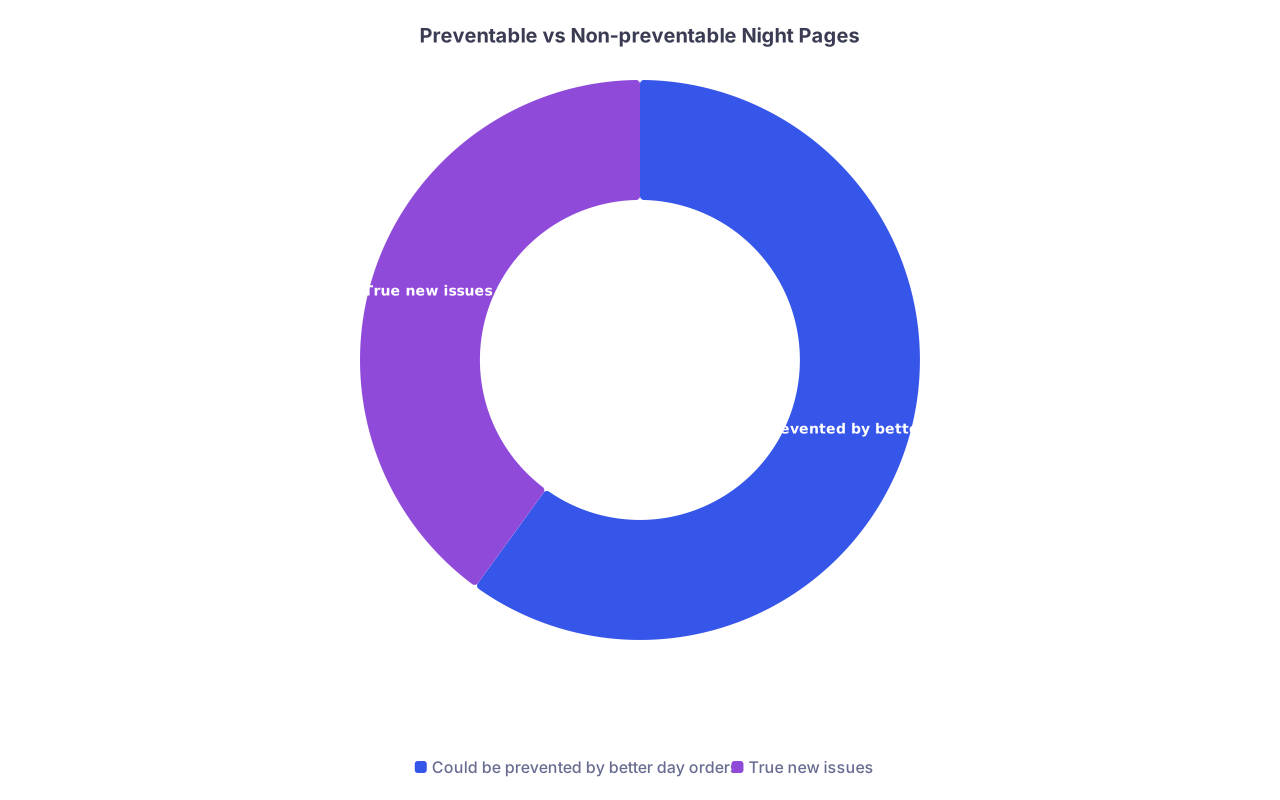
| Category | Value |
|---|---|
| Could be prevented by better day orders | 60 |
| True new issues | 40 |
That 60% number isn’t exaggerated. On a poorly run service, most of your pages stem from incomplete or lazy daytime orders.
How to avoid this
During the day, especially at sign-out time:
- Look for the “usual suspects”:
- Patients with no bowel regimen.
- Poorly controlled pain with only q6h PRN options.
- Known insomniacs with nothing ordered for sleep.
- Very tight glucose targets in frail or fluctuating patients.
- Write anticipatory orders:
- Bowel regimen with a step-up algorithm.
- Clear multimodal pain plan (scheduled + PRN).
- Conservative, realistic glucose ranges with correction protocol.
- PRN sleep med if clinically appropriate.
Also—tell your night self what’s coming:
“Room 12: high risk for decompensation, we’ve had to bolus them twice today; low threshold to call ICU.”
“Room 19: mild chronic pain but super anxious; you’ll get pages—try scheduled Tylenol plus PRN and set expectations.”
Good sign-out isn’t courtesy. It’s pager defense.
8. Failing to Escalate Early When Things Feel Wrong
Here’s a quieter but dangerous paging trap: you do answer, do see the patient, but then sit on a bad situation alone for too long because you’re scared to “bother” your senior or attending.
So you:
- Get a page: “BP 82/50, HR 120, febrile.”
- Go see the patient.
- Suspect sepsis, order labs, cultures, fluids, broad-spectrum antibiotics.
- But you’re unsure about ICU vs floor, so you “watch them for a bit.”
Ninety minutes later, they’re on pressors in the unit and your senior is asking, “When did this start?”
The trap here is ego mixed with fear. You want to manage independently. You also don’t want to look incompetent. So you stay silent longer than is safe.

How to avoid this
You should call early for:
- Any patient with sustained hypotension or tachycardia with concern for shock.
- New or worsening hypoxia not fixed by a small bump in oxygen.
- Any real concern for stroke, seizure, or acute mental status change.
- Any arrhythmia you’re not fully comfortable managing.
- Any feeling of “I’m out of my depth and something is off.”
Your senior would rather be called early and often than late and once.
When you call, have a clear, succinct presentation ready:
- “I was paged at 01:30 for X.”
- “Vitals then and now: …”
- “Exam: …”
- “Labs/Imaging: …”
- “I’ve done A, B, and C.”
- “I’m worried about [shock/PE/stroke/etc.] and think we may need ICU/rapid response.”
That doesn’t make you look weak. That makes you look safe.
9. Letting the Pager Control Your Night Instead of Planning Ahead
The final mistake is more global: you start your shift reactive instead of proactive. No pre-rounding on which patients are sickest. No mental map of the floors. No rough plan for when you’ll:
- Check labs.
- Follow up on imaging.
- Update families.
- Reassess borderline patients.
So when the pager chirps, it feels like random lightning from a black sky. You’re always surprised. Always behind.

| Step | Description |
|---|---|
| Step 1 | Start of Shift |
| Step 2 | Review sickest, labs, pending tests |
| Step 3 | Wait for pages |
| Step 4 | Set priorities and reminders |
| Step 5 | Constant interruptions |
| Step 6 | Controlled response to pages |
| Step 7 | Missed follow ups, repeated pages |
| Step 8 | Proactive check? |
How to avoid this
In the first 30–45 minutes of your shift (when possible):
- Review:
- Which patients are actually sick.
- Recent abnormal trends.
- Pending tests that will come back overnight.
- Decide:
- Who needs a check-in regardless of pages.
- Which results are critical to act on immediately.
- Set:
- Your own “internal pages” — manual reminders to yourself to re-check things at specific times.
You will still get hammered by unexpected pages sometimes. But there’s a huge difference between “interrupted while moving toward a plan” and “interrupted while already lost.”
Quick Visual: Where Interns Lose Their Nights
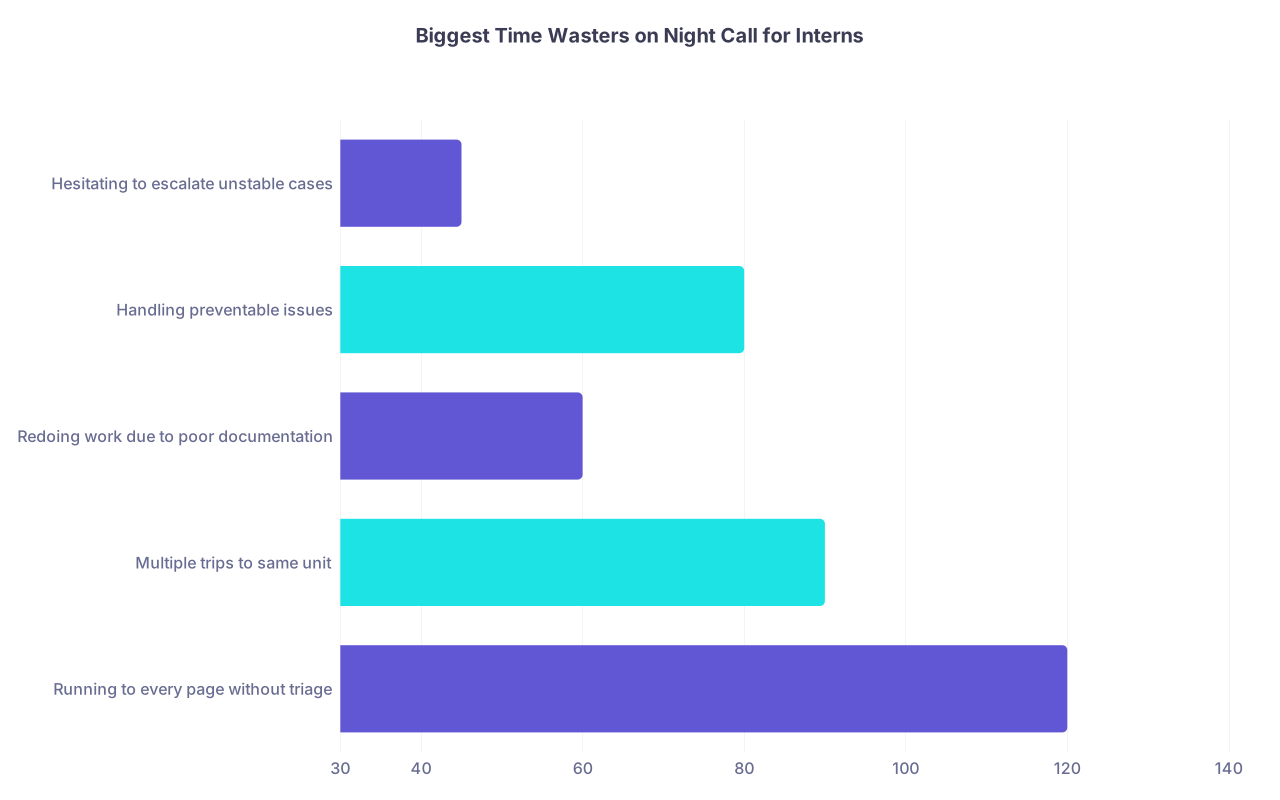
| Category | Value |
|---|---|
| Running to every page without triage | 120 |
| Multiple trips to same unit | 90 |
| Redoing work due to poor documentation | 60 |
| Handling preventable issues | 80 |
| Hesitating to escalate unstable cases | 45 |
Those are ballpark minutes per bad habit per night. Stack two or three of these and your entire 12-hour shift is gone.
The Bottom Line: Don’t Feed the Pager Monster
If you remember nothing else, remember this:
Not every page is an emergency.
Triage by safety, not by timestamp. Ask structured questions before you leave your chair.Preparation beats speed.
A 60-second chart review before calling back can save you 10 minutes of fumbling and a second call.Proactive systems prevent half your pages.
Good anticipatory orders, real sign-outs, batching by unit, and a ruthless to-do list will protect your sanity—and your patients.
The pager isn’t going away. But it doesn’t have to own your night.