The fastest way to lose the trust of your team as an intern is not a medical error. It is calling for help the wrong way at 2 a.m.
Everyone tells you, “Always ask for help.” That’s only half true. The part nobody writes in handbooks is how, when, and in what state you ask for it. That’s what attendings and seniors judge you on. Quietly. Permanently.
Let me walk you through how this really works on overnight intern shifts, because what your program director says at orientation and what your senior thinks at 3:27 a.m. are not the same thing.
What Seniors Actually Want From You Overnight
Seniors are not sitting at home or in the call room hoping you never call. They’re running a continuous calculation in their head:
“Can I trust this intern’s judgment? If they’re calling, do I need to sprint, walk, or just advise?”
They’re not grading you on whether you know everything. They are grading you on three things:
- Do you recognize when something is wrong early?
- Do you call before it’s a disaster?
- Do you bring something to the table when you call?
That third one is where most interns fail.
Your job is not to be a walking UpToDate article. Your job is to be the early warning system with a half-formed plan.
Let me make this more concrete.
A good 2 a.m. call from an intern sounds like this:
“Hey, sorry to wake you. It’s John on 6 West. I’m worried about Mr. Smith in 624. He was stable at sign-out, now his BP dropped from 120s to 80s over the last 20 minutes, HR is 120, he looks clammy. I repeated vitals, started a 500 cc LR bolus, got a stat CBC, BMP, lactate, and I’m at bedside. I think he’s septic vs bleeding—no obvious source yet. Can you come take a look with me?”
That call tells your senior:
- You recognized a change.
- You did immediate basics.
- You’re physically with the patient.
- You have a differential, however rough.
- You’re asking for specific help.
A bad 2 a.m. call:
“Uh, hey, the nurse says the patient in 624 doesn’t look good. What do you want to do?”
That’s how you get labeled “needs handholding.” And that label will follow you to every eval.
The Red-Line Situations: You Call First, Think Second
There are scenarios where the unwritten rule is: call now, organize your thoughts while they’re on the way.
Every senior and attending I know would rather be woken up for a false alarm in these categories than hear the words “it started a while ago, but I thought I could handle it.”
These are the “no one will ever be mad you called” scenarios:
| Scenario Type | Examples (Not Exhaustive) |
|---|---|
| Airway/Breathing | New stridor, severe dyspnea, SpO2 < 88% on max support |
| Hemodynamic collapse | SBP < 80, MAP < 60 with symptoms, new mottling |
| Neuro changes | New focal deficit, unresponsive, seizure |
| Chest pain/red flags | Suspected MI, PE, aortic catastrophe |
| Active bleeding | Hematemesis, melena with hypotension, surgical site bleed |
If you are even thinking:
- “This could crash in the next 5–10 minutes,” or
- “If this goes bad, I cannot fix it alone,”
You do not worry about “bothering” the senior. You do not spend 20 minutes reading about septic shock targets before you call.
I’ve watched interns try to “fix it first, then call if I can’t.” That’s how people end up in morbidity and mortality conferences.
So the first unwritten rule: if the patient could die in the next 30 minutes, you call. Full stop. You will never be punished for that. You will be punished for waiting.
The Pre-Call Checklist: What You Do Before You Dial
Here’s the part nobody tells you explicitly: the fastest way to earn respect overnight is to have a predictable rhythm when you call. Seniors start to notice, “When this intern calls me, I know they’ve already done X, Y, Z.”
There’s a mental checklist you should run through for almost every “I think I need help” situation. Not perfectly. Not every box every time. But this is the skeleton:
See the patient. In person.
Reading the vitals on the board is amateur hour. I’ve heard seniors say, “If they call me without seeing the patient, I already don’t trust their judgment.” Go to the room. Look at them. Listen to their breathing. Talk to them if you can.Get current vitals and trends.
Not “he was 120/80 earlier.” You want, “BP was 118/76 at 20:00, now 86/50 at 01:40, HR climbing from 90 to 120.”Talk to the nurse.
Ask: “What changed? When did you first notice it? Anything given recently? How does this compare to earlier tonight?”
Good nurses will tell you, “He’s not himself,” and they’re usually right. Don’t ignore that.Do one or two basic interventions if safe.
Oxygen up. IV bolus if hypotensive and not in florid pulmonary edema. Check blood sugar. Recheck a manual BP. Pain meds for obvious pain if appropriate. You don’t need to fix the world, but you should do the low-risk, high-yield basics.Collect key data.
Quick chart review. Recent labs. Code status. Active problems. Was there a recent change in meds or status? Did GI just scope him? Did he just come from PACU?
Then, and only then, do you call.
The secret: seniors don’t expect you to know the answer. They expect you to show your work. If you consistently call with, “I saw the patient, did these 1–2 things, and here’s what I’m seeing,” you start getting trusted fast.
How to Present the Situation at 3 a.m. Without Sounding Lost
Delivery matters more than you think.
Same clinical scenario, two different interns:
Intern #1:
“Hey, Mr. Jones is kind of hypotensive, I think? I’m not sure, the nurse is worried and I haven’t seen him yet but I can, uh, check.”
Intern #2:
“Hey, Mr. Jones in 514—post-op day 1 from colectomy—was 120/70 earlier, now 82/50 and HR 118. I went to see him—he’s alert but dizzy when he sits up, belly soft with mild tenderness, no peritoneal signs. I gave 500 cc LR, BP nudged to 90/55. No chest pain, lungs clear, urine output has dropped this shift. I’m worried about hypovolemia vs early sepsis. I’d like you to come see him.”
Same knowledge base. Completely different impression.
Here’s a simple structure you can default to on overnight calls. Think of it as SBAR with a spine:
Who you are & who the patient is
“This is Sarah, the night float intern. I’m calling about Mr. X in 432, 68-year-old with COPD and CHF.”What changed & how fast
“He was stable at sign-out, and over the last hour his O2 sat has dropped from 94% on 2 L to 86% on 4 L, RR went from 16 to 28.”What you saw at bedside
“I saw him—he’s using accessory muscles, speaking in short phrases, diffuse wheezes, no new focal findings, no chest pain.”What you already did
“I increased O2 to 6 L, gave scheduled nebs plus one PRN, got a stat CXR and ABG, and called RT.”Your working differential & ask
“I’m thinking COPD exacerbation vs pneumonia. I’d like you to come see him and help decide if we need ICU or can manage on the floor.”
That’s what a “good call” sounds like to a senior. You’re not babbling. You’re not dumping the entire chart. You’re not saying, “I don’t know anything, please fix it.”
You’re saying: “I’m in the game. Join me.”
The Politics of “Too Much Help” vs “Not Enough”
Here’s the uncomfortable truth: there is a narrow band of calling behavior that gets you labeled “strong.” Too far either way and you get a reputation.
And yes, people absolutely talk about it at 7 a.m. checkout.
- “She never calls for help; I only find out when things are already on fire.”
- “He calls for literally everything; I can’t sleep when he’s on.”
You do not want to be in either sentence.
The center lane looks like this:
- You call early for real changes in status.
- You do not call for every 99.3 fever or mild tachycardia in an otherwise stable post-op.
- You do call if a patient you were slightly worried about keeps drifting in the wrong direction.
- You use messaging/texting (if your system has it) for low-acuity questions, not STAT pages.
The way seniors quietly grade you is by pattern:
If in a given night:
- You see your patients.
- You handle straightforward pages (constipation, mild pain, reordering home meds) without needing a phone-a-friend.
- You call once or twice for real issues with a clear presentation and a basic plan.
You’re gold.
But let’s be clear on the flip side. There are interns who under-call. Usually the “I don’t want to look dumb / bother people / admit I’m out of my depth” type.
Those are the ones who get burned.
I remember one IM senior walking into sign-out fuming because an intern had “managed” a spiraling septic patient for hours—fluids, repeat labs, some random antibiotics—without ever calling. The patient ended up in the ICU on pressors by morning.
The senior’s exact line in the workroom:
“He had six hours to pick up the phone. I don’t trust him anymore.”
That’s how reputations really form.
Common Overnight Scenarios: When You Should Call vs Manage
Let me give you a few patterns. These are not rigid rules, but they track with how most experienced seniors think.
Scenario 1: Hypotension
Call immediately if:
New SBP < 90 or MAP < 60, especially with symptoms (dizziness, chest pain, AMS, low urine output). Particularly if they weren’t like this at sign-out.Reasonable to start working, then call quickly:
Mild drop (e.g., 110 to low 90s) in an asymptomatic, post-op patient where you suspect relative hypovolemia. You can give a small bolus, reassess, but if the trend continues downward, you call.Manage yourself, communicate later:
Borderline low pressures that are baseline for that patient, asymptomatic, with a clear explanation in the chart, and your senior has explicitly said, “Don’t wake me for SBP in the 90s in this guy.”
Scenario 2: Chest Pain
- You call for all new chest pain. Period.
The only nuance is how frantic you sound. Exertional, pressure-like, associated with diaphoresis or dyspnea? Sound urgent. Atypical, reproducible, minor discomfort on palpation in a 22-year-old? Sound calm—but still call, get an EKG, basic labs.
If your senior finds out in the morning that someone had chest pain at 1 a.m. and you didn’t call, you’ve just failed a core safety test.
Scenario 3: Fever
This is one where interns overcall early on and then undercall when they get comfortable.
- You call if:
Fever + hemodynamic instability, altered mental status, immunosuppression, neutropenia, major lines/devices, or if you’re just uneasy because “this patient looks sick.” - You usually manage and update in the morning if:
Isolated 38.1 in a stable patient, already on antibiotics, you’ve checked the basics (CXR if respiratory symptoms, urinalysis if urinary symptoms, blood cultures if appropriate), they’re not toxic, and your senior has previously outlined what to do.
The secret is this: if you’re having an internal debate about whether you need to call about a fever, you probably should. At least early in the year.
How to Use Nurses as Allies, Not Just Pagers
Overnight, your best ally is not UpToDate. It’s the seasoned night nurse who’s been there longer than your attending.
The unspoken dynamic: nurses know which interns are safe to page and which ones will delay care. They will escalate differently depending on which bucket you’re in.
You want to be the intern where they think:
- “If I page them and say I’m worried, they’ll take it seriously.”
- “They come to the bedside and listen.”
- “If it’s bad, they don’t hesitate to call the senior.”
A few behind-the-scenes truths:
- Nurses absolutely notice when you call the senior early vs sit on things.
- They will mention it to the senior: “Yeah, she came right away and called you quickly.” Or, “He seemed unsure what to do, and I had to ask him to call you.”
- Those comments shape how much rope your seniors give you going forward.
So, practical rule:
- If a nurse who is usually calm says, “I really don’t like how this patient looks,” I don’t care what the vitals say—you go, you evaluate, and you have a low threshold to call your senior from the bedside.
When You Disagree With Your Senior (Yes, It Happens)
Another unwritten rule: you’re allowed to push back—carefully.
Sometimes your gut is screaming louder than your senior’s reassurance. Classic setup: you call for a concern, senior downplays it, tells you, “Just give a bolus and recheck,” but the patient still looks bad to you.
Here’s how the mature intern handles it:
- You do what they said promptly.
- You reassess the patient yourself, not 90 minutes later, but in 10–20 minutes.
- If they’re still circling the drain, you call back and say something like:
“Hey, I did the bolus and repeated vitals. BP is still 82/48, HR is now 125, he looks more lethargic. I’m more worried now. I’d feel better if you came to see him.”
Most good seniors will hear the tone in that and come.
If they still brush it off and you’re honestly scared for the patient, the escalation path is:
- Call again and be direct about your level of concern.
- Loop in the charge nurse—they often help push for eyes on the patient.
- If you think it’s truly unsafe, you can go up the chain (attending, RRT, code). That’s rare, but it exists for a reason.
Your duty is to the patient, not to avoid bruising someone’s ego.
The Emotional Side: Fear of Looking Incompetent
Let me say this bluntly: every good intern has made at least one humiliating 3 a.m. call.
You will have a moment where you wake a senior for something stupid. You misread a monitor. You panic over a benign rhythm. You freak out about a “low” BP that’s the patient’s baseline.
It happens. To everyone.
What differentiates the ones who grow from the ones who stagnate is what they do after:
- You remember the lesson.
- You adjust the threshold slightly.
- You ask the senior later, “For my learning, what would you want me to do next time?”
What you do not do is swing all the way to the other extreme and stop calling when you should because of one awkward interaction.
The secret most interns don’t know: seniors and attendings aren’t just evaluating your medical thinking. They’re evaluating your trajectory. Does this intern learn? Do they calibrate? Do they show better judgment in October than they did in July?
If the answer is yes, they forget the dumb call. If the answer is no, that’s when the narrative “doesn’t improve” starts to stick.
A Simple Overnight Mental Model to Keep You Out of Trouble
When you’re alone in the hallway at 2:30 a.m., here’s the mental algorithm I’d actually use, not the sanitized one in your orientation slides:

| Step | Description |
|---|---|
| Step 1 | Notice change or get page |
| Step 2 | See patient in person |
| Step 3 | Call senior immediately |
| Step 4 | Get vitals, talk to nurse |
| Step 5 | Do basic interventions |
| Step 6 | Manage and recheck soon |
| Step 7 | Call senior with summary + plan |
| Step 8 | Reassess with senior |
| Step 9 | Life threat in next 30 min? |
| Step 10 | Clear plan and patient stable? |
If you follow that 80% of the time, you’ll be fine. The remaining 20% you’ll refine by watching how your seniors behave.
And that’s another trick: study your seniors. The good ones. Listen to what they ask, what they do first, when they look relaxed vs when they start moving faster. They’re giving you the unwritten rules in real time without saying a word.
The Long Game: How Your Help-Calling Style Shapes Your Reputation
What nobody tells you during intern year is that the way you handle nights is one of the strongest signals about your future ceiling.
I’ve sat in those behind-closed-doors meetings where faculty talk about residents. Phrases like:
- “Solid clinically, but I don’t trust their judgment at night.”
- “She calls appropriately and early. I sleep well when she’s on.”
- “He’s smart but doesn’t know when he’s in over his head.”
Those comments didn’t come from clinic days. They came from overnight behavior.
When you:
- Call early for real problems
- Show you’ve thought and acted before calling
- Are humble enough to ask for help but not so helpless you need spoon-feeding
you get slotted in the “safe, reliable, leadership potential” category. That’s who gets the letters. The chief positions. The fellowships.
It starts with those messy, sleep-deprived, anxiety-filled calls you make this year.
Final Thought: You’re Not Supposed to Be Good at This Yet
You’re not failing because you’re unsure when to call. You’re an intern. The uncertainty is the job.
What separates decent interns from excellent ones isn’t knowing everything. It’s how quickly they learn the rhythm of:
- See the patient.
- Do the basics.
- Call early for the right things.
- Bring a snapshot and a rough plan.
- Adjust their threshold with each night on call.
Master that, and overnight shifts stop feeling like Russian roulette and start feeling like controlled chaos.
And once you’ve learned how to call for help the right way, the next step is learning how to be the person on the other end of that midnight page—the senior who can read an intern’s voice and know exactly how fast to run. But that’s a story for another year.
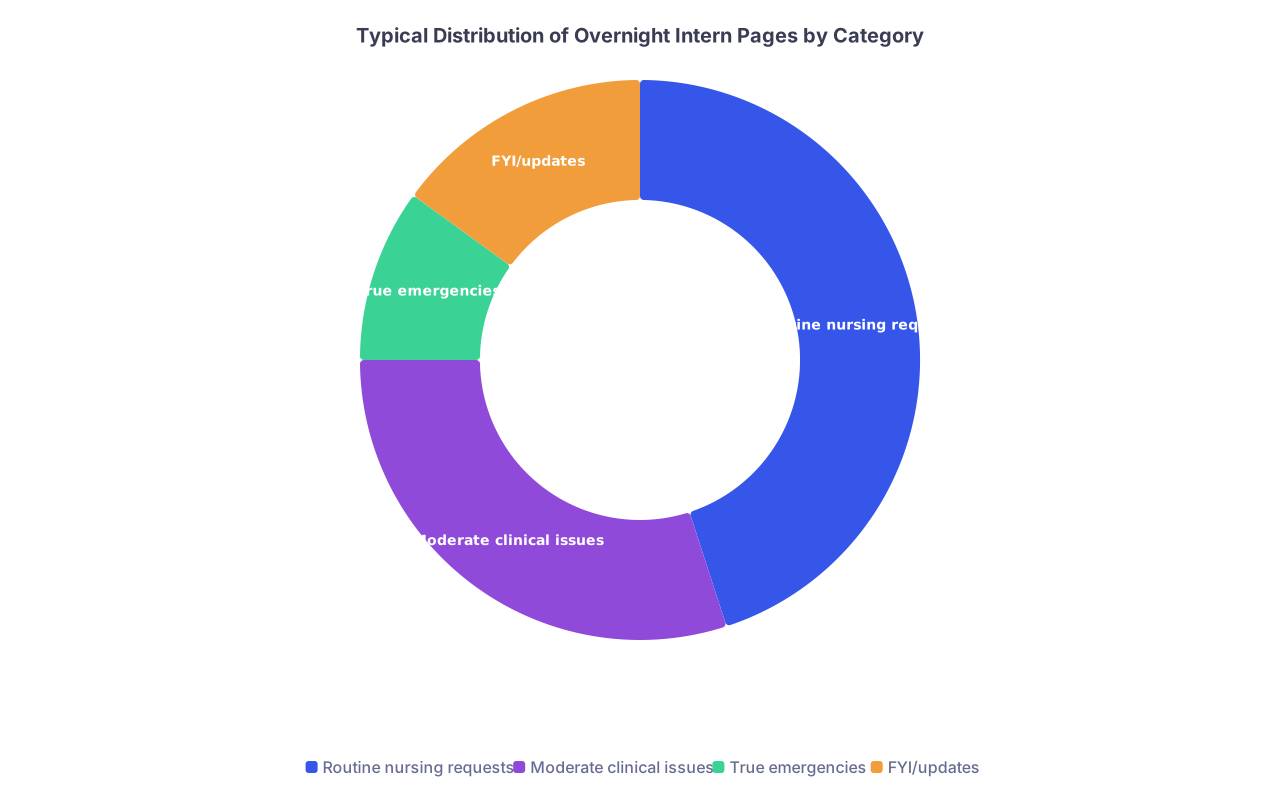
| Category | Value |
|---|---|
| Routine nursing requests | 45 |
| Moderate clinical issues | 30 |
| True emergencies | 10 |
| FYI/updates | 15 |


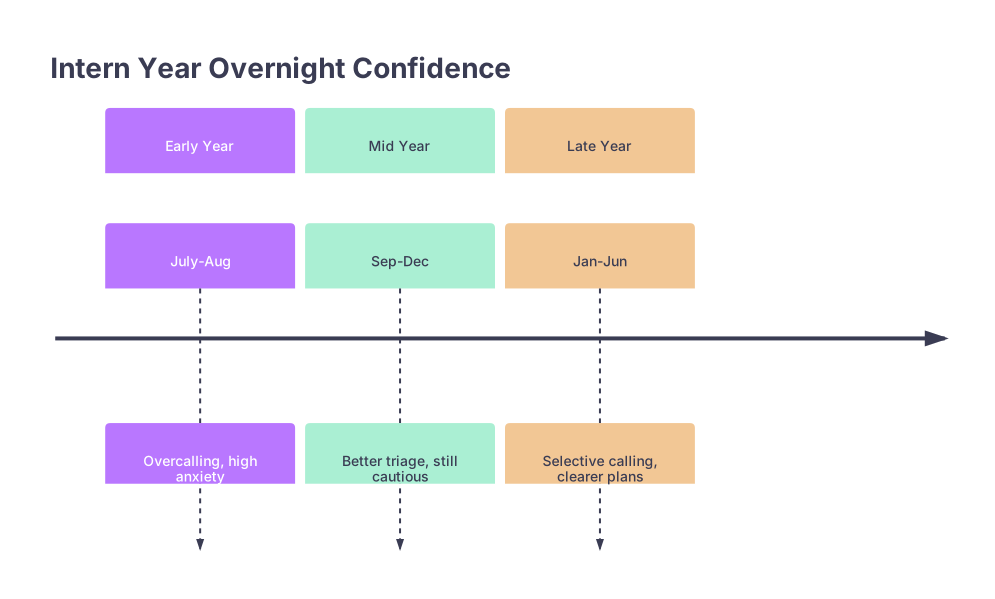
| Period | Event |
|---|---|
| Early Year - July-Aug | Overcalling, high anxiety |
| Mid Year - Sep-Dec | Better triage, still cautious |
| Late Year - Jan-Jun | Selective calling, clearer plans |