
The attendings who pressure you to ignore duty hours are wrong—and you will be the one punished if something goes bad.
That’s the ugly truth. You’re caught between people who control your evaluations and rules that can endanger your program if broken. So you feel trapped. Do the “team player” thing and stay late? Or follow ACGME rules and get labeled “not committed”?
Let me walk you through what to do, step by step, depending on exactly how bad your situation is.
Step 1: Name Which Situation You’re Actually In
Not every duty hour conflict is the same. Before you react, be brutally specific about what’s happening.
You’re in one (or more) of these buckets:
The “Just Finish Up” Pressure
You’re post-call, technically supposed to leave, but the attending says things like:- “Just finish your discharges. It’s only another hour.”
- “We all did this as interns. The rules are too soft now.”
The Chronic Overload Service
The workload is objectively impossible to complete within duty hours. Nobody explicitly tells you to lie, but everyone just… does.The Explicit “Fudge the Numbers” Request
Your senior or attending directly tells you:- “Just log 80 hours. We all know it’s more, but don’t tank the program.”
- “Don’t put that you stayed until midnight. Just mark 10 p.m.”
The Retaliation Threat
You hinted at duty hours, and now you’re hearing:- “Residents here don’t complain.”
- “If you care this much about hours, maybe this specialty isn’t for you.”
These are not handled the same way. You don’t go nuclear on situation #1. But you also don’t politely “keep working on your communication” in situation #4.
Step 2: Know the Rules Better Than the People Breaking Them
If you’re going to push back, you’d better be precise.
| Rule Type | Common Standard |
|---|---|
| Weekly limit | ≤ 80 hours/week averaged over 4 weeks |
| Shift length | Max 24 + 4 hours transition |
| Days off | 1 day in 7 free of clinical duty |
| Time between shifts | 8–10 hours (varies by specialty) |
| In-house call freq | No more often than every 3rd night |
Check your own program’s policy—GME or your resident handbook. Save the PDF. Screenshot it. You are not arguing from “I feel tired.” You’re arguing from: “This is out of compliance with ACGME and our written policy.”
Why this matters:
- If/when you escalate, you must be fact-based.
- Your chief/residency leadership is required to respond to patterns, not vibes.
- If your attending tells you “That doesn’t apply here,” you’ll know they’re bluffing.
Step 3: Handle the “Just Stay Late” Scenario in Real Time
Let’s say it’s post-call. You’ve hit 24+4 hours. You’re drowning in sign-outs and discharges. The attending says:
“We still have two new admits and four discharges. Just push through. You can sleep later.”
Here’s how to respond in a way that protects you without setting off a bomb.
First move: Anchor to the rules and the patient.
Try:
- “I’m already at my 24+4 hours today. If I stay, I’ll be over duty hours. I want to make sure the handoff is safe and detailed before I leave.”
- “I can stay to give a thorough sign-out now, but I shouldn’t be managing new admissions at this point. I’ve been here 26 hours.”
If they push back:
- “I want to respect the duty hour rules because they exist for patient safety and for the program’s accreditation. How do you want to redistribute this work?”
You are:
- Not refusing to help.
- Not saying “I’m tired.”
- Putting the responsibility to “solve” the workload back on the attending.
If they still insist?
You do the safest possible compromise in the moment:
- Prioritize critical patient care (active instability, stat issues).
- Give meticulous sign-out.
- Document in your logbook/work-hour tracker honestly.
- Then you leave.
Yes, some attendings will be annoyed. But you will have:
- Stayed inside the rules as much as possible.
- Limited your exposure.
- Preserved accurate documentation.
Later, you’ll decide what to do with that encounter (we’ll get there).
Step 4: When Your Senior is the Problem
Often it is not the attending directly. It is your senior resident:
“Don’t log more than 80. It’ll screw all of us.”
“Nobody logs the real hours here. Just be smart.”
That’s a cultural problem, not just one bad supervisor.
In the moment, avoid direct confrontation you can’t win. But don’t cave on your logs.
You can say:
- “I get what you’re saying. I’m still going to log my actual hours so I don’t get in trouble later.”
That’s it. Don’t over-explain. Don’t preach.
Then you:
Start tracking your hours independently (simple spreadsheet, note app). Keep:
- Date
- In time / out time
- Service / site
- What caused the late stay (call, admission, procedure).
Compare your own log with the official system.
If the official system “rounds you down” or auto-adjusts, screenshot before/after if you can.
This set of receipts is what makes your later conversation with leadership concrete, not whiny.
Step 5: Decide Your Escalation Level
You don’t need to file a formal complaint every time you work 81 hours one week. But patterns matter.
Use this mental framework:
Level 0 – Single Mild Violation, No Pattern
Example: You stayed 1–2 hours late one time to stabilize a crashing patient. The attending was reasonable. You logged it accurately. No one told you to lie.
Next steps:
- Document accurately.
- Move on.
- If it keeps happening, it’s no longer Level 0.
Level 1 – Repeated Overages, No Overt Coercion
Example: On your ICU rotation, you’ve hit 84–90 hours per week for 3 out of the last 4 weeks. Everyone shrugs. No one explicitly says “Lie,” but the vibe is “suck it up.”
Here’s what you do:
Bring this to your chief resident. Not as a complaint, but as a problem to solve.
Try:
“I’m concerned about our ICU hours. I’ve been logging 84–88 hours per week for the past three weeks. The workload seems consistently above what can be done safely in 80 hours. I want to talk about how we can make this sustainable.”Come with specifics:
- Number of patients you’re covering.
- Times you’re regularly staying past sign-out.
- Call frequency.
Ask for solutions, do not demand them:
- “Is there a way to redistribute admits?”
- “Can we adjust sign-out patterns or get a float?”
Good chiefs will try to help. Weak chiefs will say “We all did it.” If they blow you off and the problem continues for an entire block, that’s a sign to go one level higher.
Level 2 – Direct Pressure to Lie or Ignore Rules
Example lines I’ve actually heard:
- “Do not put that in your logs. The ACGME audit will kill us.”
- “If you can’t handle the hours, this might not be the right program for you.”
This is not benign. This is a program putting itself above your safety and the rules.
Your sequence should be:
Document the exact words, date, and who said it. Immediately. In your own notes.
Try one direct boundary, if it’s safe:
“I’m not comfortable falsifying duty hours. I’ll keep logging my real hours and I’m happy to work with you on workflow solutions.”
Then escalate outside that person’s chain:
- If it’s a senior: go to chief resident or APD.
- If it’s an attending: go to program director or APD.
When you talk to leadership, lead with patient safety and accreditation:
“I want to bring something to you because it affects duty hour compliance and, honestly, patient safety. On [date], [person] told me to log fewer hours than I actually worked because it would hurt the program. I’m uncomfortable with that. I’ve been consistently over 80 hours on [rotation], here are my logs.”
If your leadership is functional, they will take this seriously.
If they don’t? You’re heading to Level 3.
Level 3 – Culture of Retaliation or Systemic Violations
Signs you’re here:
- Multiple residents have been warned not to “rock the boat.”
- People are afraid to raise issues with GME.
- You see duty hour violations suppressed or altered in the system.
- There’s open hostility when anyone brings up ACGME rules.
At this level, your strategy shifts. You’re doing two things at once:
- Protecting yourself in the short term.
- Setting up an external paper trail for the long term.
Step 6: Use the Safety Valves Your Program Hopes You Forget
You have more protection than you think, but you have to actually use it.
Use Anonymous or Semi-Anonymous Channels
Most programs have at least:
- A GME office contact (Director of GME, DIO).
- An anonymous reporting tool (sometimes via the hospital intranet).
- A resident council or house staff association.
You can submit something like this:
“I’m a current intern in [program]. On multiple services, we’re consistently working over 80 hours/week, and some supervisors are pressuring residents to under-report actual hours to keep the program out of trouble. This feels unsafe and against ACGME policy. I’m afraid of retaliation if I speak openly. I’m requesting that GME review duty hour logs against call schedules and consider confidential listening sessions with trainees.”
No drama. Just facts and asks.
Annual ACGME Survey: Don’t Waste It
That survey is not busywork. Programs panic about those results for a reason.
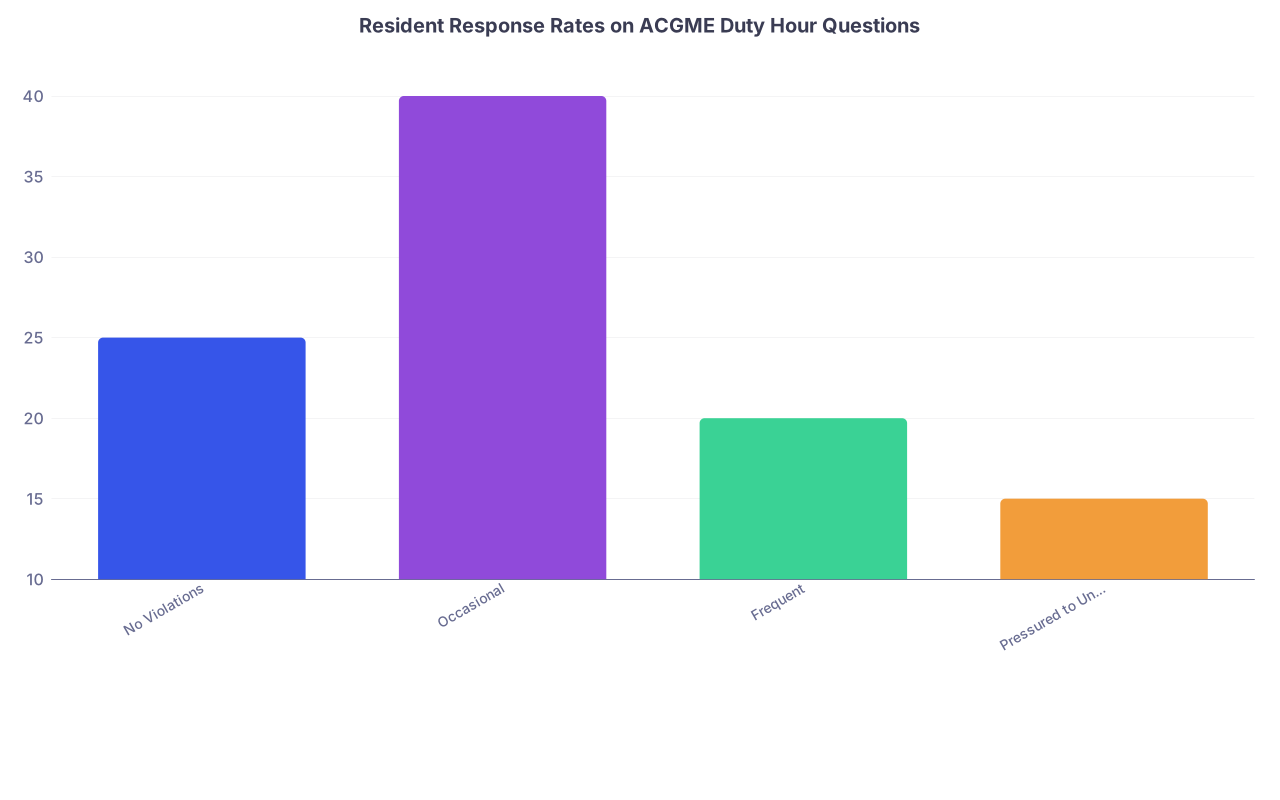
| Category | Value |
|---|---|
| No Violations | 25 |
| Occasional | 40 |
| Frequent | 20 |
| Pressured to Under-report | 15 |
If your situation is bad, you:
- Answer accurately.
- Do not sugarcoat to “protect” your program.
- Coordinate with trusted co-residents to report reality.
ACGME cares about patterns. Ten residents saying “frequent violations” and “pressured to under-report” is dynamite. It forces a response.
Step 7: How to Do This Without Torching Your Reputation
You’re right to be scared of getting labeled “difficult.” Medicine is petty. People talk.
So you have to be smart about tone and timing.
Here’s what to do:
Stay clinically excellent.
If you’re the intern who misses labs, ignores pages, and also complains about hours, you’ll be written off. Unfair, but true.Use neutral, professional language.
Never send an email saying “toxic” or “abusive culture.” That gives people something to attack. Say:- “Unsustainable workload.”
- “Consistent duty hour non-compliance.”
- “Concerns for patient safety.”
Focus on systems, not personalities.
Instead of “Dr. X is abusive,” try:
“On [rotation], we consistently have more patients than can be safely managed by one intern within duty hours. Multiple attendings expect work to continue post-call beyond 24+4 hours.”Choose your battles.
- Slight overage once, no one pressured you to lie? Log it. Move on.
- Repeated, systemic abuse with clear rules ignored? That’s worth escalation.
Step 8: When You Genuinely Need to Say “No” in the Moment
There are rare situations where you must draw a hard line. Example:
You’ve already done 28 hours in-house post-call because the team is overwhelmed. It’s now elective add-on cases, new procedures, “great learning opportunities.”
You’re barely functioning.
You say:
“I’m at 28 hours now and I’m not safe to continue clinical work. I need to hand off and leave.”
If they say “You have to stay,” you don’t start screaming. You calmly repeat:
“I’m not safe. I’m happy to call the chief or program director to clarify expectations, but I can’t safely continue.”
Then you call the chief yourself.
If the whole ladder fails and you’re forced to stay anyway, document:
- Date, time, who was present, what you said, what they said.
- Your logs, accurately.
This is the kind of thing GME and ACGME take very seriously later, especially if it’s not just you.
Step 9: Think Long Game: Your Career, Their Paper Trail
Residents forget this: attendings and programs are more exposed than you are.
You rotate out in a month or a year. They get ACGME inspections, CMS scrutiny, malpractice risk, and years of potentially bad recruiting.
So while it feels like you’re powerless, over time:
- Your accurate logs
- ACGME survey answers
- Anonymous reports
- Direct conversations with GME
…all add up.
Use them.
If you’re in a truly dysfunctional place with no sign of improvement:
- Keep your head down clinically.
- Protect your mental and physical health as much as you can.
- Keep receipts.
- Graduate.
- And then be honest—with applicants, in alumni surveys, with ACGME if they contact you.
That’s how broken programs eventually get fixed or closed.
Step 10: When It’s Eating You Alive
Duty hour violations aren’t just about sleep. They’re about burnout, depression, and mistakes you can’t unsee.
If you’re at the point where:
- You’re driving home and can’t remember the last few miles.
- You’re making near-miss medication or order errors.
- You’re crying in stairwells between pages.
You’re not being dramatic. You’re in danger.
Do three things:
Tell someone with power you trust.
- A chief you respect.
- An APD with a reputation for caring about residents.
- A faculty mentor.
Script:
“I’m at the point where the hours and workload are compromising my ability to practice safely. I’m exhausted beyond what is manageable and I’m worried I’m going to hurt someone or myself. I need help problem-solving this.”Use employee assistance or mental health resources.
That’s not weakness. That’s survival. Many programs have free, confidential counseling.Adjust your expectations.
No, you can’t fix the hospital. You can, however, do aggressive triage:- Say no to extra research, committees, ‘extras’ for now.
- Protect your days off; stop letting people guilt you into giving them up.
- Tighten your boundaries outside work. Sleep is not optional at this point.
A Quick Visual: How to Decide What to Do

| Step | Description |
|---|---|
| Step 1 | Duty hour concern |
| Step 2 | Log accurately and move on |
| Step 3 | Talk to chief or PD with data |
| Step 4 | Document and contact GME |
| Step 5 | Continue monitoring |
| Step 6 | Use survey and anonymous channels |
| Step 7 | One time or pattern |
| Step 8 | Patient safety issue? |
| Step 9 | Pressured to lie? |
| Step 10 | Improves? |
Example Phrases You Can Actually Use Tomorrow
Sometimes you just need the words. Steal these.
To an attending pushing you to stay late:
- “I’ve hit my 24+4 hours. I want to make sure we have a thorough handoff, but I shouldn’t be taking on new admissions at this point.”
To a senior telling you to under-report:
- “I understand the concern, but I’m going to log my actual hours so I stay consistent with policy.”
To a chief:
- “On this rotation, I’ve been over 80 hours for three consecutive weeks. Here are my logs. I’d like your help thinking through ways to make this sustainable and compliant.”
To GME (email):
- “I’m writing because our current workload on [service] has led to frequent duty hour violations and some supervisors have discouraged accurate logging. I’m concerned about patient safety and resident well-being and would appreciate a confidential conversation about this.”
Key Takeaways
- Know the rules and log honestly. Your future self—and your license—will thank you.
- Address patterns, not one-off nights. Start with chiefs/PDs; if there’s coercion or a culture of hiding violations, go to GME and use the ACGME survey.
- Protect your safety and sanity. Say no when you’re truly unsafe, get help early, and remember: attendings come and go, programs rise and fall, but you only get one brain and one career.