
What do you actually do on a slammed call night when you’re drowning in admits and your co-intern is casually scrolling on their phone?
This is not a theoretical ethics problem. It’s 10:45 p.m., there are 3 ER-to-floor admits pending, one of your patients is desatting, a family is angry in room 12, and your co-intern just said, “I can’t take that admission, I’m really behind on my notes,” for the third time this week.
Here’s how to handle that situation like an adult, without burning yourself out, turning toxic, or nuking your reputation.
Step 1: Get Clear on What’s Actually Happening
First, you need to distinguish between three very different scenarios:
- They are lazy / avoidant.
- They are overwhelmed / incompetent / slower than average.
- The system or senior structure is the real problem.
If you mislabel this, you will respond wrong and either:
- become resentful when they’re actually struggling
- or become an enabler when they’re actually gaming the system.
Ask yourself some blunt questions over a couple of shifts:
- Are they consistently disappearing right when work gets heavy?
- Do they magically “have a note to finish” whenever new admissions drop?
- Are nurses and residents also commenting “Yeah, we never see them”?
- Or do they stay late, try, but are just painfully slow and disorganized?
Two patterns:
- Avoidant intern: finishes on time, somehow never in the room when there’s scut, constantly “busy” but chart shows minimal work, always negotiating out of tasks.
- Overwhelmed intern: still in the workroom an hour after you, asks lots of help questions, genuinely anxious, documentation messy, may actually be working harder than you with less to show.
Your approach needs to match the pattern. Treating a struggling intern like a slacker will make you look like a jerk. Treating a slacker like a fragile butterfly guarantees you’ll be exploited all year.
Step 2: Before You Confront Anyone, Fix Your Own System
You can’t control another intern. You can control:
- How work is divided
- How you document the imbalance
- How you communicate with seniors
First move: make the workload explicit and visible.
When you’re on a team (ward month, night float, etc.), switch from vague, informal “I’ll grab that” to an explicit, shared system.
Example: Shared task list on the workroom whiteboard or a simple written list next to the census:
- Admit 1 – Interstitial lung disease – Assigned: You
- Admit 2 – DKA – Assigned: Them
- Cross cover pages – alternate every other page
- Discharge summaries – 2 each
- Follow-ups: you take odds, they take evens
When things are visible, patterns reveal themselves. It’s no longer “you feel like you do more.” It’s: you did 4 admits, they did 1, and both of you were on the same call.
You’re not making a courtroom exhibit. You’re creating structure that protects you.
Step 3: Try the Direct, Calm Conversation (Before Escalating)
You do not start by ratting them out to the PD. That’s how you develop enemies and drama.
You start with a low-key, direct, and private conversation. Not at 2 a.m. when everyone is fried. Use a moment between pages, or early in a call night.
Simple script:
“Hey, so I’ve noticed the last few shifts I’ve been picking up most of the admits and a lot of the cross-cover stuff. I’m starting to feel pretty stretched. How can we divide things more evenly so we both survive this month?”
Then shut up. Let them talk. How they respond tells you almost everything.
Common responses:
Struggling but decent human:
“Honestly I’m drowning. I’m so slow with admits and my notes. I’m not trying to dump on you; I just feel behind all the time.”
With this person, you troubleshoot.Defensive / minimizing:
“I don’t think it’s that bad. I’ve been doing my share too.”
You respond with specifics (kindly):
“On Monday you had 1 admit, I did 3. Yesterday I did most of the pages. I’m not trying to attack you, I’m just telling you how it’s landing on my side.”Blatantly avoidant:
“Well I need my notes to look good for fellowship. I just can’t take as many admits as you.”
Translation: they’re fine with you drowning so they can polish.
With #1, you try to help them function. With #2–3, you move to boundary-setting and escalation.
Step 4: If They’re Struggling, Not Lazy – Collaborative Fixes
If it’s a competence / speed / overwhelm issue, you can actually fix a lot without making anyone the villain.
Focus on workflow, not character.
Some practical interventions I’ve seen work:
- Pre-assign who gets the first 2-3 admits of the night so there’s no last-minute negotiating.
- Timebox tasks: “You write the H&P, do orders, and I’ll quickly help review before we see the next admit.”
- Share templates: give them your admission H&P template, your sign-out template, your discharge summary skeleton. This alone can save them 20-30 minutes a day.
- Divide by strength: if they’re better at procedures, have them grab paracenteses, foleys, ABGs while you do more notes, but keep it balanced over time.
Key line you can use often:
“I’m happy to help you, but I also can’t be doing 70–80% of the total work. Let’s figure out a way to make it sustainable for both of us.”
For a struggling intern, that line is usually grounding, not threatening.
And yes, you document in your own brain: “I tried to help, I gave them tools, I didn’t just complain.”
Step 5: If They’re Avoidant – Set Hard Boundaries
Now we’re in different territory. This is the intern who:
- Vanishes frequently (“I’m going to check on a patient”) for 40 minutes.
- Always “in the middle of something important” when a new page hits.
- Bails at 6:59 p.m. every single day while you’re clearly still charting.
You can't save them. And you shouldn’t try.
You do three things:
Stop automatically rescuing.
When the nurse says, “Can you put in these orders, your co-intern isn’t answering,” you respond:
“Can you page Dr. X first? They’re covering that patient.”
If truly urgent, step in for patient safety, but make it clear whose job it was.Refuse vague workloads.
When they say, “I can’t take that admit, I’m slammed,” respond calmly:
“I’ve already taken the last two and still have three notes to finish. The fair thing is for you to take this one. If you’re really overwhelmed, we can loop in the senior and divide it together.”
Then actually loop in the senior if they resist.Use the senior resident appropriately.
Seniors are not mind readers. Some are oblivious; some are conflict-avoidant. Spell it out, professionally, not whining.Example language to a senior on a rough night: “We’ve had 4 admits so far; I’ve done 3. I’m starting to fall behind on cross-cover tasks. I need help rebalancing the work so patient care doesn’t suffer.”
Notice you’re not saying, “They’re lazy.” You’re presenting facts and a patient safety angle. That’s how you get action without looking like you’re tattling.
Step 6: Looping in Seniors and Chiefs Without Looking Like a Snitch
You will hear a lot of “Don’t throw your co-intern under the bus.” Fair. But there’s a line where “being a team player” turns into “being exploited while patients get worse care.”
Use a staircase of escalation:
Direct conversation with co-intern (already covered).
In-the-moment redistribution with senior on call.
If persistent across weeks, quiet, factual conversation with your regular senior on the team:
- “This has been an ongoing pattern over the last two weeks: I’m consistently taking more admits and handling most of the cross-cover calls. I’ve tried talking directly with them once already. I’m concerned I’m going to miss something if I keep absorbing this much.”
If still not improving and it’s clearly affecting patient safety or your ability to function:
- Brief, factual heads-up to chief or associate program director. Usually framed as: “I’m not asking for anyone to be punished, but I do need support. I’ve been consistently carrying significantly more of the shared workload despite trying direct feedback and senior involvement.”
You are not filing a lawsuit. You are asking for help to make the work safe and sustainable. Those are very different energies.
Step 7: Protecting Yourself From Burnout While This Drags On
Because yes, sometimes this never fully gets fixed. Some co-interns just… glide.
Here’s how you don’t get destroyed in the process.
Decide your non-negotiable line.
For example: “I will not consistently do more than 60–65% of the work on a two-intern team.”
You may go above that sometimes (disaster night, true crisis), but if it becomes the norm, you pull the senior in every time.Stop chasing praise.
You will be tempted: “If I just work harder, the attendings will see I’m the stronger intern.”
Reality: some will notice, some will not. Your health is not collateral for maybe-strong-eval-energy.Short, honest documentation where it matters.
On 360 evals or team feedback forms, you can say:- “I often felt I was carrying more than my share of the admissions and cross-cover responsibilities. I attempted to address this directly and with seniors.” That is not petty. It’s factual. Chiefs actually read these.
Guard your off-time like it’s medication.
When you’re being overworked on shift, you cannot also be the intern who always stays 2 extra hours writing perfect notes. You pick what truly must get done, get it done, go home. Even if that means the note looks more like “coherent bullet points” than literature.
Step 8: Navigating the Politics – What People Won’t Say Out Loud
Here’s the stuff people say quietly in workrooms:
- “If you complain too much, you get labeled ‘not a team player.’”
- “PDs protect the golden child even if they’re lazy.”
- “That co-intern coasts but has god-tier letters and nobody touches them.”
Some of that happens. Medicine is not a clean meritocracy.
Your job is not to fix all injustice. Your job is:
- Don’t be a martyr.
- Don’t be a doormat.
- Don’t become bitter and toxic.
So you take the middle path:
- You work hard and competently.
- You set boundaries when work distribution becomes unfair.
- You escalate when patient safety is at risk or patterns are extreme.
- You don’t gossip or trash-talk that co-intern to everyone. Keep commentary upwards, not sideways.
Because the one thing worse than a lazy co-intern is being branded as “the complainer.” Unfair, but real.
Practical Scripts for Common Awkward Moments
Let me hand you actual words; you can tweak the tone to match you.
1. New admit drops, they dodge again
Senior: “We’ve got another admit from the ED.”
Them: “I can’t, I’m buried in notes.”
You: “I took the last two admits and still have three notes outstanding. I think it’s their turn for this one. If we’re both behind, maybe we can split parts of it?”
If senior waffles:
You: “I’m worried I won’t be able to safely manage my current patients if I take another full admit.”
Now it’s a safety statement, not a preference.
2. They vanish constantly
Nurse: “Can you put in something for pain for room 14? I paged Dr. X but no answer.”
You: “Room 14 is Dr. X’s patient. Can you try their pager again? If you still can’t reach them and it can’t wait, page me back and I’ll help.”
You’re signaling to nursing: They are responsible… without throwing a tantrum.
3. Giving feedback during a less chaotic moment
You: “Can I be honest for a second?”
Them: “Yeah.”
You: “On our last few shifts, I’ve ended up taking more admits and most of the cross-cover calls. I get that nights are busy for everyone, but I’m getting pretty tapped out. I need us to split things more evenly or get senior help when we’re both maxed. I don’t want this to turn into resentment.”
Notice the last line. You’re telling them: I’m trying to not hate you. That helps.
4. Talking to a senior you trust
You: “I want to flag something. I’ve noticed a recurring pattern where I’m taking significantly more of the admits and cross-cover work than my co-intern. I’ve tried addressing it directly once, but it hasn’t really shifted. I’m worried I’m going to miss something or burn out if it keeps going. Can you help us set clearer expectations as a team?”
Seniors who are even mildly competent will get the message.
Tools to Make Imbalance Visible (Without Drama)
You don’t need a spreadsheet. You need simple, visible structure.
Some practical options:
| Tool | Main Use |
|---|---|
| Whiteboard list | Assigning admits/tasks live |
| Shared notepad | Tracking pages and follow-ups |
| Alternating system | Clear admit/page rotation |
| End-of-shift recap | Quick verbal “who did what” |
Use one or two of these:
- Whiteboard / paper list: every admit written with initials next to it.
- “Alternating pages”: whoever took the last nurse/page, the next one automatically goes to the other intern.
- End-of-shift 1-minute check: “You had 4, I had 3, looks pretty even” or “I took more today; tomorrow let’s flip it.”
This removes the “I feel” and replaces it with “We agreed.”
When the Co-Intern Is Unsafe, Not Just Lazy
Separate category: the co-intern who is not just light on work but also dangerous.
Red flags:
- Repeatedly “forgets” to follow up critical labs or imaging.
- Writes notes that misrepresent what actually happened.
- Falsely signs out that tasks were completed.
- Refuses to answer pages for legitimately sick patients.
Here you do not play around with feelings. You escalate. Because your name is also on those charts. Your sign-out may depend on their work.
Steps:
Direct, clear warning:
- “Hey, you signed out that you ordered the CT, but I don’t see it in the system. That can’t happen again—that could hurt a patient and it puts us both at risk.”
If it repeats, tell the senior explicitly:
- “This is now the second time tasks from my co-intern’s side have been signed out as done when they weren’t. I’m concerned about safety and liability.”
If senior hand-waves, you go to chief/APD. With specifics, not vibes:
- “On X date, CT was signed out as ordered; it was not ordered. On Y date, critical potassium was not rechecked despite plan. I’ve brought this up to [Senior Name]. I’m concerned for patient safety.”
This is not “being dramatic.” This is what you’d want someone to do if you were the patient.
Visual: How This Usually Escalates Over Time

| Step | Description |
|---|---|
| Step 1 | Notice imbalance |
| Step 2 | Clarify pattern over few shifts |
| Step 3 | Offer help and structure |
| Step 4 | Set boundaries |
| Step 5 | Monitor for improvement |
| Step 6 | Involve senior for fair division |
| Step 7 | Maintain structure |
| Step 8 | If persistent and unsafe |
| Step 9 | Escalate to chief or APD |
| Step 10 | Struggling or Avoidant |
| Step 11 | Improves? |
How to Leave the Rotation Without Residual Poison
End of the month, you’re filling out evals and mentally replaying all the nights you got hammered while they coasted.
Here’s how to handle it like a professional:
On official evaluations: stick to patterns and behaviors, not character assassination.
- “Frequently unavailable for shared work, leading to uneven distribution of admissions and pages.”
- “Often required reminders or senior intervention to engage in team workload.”
Directly to them (if it feels appropriate and not dangerous):
- “I’ll be honest, there were times this month I felt pretty overwhelmed because I was taking more of the work. I hope on future rotations you and your co-intern can be a bit more explicit about dividing tasks—it really matters.”
Then you let it go. You don’t need an apology from them for you to move on.
You’ll have other co-interns. Some will be absolute workhorses who save you. This one month is not the entire story of your intern year.
Quick Visual: Your Options at Each Stage
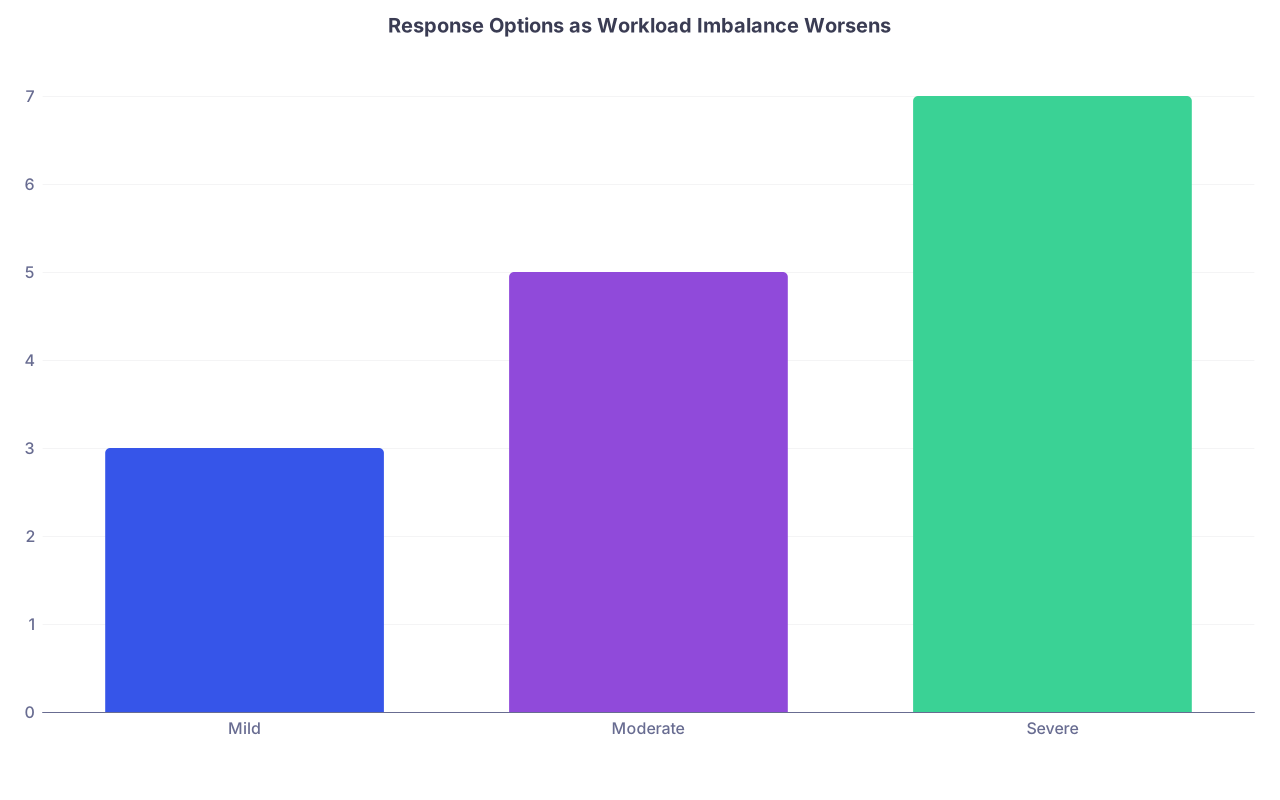
| Category | Value |
|---|---|
| Mild | 3 |
| Moderate | 5 |
| Severe | 7 |
(Think of it like this: early, you use ~3 tools—structure, direct talk, mild boundary. Mid-level, you’re at ~5 tools—senior involvement, explicit assignment, stronger boundaries. Severe, you are throwing everything—senior, chiefs, documentation, safety escalation.)
FAQs
1. What if my senior resident keeps saying, “Just be a team player,” when I bring this up?
Then you escalate above them, but carefully. You can say to a chief or APD:
“I’ve tried addressing workload imbalance directly with my co-intern and via my senior, but the pattern persists. I’m being advised to ‘just be a team player,’ but I’m worried about burnout and missing things because of the extra load. I’d like guidance on how to make this safer and more sustainable.”
You’re not throwing the senior under the bus by name-calling; you’re reporting the process and asking for leadership input.
2. I’m afraid if I speak up, my co-intern will turn other residents against me. Should I still say something?
Yes, but be smart. Keep everything factual. Avoid gossip. Avoid trash-talking them to other interns. When you speak up, do it to people with authority (seniors, chiefs, APD) and make it about patient care and sustainability. Most reasonable residents can smell who’s trying to solve a problem vs who’s starting drama. Over time, consistency wins.
3. Is it ever okay to just keep quiet and power through for the sake of a good eval?
You can choose to silently carry a little extra work for a short period if you think the politics or stakes are unusually high. But if this is chronic, you’re paying with your health and attention. That’s not sustainable and it’s not safe. A slightly shinier eval is not worth becoming the intern who misses a GI bleed because you were buried in three extra admits that shouldn’t have been yours.
Key takeaways:
- Make the workload visible and explicit; don’t fight ghosts and feelings.
- Try direct conversation once, then bring in seniors if patterns persist—focus on fairness and safety, not character.
- Protect yourself from burnout with clear internal limits, strategic escalation, and a refusal to be the quiet martyr who carries everyone else.