
If You’re Starting Intern Year with Young Kids: Workload Strategies
What happens when you’re post-call, your pager finally quiet, and daycare closes in 40 minutes across town?
If you’re starting intern year with little kids at home, you are not “just” starting residency. You’re starting two full-time jobs that do not care about each other’s schedules. The hospital wants your brain. Your kids want your body and your presence. Both feel urgent. Both are exhausting.
Let me walk you through how to structure this so you do not fall apart by October.
Step One: Get Brutally Honest About Your Real Capacity
Most interns overestimate what they can do. Parents of young kids overestimate even more, because you’re used to just “figuring it out.”
Stop that. You cannot willpower your way around a 28‑hour call and a toddler with a stomach bug.
Before you start:
- Look at your rotation schedule month by month.
- Look at your child care options (and backup options).
- Look at your partner’s/work support system.
Then ask: “On a typical 24 hours, how many of those can I realistically work, commute, parent, and not fully break?”
Not ideal. Not Instagram. Real.
Map your time like a budget
Do a blunt exercise for a hard month (say inpatient wards + call):
- 24 hours in a day.
- Subtract:
- Minimum 6–7 hours for sleep on non-call days (yes, really—if you always cut this, you will pay for it).
- Commute (both ways).
- Basic human maintenance: 30–45 minutes total for shower, food, bathroom, life admin.
- Anchored kid time you are not willing to give up (bedtime routine, daycare pickup 2 days a week, etc.).
What’s left is the “budget” for work + anything else. That number is not big.
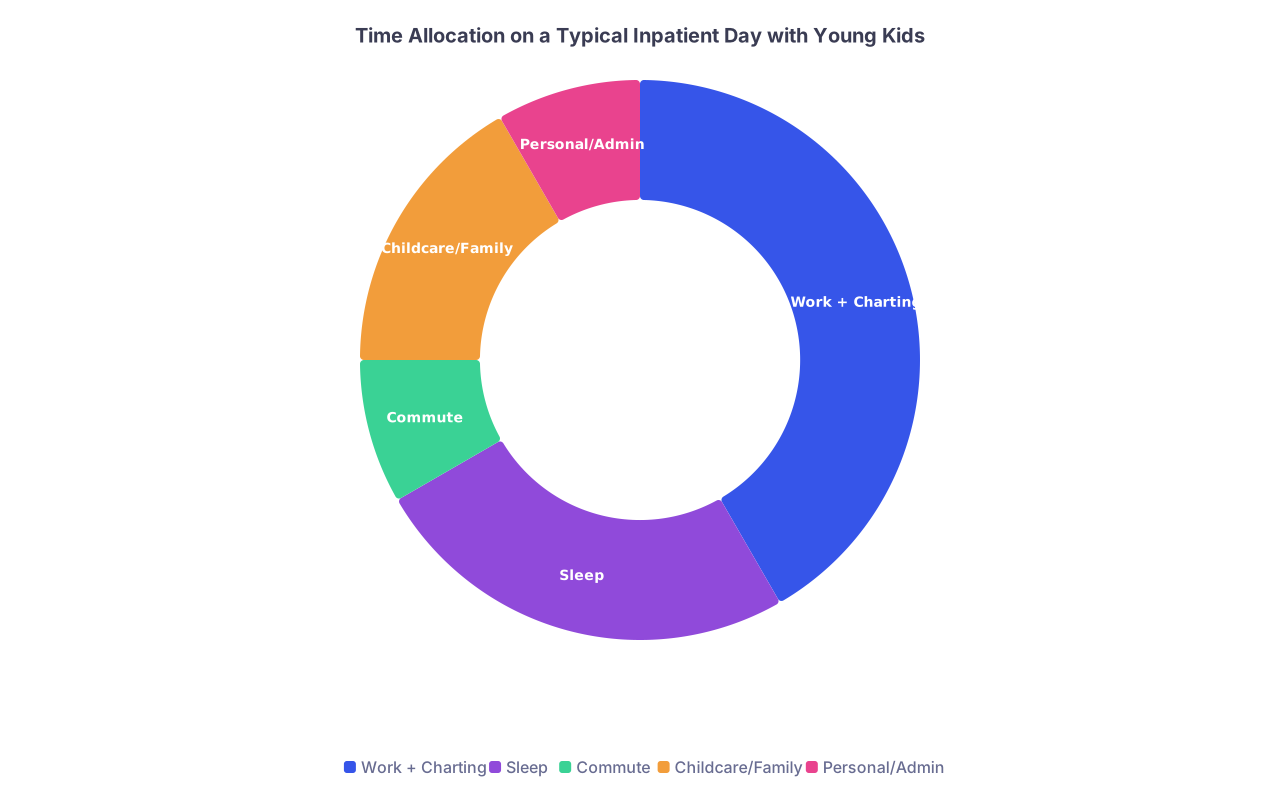
| Category | Value |
|---|---|
| Work + Charting | 10 |
| Sleep | 6 |
| Commute | 2 |
| Childcare/Family | 4 |
| Personal/Admin | 2 |
If the math only works if you sleep 4 hours and never see your kids, good. That means the system is the problem, not your “motivation.” You’re going to need structure and boundaries, not more hustle.
Step Two: Build a Childcare System That Assumes Chaos
If your childcare system only works when nobody is sick, call is light, and traffic is smooth, it is not a childcare system. It’s wishful thinking.
You need redundancy.
The minimum setup that actually works
For most residents with young kids, the lowest-risk structure looks like:
- Primary coverage (daycare, nanny, or family)
- Backup coverage (second daycare, backup nanny service, or local family/friend)
- True emergency plan (someone who can step in when you’re stuck in a code or an OR and literally cannot leave)

Let’s compare some realistic options:
| Setup Type | Pros | Cons |
|---|---|---|
| Daycare only | Cheaper, socialization | Strict hours, closed holidays |
| Nanny only | Flexible, sick-kid coverage | Expensive, single point fail |
| Daycare + sitter | Redundancy, some flexibility | Requires coordination |
| Nanny + daycare | Maximum coverage, backups | Very expensive |
| Family + daycare | Trust, emotional support | Family may burn out |
If your program has variable start times (e.g., 5:30 am pre-rounds on surgery vs 7:00 am on clinic), daycare alone will not cover your early mornings. You need either:
- A nanny/sitter who can come 1–2 hours before daycare opens and do drop-off, or
- A partner/family member who fully owns mornings (no “we’ll see who’s free”).
Spell out exact triggers for backup
Do not wait until the crisis. Write down rules like:
- “If I’m on call and daycare calls for pickup, the backup person (grandparent/partner/friend) always goes. No discussion.”
- “If my workday runs past 5:00 pm and daycare closes at 6:00 pm, I text backup by 4:15 pm if I’m not wrapping up notes.”
This prevents the 5:32 pm panic call from daycare while you’re still in sign-out.
Step Three: Negotiate Workload and Expectations Up Front
If you wait until you’re drowning to talk to your program, it sounds like you cannot handle residency. If you talk early, it sounds like planning. Those are perceived very differently.
Early conversation with leadership
By July ORIENTATION at the latest, you should have had some version of this conversation with:
- Your program director (PD)
- Your chief residents
You say something like:
“I have a 2‑year‑old and a 4‑month‑old at home. I have stable primary and backup childcare mapped out, but my constraints are: no reliable childcare past 6 pm on weekdays, and my partner travels 1 week/month. I am fully committed to my training and understand the demands, and I want to be proactive about making this sustainable. Can we talk about:
- Which rotations have the most unpredictable hours,
- When I should absolutely not plan to do daycare pickup, and
- How you prefer we handle last-minute childcare emergencies so I don’t leave anyone scrambling?”
That sounds like a grown adult, not someone asking for special treatment.
What you can reasonably ask for (and what you cannot)
You usually can ask for:
- Avoiding the most brutal rotations during the immediate postpartum period (if still within policy).
- Grouping night float weeks so your childcare can adjust.
- Not being on the exact same brutal rotation as another co-resident parent if coverage collapses (so you can help each other).
You usually cannot demand:
- No nights.
- No weekends.
- No ICU/ED time.
- To always leave by 4 pm “for daycare.”
Reality check: the duty hours and rotation requirements are not going away. You’re working on how to survive them, not erase them.
Step Four: Tighten Your Workday So You Can Actually Leave
You cannot control when a patient crumps at 5:58 pm. You can control how much nonsense is still left on your plate at 4:45.
Most new interns bleed time everywhere. If you have kids, you don’t have that luxury.
Intern time leaks that destroy family life
The usual offenders:
- Writing 10 half-finished notes that you “clean up later” at 7 pm
- Rewriting other people’s plans over and over instead of clarifying once
- Social rounding (wandering, chatting) when you’re already behind
- Failure to delegate: you drawing every lab instead of asking the nurse if it’s already bundled
Your goal is not to be the hero intern. Your goal is to be competent, efficient, and able to get out within a reasonable duty-hour definition most days.
A simple workday structure that helps you get home
Rough inpatient day example:
Pre-rounding (if applicable):
- Only gather data you actually need to make decisions.
- Start a to-do list for each patient: “Orders,” “Calls,” “Follow-ups,” “Note.”
Work rounds:
- While attending is talking, update that list in real time.
- Ask: “So for today, the concrete plan is: X, Y, Z?” Lock it down once.
Midday (this is where you win or lose your evening):
- Before noon: place all major orders, call key consults, send discharge summaries for likely discharges.
- Block 30–45 minutes for “notes only” with pager coverage traded with co-intern if possible.
After 3 pm:
- Ruthless priorities. Ask yourself: “What absolutely must be finished before I walk out?”
- Finish notes. Finish discharge stuff. Tie up consult follow-up. Everything else, communicate handoff.
Sign-out:
- Clear, tight sign-out that doesn’t generate extra work later.
- Do not offer to “just stay and help” if it is not required and your day is done. You are not lazy for leaving on time. You are a parent.

| Step | Description |
|---|---|
| Step 1 | Pre round |
| Step 2 | Work rounds |
| Step 3 | Orders and calls before noon |
| Step 4 | Midday note block |
| Step 5 | 3 pm prioritize tasks |
| Step 6 | Finish notes and discharges |
| Step 7 | Clear sign out |
| Step 8 | Leave on time if able |
Step Five: Rebuild Home Life for an 80‑Hour World
The version of parenting where you leisurely cook dinner, craft, and put the kids to bed every night is not happening this year. If you cling to that fantasy, you’ll just feel like a failure.
You need a lean version of home life.
Decide your “non-negotiable” kid time
For some people, it’s:
- 20–30 minutes of focused play/reading in the evening when you’re home.
- Bedtime stories.
- Saturday morning breakfast pancakes.
Pick 1–2 things. Not seven. And then defend them.
If you know your brain is useless after 7 pm, maybe mornings are your time: breakfast, daycare drop-off, dance party in the kitchen. That “counts.” Don’t swallow the lie that only 6–8 pm counts as parenting.
Strip away everything you do not actually have to do
You’re not in a season of being a “complete person.” You’re in survival year.
Stuff you should seriously consider outsourcing/ditching:
- Cooking complex meals every night → rotate 5 easy dinners + meal kits + freezer stuff.
- Deep cleaning → pay someone monthly if you can, or accept lower standards.
- Perfect birthday parties, Pinterest crafts → no. Store-bought cake. One balloon. Done.
- Volunteering for every school event → maybe not this year.
If you have a partner, the division of labor must reflect reality, not vibes. During heavy rotations, that might look like:
- You: income, benefits, bedtime when home, weekend blocks of solo kid time.
- Partner: weekday logistics, groceries, bills, 90% of house admin.
This has to be explicit, not assumed.
Step Six: Handle the On-Call + Kid Chaos Without Imploding
This is the part everyone is actually scared of: the day the hospital and the kids need you at the same time.
It will happen. Plan now.
Common horrible scenarios (and what to do)
Daycare calls: your child has a fever, you’re cross-covering 30 patients.
- You are not leaving the floor. Full stop.
- You text/call your pre-arranged backup: “Daycare called. Fever. I’m on call, can’t leave.”
- If there is no backup and your partner is unreachable, you inform your senior:
“Daycare called. I have no one else who can pick up on short notice this time. I know this is brutal, but I may need to step away briefly to get my child unless we can find someone to trade call with.”
- This is where having told your PD and chiefs in advance that you’re a primary caregiver pays off. They’re more likely to help creatively (switch calls, trade shifts).
You’re post-call and scheduled to pick up the kids at 4 pm, but checkout runs long.
- You do not silently stew. At 2–3 pm, if rounds are still going, say to your senior:
“I’m post-call and responsible for daycare pickup at 4 pm. I’m concerned I may not make it if we don’t wrap by 3:30. Can I sign out my remaining patients to you or the day team by 3 so I can leave on time?”
- Nine times out of ten, if you’ve been working hard all day, they’ll accommodate that. If they don’t, that’s feedback to take to a chief after.
- You do not silently stew. At 2–3 pm, if rounds are still going, say to your senior:
Child is hospitalized or seriously sick.
- This is not “I’ll just power through.”
- You email/call PD and chief with a direct statement: your child is hospitalized/ill and you will need X days off or a temporary schedule adjustment.
- Programs are run by humans. They usually respond like humans when something is truly serious.
Step Seven: Protect Your Brain Enough to Function
You’re going to be tired. That’s baked in. But there’s tired, and there’s completely nonfunctional.
You have kids. You cannot afford the second one.
Sleep: your only actual performance enhancer
You need blocks of real sleep. Not heroic 3-hour marathons with charting in between.
- On non-call weeks: defend a 6–7 hour sleep window like it’s a procedure.
- Nights: when you’re post-night float and your kids are bouncing at 3 pm, you may need someone else to take them out of the house so you can sleep. Build that into your support system.
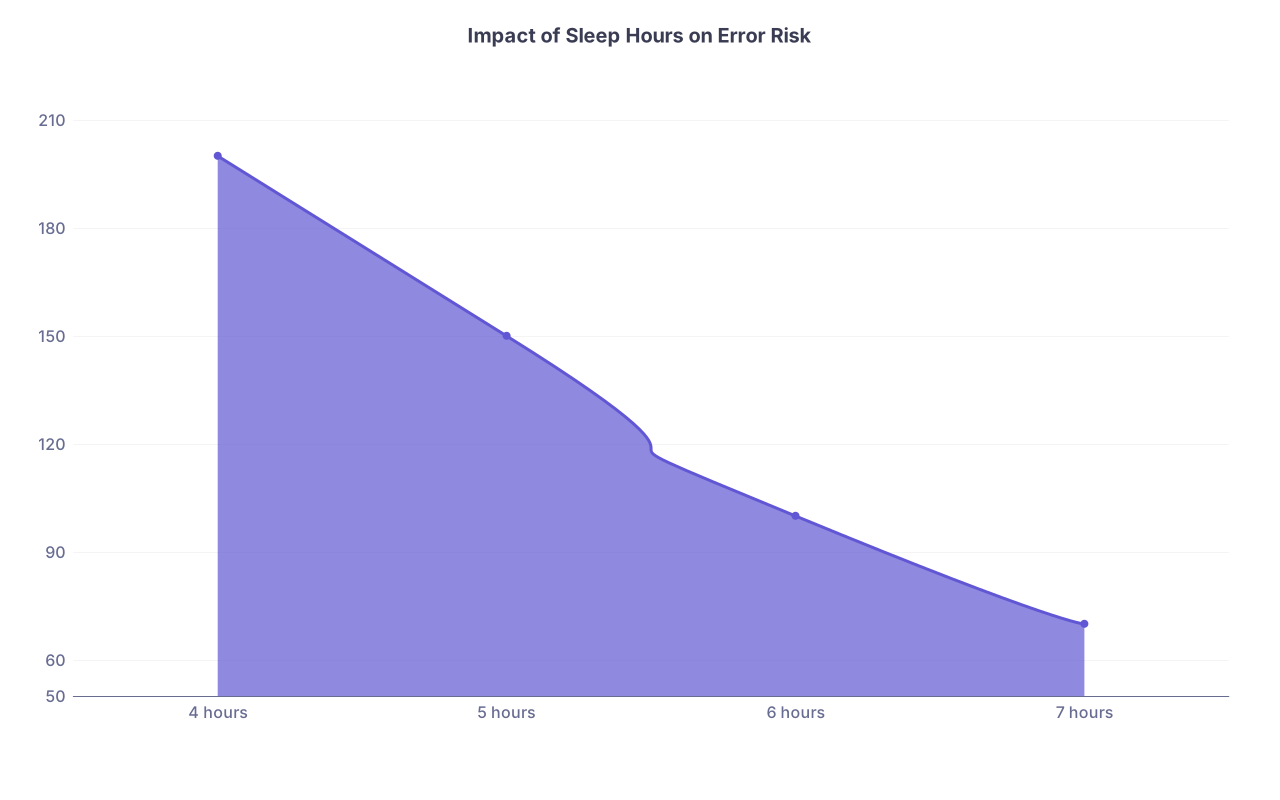
| Category | Value |
|---|---|
| 4 hours | 200 |
| 5 hours | 150 |
| 6 hours | 100 |
| 7 hours | 70 |
(That pattern is real: below 6 hours regularly and your cognitive function drops off a cliff.)
Mental health and the guilt spiral
You will feel guilty:
- At work, for not being with your kids enough.
- At home, for not studying enough or doing more for patients.
You’re not special. Everyone in your situation feels this. The only difference is whether you let it run the show.
Do a mental check-in once a week:
- Am I eating anything resembling real food?
- Am I snapping at my kids every time I see them?
- Am I crying in the call room more days than not?
- Is my partner saying I’m “not really here” even when I’m home?
If yes, that’s not “normal residency.” That’s early burnout or depression. You talk to:
- Your program’s wellness/mental health provider
- A therapist outside the program
- A trusted senior resident who’s also a parent
Step Eight: Use Other Resident Parents as Your Cheat Codes
Do not try to invent this alone. Talk to the people one or two years ahead of you with kids.
Ask very direct questions:
- “On which rotations did you absolutely need a nanny vs daycare?”
- “Which attendings are quietly supportive of parents?”
- “What time did you realistically leave on [specific rotation] on most days?”
- “How did you handle pumping, if relevant, on nights/rounds/OR?”
They’ll tell you the unvarnished truth you will never get officially.

If your program has a “residents with families” group, join it. If they do not, you can start a GroupMe/WhatsApp with just 5–6 people and it will change your life:
- Swapping call shifts for key kid events
- Emergency “can anyone pick up my kid from X because I’m scrubbed in?”
- Sharing vetted babysitters who understand resident schedules
Step Nine: Make Peace With Being “Good Enough” at Everything
You’re not going to be the intern who always has the most detailed notes, the cleanest house, the most present parenting, and the fittest body. Those people don’t exist. They just lie well.
Here’s the standard that actually works:
- At work: safe, reliable, prepared, asks for help early, doesn’t vanish.
- At home: present in short, focused blocks, keeps kids physically and emotionally safe, loves them obviously.
- For yourself: doesn’t fully erase your own health and mind for 3 years.
You will drop balls. Sometimes one of those balls will be at home, sometimes at work. You own it, fix what you can, and keep going.

Final Reality Check
If you’re starting intern year with young kids, you’re not doomed. You’re just operating with a much smaller margin of error.
Three big points to keep in your head:
- Your childcare system matters more than your study schedule. If that fails, everything else burns. Build in backups and explicit rules.
- You must be efficient and a little ruthless at work. Not to be a star, but so you can actually leave without endangering patients or your co-residents.
- You’re playing a long game, not one heroic year. Protect sleep where you can, be honest with your program early, lean on other resident parents, and let “good enough” be the goal at work and at home.
You can be a solid intern and a real parent at the same time. Not perfect at either, but real. That’s enough.