
You’re post‑call, kind of wrecked, half-running on adrenaline and half on stale coffee. It’s day 4 of a 6‑day call cycle on your current service. Tomorrow, you’re supposed to switch to a completely different service… that also has call. The schedule says: post‑call today, new service orientation in the afternoon, then you’re on short call there tomorrow.
You’re looking at that line in the schedule and thinking: “If I actually do all of this the way it’s written, I’m going to be unsafe. And miserable. And probably make mistakes.”
You’re right.
This is exactly where early‑interns get steamrolled—by the schedule, by “we’ve always done it this way,” by their own reluctance to speak up. Let’s walk through how to protect your sleep and your patients’ safety without turning yourself into The Difficult Intern.
1. Understand what you’re up against (and what rules exist)
Before you start asking for changes, you need a clear internal picture: is this situation just annoying, or actually unsafe/against policy?
There are a few common variants of “switching services mid‑call cycle”:
- You’re on a q4 call system on Service A (e.g., nights or 24‑hr shifts), and halfway through that block you switch to Service B that has its own call system.
- You’re post‑call on one service and expected to show up to a “new service” orientation or clinic the same afternoon.
- You have back‑to‑back calls across services (e.g., long call Sunday on one service, night float start Monday on another).
- You’re carrying over patients across services with zero overlapping coverage, which can wreck your post‑call day and bleed into your next assignment.
Let’s be clear: there’s a difference between “this sucks” and “this is not okay.”
You should know three sets of rules:
ACGME work‑hours rules (or your country’s equivalent)
In the US, as a PGY‑1:- Max 80 hours/week averaged over 4 weeks
- At least 8 hours off between shifts (10 preferred)
- Max 24 hours of continuous clinical care (+4 hrs wrap-up, no new patients)
Your program’s own duty‑hours policies
Almost every program has something in writing about:- Minimum time off between duty periods
- What counts as “duty” (clinics, conferences, orientation… usually yes)
- Post‑call protections
Your hospital’s moonlighting/shift policies
Sometimes they define any clinical shift, regardless of service, as duty hours. That matters when they try to argue “new service orientation is not real work.” Often it absolutely is.
If what they’re asking you to do breaks these, you’re not being “dramatic” by pushing back. You’re doing your job.
2. Map your schedule like a lawyer (before you complain)
Do this on paper or in a notes app. Clarity is power.
Write out:
- Each shift start and end time for the current service call cycle (e.g., “07:00–07:00 24‑hr call,” “Night shift 19:00–07:00”).
- The exact time and nature of the switch (e.g., “Post‑call 07:00, expected at 13:00 for new service rounds”).
- The next few days on the new service, especially any call, nights, or long shifts.
Now count:
- How many hours between the end of your last call shift on Service A and the start of anything on Service B.
- Total hours in the rolling 7‑day period.
- Any >24‑hour continuous stretches created by overlapping expectations.
It might look like:
- Monday: 07:00–19:00 day shift (Service A)
- Tuesday: 07:00–07:00 24‑hr call (Service A)
- Wednesday: Post‑call, but “please come to 14:00–17:00 orientation for Service B”
- Thursday: Short call on Service B 07:00–21:00
That Wednesday “orientation” is the problem. You realistically get home at 09:00, sleep until 13:00, commute back in, work 14:00–17:00, go home, and then be back at 07:00. That’s not rest. That’s survival mode.
Having this mapped out lets you say, calmly and specifically:
“I’m coming off a 24‑hour call at 7 am Wednesday. I’m then scheduled for 2–5 pm orientation that day and back on 7 am–9 pm Thursday short call. That gives me at most ~3–4 hours of sleep post‑call before driving back in and starts a >36‑hour stretch of fragmented rest. I’m worried this is unsafe for patient care.”
This lands much better than “I’m tired and this feels bad.”
3. Who to talk to, and in what order
You don’t open with the program director or GME office. You’ll get more done with a smaller, local ask first.
Step 1: Your senior on the current service
Your goals:
- Clarify expectations (sometimes seniors protect you more than you realize).
- See if they’ll help push back for you.
Script it:
“I wanted to sanity‑check my schedule with you. I’m on 24‑hour call Tuesday, off at 7 am Wednesday. I’m then told to be at the new service orientation Wednesday at 2 pm, and I’m on short call there Thursday. I’m concerned that if I come back in Wednesday afternoon, I won’t be rested enough and it may affect safety. Are interns generally excused from mid‑day commitments post‑call, or is there flexibility here?”
Best case, they say, “Yeah, you’re post‑call, you’re not going to that. I’ll email them.” Many decent seniors do this without drama.
If they say some version of “we’ve all done it, you’ll be fine,” you move up a level.
Step 2: The chief residents or scheduling chief
They usually actually control the puzzle pieces.
Email is fine, but I’d use this pattern: short email + available for brief chat.
Subject: “Duty hours concern with mid‑cycle service switch”
Body:
“Hi [Chief],
I wanted to flag a duty‑hours/safety concern with my upcoming switch from [Service A] to [Service B]. I am scheduled for 24‑hour call on [date], ending at 7 am [next date], with a 2–5 pm orientation on [Service B] the same day, followed by 7 am–9 pm short call the next day.
This setup would allow for very limited post‑call rest and may place me over safe duty patterns. Is there any way to adjust the orientation timing or relieve me from that requirement post‑call so that I can come in rested for the new service?
Happy to discuss briefly if that’s easier.
Thanks,
[Your Name]”
You’re not demanding. You’re pointing out a problem and proposing a solution.
If they’re reasonable, they’ll:
- Exempt you from that mid‑day thing,
- Or swap your first call date,
- Or move your switch by a day.
Step 3: Program leadership (if needed)
If the chiefs shrug or say “nothing we can do,” and the schedule is genuinely unsafe or noncompliant, you escalate.
You don’t start with accusations or “I’ll report this to ACGME.” You’ll lose allies fast. You frame it as safety and ask for guidance:
“Dr. X, I’m reaching out because I’m unsure how to handle a schedule situation that may affect patient safety. I’m currently scheduled for [describe exact pattern]. My concern is that this allows insufficient rest after a 24‑hour call before starting new duties, and may conflict with our stated duty‑hours policies.
I’ve spoken with [Chief] and [Senior], but we haven’t found a workable adjustment yet. How would you recommend handling this so that I can care for patients safely and remain within duty‑hours guidelines?”
If they’re any good at their job, alarm bells will ring. Good programs hate written evidence of duty‑hours problems.
4. Specific mid‑cycle scenarios and what to actually do
Let’s go concrete. You’re going to see these.
Scenario A: Post‑call “orientation” or clinic for new service
Reality: Post‑call days are often abused. People slap “low-key” activities there, pretending they’re not real work.
Your move:
- Treat any scheduled clinical or mandatory activity as duty hours. Because it is.
- Ask to join orientation the next available date or get the short version by email.
- If they insist you “just come for an hour,” you still count it as duty hours.
How to phrase it:
“Since I’m post‑call that day, I’ll be coming off 24 hours in the hospital. Is there a later orientation date I can attend so I can have a true post‑call rest period? If not, is there a way to review the key information remotely before starting short call the next day?”
If they dig in, talk to your chief. Orientation rarely trumps safety.
Scenario B: Back‑to‑back call systems across services
Example: You finish a 6‑day stretch with 2 calls on Service A, switch to Service B that has q3 call, and they’ve slotted you right into the high‑intensity portion.
This can wreck your weekly hours and your brain.
You don’t say, “I don’t want call.” You say:
“Looking at this, I’m ending a 6‑day stretch with 2 calls on Service A, and then I start with 2 calls in the first 4 days on Service B. I’m concerned this might push me close to or over duty‑hours limits and truly affect my ability to function safely. Is there any flexibility to start me off with non‑call days and shift one of those calls later in the block?”
Many chiefs will swap call days or give you a buffer.
If they say no: start accurately logging your hours. If your weekly total actually blows through 80, you have hard data when you escalate.
Scenario C: You’re asked to “just carry your old service” while starting the new one
This is sneaky. Someone says, “Hey, can you keep following your two complicated patients for a couple days, since you know them best?” And at the same time, you’re expected to fully function on your new service and maybe take call there.
Now you’re essentially doing two jobs.
You can say no without being an ass:
“I’m happy to hand off detailed sign‑out and be available for questions today, but I won’t be able to safely continue managing these patients while I’m starting on a new service, especially with call starting tomorrow. The risk is that I’ll miss something on both sides. Let me write a thorough transfer note and talk through everything with [new primary].”
If they reply with guilt trips (“Continuity is important”), you stand your ground. Because if something goes wrong, continuity will not be the excuse that protects you.
5. How to protect your sleep in reality, not theory
Let me be blunt: no matter how perfect your schedule looks on paper, residency will absolutely eat your sleep if you let it. But in these mid‑cycle switches, you have to be ruthless. You’re going to be thrown into unfamiliar workflows and patient panels while still recovering from call.
Here’s what you control:
The night before the switch
- Don’t volunteer for extra tasks. This is not the night to help someone with three elective consults at 22:00.
- Triage your sign‑outs. Focus on what will actually matter in the next 24–48 hours for the new team, not a literary masterpiece.
- Pack to minimize decisions the next day (clothes, snacks, any forms you need).
The actual post‑call day
If you’ve won the battle and your post‑call afternoon is protected:
- Go home as soon as legally allowed. Don’t linger; this is where minutes matter.
- Turn your phone volume to “emergencies only.” Tell your co‑intern: “Text if something is unclear, call only for true emergencies.” And mean it.
- Set two alarms. Aim for at least one solid sleep block of 4–6 hours. If you wake up groggy at hour 2, force another 1–2 hours.
- No “just a quick grocery run,” no errands, no catching up on emails.
You are not being lazy. You’re obeying basic neuroscience.
If you lost the battle and do have to come in mid‑day:
- Eat something with actual protein post‑call before you crash.
- Take a short nap (90 minutes or so) instead of sleeping all afternoon and going in even more delirious.
- After the required appearance, go straight home. Don’t hang out, don’t “get a head start” on the new service.
The first 48 hours on the new service
You will be slower. You will feel dumb. That’s baseline for service switches, made worse when you’re sleep‑depleted.
So you do three things:
Shrink your cognitive load.
- Use your own simple templates for H&Ps and notes so you’re not learning new style + thinking clinically at the same time.
- Ask the senior: “Top 3 priorities on this service? What do I absolutely not miss?”
Over-communicate your fatigue level appropriately.
- To your senior: “I’m coming off a pretty tight call cycle and yesterday’s post‑call was rough. I might be a little slower with orders; I’ll double‑check anything high risk with you.”
- Not as an excuse, but as a reality check. They’ll often steer more complex stuff away from you that first day if they know.
Tactically use caffeine and short breaks.
- Small, repeated doses, not a 600 mg slam at 07:00. You’re going to need to function into the evening.
- Take 5‑minute hallway walks when your brain starts blanking on obvious labs. That’s the warning sign.
6. When the system really won’t budge
Some programs are fantastic about this. Some are… not. If you’re stuck in the latter, you still have options, but they’re more defensive.
Document, quietly
- Keep a simple log: dates, start/end times, type of shifts.
- Note any time you were required to be in-house post‑call beyond simple checkout.
- Don’t wave this around. But have it.
Use official duty‑hours reporting
If your program has an online system (New Innovations, MedHub, etc.), use it honestly. Not “hero hours.” Real hours. When the pattern shows repeated violations, it becomes much harder for leadership to shrug off.
If someone pressures you to underreport, that’s a problem you should take to a trusted faculty member or the GME office.
Find an advocate
Identify one attending or APD who actually cares about wellness and safety, not just lip service. Bring specific patterns, not vague feelings:
“Three times in the last month, I’ve had post‑call obligations that cut sleep to 3–4 hours and then started new clinical duties the next day. I’m worried I’m going to make a serious error at some point. How would you recommend I handle this going forward?”
If they hand‑wave that away, that tells you a lot about your institution. But many will intervene behind the scenes.
| Scenario | Category |
|---|---|
| Post-call required clinic or orientation | Red flag |
| Back-to-back 24-hr or night shifts across services | Red flag |
| One light teaching session post-call (optional) | Tough-but-OK |
| Starting new service with 1–2 non-call days | Tough-but-OK |
| Carrying full patient load on two services | Red flag |
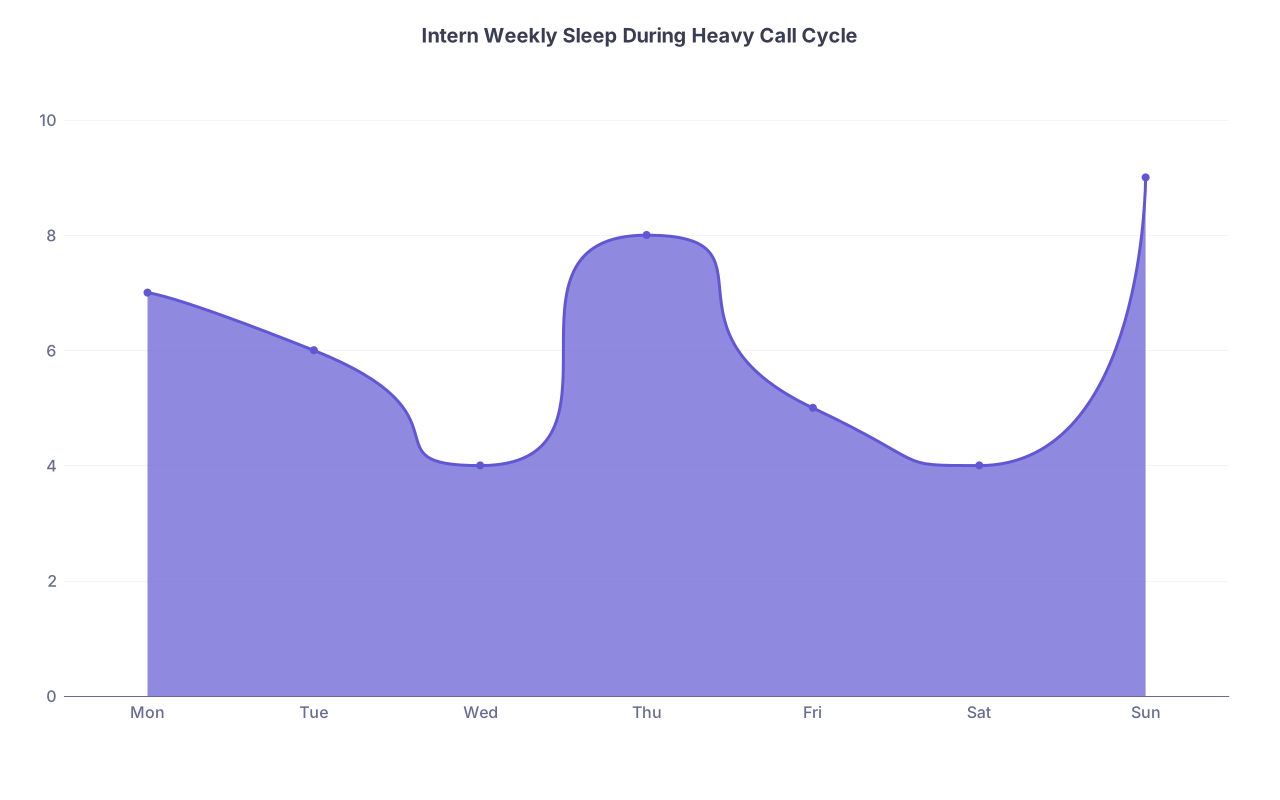
| Category | Value |
|---|---|
| Mon | 7 |
| Tue | 6 |
| Wed | 4 |
| Thu | 8 |
| Fri | 5 |
| Sat | 4 |
| Sun | 9 |
7. Protecting patient safety when you’re forced to work tired
Sometimes, despite your best efforts, you end up mid‑switch, short on sleep, and still have to show up. Then the game shifts to mitigation.
You’re not going to “power through.” You’re going to adjust how you practice.
Here’s how:
- Cut your solo cowboy moves to zero. If there’s a high‑risk decision (escalating pressors, changing anticoagulation on a borderline patient, discharging someone borderline stable), pull in your senior. Phrase it simply: “I’m more tired than usual today with the switch; can I run this by you?”
- Double‑check all orders you place after midnight or in the last 2 hours of your shift. These are the danger zones.
- Avoid “just doing one more thing” as you’re walking out post‑call. That’s where I’ve seen the dumbest mistakes: wrong patient, wrong dose, missing key lab.
- If you catch yourself rereading the same note three times and not absorbing it, call it: “I’m not processing this. Let me step away for 3 minutes and come back.”
This isn’t weakness. It’s managing your impaired state.

| Step | Description |
|---|---|
| Step 1 | Notice unsafe schedule |
| Step 2 | Map shifts and hours |
| Step 3 | Talk to current senior |
| Step 4 | Protect post call day |
| Step 5 | Email chiefs with specifics |
| Step 6 | Escalate to program/GME |
| Step 7 | Optimize sleep and handoffs |
| Step 8 | Resolved? |
| Step 9 | Adjusted? |
FAQ (exactly 5 questions)
1. What if my co-interns all “tough it out” and I’m the only one speaking up?
There’s always someone bragging about 36‑hour stretches and “never saying no.” Ignore that noise. It’s usually a mix of insecurity and bad boundaries. Patient safety doesn’t care about your co‑interns’ macho stories. You can be respectful and still say, “This pattern is unsafe; I’m asking for a schedule adjustment.” Long term, the intern who protects their brain and practices carefully wins, not the one who burns out trying to impress people who don’t sign their board certification.
2. Can I get in trouble for accurately reporting duty hours?
Programs sometimes act irritated when people report real hours, but they are required to have honest reporting. If leadership directly tells you to falsify hours, that’s a serious violation and something you can take to GME or, if needed, the ACGME. Most of the time, once they see patterns, they’ll fix the schedule quietly. Use neutral language: “This is what I worked,” not, “You’re breaking the law.”
3. What do I do if I feel actually unsafe to drive home post-call during a switch?
You stop. This is non‑negotiable. Tell your senior or attending: “I don’t feel safe to drive right now.” Many hospitals have taxi/ride programs for this exact situation. If they don’t, ask if you can sleep in a call room for 1–2 hours before leaving. Worst case, call a friend or rideshare and pick up your car later. Falling asleep at the wheel is not a badge of honor; it’s a near-miss fatal event.
4. How early should I bring up a problematic mid-cycle switch?
As soon as you see it on the schedule and understand the pattern. Weeks ahead is ideal. That gives chiefs actual flexibility to swap people around. Waiting until the day before turns it into an emergency and makes everyone less helpful. A quick email like, “I noticed I’m switching from nights to 24‑hr call the next day; can we adjust this?” a couple weeks out is far easier to fix than complaining at sign-out.
5. How do I phrase my concern without sounding like I’m attacking the program?
Anchor your language in safety and policy, not feelings or accusations. “I’m worried this pattern doesn’t allow safe rest and might violate our duty‑hours guidelines” is very different from “You’re overworking us and don’t care about wellness.” Use specifics: dates, times, shifts. Ask for guidance or solutions: “Is there a way to adjust this so I can be rested for patient care?” Reasonable people respond well to that. And if they don’t, that’s on them—not you.
Key points to walk away with:
- Mid‑cycle service switches during call can create real safety risks; treat them like a clinical problem to solve, not just something to endure.
- Be specific, calm, and early when you ask for changes; show the exact hours and propose reasonable fixes.
- When the system won’t move, protect what you can: your sleep blocks, your practice style when tired, and your documentation of what actually happened.