
The fastest way to turn a manageable call night into pure chaos is sloppy sign-out.
You are not “just” handing off names. You are deciding, in that 10–15 minutes, how the next 12 hours of someone’s life will go—and how safe your patients will be. Most interns learn this the hard way, at 2:37 a.m., standing outside a crashing patient’s room, reading a useless sign-out that says: “Stable. NAI.”
Do not be that person.
Below is exactly how poor sign-out habits destroy intern call—and what you need to do now to avoid becoming the intern everyone dreads signing out from.
The Core Mistake: Treating Sign-Out Like an Afterthought
Interns consistently underestimate one thing: how much sign-out quality determines their night.
Bad sign-out feels like this:
- You start call with 30 patients “tucked,” but you actually know maybe 2 of them.
- The problem list is vague. “CHF,” “COPD,” “AKI” with no context.
- The plan section is blank or boilerplate. “Monitor,” “CT pending,” “Follow labs.”
- No real sense of acuity. No heads-up about who is actually sick.
- Minimal anticipatory guidance: no “If X, then Y” instructions.
You are now on the hook for all those bodies with almost no meaningful information—and no time to fix it up front.
The dangerous mindset is: “Sign-out is just copying the note problem list + pending stuff.”
Wrong. That is how you build a to‑do list, not a handoff.
Strong sign-out answers three questions clearly:
- Who is this patient and why are they here?
- How sick are they right now?
- What exactly do you want me to do / watch for tonight?
If your sign-outs (giving or receiving) are not doing that, your call is already set up to be miserable.
The Most Common Sign-Out Failures That Ruin Call
These are the patterns I see over and over from interns. They are predictable. And they are fixable.
1. Vague, Useless One-Liners
The classic lazy one-liner:
“65M, CHF/COPD, here with SOB. Improving. Stable.”
This tells you almost nothing that matters at 1 a.m.
What is missing:
- Current oxygen needs (room air vs 4L vs BiPAP last night)
- What changed today (diuresed? net negative? weaned off something?)
- What is actually worrying the day team (or what almost happened)
The difference between “Stable” and “Stable after being on BiPAP twice, still on 4L, borderline blood pressure” is the difference between sleeping and checking vitals every hour.
Better one-liner structure:
- Why they came in
- What the key active problem is now
- Today’s major changes
- Current “steady state” and risk
For example: “65M with HFrEF (EF 25%) admitted for acute decompensation; today diuresed 3L, on 2L NC (down from 4L), soft BPs but stable around 95/60, borderline creatinine up from 1.2 to 1.6—improving but high risk of hypotension/AKI overnight.”
Not long. Just specific.
2. No Clear “If X, Then Y” Plan
This is the most painful failure for the night intern.
Scenario:
You get paged: “Pt 324, BP 88/55, HR 110.” You open sign-out. It says:
“P: Monitor BP.” That is it.
Now you:
- Either run to the bedside every time anything happens.
- Or you guess what the day team would have wanted. Both options are unsafe. And stressful.
Your job, when giving sign-out, is to create decision support for the night. Which means writing explicit, simple contingency plans.
Examples of high-yield anticipatory guidance:
- “If SBP < 90 or MAP < 65, hold PM lasix and re-evaluate—low threshold to give 500 mL LR if exam is dry.”
- “If temp ≥ 38.5, repeat lactate, draw blood cultures, give 1L LR, broaden to vanc/zosyn, and call me / senior if hypotensive.”
- “If pain uncontrolled after 3 PRN oxy doses in 4 hours, call for breakthrough regimen—may need PCA.”
It feels tedious when you are tired by late afternoon. But those three lines can prevent a 30-minute mess in the middle of the night.

3. Hiding Sick Patients in the Middle of the List
Another subtle but brutal mistake: you do not highlight which patients are actually high risk.
You end up with:
- A 25-year-old with cellulitis at the top of your list.
- A 78-year-old septic shock patient on pressor wean buried in the middle.
- The DNR/DNI who almost got transferred to ICU yesterday is written up like everyone else.
The night intern then spends the first 2 hours chasing diet orders and overnight bowel regimens, while the truly sick patient decompensates quietly.
You must stratify your list. At minimum:
- Mark high-risk patients (e.g., star, bold, “SICK,” or color code if EMR permits).
- Verbally emphasize in sign-out: “If I were you, I’d check on rooms 312 and 318 early. They’re the ones that could go south.”
Stop being “fair” in your list ordering. Be clinically realistic. Some patients are grenades with the pin halfway out. Say that.
4. Ignoring Code Status and Goals of Care
This one burns people early.
Scenario I have seen too many times:
- DNR/DNI patient with metastatic cancer, comfort-focused care, but still on some antibiotics, maybe IV fluids “for now”.
- Night intern, unaware of detailed goals-of-care discussion, gets called for worsening respiratory status.
- They panic, order aggressive labs, consider ICU transfer, maybe even call a rapid response—only to have the family say, “They did not want any of this.”
Why did this happen?
Because the sign-out said:
“73F, metastatic ovarian CA, here with pneumonia. DNR/DNI. On ceftriaxone. Monitor.”
No goals-of-care summary. No line about what the family actually said. No “We are NOT escalating beyond current interventions.”
Safe sign-out for these patients includes:
- Code status (clearly)
- The tone of recent goals-of-care discussions
- Agreed-upon limits: “Family does not want ICU transfer, no pressors. OK with antibiotics and fluids but no escalation.”
Write it explicitly: “DNR/DNI. Family understands prognosis is poor; goal is comfort-focused care on floor. Do not transfer to ICU or escalate with pressors; treat discomfort and allow natural progression.”
That protects the patient. And it protects you from panicked, misaligned decisions at 3 a.m.
5. Dumping Tasks Without Context
Another hallmark of bad sign-out: a list of orphan tasks.
- “Follow CT head.”
- “Recheck K at 2200.”
- “Trend troponins.”
- “Check post-void residual.”
No explanation. No “why.” No threshold for action.
This turns your night into a scavenger hunt. You spend time chasing tasks that may no longer matter, or you ignore “small” follow-ups that were actually critical.
Context turns tasks into care:
- “Follow CT head for new confusion in pt on apixaban. If bleed, hold AC and call neurosurg.”
- “Recheck K at 2200 after 60 mEq PO for K 2.9. If still <3.2, give additional 40 mEq and place on telemetry.”
- “Trend troponins x3 for chest pain, first was 0.06 (upper limit 0.04), EKG unchanged. If any upward trend, page cardiology overnight.”
If you are too rushed to add that level of detail, you are signing out too many unresolved issues. Close what you can before handoff. For what you cannot close, at least explain the thinking.
Structural Problems That Make Sign-Out Dangerous
There are also “meta” mistakes—how you structure the whole handoff—that consistently make things worse.
1. Not Updating the List Before Handoff
Walking into sign-out with a stale list is amateur hour:
- Patients still on the list who discharged at 3 p.m.
- No new labs from the afternoon.
- Consultants who already saw the patient but are still listed as “awaiting recs.”
- Antibiotics still listed as “vanc/zosyn” when you narrowed to ceftriaxone 5 hours ago.
This is how the night intern pages ID at 1 a.m. for “pending recs” that were already written at 5 p.m. You waste people’s time and look disorganized.
Build a habit:
- 30–60 minutes before sign-out, do a quick list scrub.
- Remove discharged patients.
- Update major plan changes.
- Clear resolved tasks.
- Add new pending issues created after noon.
That 10–15 minutes saves you and the night intern multiple headaches.
2. Speed-Reading and “Any Questions?” Handoffs
You have seen this:
- Day intern reads through 20 patients at auctioneer speed.
- No pause after complex cases.
- Ends with “Any questions?” while already standing up to leave.
People rarely ask questions in that moment. They do not want to look slow. So they say “no.” Then at 11 p.m. they are lost.
Safer pattern:
- Slow down on the 3–5 sickest or most complex patients.
- Explicitly say: “This one is important; let’s pause after I go through it.”
- Encourage questions: “What is not clear here?” instead of “Any questions?”
- For very sick patients, consider walking the night intern to the bedside for a 2-minute face-to-face handoff.
You do not need a 5-minute speech for every cellulitis. But you absolutely need it for the fresh GI bleed who stopped bleeding “for now.”
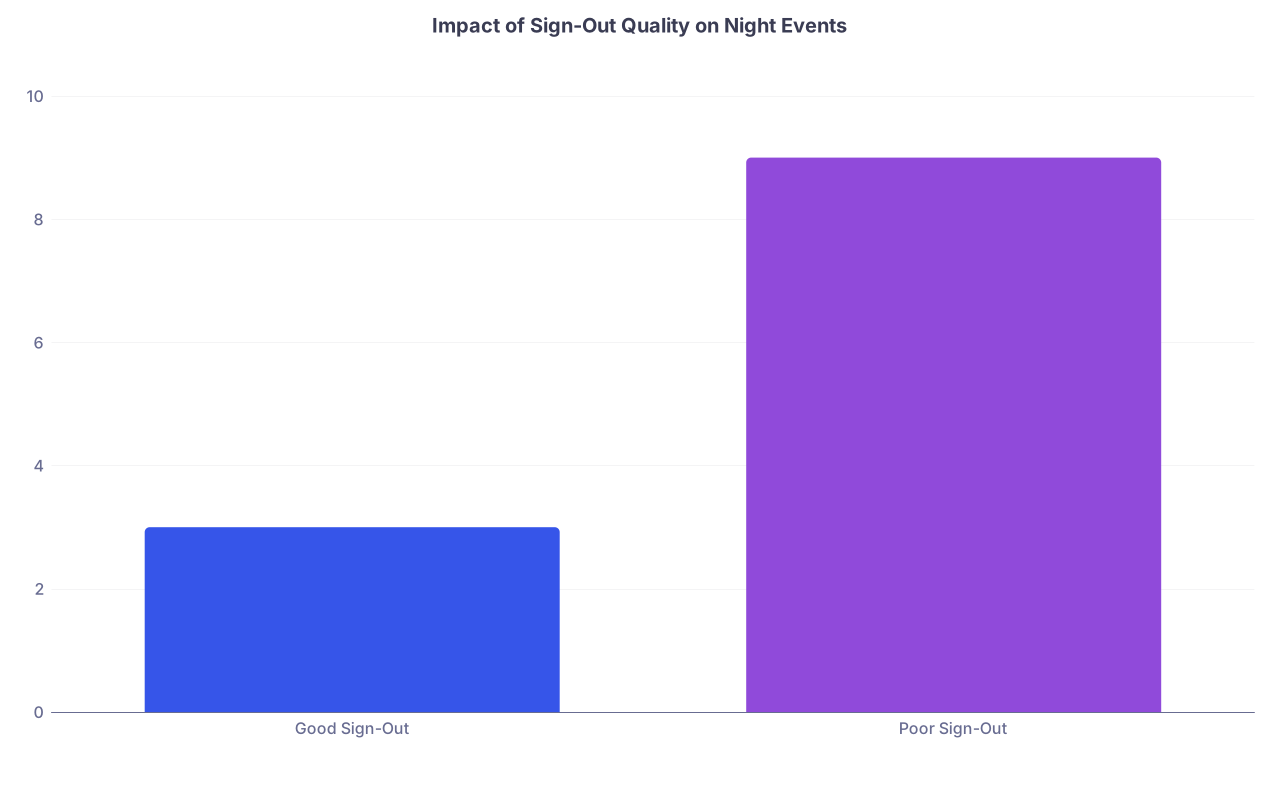
| Category | Value |
|---|---|
| Good Sign-Out | 3 |
| Poor Sign-Out | 9 |
How Bad Sign-Out Turns Call into a Personal Nightmare
Let me be explicit about what happens to you when sign-out is sloppy—whether you are the one giving or receiving it.
1. Decision Fatigue on Steroids
On call, you are already managing:
- Cross-cover patients
- New admissions
- Pages for every minor issue
If you also have to reconstruct the entire clinical story for each patient because sign-out was garbage, your brain fries early.
You will:
- Overreact to minor issues (“This might be bad, I do not know this patient.”)
- Underreact to major ones because they look “stable” in the chart
- Make conservative but sometimes harmful decisions (admitting to ICU unnecessarily, ordering shotgun labs)
Good sign-out preserves your cognitive bandwidth for new problems, not for catching up on old ones.
2. Wasted Time on Low-Value Work
Bad sign-out guarantees:
- Repeating labs or imaging already done or already addressed.
- Calling consultants who have already weighed in.
- Chasing non-issues (e.g., following a CT that turned out to be for a completely resolved problem).
Meanwhile, the one patient who really needed a 1 a.m. check-in does not get it.
Your night becomes busy but not productive. You go home exhausted but uneasy.
3. More “Oh Sh*t” Moments at the Bedside
Most interns have a story like this by November:
- They walk into a room with a crashing patient.
- Nurse says, “He has been like this for a while, no one told you?”
- They open the sign-out and realize there was no mention of how sick the patient really was.
Now everything is:
- High pressure.
- In front of the family.
- With limited background.
Some of that is inevitable. Medicine is unpredictable. But bad sign-out multiplies these events. And each one chips away at your confidence.
4. Reputation Damage You Do Not See Coming
Attendings and seniors absolutely talk about who gives decent sign-out and who hands off disasters.
Patterns they notice:
- Do your patients always seem less stable overnight than your sign-out suggested?
- Are night teams constantly paging about unclear plans?
- Do your patients get rapid responses early after shift change?
You may never be told directly. But it shapes how much autonomy and trust you get. Good sign-out is one of the fastest ways to look like you know what you are doing—because it usually means you do.
Building Safe, Efficient Sign-Out Habits (So Call Does Not Suck)
You cannot control how everyone else signs out to you. But you can:
- Give excellent sign-out for your patients.
- Extract the information you need when you are receiving sign-out.
A Simple, Reliable Sign-Out Structure
Use something like this for each patient:
- ID + Why they are here (concise)
- Today’s course / active problems
- Current clinical status
- Overnight tasks
- Anticipatory guidance (“If X, do Y”)
- Code status / special considerations
Example:
- “58M with decompensated cirrhosis admitted for variceal bleed, now s/p banding yesterday.”
- “Today: No further bleeding. Hgb stable around 8.2 after 2 units. On octreotide gtt and CTX. Lactate normalized.”
- “Currently: On RA, MAP high 60s to low 70s, mild confusion but oriented, making urine.”
- “Overnight: No specific tasks except monitor Hgb on AM labs.”
- “If he has any hematemesis, black emesis, or hypotension (MAP < 65), bolus 1L LR, check STAT CBC, call GI fellow and senior, and consider ICU transfer.”
- “Code: Full, but GI and ICU aware from today.”
That takes maybe 45–60 seconds to say, once your list is written well.
When You Are Receiving Sign-Out: Ask These Questions
Do not accept garbage. Quickly ask:
- “Who are the 3 sickest patients I should see first?”
- “What are the top 2–3 things you are worried could go wrong tonight?”
- “Any patients with complicated goals-of-care I should know about?”
For specific patients, if things feel vague:
- “If their BP drops / O2 goes up / pain worsens, what would you want me to do first?”
- “Is there anyone you were thinking might need ICU or escalation in the next 24 hours?”
You are not being annoying. You are making the night safer—for both the patients and yourself.
| Aspect | Poor Sign-Out | Strong Sign-Out |
|---|---|---|
| One-liner | “Stable. NAI.” | Clear reason for admit + current status |
| Tasks | “Follow CT.” | Task + why + action threshold |
| Anticipatory guidance | None | Explicit “If X, then Y” |
| Risk stratification | Everyone looks the same | Sick patients clearly marked |
| Goals of care | “DNR/DNI” only | Brief summary of limits and wishes |
Final Takeaways: Do Not Learn This the Hard Way
If you remember nothing else:
Sloppy sign-out is not just annoying, it is dangerous. Vague one-liners, no contingency plans, and hiding sick patients in the middle of the list will wreck your night and risk your patients.
Your job is to make the night intern’s decisions easier, not harder. Clear context, prioritized sick patients, and specific “If X, then Y” instructions turn chaos into something manageable.
Protect yourself by demanding clarity. When you receive sign-out, quickly identify the sickest patients, clarify goals of care, and get explicit plans for likely problems. Silent confusion at 5 p.m. becomes loud panic at 3 a.m.
Fix your sign-out habits early. Your future self on night float will thank you.