
The fastest way to double your workload as an intern is not bad medicine. It is bad communication.
You can be clinically sharp and still drown if your pages, notes, and handoffs are sloppy. I have watched very capable interns get labeled “disorganized” or “unsafe” not because they missed diagnoses, but because they kept making the same communication mistakes that generated chaos for everyone else.
Let’s walk through the most common missteps that silently manufacture extra work, delays, and night-time disasters during your first year.
1. Vague, Incomplete Paging: The “Can You Call Me?” Disaster
The laziest page is also the most expensive one in terms of time:
“FYI pt in 724 is hypotensive”
“Can you call me? – nurse”
“Pain 8/10 pls address”
Those pages guarantee:
- Extra back-and-forth
- Repeating questions
- Frustrated nurses
- Slower care
You think you’re saving time by replying quickly. You are not. You are just pushing the cognitive work onto someone else and guaranteeing more interruptions later.
What this mistake looks like
- Responding to a page with: “What’s the BP?” “What’s the HR?” “Any fever?” over three separate messages instead of asking once, clearly.
- Calling back without having the chart open or basic vitals/labs up.
- Answering a question without confirming the actual clinical situation (old vitals, last night’s note, no idea what changed).
Every time you say, “Wait, can you repeat that?” or “Let me check and call you back,” you just created two tasks instead of one.
How to fix it: Standardize your page responses
When you respond to a page, get what you need the first time. Train yourself to always gather:
- Brief ID: who is this patient?
- Actual problem: what changed?
- Objective data: vitals, relevant labs, outputs
- Context: recent events, new meds, procedures
Use something like this when you call back:
“Hi, this is Dr. Lee from medicine intern team. I am calling about Mr. Smith in 724 – I see he is here for CHF. You paged about hypotension. Can you tell me: latest full set of vitals, mental status, urine output, and if he has had any recent med changes or boluses?”
That sounds like more words. It is actually less work. Because:
- You get a stable picture in one call.
- You can make a plan on that call.
- Fewer follow-up calls and “Oh, I forgot to mention…”
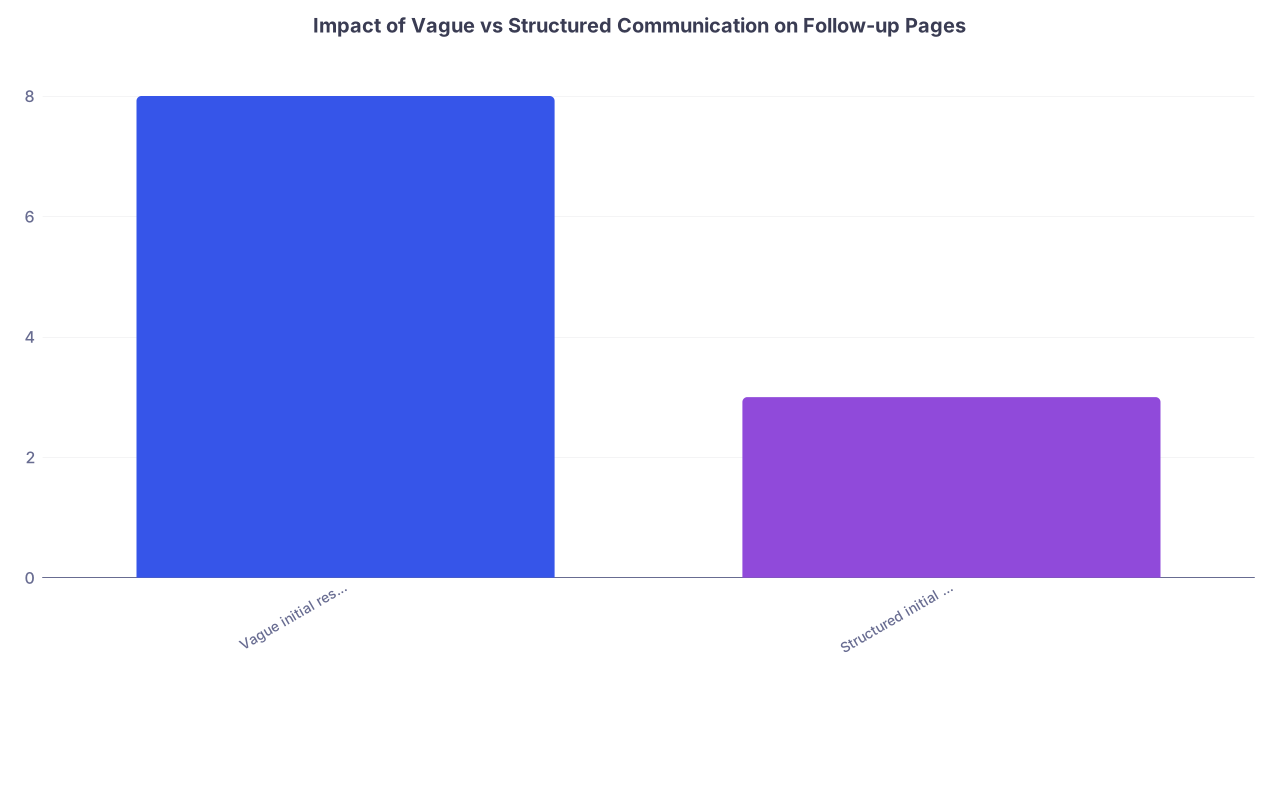
| Category | Value |
|---|---|
| Vague initial response | 8 |
| Structured initial response | 3 |
The structured approach might feel formal at first, but I have seen page volume drop dramatically when interns adopt it. Less noise, fewer boomerang problems.
2. Sloppy Hand-Offs: Planting Time Bombs for Night Float
A bad sign-out does not just annoy night float. It creates real risk. And it absolutely guarantees more work for someone, usually at 3 a.m.
The classic intern mistake: assuming “they can just look in the chart.”
Hand-off errors that wreck nights
No clear “if/then” plans
“Watch for hypotension” without “If SBP <90, give 500 mL LR over 30 min, repeat lactate, then page me / cross-cover.”Burying active issues in a novel-length note
Three paragraphs of hospital course, two vague lines about current problems, nothing about what might go wrong tonight.Not updating handoff after major daytime changes
Patient was stable at noon, went into rapid Afib at 4 p.m., got started on a drip at 5 p.m., but your sign-out at 7 p.m. still says “tele for observation” because you forgot to edit it.Ambiguous code status or goals of care
Night float gets paged for “respiratory distress” on a patient whose sign-out says nothing about DNR/DNI discussions that actually happened at 5 p.m.
What good (work-saving) sign-out actually looks like
Your goal: night float can safely manage 90% of overnight issues without calling you, because you gave them a game plan.
For each active problem, your sign-out should include:
- What the issue is
- What has been done so far
- What you are worried might happen
- Exactly what to do if X happens
Example:
“# Upper GI bleed – Hgb 7.4 from 9.2 this a.m., 2 units PRBC in, GI aware and plan for EGD tomorrow. Currently hemodynamically stable on tele. If SBP < 90 or HR > 110, give 500 mL LR bolus and recheck VS in 15 minutes. If ongoing melena or Hgb drop >1 overnight, page GI on-call and consider ICU transfer.”
That paragraph will save you:
- Random 3 a.m. calls for questions that you already know the answers to.
- Night float wasting time hunting through notes and lab trends.
- You later being blamed for “poor sign-out” in a morbidity and mortality conference.
3. Documenting for Yourself Instead of for the Team
Weak documentation does not just impact billing. It forces everyone else to reconstruct the story every time they see the patient.
The typical intern note mistake: writing stream-of-consciousness and calling it a SOAP note.
Common charting missteps that generate more work
No clear assessment
“WBC 16,000 today. CXR stable. UA pending.” – That is not an assessment. That is a list. The next person has to interpret it all over again.Plan with no prioritization
Machine-gun bullets of orders with no sense of what matters:- F/u labs
- F/u cultures
- Pain control
- PT/OT
- Monitor vitals
Nothing prioritized. Nothing connected to a diagnosis.
Copy-paste bloat
Pages of identical text day after day. The actual new decisions (when antibiotics changed, when you stopped fluids, why you held beta-blocker) are buried or missing.No communication of uncertainty
You are not sure if this is pneumonia vs. aspiration vs. volume overload. That is fine. But write it. If you pretend you are certain when you are not, the team later has to redo all the cognitive work when things do not improve.
A note that actually reduces work
Think of your note as a handoff in written form. It should answer:
- What do we think is going on?
- What are we doing about it?
- What are we watching for?
- When and how will we reassess?
Example for one problem:
“# Sepsis likely from pneumonia vs aspiration
– Evidence: fever, WBC 16, lactate 2.4, new RLL infiltrate on CXR, aspiration risk after vomiting yesterday. UA pending, but no dysuria or CVA tenderness.
– Plan: Continue ceftriaxone + azithro, add anaerobic coverage if no improvement in 24 h. Repeat lactate at 16:00, daily CBC, strict I/Os. If persistent hypotension (SBP < 90) after 2 L total fluids, discuss pressors/ICU. If UA or blood cx suggest alternative source, narrow antibiotics accordingly.”
That kind of thinking-on-paper:
- Saves your attending from asking you basic questions on rounds.
- Saves your co-interns from redoing your mental work when they cross-cover.
- Saves you from wondering “why the hell did we start this antibiotic?” on day 4.

4. Talking Like a Student When You Call Consultants
The worst way to trigger extra work from consultants is to present like you are still on your third-year clerkship. Rambling, unfocused, and with no clear question.
Consultants are not annoyed by being called. They are annoyed by being called badly.
Common consultation communication failures
No specific question
“We just want your input.” Input on what? Diagnosis? Management? Need for procedure? Disposition?No concise one-liner
Starting with a 3-minute HPI before saying, “This is a 76-year-old with…” is amateurish. It signals you are not sure what matters.Dumping the chart instead of synthesizing
“He has a history of CAD, COPD, CKD, diabetes, AFib, had a CABG in 2005, got a stent in 2010, was admitted last year for…” Stop. They will read the chart. Your main value is synthesis, not a chronological recitation.Calling too early or too late
Too early: calling GI before you have vitals, basic labs, or any idea of stability.
Too late: 7 p.m. call for an issue that was present and stable at 10 a.m.
How to call a consult without making enemies
Use a tight structure:
- Who you are and what team you are on.
- One-liner: age, key comorbidities, reason for admission.
- The focused story related to the consult.
- What you have done so far.
- Your specific question.
Example:
“Hi, this is Dr. Singh, the medicine intern on 7W. I am calling about Mr. Jones, 68, with CAD and COPD admitted for pneumonia, now with rising creatinine.
He came in 2 days ago with hypoxic respiratory failure, started on ceftriaxone/azithro and 2 L NC, now down to 1 L. Baseline Cr is 1.0, today it is 2.1 from 1.4 yesterday. Urine output has decreased to 0.3 mL/kg/hr in the last 12 hours. We have held lisinopril and furosemide, checked a urinalysis (bland), and done a bladder scan (not retaining). No hypotension or nephrotoxins identified yet.
I am wondering: can you help with further workup of this AKI and guidance on fluid management vs diuresis given his borderline volume status?”
You save yourself:
- Multiple call backs of “What are his vitals?” “Has he gotten contrast?” “What meds is he on?”
- The consultant feeling like they have to go interrogate the chart themselves from scratch.

| Step | Description |
|---|---|
| Step 1 | Identify yourself |
| Step 2 | State one liner |
| Step 3 | Summarize focused story |
| Step 4 | Describe what is done |
| Step 5 | Ask specific question |
5. Hidden Assumptions With Nurses and Allied Staff
Interns often underestimate how much extra work they create by assuming nurses “know what we mean” or “will just page if there is an issue.”
That assumption is lazy. And dangerous.
Miscommunications that come back to haunt you
Unclear parameters in orders
“Hold metoprolol if SBP low.” What does “low” mean? 100? 80? HR > 60? You just ensured multiple calls and inconsistent practice.Not discussing the plan after writing complex orders
You order a sliding scale insulin, change diet from NPO to clears, and adjust fluids. You never actually tell the bedside nurse the timing and priorities. Then you get annoyed when the fingerstick is late or wrong.Discharge plans not shared early
You know a patient will likely go home tomorrow, but you do not mention it on rounds or to the nurse. Then physical therapy, case management, and family are all unprepared. Discharge gets delayed, and you spend your afternoon fighting fires.Silent expectation of monitoring that is not ordered
Want strict I/Os? Orthostatic vitals? Neuro checks Q2? If it is not ordered and not communicated, do not be surprised when it is not done. And you having to redo the assessment later.
How to reduce friction and rework
When you put in an order that depends on nursing action or interpretation, ask yourself:
- Would I know what to do if I were the nurse reading this?
- Are the thresholds and actions explicit?
For example:
Instead of: “Hold heparin if platelets low.”
Write: “Hold heparin if platelets < 50K OR new drop > 50% from baseline, and page covering provider.”Instead of: “Accuchecks AC/HS.”
Add: “If BG < 70, follow hypoglycemia protocol and page team. If BG > 300 x 2, page team.”
Then say it out loud:
“I placed new insulin orders with hold parameters and when to page us. If BG is persistently in the 300s despite coverage, please call so we can adjust.”
You are not “bothering” anyone by over-communicating early. You are preventing a dozen micro-failures that all bounce back to you.

6. Overpromising to Families, Under-Communicating to Teams
If you want chaos, tell a family:
- “We will get that CT in the next hour.”
- “She will probably go home tomorrow.”
- “The attending will be by around noon.”
Then never document it, never tell your team, and never check if it is realistic.
Dangerous communication traps with families
- Giving specific time guarantees you do not control: imaging slots, consultant arrival, discharge time.
- Saying “we” decided when you actually mean “I think…” – then your attending has a different plan.
- Not aligning expectations with actual team decisions – family believes one story, the chart and the team reflect another.
Result:
- Angry families demanding explanations.
- Nurses stuck in the middle explaining delays they did not cause.
- You doing damage control at 5 p.m. when you could have avoided the problem at 9 a.m.
How to talk to families without creating future mess
Use guarded, honest, and specific language:
Instead of: “We’ll get the MRI this afternoon.”
Say: “We have ordered an MRI for today and are waiting for a time slot. It may happen this afternoon or evening, depending on urgency and availability.”Instead of: “You should go home tomorrow.”
Say: “If his oxygen and labs stay stable and therapy feels safe about mobility, we are aiming for discharge tomorrow, but that can change.”
Then document key expectation-setting in the chart. A brief line like:
“Discussed with family: MRI ordered but timing dependent on radiology schedule; aiming for discharge in 1–2 days if stable.”
Now your team, your night float, and consulting services all know what the patient has been told. Fewer surprises. Fewer “he said / she said” headaches.
7. Multi-Channel Chaos: Text, Voicemail, EMR Messages, and Lost Tasks
Another subtle intern mistake: scattering communication across too many channels with no tracking system.
You think you are being responsive. What you are actually doing is creating hidden, untraceable obligations that you will forget.
Common fragmentation patterns
- Verbal promise on rounds: “I will call the son this afternoon.”
Text from nurse: “Family wants update.”
EMR message from case manager: “Need plan for discharge meds.”
Voicemail from consultant: “Call me back about this patient.”
None of that gets written down in one place. That is how tasks die.
| Channel | Typical Use | Risk of Forgetting |
|---|---|---|
| Verbal only | Hallway conversations | Very high |
| Paged | Immediate issues | Medium |
| EMR inbox | Non-urgent questions | Medium |
| Text/chat | Quick clarifications | High |
| Documented note | Plans and updates | Low |
How to avoid multi-channel failure
You need a single source of truth for your active tasks. I have seen interns stay sane by:
- Keeping a small pocket notebook or a simple digital task list.
- Writing down every “I’ll do X” in one place the moment they say it.
- Crossing tasks off only when done, not when “I started working on it.”
When you agree to a task via:
- Page → write it down.
- In-person conversation → write it down.
- Family request → write it down.
- Consultant request → write it down.
Yes, it feels slow at first. Then you realize you are the only intern not staying an extra hour trying to remember what you promised to do.
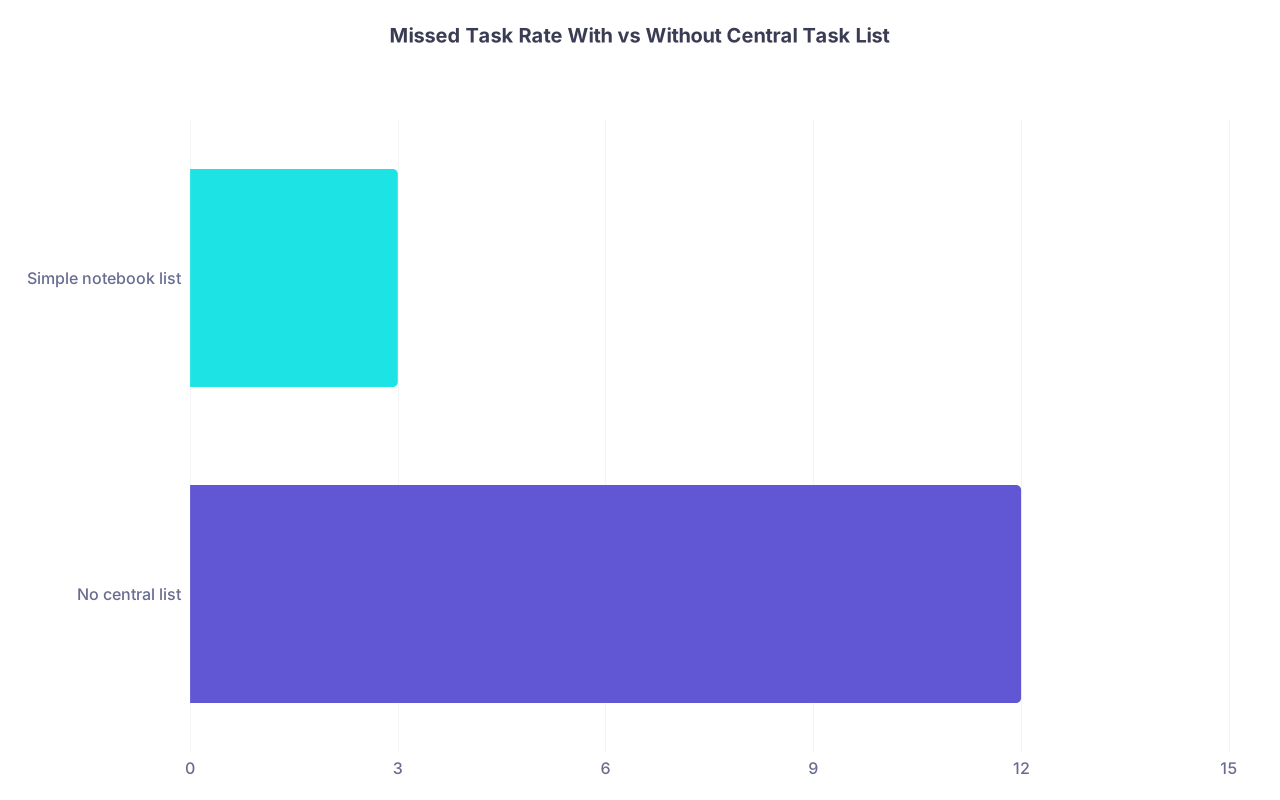
| Category | Value |
|---|---|
| No central list | 12 |
| Simple notebook list | 3 |
8. Silence When You Are Unsure
New interns are terrified of looking incompetent, so they say nothing. They pretend they understood the plan on rounds. They do not confirm orders with attendings. They nod through nursing questions they do not fully grasp.
Silence is not harmless. It creates confusion down the line and more work cleaning up.
Where silence sabotages you
On rounds:
Attending: “Let’s stop fluids, increase diuresis, and tighten BP control.”
You: no clarifying questions, then later you are guessing doses, targets, and timing.With consultants:
They give a recommendation that feels off, but you do not push back or ask “why now vs. later?” You then have to re-call or re-page later when your attending disagrees.With nurses:
Nurse asks, “Are you OK with her walking off the unit to visit family?” You are uncertain and say a vague “That should be fine” without checking CIWA scores, telemetry needs, or fall risk. Then everyone scrambles when something goes wrong.
The smarter alternative: ask one good question now
You avoid so much downstream chaos by being briefly “inconvenient” and clear up front.
Example questions that save work:
- “To be sure I understand, for BP control, what range are we targeting today?”
- “You mentioned two options – would you prefer we start heparin now or wait until after the CT?”
- “Given her fall risk and ativan doses, are you comfortable with her leaving the unit, or should we restrict ambulation to supervised only?”
You are not bothering people. You are preventing:
- Non-sensical orders.
- Conflicting recommendations.
- Middle-of-the-night reversals.

Your Next Step Today
Pick one patient you are responsible for right now (or from your last shift). Then do this:
- Open their last note and your sign-out.
- Ask yourself:
- Would night float know exactly what to do if things got worse?
- Would a consultant know why we are doing what we are doing?
- Would a nurse know when to call and what to watch?
If the answer is “no” to any of those, rewrite just one piece of communication:
- Tighten the handoff.
- Clarify the order parameters.
- Sharpen the assessment and plan.
Do that once a day. You will be shocked how quickly your “communication” stops creating extra work—and starts quietly protecting your time, your patients, and your reputation.